
Golf Club Fitting
December 7, 2025
Professional club fitting used to require expensive equipment and in-person appointments. AI is changing that—here's how the technology works and what it means for your game.
---
The Short Answer
AI golf equipment analysis uses machine learning to evaluate your clubs and provide personalized fitting recommendations without requiring a launch monitor or in-person visit. These tools analyze factors like club age, shaft specifications, loft gapping, and equipment cohesion to identify what's helping or hurting your game.
The technology isn't replacing professional fitters. It's making basic equipment analysis accessible to the 90% of golfers who never get fitted at all.
---
What Is AI Golf Equipment Analysis?
Traditional club fitting has always required three things: expensive launch monitors that cost between $15,000 and $50,000, trained fitters who know how to interpret the data, and your physical presence to hit shots and test equipment. This combination of requirements has limited access to golfers who live near fitting centers and can afford sessions that run $200 to $500.
AI equipment analysis takes a fundamentally different approach. Instead of measuring your swing in real-time, it evaluates the equipment you already own and compares it against established fitting principles, your playing profile, and data patterns from thousands of other golfers.
The technology can analyze club specifications like length, loft, lie angle, and shaft flex. It evaluates equipment age and identifies wear indicators that affect performance. It examines your whole bag to find gapping issues and checks whether your specifications are consistent across your bag. It can even assess technology generations and identify compatibility issues between clubs from different eras.
Based on this analysis, AI can recommend which clubs are well-suited to your profile, where your bag has gaps or redundancies, which specific upgrades would help most, and whether professional fitting would be worth your investment.
---
How the Technology Works
Modern AI golf analysis relies on several interconnected technologies working together.
Photo recognition has advanced dramatically in recent years. Computer vision models trained on thousands of club images can now identify club head models and generations, shaft types and flex indicators, grip conditions, and wear patterns on faces and soles. This eliminates the need for golfers to know their exact specifications—the AI extracts that information visually from smartphone photos.
Once clubs are identified, specification analysis compares their specs against fitting databases. The system checks shaft weight progression, because your driver shaft should be lighter than your iron shafts following a logical sequence. Many golfers unknowingly play with random shaft weights that create timing inconsistencies throughout their bag.
Loft gapping analysis ensures the loft difference between consecutive clubs remains consistent, typically 3-4 degrees. Gaps or overlaps in your loft progression cause the distance inconsistencies that frustrate so many players. Flex consistency matters too—a regular flex driver paired with stiff flex irons creates timing problems that even good swings can't overcome.
The most valuable AI feature is personalized recommendation matching. A player with 95 mph swing speed has completely different needs than someone swinging at 75 mph. A 25 handicap benefits from different equipment priorities than a 5 handicap. AI considers swing speed estimates, handicap and skill level, playing frequency, common miss patterns when provided, and performance goals to tailor its recommendations.
Still wondering if fitting is worth it? Here's the honest answer to "should I get fitted for golf clubs" in 2025.
---
AI vs. Traditional Fitting
The key difference between these approaches is fundamental. Traditional fitting measures your swing and matches equipment to it in real-time. You hit shots, the launch monitor captures data, and the fitter adjusts variables until the numbers optimize. AI analysis works differently—it evaluates your equipment and identifies optimization opportunities based on your profile and fitting principles.
Traditional fitting costs $200 to $500 and takes 2-3 hours at a fitting center with launch monitors and fitting carts. AI analysis costs nothing to $10 per month, takes 5-10 minutes, requires only a smartphone, and can be done anywhere. Traditional fitting gives you real-time swing data and lets you test clubs physically. AI analysis provides ongoing tracking that one-time fittings can't offer.
These approaches complement each other rather than compete. AI analysis can tell you whether you need a professional fitting at all—and if so, what specific questions to ask when you get there. Many golfers waste money on fittings when their equipment is actually fine. Others delay fittings when they'd benefit significantly. AI helps you figure out which camp you're in.
---
What AI Equipment Analysis Does Well
The technology excels at identifying obvious mismatches that golfers miss because they don't know their own specs. If you're playing senior flex shafts with a 100 mph swing speed, AI catches that immediately. These low-hanging fruit improvements often go unaddressed for years simply because golfers don't realize the mismatch exists.
AI is particularly strong at evaluating gapping and progression—looking at your entire bag as an integrated system rather than individual clubs in isolation. Maybe each of your clubs is fine on its own, but you have two that produce the same distance while a 30-yard gap exists elsewhere in your bag. Human fitters sometimes miss these systemic issues when focused on optimizing individual clubs.
Unlike one-time fitting sessions, AI tools can track changes over time. As you make upgrades, adjust clubs, or evolve your game, the analysis updates to reflect your current situation. This ongoing monitoring catches issues that develop gradually.
The educational component matters too. Many golfers don't understand why specifications matter or how different factors interact. AI analysis explains the reasoning behind recommendations, helping golfers become more informed consumers of equipment and fitting services.
Perhaps most importantly, AI democratizes access. The 25+ million American golfers who've never been professionally fitted now have a meaningful starting point for understanding their equipment.
Try it yourself, free: Our Single-Club Fit Grader runs AI analysis on a single club's launch monitor data — you get a fit grade, a narrative explaining what's working and what's not, and specific recommendations. No sign-up until you want the full AI report.
---
What AI Can't Do
The technology has real limitations that users should understand.
AI cannot measure your actual swing. It doesn't know your angle of attack, face angle at impact, or dynamic lie angle. These factors require launch monitors and physical observation. If your equipment problems stem from swing characteristics rather than equipment specs, AI analysis won't identify the root cause.
There's no substitute for actually hitting clubs. AI can recommend a shaft based on your profile, but you need to swing it and feel the results. The tactile feedback of testing equipment simply can't be replicated through software.
AI also can't fix swing problems. If your issue is mechanical—a casting motion, early extension, or over-the-top move—no equipment change will solve it. AI can identify equipment issues but cannot diagnose swing flaws that might be causing your problems.
Complex fitting scenarios benefit from human expertise. Unusual body types, injury accommodations, elite-level optimization, and players with highly specific requirements often need the judgment and experience that professional fitters provide. AI works best for the broad middle of the golfer population, not the edge cases.
---
The Rise of AI in Golf
Equipment analysis is part of a broader trend of artificial intelligence entering the sport at every level.
Swing analysis apps now use phone cameras to measure positions and provide feedback. While not as accurate as professional motion capture systems, they've made basic swing analysis accessible to anyone with a smartphone. Shot tracking systems like Arccos and Shot Scope use GPS and sensors to map every shot you hit, identifying patterns and weaknesses across hundreds of rounds.
Course management AI analyzes your game data and recommends strategies for specific holes and situations. Some systems even factor in wind, pin positions, and your personal tendencies to suggest optimal targets.
Equipment matching represents the newest frontier—taking the principles that professional fitters have used for decades and encoding them into software that anyone can access. The common thread across all these applications is democratization. AI isn't replacing professionals. It's creating entry points for golfers who wouldn't otherwise have access to these insights.
AI fitting is one of several cheap alternatives to professional golf club fitting that didn't exist five years ago.
---
How FitMyGolfClubs Uses AI
We built FitMyGolfClubs specifically to solve the equipment analysis problem in a way that's accessible, honest, and actually useful.
Our AI evaluates your bag across eight distinct dimensions. We analyze club age and condition, shaft weight progression throughout your set, kick point consistency, loft gapping between clubs, flex consistency, adjustability optimization for clubs with those features, technology cohesion across different equipment generations, and favorite club matching.
That last factor is unique to our approach. Instead of generic recommendations based on averages, we identify your best-performing club—the one you trust and hit consistently—and use it as a baseline for optimizing the rest of your bag. If your 7-iron is perfect for your swing, we work backward to figure out what specs the rest of your clubs should have.
Photo identification makes the process simple. Snap photos of your clubs, and our computer vision system powered by Google Cloud Vision API identifies makes, models, and specifications automatically. You don't need to know your shaft flex or club head model—we figure it out from the images.
Our handicap-based recommendation engine adjusts suggestions based on your skill level. A 20-handicap player and a 5-handicap player have different needs, different priorities, and different thresholds for what constitutes a meaningful improvement. Our proprietary algorithm filters out noise and focuses on changes that will actually help your specific game.
What separates us from manufacturers is intellectual honesty. We'll tell you when your clubs are fine. The golf industry profits from convincing you to upgrade constantly. We profit from giving you accurate information—even when that means saying "your equipment isn't the problem, save your money."
---
Is AI Equipment Analysis Right for You?
AI analysis makes sense if you've never been professionally fitted and want to understand your baseline. It's valuable if you're curious whether your equipment is holding you back or if you want to understand your clubs better before spending money on new equipment. Golfers considering upgrades benefit from data-backed guidance rather than guesswork, and anyone playing with a mix of old and new clubs can identify compatibility issues.
You should consider professional fitting instead if you're buying a full new set where the investment exceeds $1,500, if you have unusual physical characteristics that require custom solutions, if you're a competitive player optimizing for tournaments, or if you've tried AI analysis and still have unanswered questions.
For most golfers, the best approach combines both. Start with AI analysis to understand what you have and identify whether problems exist. Use those insights to decide whether professional fitting is worth the investment and time. If you do get fitted, you'll arrive with better questions and clearer objectives.
---
The Future of Golf Equipment Analysis
AI in golf is still in early stages. Within the next five years, expect real-time analysis using phone cameras during your actual swing, club testing simulation based on your swing profile, dynamic recommendations that update automatically as you improve, and integration with shot tracking for direct equipment-to-outcome connections.
The gap between professional fitting and DIY solutions will continue to shrink. Not because AI replaces expertise, but because it makes baseline analysis universally accessible. Professional fitters will evolve to focus on complex cases and optimization that AI can't handle, while AI handles the foundational analysis that most golfers need.
---
Try It Yourself
FitMyGolfClubs offers free AI-powered equipment analysis. Upload photos of your clubs, answer a few questions about your game, and get a complete evaluation of your bag across eight factors.
No appointment needed. No sales pitch. No pressure. Just data about your equipment and honest recommendations about what would actually help your game.
Experience AI fitting yourself. FitMyGolfClubs analyzes your equipment from photos and provides personalized recommendations—the technology described in this article, available now.
On a computer? You can also grade your bag in your browser — no app to install.
Frequently asked questions
What is AI golf equipment analysis?
AI golf equipment analysis uses machine learning to evaluate the clubs you already own and provide personalized fitting recommendations without a launch monitor or in-person visit. It analyzes factors like club age, shaft specifications, loft gapping, and equipment cohesion to identify what's helping or hurting your game. It compares your equipment against established fitting principles, your playing profile, and data patterns from thousands of other golfers.
How much does traditional golf club fitting cost compared to AI analysis?
Traditional golf fitting costs $200 to $500 and takes 2-3 hours at a fitting center with launch monitors and fitting carts. AI analysis costs nothing to $10 per month, takes 5-10 minutes, requires only a smartphone, and can be done anywhere. Launch monitors used in traditional fitting cost between $15,000 and $50,000, which limits access for many golfers.
What is proper loft gapping between golf clubs?
Loft gapping analysis ensures the loft difference between consecutive clubs remains consistent, typically 3-4 degrees. Gaps or overlaps in your loft progression cause the distance inconsistencies that frustrate many players. Beyond loft, your driver shaft should be lighter than your iron shafts following a logical sequence, since random shaft weights create timing inconsistencies throughout your bag.
What can AI golf equipment analysis not do?
AI cannot measure your actual swing, including angle of attack, face angle at impact, or dynamic lie angle, which require launch monitors and physical observation. It can't replace actually hitting clubs and feeling the tactile feedback, and it can't fix mechanical swing problems like casting, early extension, or over-the-top moves. Complex scenarios like unusual body types or injury accommodations benefit from human expertise.
How does AI identify my golf clubs from photos?
Computer vision models trained on thousands of club images identify club head models and generations, shaft types and flex indicators, grip conditions, and wear patterns on faces and soles. This eliminates the need to know your exact specifications, as the AI extracts that information visually from smartphone photos. FitMyGolfClubs uses the Google Cloud Vision API to identify makes, models, and specifications automatically.
When should I get a professional golf fitting instead of using AI?
Consider professional fitting if you're buying a full new set where the investment exceeds $1,500, if you have unusual physical characteristics requiring custom solutions, if you're a competitive player optimizing for tournaments, or if you've tried AI analysis and still have unanswered questions. AI works best for the broad middle of the golfer population, while fitters handle complex cases and elite-level optimization.
Related reading
- Golf Club Fitting Without Hitting Balls — How equipment-only analysis works — no launch monitor.
- How to Fit Your Golf Clubs at Home — DIY fitting with AI and simple tools.
- How Do I Know If My Golf Clubs Fit Me? — 7 warning signs your gear does not match your swing.
- How Much Does Golf Club Fitting Cost? — What fitting runs at every provider — and a cheaper way.
- Eldrick vs FitMyGolfClubs — two AI fitting tools, side by side.
Related Articles
Golf Club Fitting
October 8, 2026
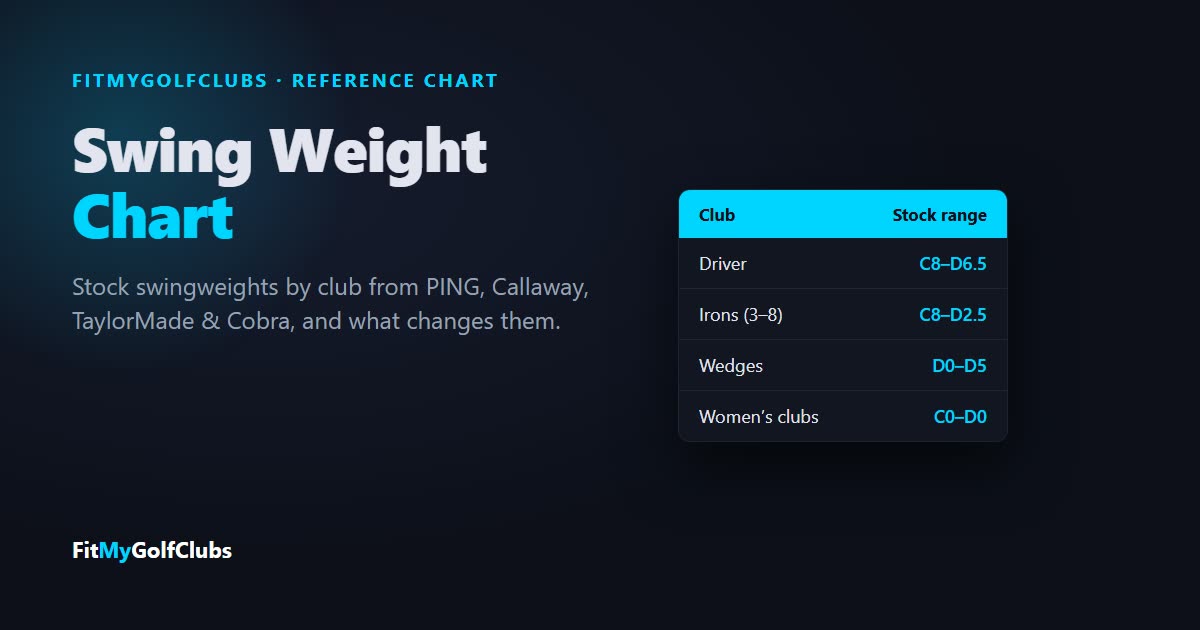
Swing Weight Chart: Standard Swingweights by Club and Brand
Swing weight chart: the A0–G9 scale, stock swingweights for drivers, irons and wedges from PING, Callaway, TaylorMade and Cobra, and what changes them.
Golf Club Fitting
October 8, 2026
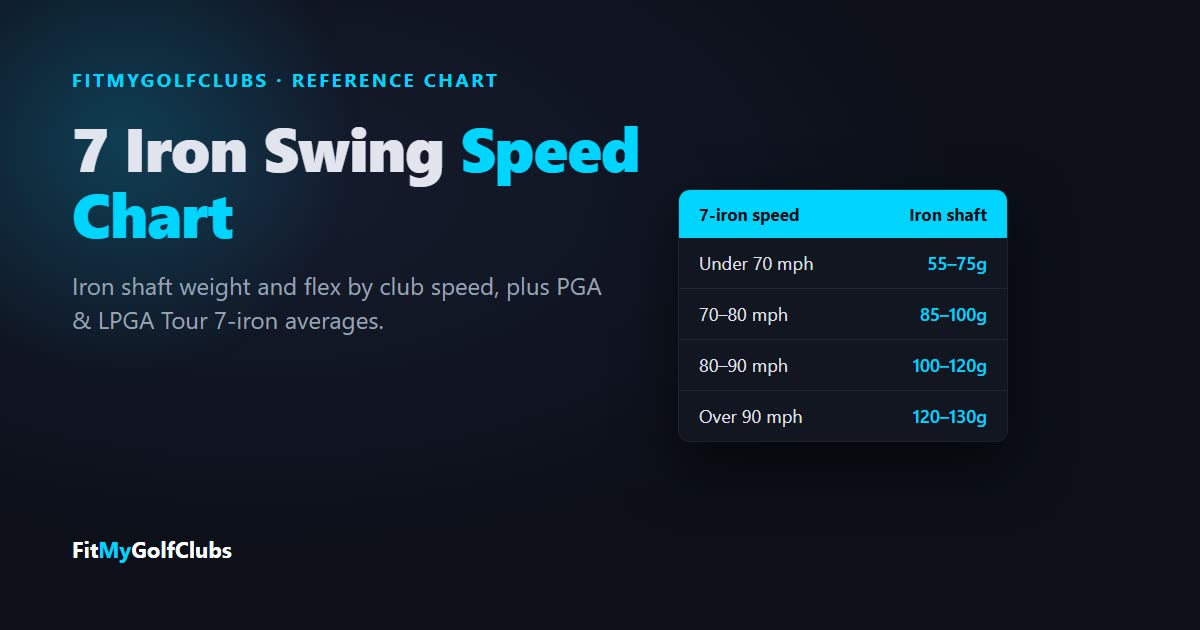
7 Iron Swing Speed Chart: Iron Shaft Weight, Flex & Carry
7 iron swing speed chart: iron shaft weight and flex by club speed, PGA (92 mph) and LPGA (78 mph) Tour averages, and 7-iron carry by speed.
Golf Club Fitting
October 8, 2026
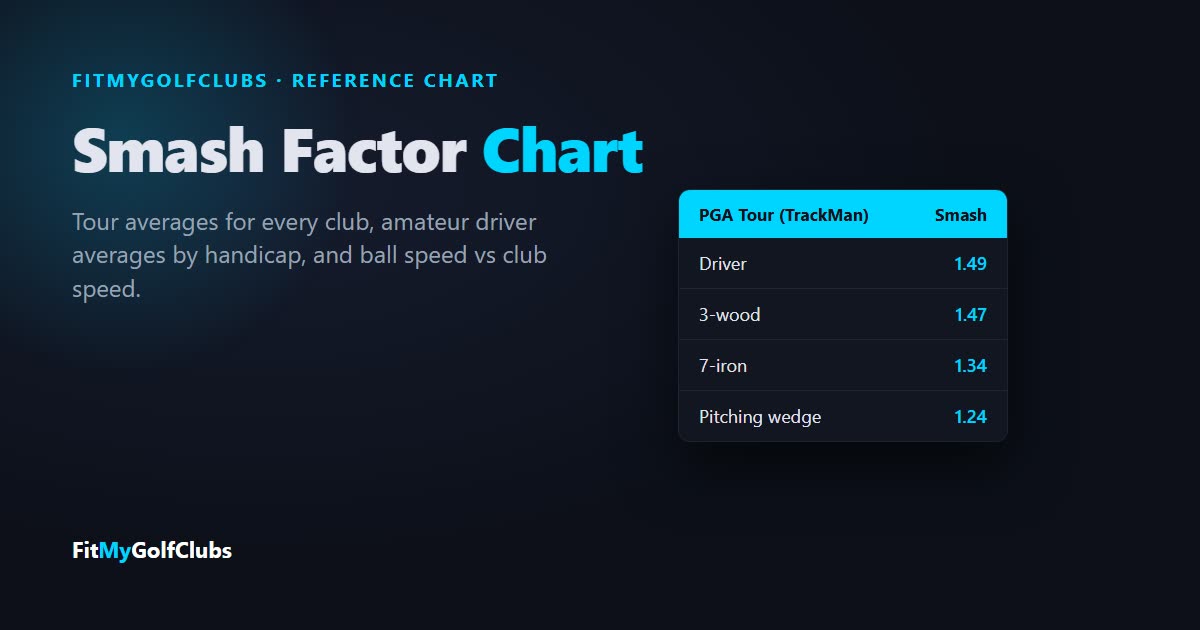
Smash Factor Chart: Tour Averages by Club + Ball Speed
Smash factor chart by club from TrackMan PGA and LPGA Tour averages, amateur driver averages by handicap, and a club speed to ball speed table.


© 2026 FitMyGolfClubs. All rights reserved. | Patent Pending
Contact: sean@fitmygolfclubs.com