
Golf Club Fitting
December 14, 2025
Golf Club Fitting Without a Launch Monitor: How Equipment Analysis Works
Traditional golf club fitting requires a launch monitor, a skilled fitter, a rack of demo clubs, and an hour or more of swinging. It's effective, but it's also expensive, time-consuming, and dependent on variables outside your control—like how you're swinging that particular day or whether the fitter has incentives you're unaware of.
But what if your existing equipment already contains the data needed to identify fitting issues? What if the clubs you own—and especially the one you hit best—could reveal exactly what's wrong with the rest of your bag?
This is the premise behind equipment-only fitting analysis. Rather than measuring ball flight, this approach analyzes the specifications of your current clubs to identify mismatches, inconsistencies, and optimization opportunities. It's not a replacement for traditional fitting, but it's a powerful diagnostic tool that most golfers have never considered.
Three of our free fitting tools work without hitting a ball: Swing Speed → Shaft Flex, Swing Speed → Shaft Weight, and Wrist-to-Floor → Club Length. Just swing speed, height, and a wrist-to-floor measurement.
The Traditional Fitting Model
Understanding equipment-only analysis starts with understanding what traditional fitting does—and where it falls short.
How Traditional Fitting Works
A professional fitting typically follows this sequence. You hit your current clubs while a launch monitor captures baseline data including ball speed, launch angle, spin rate, and carry distance. The fitter observes your swing tendencies, tempo, and ball flight patterns. You test alternative clubheads and shafts while the fitter compares data against your baseline. The fitter recommends specifications based on which combinations produced the best numbers.
This process works. Launch monitors provide objective data, and experienced fitters can interpret that data to match equipment to your swing. For golfers building a bag from scratch or testing unfamiliar club models, there's no substitute for actually hitting shots and seeing results.
Where Traditional Fitting Has Limitations
Despite its strengths, traditional fitting has blind spots that rarely get discussed.
Snapshot problem. A fitting captures your swing on one specific day, often in an indoor bay under artificial conditions. If you're tired, nervous, fighting a swing thought, or just having an off day, the data reflects that temporary state rather than your typical performance. The clubs optimized for that snapshot may not serve you on the course.
Fitter variability. Fitting quality depends entirely on the individual fitter's knowledge, experience, and attention. A master fitter with decades of experience interprets data differently than someone who completed a certification course last month. You often don't know which you're getting until you're mid-session.
Retail conflicts of interest. Many fittings happen at retail locations where the fitter is also a salesperson. Some fitters work on commission. Some locations have dealer agreements limiting which brands they recommend. Some are incentivized to move certain inventory. None of this is disclosed, and it's nearly impossible for a golfer to detect.
Marginal data differences. Here's something fitters rarely admit: for many golfers, the launch monitor differences between their current clubs and test clubs are surprisingly small. A few yards of carry, a degree of launch, a hundred RPM of spin. These differences exist, but they're often within normal shot-to-shot variance. The dramatic "before and after" results promoted in fitting marketing don't reflect most golfers' actual experience.
For a full breakdown of what fittings cost across different providers, see our guide on how much golf club fitting costs.
The Equipment-Only Approach
Equipment-only analysis takes a fundamentally different approach. Instead of measuring ball flight, it measures your equipment—and uses your existing clubs as the data source.
The Core Theory
Every golfer has a favorite club. That one club you grab when you need to hit a good shot. The one that feels right in your hands and produces predictable results. The one you trust.
That club isn't your favorite by accident. It's your favorite because—whether through luck, previous fitting, or trial and error—its specifications happen to match your swing. The shaft weight feels right for your tempo. The flex loads and releases in sync with your transition. The kick point delivers the ball flight you expect.
The insight is this: if one club in your bag accidentally matches your swing, the rest of your bag should be built to match that same profile. Every club should feel like your favorite. Every club should load and release with the same timing. Every club should require the same tempo.
When your equipment is properly matched, you don't adjust your swing to fit the club. The club fits you.
Three Inputs Required
Equipment-only analysis needs three pieces of information.
Swing speed estimate. This doesn't need to be launch monitor precise. A reasonable estimate based on carry distance or age/athleticism gets you in the right range. The goal isn't to determine exact shaft flex—it's to establish whether your current equipment is in the right ballpark.
Favorite club identification. Which club do you hit best? Which one do you trust? This becomes the baseline against which everything else is compared.
Full bag composition. Every club in your bag, with as much specification detail as possible. Brand, model, shaft type, flex, weight, length, grip size. Photo-based identification can capture most of this automatically.
With these inputs, analysis can extrapolate what your entire bag should look like based on what's already working.
Why Your Favorite Club Matters
The favorite club concept deserves deeper examination because it's central to equipment-only methodology.
It's Not Random
When golfers identify their favorite club, they often can't articulate why it's their favorite. It just feels good. It goes where they aim. They hit it solid more often than other clubs.
But there's always a reason. The specifications of that club—shaft weight, flex profile, kick point, length, swing weight—happen to align with how that golfer swings. The shaft loads during their transition and releases through impact in a way that matches their tempo. The weight feels balanced throughout the swing. The length allows them to find the center of the face consistently.
This alignment usually happens accidentally. Maybe that club came from a different set. Maybe it's older than the rest of the bag. Maybe it was the one club that was actually fitted. Whatever the reason, it works—and that working relationship contains information.
The Interpolation Anchor
In equipment-only analysis, the favorite club becomes the anchor point. Its specifications define what "correct" looks like for that golfer.
From there, the analysis asks: do the rest of the clubs in the bag follow logical progressions from this anchor? Does shaft weight flow properly from wedges through driver? Do flex profiles remain consistent? Do kick points align?
When the answer is no—when other clubs deviate from what the favorite club suggests should work—those deviations become the fitting issues to address.
The Science of Shaft Consistency
This is where equipment-only analysis gets technical. Understanding why shaft consistency matters requires understanding how shafts actually behave during a golf swing.
Shaft Flex Timing
Every shaft loads and releases during the swing. When you start your downswing, the clubhead lags behind, causing the shaft to bend backward. As you accelerate through impact, the shaft releases that stored energy, straightening and actually kicking forward slightly.
The timing of this load-release cycle is critical. If the shaft releases too early, the clubface closes before impact—producing hooks and pulls. If it releases too late, the face stays open—producing pushes and slices.
Shaft flex ratings (regular, stiff, x-stiff) loosely correlate with this timing, but the relationship isn't straightforward. A "stiff" shaft from one manufacturer may release earlier than a "regular" shaft from another. For a detailed breakdown, see our swing speed to shaft flex chart.
Kick Point Profiles
Beyond flex, shafts differ in where they bend most—their kick point or bend point.
Low kick point shafts bend more toward the clubhead. This produces higher launch, more spin, and a sensation of the head "releasing" through impact. Players with slower tempos or who struggle to get the ball airborne often benefit.
High kick point shafts bend more toward the grip end. This produces lower launch, less spin, and a more stable sensation through impact. Players with aggressive tempos or who fight high spin often benefit.
Mid kick point shafts split the difference.
The problem isn't having the wrong kick point—it's having inconsistent kick points across your bag. If your 7-iron has a low kick point that releases early but your 5-iron has a high kick point that releases late, you're forced to make different swings with each club. Your brain has to recalibrate timing for every club change.
EI Curves and Bend Profiles
Shaft engineers measure stiffness using EI (flexural rigidity) curves. These charts show exactly how stiff the shaft is at every point along its length—from butt to tip.
Two shafts labeled "stiff" can have completely different EI curves. One might be tip-stiff with a softer butt section. Another might be butt-stiff with a softer tip. They'll behave differently during the swing despite carrying the same flex label.
This is why "stiff" doesn't mean the same thing across brands—and why matching flex labels doesn't guarantee consistent feel. Equipment-only analysis looks beyond labels to identify actual profile mismatches. Our article on stiff vs regular flex covers this in more depth.
Shaft Weight Progression
Proper shaft weight should flow progressively from your shortest club to your longest.
Wedge shafts are typically heaviest—often steel in the 120-130 gram range. Iron shafts are slightly lighter. Hybrid and fairway wood shafts lighter still. Driver shafts are lightest—often graphite in the 50-70 gram range.
This progression exists because longer clubs create more swing arc and leverage. A heavier shaft in a longer club becomes harder to control; a lighter shaft in a shorter club can feel unstable.
Problems occur when this progression has gaps or inversions. If your 5-iron shaft is heavier than your 7-iron shaft, or your hybrid shaft is heavier than your iron shafts, the inconsistency disrupts tempo and timing.
Torque Relationships
Torque measures a shaft's resistance to twisting. Lower torque means less twist; higher torque means more twist.
Like other shaft properties, torque should remain relatively consistent across your bag—or at least progress logically. A low-torque driver paired with high-torque irons creates inconsistent feel at impact, especially on off-center hits.
Tempo Shouldn't Change Club to Club
Here's the practical application of all this shaft science: when your equipment is properly matched, you make the same swing with every club.
The Sign of Mismatch
You know your equipment is mismatched when you have to consciously adjust your swing for certain clubs. When you think "swing easy" with your driver but "accelerate through" with your irons. When one club requires a slower tempo and another requires a faster one. When you're comfortable with some clubs and fighting others.
These adjustments feel normal because most golfers have always done them. But they're not necessary with properly matched equipment. They're compensations for specification inconsistencies.
What Consistency Feels Like
A properly matched bag feels almost boring. Every club swings the same. Every club loads and releases with the same timing. You don't think about adjusting—you just swing and the club does what you expect.
This consistency produces confidence. When you're not worried about whether a specific club will cooperate, you focus entirely on the shot. Mental energy that went toward equipment management redirects toward course management.
What Equipment Analysis Can Detect
Without hitting a single ball, equipment-only analysis can identify multiple fitting issues.
Shaft weight progression gaps — where the weight flow from wedges to driver has inconsistencies or inversions that disrupt tempo.
Flex inconsistencies — where some clubs are too stiff and others too soft for your swing speed, creating timing variations.
Kick point mismatches — where different clubs in your bag have different bend profiles, requiring swing adjustments.
Loft gapping issues — where the loft differences between consecutive clubs create distance gaps or overlaps.
Age and technology mismatches — where some clubs use modern technology while others are decades old, creating performance inconsistencies.
Grip size variations — where grip thickness varies across the bag, affecting release timing and comfort.
These issues all have one thing in common: they're detectable from the equipment itself, without requiring ball flight data.
Where Traditional Fitting Still Wins
Equipment-only analysis has limitations. Some fitting elements genuinely require hitting balls and measuring results.
Dynamic lie angle. Static measurements can estimate lie angle needs based on height and wrist-to-floor distance, but dynamic lie—where the club actually contacts the ground during your swing—requires hitting shots off a lie board. If lie angle is your primary issue, you need traditional fitting.
Testing unfamiliar models. If you're considering a club you've never hit—a new driver model, a different iron design—equipment analysis can't tell you whether you'll like it. You have to hit it.
Fine-tuning for specific shot shapes. If you're trying to build a specific ball flight—reduce fade, add draw, lower trajectory—trial-and-error testing with a launch monitor is the most direct path.
Building from scratch. If you don't own clubs yet, there's no existing equipment to analyze. New golfers need to hit clubs to find what works.
For guidance on whether traditional fitting makes sense for your situation, see our article on whether fitting is worth it for high handicappers.
Using Both Approaches Together
Equipment-only analysis and traditional fitting aren't competitors. They're complements.
Pre-Fitting Diagnostic
Before spending $200+ on a professional fitting, equipment analysis can identify exactly what needs attention. Instead of arriving and saying "fit me for everything," you arrive knowing that your shaft weights are inconsistent, your driver flex is wrong, and your wedge lofts have gaps. The fitting becomes targeted and efficient.
Informed Consumer
When you understand your equipment's issues before the fitting, you can evaluate the fitter's recommendations. If they suggest changes that don't address the problems you've identified—or suggest changes to clubs that were already working—you can ask why. You're no longer dependent on blind faith.
Post-Fitting Validation
After a fitting, equipment analysis can validate that the recommended specs actually address the identified issues. Did the new shaft weights create proper progression? Do the flex profiles now align? Is the bag now consistent?
Ongoing Monitoring
Your swing changes over time. Flexibility decreases. Swing speed evolves. What fit you five years ago may not fit you today. Equipment analysis provides ongoing monitoring without requiring repeated fitting sessions.
The Bottom Line
Traditional golf club fitting captures ball flight and works with a fitter to optimize results. Equipment-only analysis examines your existing clubs to identify specification mismatches, inconsistencies, and opportunities for improvement.
Both approaches have value. Traditional fitting excels at testing new equipment and measuring dynamic factors like lie angle. Equipment analysis excels at diagnosing problems with your current bag, ensuring shaft consistency, and validating that your equipment works as a cohesive system.
The insight that makes equipment analysis work is simple: your favorite club reveals what specifications match your swing. When the rest of your bag shares those specifications—with logical progressions for shaft weight and club length—every club becomes your favorite.
Most golfers have never examined their equipment this way. They've accumulated clubs over years without considering whether those clubs work together. The result is a bag full of specification inconsistencies that force swing adjustments and undermine confidence.
It doesn't have to be that way.
Curious what your equipment reveals?
FitMyGolfClubs analyzes your bag composition and identifies specification mismatches—without hitting a single ball. See what your clubs say about your setup.
On a computer? You can also grade your bag in your browser — no app to install.
Frequently asked questions
Can you get a golf club fitting without hitting balls?
Yes. Equipment-only fitting analysis works without hitting a ball by analyzing the specifications of your current clubs rather than measuring ball flight. It identifies mismatches, inconsistencies, and optimization opportunities in your existing bag. FitMyGolfClubs offers three free tools that work this way: Swing Speed to Shaft Flex, Swing Speed to Shaft Weight, and Wrist-to-Floor to Club Length, needing only swing speed, height, and a wrist-to-floor measurement.
What information do you need for equipment-only golf club fitting?
Equipment-only golf analysis needs three inputs: a swing speed estimate, identification of your favorite club, and your full bag composition. The swing speed estimate doesn't need launch-monitor precision; carry distance or age and athleticism gets you in the right range. Your favorite club becomes the baseline for comparison, and full bag details include brand, model, shaft type, flex, weight, length, and grip size, which photo-based identification can largely capture automatically.
Why does your favorite golf club matter for fitting?
Your favorite golf club matters because its specifications happen to match your swing, whether through luck, previous fitting, or trial and error. The shaft weight suits your tempo, and the flex loads and releases in sync with your transition. In equipment-only analysis it becomes the anchor point defining what correct looks like for you, so the rest of your bag can be built to match that same profile.
Why should shaft weight progress through a golf set?
Shaft weight should flow progressively from your shortest club to your longest because longer clubs create more swing arc and leverage. Wedge shafts are typically heaviest, often steel in the 120-130 gram range, irons slightly lighter, hybrids and fairway woods lighter still, and driver shafts lightest, often graphite in the 50-70 gram range. Gaps or inversions, like a 5-iron heavier than a 7-iron, disrupt tempo and timing.
What golf fitting issues can equipment analysis detect without ball flight?
Equipment-only golf analysis can detect several issues without hitting a ball: shaft weight progression gaps with inconsistencies or inversions, flex inconsistencies where clubs are too stiff or too soft, kick point mismatches requiring swing adjustments, loft gapping issues creating distance gaps or overlaps, age and technology mismatches, and grip size variations affecting release timing and comfort. All are detectable from the equipment itself rather than from ball flight data.
When do you still need traditional golf club fitting?
You still need traditional golf fitting for certain elements that require hitting balls. Dynamic lie angle, where the club contacts the ground during your swing, requires shots off a lie board. Testing unfamiliar club models requires actually hitting them. Fine-tuning specific shot shapes, like reducing fade or adding draw, needs launch-monitor trial and error. And building from scratch requires hitting clubs, since new golfers have no existing equipment to analyze.
Related Articles
Golf Club Fitting
October 8, 2026
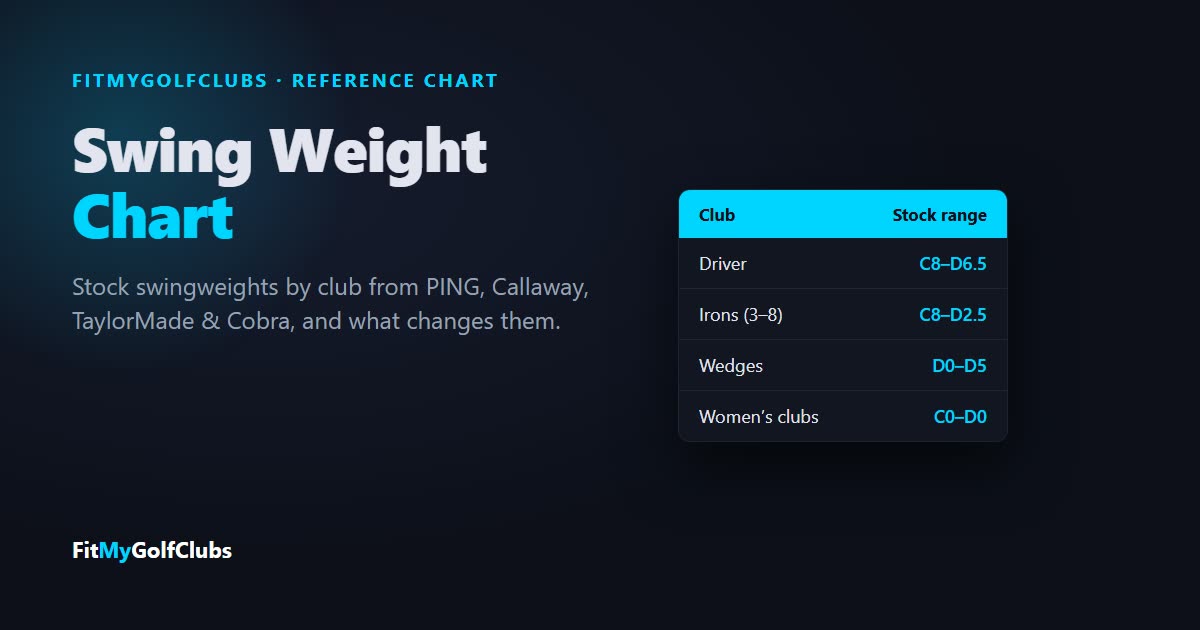
Swing Weight Chart: Standard Swingweights by Club and Brand
Swing weight chart: the A0–G9 scale, stock swingweights for drivers, irons and wedges from PING, Callaway, TaylorMade and Cobra, and what changes them.
Golf Club Fitting
October 8, 2026
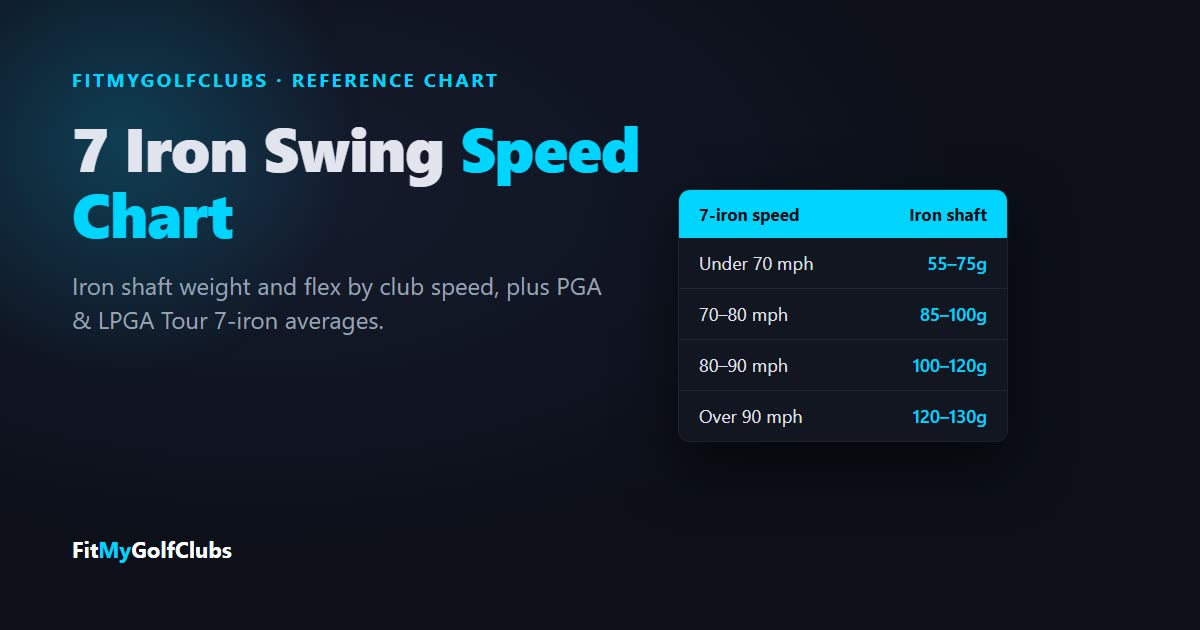
7 Iron Swing Speed Chart: Iron Shaft Weight, Flex & Carry
7 iron swing speed chart: iron shaft weight and flex by club speed, PGA (92 mph) and LPGA (78 mph) Tour averages, and 7-iron carry by speed.
Golf Club Fitting
October 8, 2026
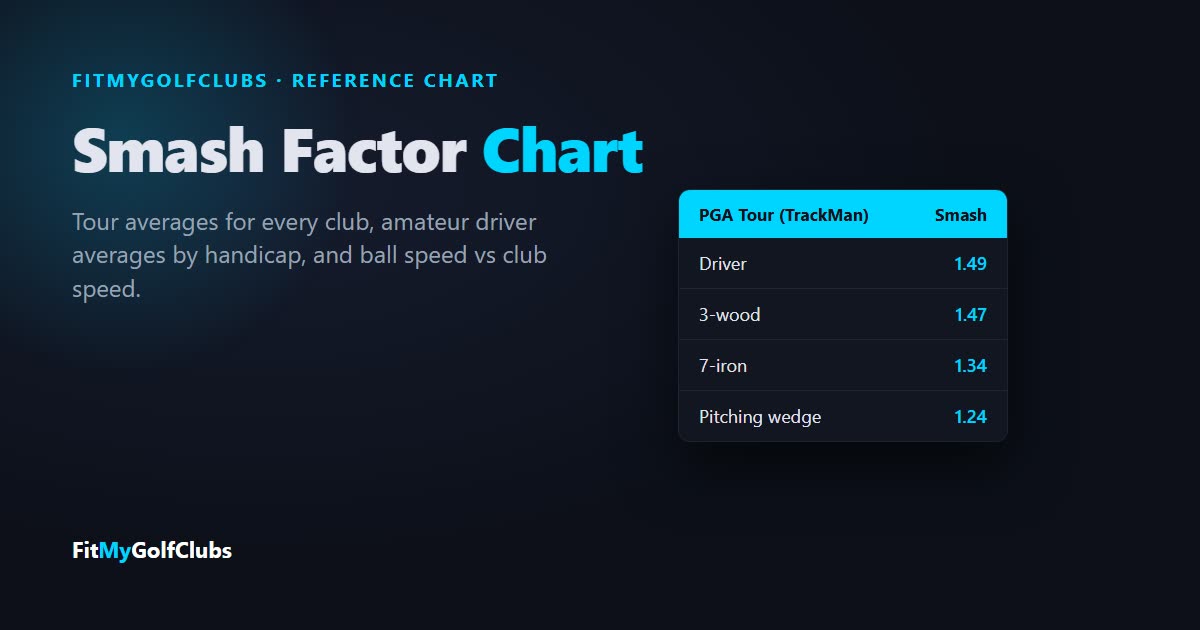
Smash Factor Chart: Tour Averages by Club + Ball Speed
Smash factor chart by club from TrackMan PGA and LPGA Tour averages, amateur driver averages by handicap, and a club speed to ball speed table.


© 2026 FitMyGolfClubs. All rights reserved. | Patent Pending
Contact: sean@fitmygolfclubs.com