

Golf Club Fitting
December 13, 2025
Last updated October 8, 2026: tour and average-golfer swing speeds now use TrackMan's 2023 data, and iron speeds use the 80%-of-driver rule.
Shaft Flex Calculator
FREE — NO SIGNUPEnter your driver swing speed — get your flex band instantly.
Don’t know your speed? Rough guide: 200-yd carry ≈ 90 mph, 220-yd ≈ 100 mph — or read it off the chart below.
Choosing the right shaft flex is one of the most important equipment decisions you'll make. Too stiff and you'll lose distance and fight a slice. Too soft and you'll struggle with control and consistency.
The problem? Most golfers guess at their flex based on what sounds right rather than what actually matches their swing. This guide gives you a clear swing speed to shaft flex chart, explains how to measure your speed, and helps you dial in the right flex for every club in your bag.
Golf Swing Speed Chart: Shaft Flex at a Glance
Find your shaft flex from driver club head speed: under 60 mph = Ladies (L), 60–75 mph = Senior (A), 75–95 mph = Regular (R), 95–110 mph = Stiff (S), and over 110 mph = Extra Stiff (X). On a borderline, tempo decides — smooth swings go softer, aggressive swings go stiffer. A stiff driver shaft suits roughly 95–110 mph; a 7-iron runs at about 80% of driver speed (TrackMan tour data: 92 vs 115 mph on the PGA Tour).
Driver Swing Speed Chart (MPH to Shaft Flex)
⚡ Skip the chart. Get a personalized answer.
Use the calculator at the top of this page for your instant flex band — or go one further: the AI version factors in tempo, transition, and miss pattern. Try it free →
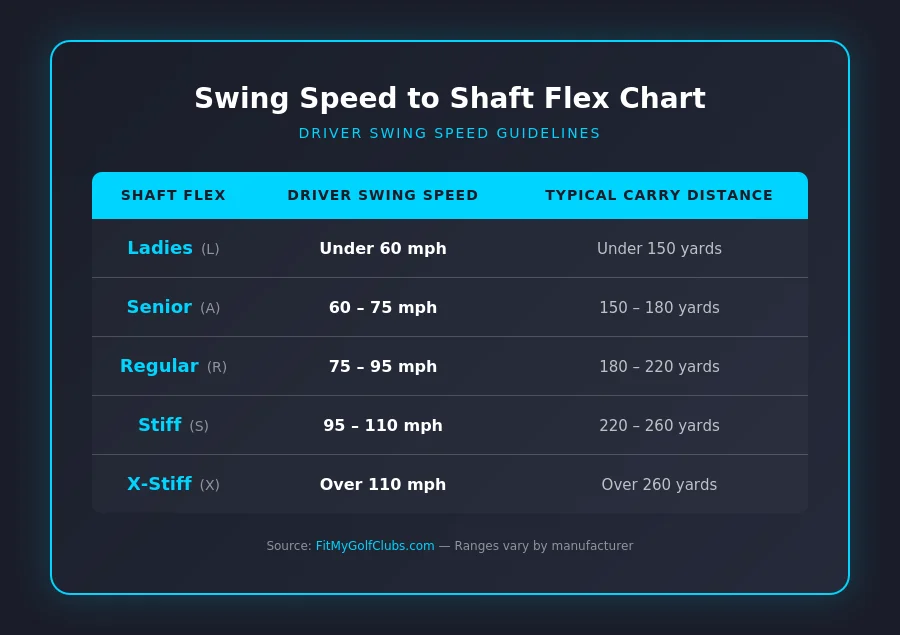
Charts are a starting point. For a recommendation that factors in your tempo and miss pattern, use our free Swing Speed → Shaft Flex tool — the AI analysis adds context a static chart can't.
Swing Speed to Shaft Flex Chart
Here are the generally accepted swing speed ranges for each flex category, based on driver swing speed:
Ladies Flex (L): Under 60 mph — Typical carry distance under 150 yards
Senior Flex (A): 60–75 mph — Typical carry distance 150–180 yards
Regular Flex (R): 75–95 mph — Typical carry distance 180–220 yards
Stiff Flex (S): 95–110 mph — Typical carry distance 220–260 yards
Extra Stiff Flex (X): Over 110 mph — Typical carry distance over 260 yards
These ranges aren't absolute—they're starting points. If you land on the Regular/Stiff borderline, see stiff vs regular flex for the tie-breaker. Factors like swing tempo, transition speed, and release point all influence which flex actually performs best for your swing.
For a deeper dive into how flex affects your shots, see our guide on how to know what flex golf shaft you need.
🎯 In between two flex categories?
A static chart can't tell you which side to land on. Our flex calculator's AI mode uses your tempo and miss pattern to break the tie. Get my flex →
▶ Watch: the swing-speed → flex chart explained in under 4 minutes — plus the three things the chart can't tell you.
Average Swing Speed by Club
Your swing speed isn't a single number — it drops as clubs get shorter and more lofted, roughly 2–3 mph per club from driver down to wedge. This club head speed chart uses TrackMan’s average male golfer (a 14.5 handicap): 94 mph with the driver, 80 mph with the 6-iron and 72 mph with the pitching wedge, with the clubs in between filled in on the same curve. Faster and slower players scale up or down, but the gaps between clubs stay similar.
Women and seniors typically run 10–20 mph slower across the board; tour players 15–25 mph faster. What matters for your bag is that the step-down stays consistent — that even progression is exactly what proper loft and length gapping is built around. If two neighboring clubs go the same distance, you have a gap problem no amount of swing speed fixes. It's the most common fitting-spec weakness across 230+ graded amateur bags — see our data. For full yardage benchmarks at every speed, see our golf club distance chart — how far each club should go by swing speed, skill level, and age.
📊 Is your bag actually gapped right?
Speed drops evenly club-to-club — your carries should too. Grade My Bag checks loft gapping across all 14 clubs and flags the overlaps. Free. Grade my bag free →
Average Driver Swing Speed by Skill Level
Where does your speed fall? These are typical driver club head speeds by player type — from tour pros to weekend golfers. Most amateurs overestimate: Tour average gets all the attention, but the average male amateur is closer to 93 mph.
Find your band, then use the swing-speed-to-flex chart above to match it: ~93 mph puts most amateurs in Regular flex, not Stiff — one of the most common mismatches we see. Speed also isn't fixed; it shifts with age, fitness, and swing changes, so re-check it every couple of seasons.
Using Ball Speed Instead of Swing Speed
Some launch monitors report ball speed rather than club head speed. Convert with smash factor: ball speed ÷ 1.44 ≈ driver swing speed for the average golfer. TrackMan’s Combine data puts the average male golfer at a 1.44 smash factor, bogey golfers at 1.43, and scratch players and tour pros at 1.49. So 130 mph ball speed ≈ 90 mph swing speed → Regular flex, 145 mph ≈ 101 mph → Stiff, and 160 mph ≈ 111 mph → just into X-Stiff. If you strike it like a tour player, divide by 1.49 instead. Once converted, read the flex chart above as usual.
How to Measure Your Swing Speed
You can't pick the right flex if you don't know your swing speed. Here's how to get accurate numbers.
Launch Monitor Testing
The most accurate method is hitting shots on a launch monitor. These devices measure club head speed directly and give you precise data. You can find launch monitors at most golf retailers and indoor simulators. Many driving ranges now offer bays with tracking technology. Club fitters use professional-grade monitors during fittings.
Even a single session gives you the data you need. Ask for your driver swing speed specifically—that's the number you'll use for the chart above.
Driving Range Estimate
If you can't access a launch monitor, you can estimate swing speed from your carry distance with a driver. A 180-yard carry suggests roughly 80 mph. A 200-yard carry suggests roughly 90 mph. A 220-yard carry suggests roughly 100 mph. A 240-yard carry suggests roughly 108 mph.
This method is less precise because it assumes solid contact and doesn't account for wind, altitude, or ball type.
Golf GPS and App Data
Some GPS devices and swing analyzer apps estimate swing speed. These vary in accuracy but can give you a ballpark figure if other options aren't available.
For more on using technology to analyze your equipment, check out how to test golf clubs with launch monitors.
Why Shaft Flex Matters
The shaft is the engine of your golf club. It stores and releases energy during your swing, directly affecting launch angle, spin rate, and shot direction.
What Happens During Your Swing
When you swing, the shaft bends backward during the downswing (loading), then snaps forward through impact (releasing). This load-and-release cycle adds speed and affects how the clubface delivers to the ball.
A shaft that matches your swing speed loads and releases at the right time, maximizing energy transfer. A mismatched shaft disrupts this timing, costing you distance and accuracy.
Too Stiff vs. Too Soft
If your shaft is too stiff: The shaft doesn't load properly during your swing. You'll see lower ball flight than optimal, shots that fade or push right, reduced distance, and a harsh, dead feel at impact.
If your shaft is too soft: The shaft loads too much and releases inconsistently. You'll see higher ball flight with more spin, shots that draw or hook left, inconsistent distance control, and a whippy, unstable feel.
One of the most common issues we see is golfers playing shafts that are too stiff for their swing speed. If you're slicing your driver, your shaft might be part of the problem. Learn more in our article on why you slice your driver but not your irons.
⚖️ Flex is half the equation. Weight is the other half.
Two "Stiff" shafts can play completely differently if they weigh 20g apart. Pair this with our Shaft Weight Calculator for the full picture. Check my weight range →
Flex Isn't Standardized Across Brands
Here's something most golfers don't realize: there's no industry standard for shaft flex. A "stiff" shaft from one manufacturer might play closer to "regular" from another.
This inconsistency means you can't assume all stiff shafts perform the same. A Fujikura stiff might feel different from a Project X stiff, even at the same swing speed. Project X is a notorious example — its 6.0 flex plays firmer than most "Stiff" labels because of how the brand profiles its shafts.
What This Means for You
Don't get locked into a flex label. Focus on performance instead. Use the swing speed chart as a starting point, then test actual shafts to see how they perform for your swing. Pay attention to ball flight and feel, not just the letter printed on the shaft.
If you're between flex categories on the chart, testing becomes even more important.
Iron Shaft Flex vs. Driver Shaft Flex
Your iron swing speed is slower than your driver swing speed—typically about 80% of your driver speed with a 7-iron, per TrackMan’s tour data. But that doesn't necessarily mean you need different flex ratings.
Consistency Matters
Most golfers play the same flex throughout their irons for consistency. If you're a stiff flex in your driver, you're probably stiff in your irons too.
However, some players benefit from slightly softer flex in long irons (where you need more help launching) and standard flex in short irons (where control matters more).
Shaft Weight Differences
Iron shafts are typically heavier than driver shafts. While your driver shaft might weigh 55-65 grams, iron shafts often run 95-120 grams in steel or 65-85 grams in graphite.
This weight difference affects how the shaft feels and performs, independent of flex rating. For a deeper look at iron shaft weight, see our golf shaft weight guide.
🔍 Wondering if your driver flex is wrong?
Drop your launch monitor numbers into our Single-Club Fit Grader — get an AI fit grade for one specific club, flex included. Grade one club →
When to Move Up or Down in Flex
Your swing speed isn't static. It can change based on age and physical condition, swing changes and lessons, equipment changes, and fitness level.
Signs You Need Stiffer Flex
Consider moving to a stiffer shaft if your ball flight has gotten too high, you're hitting hooks or pulls more often, your distance has increased significantly, or shots feel out of control at impact.
Signs You Need Softer Flex
Consider moving to a softer shaft if your ball flight has gotten too low, you're hitting fades or pushes more often, you've lost distance, or shots feel harsh and dead at impact.
🏌️ One number doesn't grade your bag.
Flex is one of 8 fit factors. Grade My Bag analyzes all 14 clubs across all 8 — flex, weight, length, lie, and more. Free, no fitting fee. Grade my bag free →
How to Test Shaft Flex Before Buying
Never buy clubs without testing the shaft flex first. Here's how to do it right.
Demo Days and Fitting Events
Manufacturer demo days let you test the same club head with different shaft options. This head-to-head comparison reveals which flex produces the best numbers for your swing.
Retail Fitting Sessions
Most golf retailers offer fitting sessions where you can test multiple flex options on a launch monitor. Even a basic fitting gives you data on how different shafts perform.
The cost for a basic fitting ranges from free to around $100. For a full breakdown, see our guide on how much golf club fitting costs.
DIY Testing
If you have access to clubs in different flexes, you can run your own comparison test at the range. Hit 10 shots with each flex and track carry distance, shot shape, and feel.
For more self-fitting techniques, check out how to fit your golf clubs at home.
The Bottom Line
Shaft flex directly impacts your distance, accuracy, and consistency. Use the swing speed chart as your starting point: under 75 mph driver speed suggests senior or regular flex, 75-95 mph suggests regular flex, 95-110 mph suggests stiff flex, and over 110 mph suggests extra stiff.
But don't stop at the chart. Get your swing speed measured, test different flex options, and pay attention to ball flight and feel. The right flex for you is the one that produces the best results, regardless of what letter is printed on the shaft. And if speed itself is what you want to change, a few lessons move the needle more than any shaft — here's what golf lessons cost in 2026. Your swing speed also picks your golf ball — the golf ball compression chart shows which compression range matches your speed. Flex is the spec your swing sets — length is the one your body sets: the golf club length chart covers standard lengths and how to adjust for your height. The easiest way to keep track of what you're actually playing: build your digital golf bag — every club's flex and shaft specs in one list.
Stop guessing what's in your bag.
FitMyGolfClubs grades all 14 clubs across 8 professional fit factors — flex, weight, length, lie, and more. No fitting appointment, no launch monitor required.
On a computer? You can also grade your bag in your browser — no app to install.
🎯 Want the full picture?
See our guide to free golf club fitting tools — check your flex, weight and length, then grade your whole bag free, no launch monitor. See the free tools →
Frequently asked questions
What is the average golf swing speed?
The average male amateur swings the driver about 90–95 mph, and the average female amateur about 78 mph. PGA Tour players average about 115 mph and LPGA players about 96 mph (TrackMan, 2023). Swing speed drops about 2–3 mph per club as you move from driver down to your wedges.
What is the average swing speed for each club?
For TrackMan’s average male golfer: driver ~94 mph, 3-wood ~90, hybrid ~85, 5-iron ~82, 7-iron ~78, 9-iron ~74, and pitching wedge ~72 mph. Faster and slower players scale up or down but keep similar gaps between clubs — a roughly 2–3 mph step-down per club.
What is a good club head speed?
"Good" is relative to your goals: 90+ mph driver speed is solid for an amateur, 100+ mph is strong, and 110+ mph is tour-level. But speed only helps if your equipment matches it — the right shaft flex and weight let you actually convert club head speed into ball speed and distance instead of leaking it to mishits.
What shaft flex do I need for my swing speed?
As a starting point by driver swing speed: under 60 mph is Ladies (L), 60-75 mph is Senior (A), 75-95 mph is Regular (R), 95-110 mph is Stiff (S), and over 110 mph is Extra Stiff (X). Tempo and transition shift these bands, so treat the chart as a starting point, not a rule.
What swing speed needs a stiff shaft?
Roughly 95-110 mph with the driver. Below 95 mph, most golfers lose distance and fight a fade with stiff shafts. Tour average is about 115 mph and the average male amateur is closer to 93 mph, so many players who buy stiff would actually perform better in regular.
Is shaft flex the same across brands?
No. There is no industry standard, so one brand's stiff can play like another's regular. Project X is a well-known example that plays firmer than its label. Use swing speed to get in the ballpark, then test actual shafts by ball flight and feel rather than trusting the printed letter.
How do I measure my swing speed without a launch monitor?
Estimate from driver carry distance: about 180 yards is 80 mph, 200 yards is 90 mph, 220 yards is 100 mph, and 240 yards is 108 mph. It is less precise than a launch monitor, but it gets you to the right flex band.
Related reading
- Golf Club Fitting Chart — Length and lie by height, flex by swing speed, and every chart we publish in one place.
- Golf Club Loft & Lie Chart — standard specs for every club, plus a free way to check your own at home.
- Golf Club Distance Chart: How Far Should You Hit Each Club — Average distances for every club, by swing speed, skill level, and age.
- Golf Ball Compression Chart: Ratings by Swing Speed — Which compression range fits your speed, plus the softest balls ranked.
- Project X Shaft Flex by Swing Speed: The Complete 2026 Chart — Why PX 6.0 plays firmer than the "Stiff" label suggests, broken down by model.
- Golf Shaft Weight Guide — Pair flex with weight. The two together define your shaft fit.
- Golf Club Replacement Frequency — Wedges every 2-3 years, drivers 3-5, irons 5-10. When to upgrade.
- How Much Do Golf Lessons Cost? 2026 Prices (+ What Pros Charge) — Lesson pricing by format and instructor credential — plus the instructor's side of the math.
- Bent, Cut Down, or Reshafted? Log a Club's Real Specs — If your clubs have been tweaked, the factory flex label no longer tells the story.
- Fujikura Ventus Shaft Chart — The most-played driver shaft decoded — Blue, Red, Black, TR, and what VeloCore changes.
- Mitsubishi Tensei Shaft Chart — The other half of the tour duopoly — CK, AV and 1K by color profile.
- Graphite Design Tour AD Shaft Chart — DI, IZ, UB, VF and XC, plus the R2 / R1 / SR flex ladder most brands do not offer.
- AutoFlex Shaft Chart — The one shaft line fitted entirely by driver speed — every SF code mapped to its published mph band.
- Project X Denali Shaft Chart — Blue, Black and Red by flex code, on the same bands as this chart.
- Newton Shaft Chart — Newton sells by swing speed instead of R, S or X: every Dot mapped to its mph band and to the letter flex on this chart.
- Graphite vs Steel Shafts — Real iron shaft weights and prices, and which to play by swing speed.
- Smash Factor Chart — TrackMan tour smash factor by club, amateur averages, and ball speed from club speed.
- 7 Iron Swing Speed Chart — Iron shaft weight by 7-iron speed, tour 7-iron averages, and 7-iron carry by speed.
Stop cross-referencing charts by hand. The FitMyGolfClubs app grades your whole bag across eight fitting factors — flex, weight, and more — straight from your specs. Free to start.
Related Articles
Golf Club Fitting
October 8, 2026
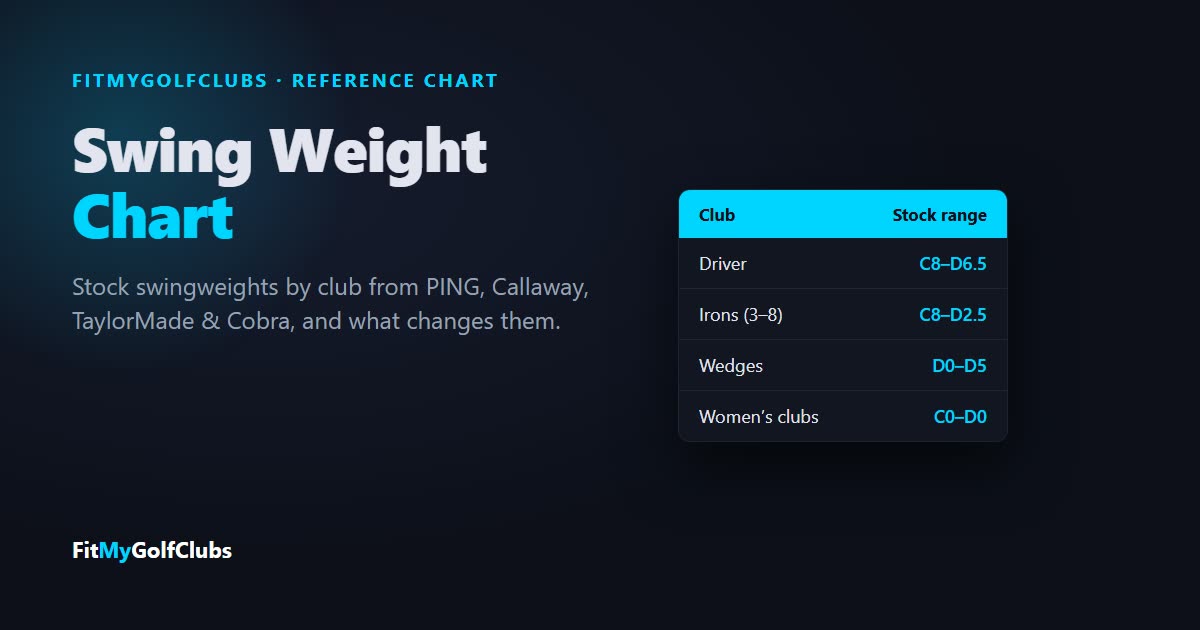
Swing Weight Chart: Standard Swingweights by Club and Brand
Swing weight chart: the A0–G9 scale, stock swingweights for drivers, irons and wedges from PING, Callaway, TaylorMade and Cobra, and what changes them.
Golf Club Fitting
October 8, 2026
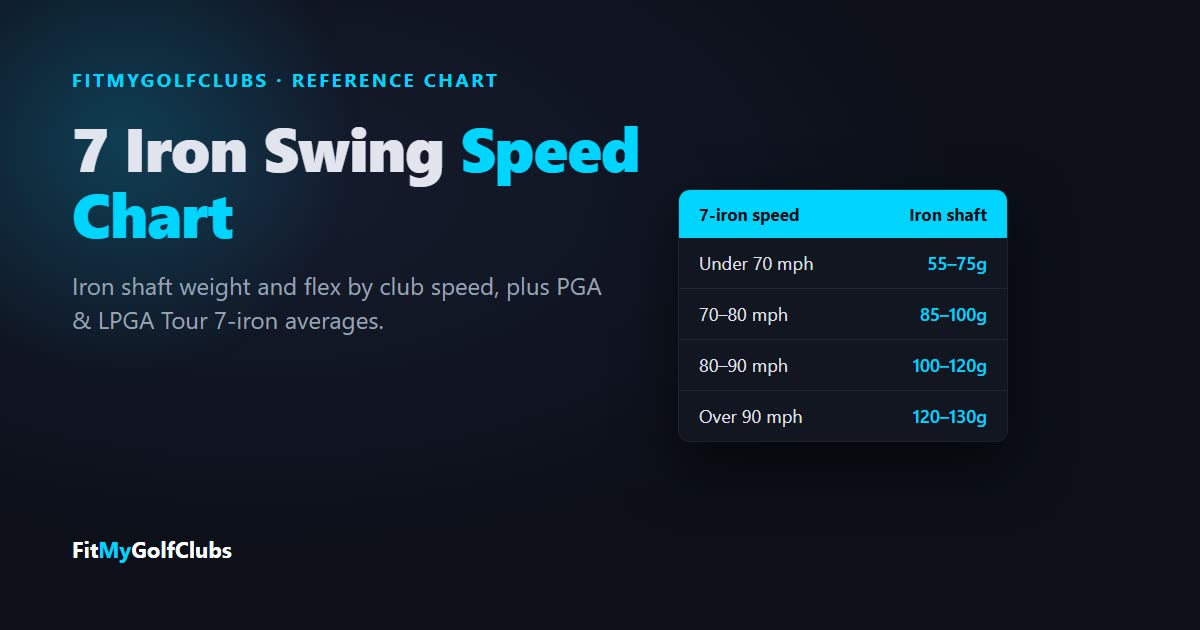
7 Iron Swing Speed Chart: Iron Shaft Weight, Flex & Carry
7 iron swing speed chart: iron shaft weight and flex by club speed, PGA (92 mph) and LPGA (78 mph) Tour averages, and 7-iron carry by speed.
Golf Club Fitting
October 8, 2026
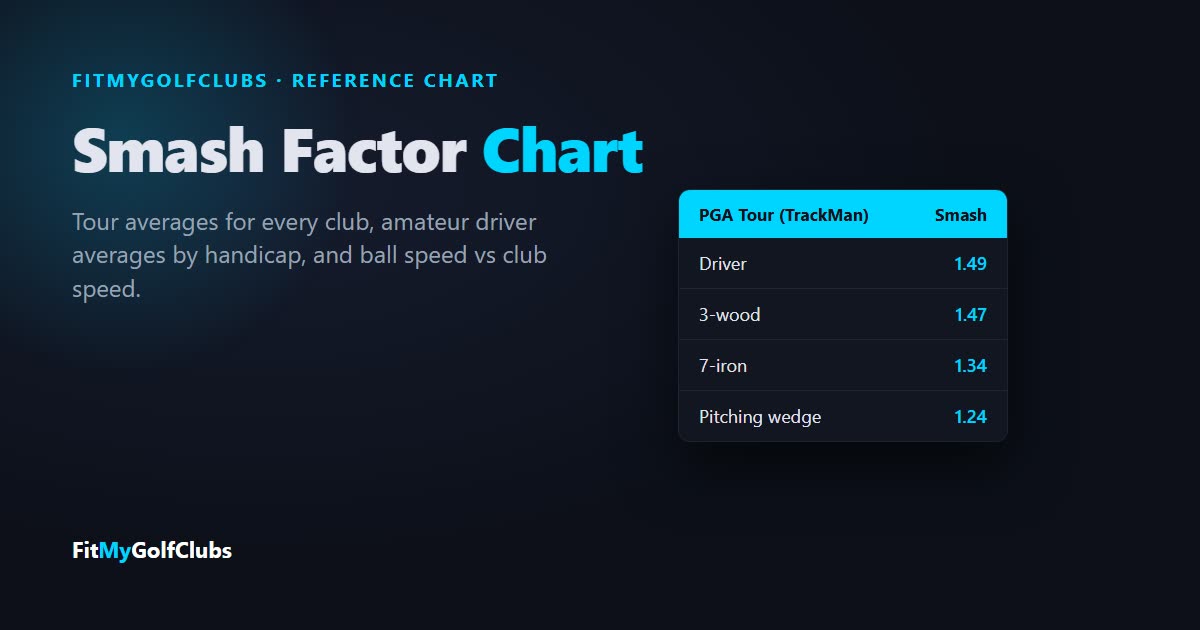
Smash Factor Chart: Tour Averages by Club + Ball Speed
Smash factor chart by club from TrackMan PGA and LPGA Tour averages, amateur driver averages by handicap, and a club speed to ball speed table.


© 2026 FitMyGolfClubs. All rights reserved. | Patent Pending
Contact: sean@fitmygolfclubs.com