

Golf Club Fitting
November 18, 2025
You can tell if your golf clubs fit you without a launch monitor or an appointment. Check eight specs against your body and your swing: length, lie angle, shaft flex, shaft weight, loft gapping, grip size, club age and your miss pattern. Two or more out of spec means your clubs are costing you shots.
Most golfers assume ill-fitting clubs are something only a $400 fitting session can reveal. They aren't. Every check below uses a tape measure, a marker, a scorecard or specs you already own — and each one tells you something specific about whether the club is the problem or you are.
Here is the fast version, then the detail on each.
The 60-second fit check
Score yourself as you go. One red flag is worth fixing. Two or more and the clubs are actively working against you.
1. Are your clubs the right length?
Length is the first thing to check because it changes everything downstream. Get it wrong and you compensate with posture, and the compensation shows up as a miss pattern you will blame on your swing for years.
Too long: you stand too tall, the swing flattens, and you catch the ball toward the toe. The common result is a hook or a pull.
Too short: you bend over more than you should, the swing steepens, and you catch it toward the heel. The common result is a slice or a push.
How to check it yourself
Use the static wrist-to-floor measurement. It takes one minute and needs a tape measure and a wall.
1. Put your golf shoes on and stand upright against a wall, heels touching it, arms hanging relaxed at your sides. Do not reach down or shrug.
2. Have someone measure from the crease of your wrist straight down to the floor.
3. Compare that number against standard length for your height. A wrist-to-floor figure well outside the standard band for your height means your irons need to be lengthened or shortened.
A quick sanity check with no tape measure: take your normal address position with a 7-iron. The butt of the grip should sit about a hand width from your thigh, and the top of the grip should point at your belt buckle. If the club feels like it is holding you up, it is too long.
Anything more than about an inch away from the right length is worth correcting. Our golf club length by height guide has the full wrist-to-floor bands, and the golf club length chart lists standard lengths for every club. There is also a printable length chart PDF if you want it in the bag.
2. Is your lie angle correct?
Lie angle is the most under-checked spec in amateur golf, and it is the one most likely to be quietly ruining your irons. It is the angle between the shaft and the ground at address, and at impact it aims your face.
Too upright: the heel digs first, the face closes, and the ball starts left of target for a right-handed golfer.
Too flat: the toe digs first, the face opens, and the ball starts right.
Here is the part that surprises people: a lie angle error of a couple of degrees can push a 7-iron shot meaningfully offline at 150 yards, and no amount of swing work fixes it, because the club is aimed wrong before you start.
How to check it yourself
You need a dry-erase marker or a strip of impact tape, and a flat board. A piece of hard plastic on the range mat works.
1. Draw a line down the sole of a 7-iron, or stick impact tape across it.
2. Hit five to eight shots off the board at normal tempo. Do not try to help it.
3. Look at where the board has scuffed the sole. Centre contact means the lie is right. Consistent marks toward the heel mean the club is too upright. Consistent marks toward the toe mean it is too flat.
Do this with a mid-iron first. If the mid-iron is off, the set usually is. Most iron heads can be bent two degrees either way by any decent club shop, and it is one of the cheapest fixes in golf.
Our loft and lie chart lists standard lie angles for every club, and you can print the club angle check mat PDF to run the sole-marking test properly at home.
3. Does your shaft flex match your swing?
Flex is the spec most golfers get wrong for reasons of ego. Stiff sounds better than regular. But a shaft too stiff for your speed will not load, so you lose height, distance and feel, and the ball tends to leak right. A shaft too soft loads too much and leaves the face open or shut depending on your timing, which is why that miss is two-way.
How to check it yourself
If you have a launch monitor number, use driver swing speed. If you do not, driver carry distance is a reasonable proxy. Carry, not total roll.
These are starting bands, not verdicts. Tempo matters as much as raw speed, and a smooth 95 mph swing can play a regular shaft happily. One band off is worth testing. Two bands off is a problem.
More detail in our swing speed to shaft flex chart, how to know what shaft flex you need, and the stiff vs regular flex comparison.
4. Do your shaft weights progress correctly?
Almost nobody checks this, and mixed sets make it common. Shaft weight should increase gradually as clubs get shorter. Driver lightest, wedges heaviest. That progression is what lets you feel where the clubhead is without changing tempo club to club.
When the progression breaks, say a lightweight aftermarket shaft dropped into the middle of a steel set, or a heavy hybrid sitting between light woods and light irons, your tempo has to change for that one club. That is where the one club I just cannot hit feeling usually comes from.
How to check it yourself
Read the labels. Most shafts print the weight in grams near the grip or just above the ferrule. Write down driver, fairway, hybrid, a mid-iron and a wedge, then confirm the numbers only ever go up as the clubs get shorter.
Any club that breaks the upward sequence is the one to look at first. Full detail in the golf shaft weight guide.
5. Are your distance gaps even?
Loft gapping is where a bag quietly wastes clubs. If two clubs go the same distance, one of them is dead weight. If two clubs are 25 yards apart, you have a yardage you can never hit properly, and it usually sits somewhere you actually need it.
The goal is even steps. Roughly 10 to 15 yards between irons, and no gap bigger than about 20 yards anywhere in the set.
How to check it yourself
You do not need a launch monitor. You need a scorecard and one honest range session.
1. Hit five shots with each club, from pitching wedge up through driver.
2. Ignore your best one. Write down the average of the middle three. Your best 7-iron is not your 7-iron.
3. Subtract each club from the one above it, and look at the list of gaps.
Two clubs within 8 yards of each other means one is redundant. A gap over 20 yards means you are missing a club, and the fix is usually a loft adjustment or swapping a long iron for a hybrid rather than buying anything new.
Our golf club distance chart shows expected carry by club and swing speed so you can see whether a gap is your loft or your speed. The printable distance chart PDF is designed to fill in at the range.
6. Is your grip the right size?
Grip size is cheap to fix and almost never checked. Too small and your hands stay too active, which shuts the face and produces hooks. Too big and your hands cannot release, which leaves the face open and produces a block or a fade. Either way you will be told it is your swing.
How to check it yourself
Measure your glove hand. Tape measure, thirty seconds.
1. Measure from the crease of your wrist to the tip of your middle finger.
2. Match that length to Golf Pride’s grip sizes below.
A second check with no tape measure, from Golf Pride: take your normal grip with your upper hand. Your fingers should barely touch the heel pad of your hand. If they wrap underneath the heel pad, the grip is too small. If they don’t touch it, the grip is too big.
For the full chart by hand and glove size, in inches and centimeters, see our golf grip size chart.
7. How old are your clubs?
Age matters, but not uniformly, and the marketing around it is mostly noise. What actually degrades is specific.
Drivers genuinely moved forward over roughly the last decade in forgiveness and adjustability. A driver older than about seven years is the one club where new technology is likely to be worth real money to you.
Wedges wear out fastest and nobody notices. Grooves degrade with use, not with years. After roughly 75 to 100 rounds, spin drops off and your short shots start releasing more than they used to.
Irons last a long time. A well-kept set of forged irons from fifteen years ago that fits you will outperform a brand new set that does not.
Grips are the cheapest performance you can buy. Once a year if you play regularly.
How to check it yourself
Look up the model year of your driver and count rounds on your wedges. Then run your thumbnail across the wedge grooves. If it glides instead of catching, the grooves are gone.
More on this in are your golf clubs too old and when you should replace golf clubs.
8. Is it your swing or your clubs?
This is the check that ties the others together, and it is the one that decides whether you need a lesson or a fitting.
The distinction is simple. A swing fault tends to vary. Some days you fight it, some days you do not, and it shows up differently across the bag. An equipment fault is consistent. It shows up the same way, with the same clubs, every single round, no matter how you feel.
How to check it yourself
Keep a note over three rounds of where each iron misses. Then look at the pattern.
If every iron misses the same direction, suspect lie angle or grip size. If only the long clubs misbehave, suspect shaft flex or length. If one specific club is the problem and the others are fine, suspect that club, usually its shaft weight. If the misses are scattered with no pattern at all, that is a swing to work on, and a fitting will not fix it.
Related reading: why do I slice my driver but not my irons.
Do you need a professional fitting?
Not always, and it is worth being honest about when it pays.
A fitting is worth it if you are buying a full set, if you are outside average height by a meaningful margin, if you have a physical change such as an injury or a swing rebuild, or if several of the checks above came back red at once.
A fitting is not the first move if you have one red flag you already know how to fix. Bending lie two degrees, regripping to midsize or swapping one wedge costs a fraction of a fitting session and solves the actual problem.
Our golf club fitting cost breakdown has real numbers, and should I get fitted for golf clubs works through the decision. If you would rather start at home, how to fit golf clubs at home covers the full process.
Check all eight at once
Running these checks by hand works, and it is worth doing at least once because you learn your own bag. But it takes a range session, a tape measure and a scorecard, and it only tells you about the clubs you thought to check.
FitMyGolfClubs does the same analysis from your specs. You enter the clubs you already own, and it grades every one of them across eight professional fitting factors: loft gapping, weight progression, club age, length, lie angle, shaft flex, kickpoint and torque. You get a letter grade for the bag, a grade per club, and a plain-language explanation of which clubs are costing you shots and why.
No launch monitor, no appointment, no hitting balls. It works from specifications, which is why it can tell you about all fourteen clubs instead of the three you brought to a fitting bay.
Grade your bag free — or read how AI golf club fitting works first. The free fitting tools cover individual checks if you only want one answer.
Frequently asked questions
How do I know if my golf clubs fit me?
Check eight specs against your body and your swing: length using a wrist-to-floor measurement, lie angle using a marker on the sole, shaft flex against your driver carry, shaft weight progression from the labels, loft gapping from your carry distances, grip size from your hand length, club age by model year and wedge groove wear, and your miss pattern across three rounds. Two or more out of spec means your clubs are costing you shots.
Can I check if my clubs fit me without a launch monitor?
Yes. Every check on this page uses a tape measure, a dry-erase marker, a scorecard or the specs printed on your own equipment. A launch monitor makes flex and gapping checks more precise, but driver carry distance and averaged range yardages are good enough to find the problems.
What is the most common club fitting mistake amateurs make?
Playing a shaft that is too stiff. Stiff sounds stronger than regular, so golfers pick up the stiffer option, and then lose height, carry and feel because the shaft never loads. The second most common is never checking lie angle, which silently aims every iron shot offline.
How much does it cost to fix ill-fitting clubs?
Far less than replacing them. Bending lie angle, adjusting length, and regripping are all inexpensive adjustments at any club shop, and they address most of what the checks above will find. Replacing a full set is rarely the right first answer.
Do I need a fitting if I am a beginner or a high handicapper?
You do not need a full fitting session, but you do need clubs that are not actively working against you. Length, lie and grip size matter more for a developing swing than for a good one, because you will build compensations around bad equipment and then have to unlearn them. Run the checks on this page first.
How often should I re-check whether my clubs still fit?
Once a season, and any time something changes. A swing rebuild, an injury, a significant change in fitness or flexibility, or a jump in swing speed all change what fits you. Wedges should be checked for groove wear more often than that.
Related Articles
Golf Club Fitting
October 8, 2026
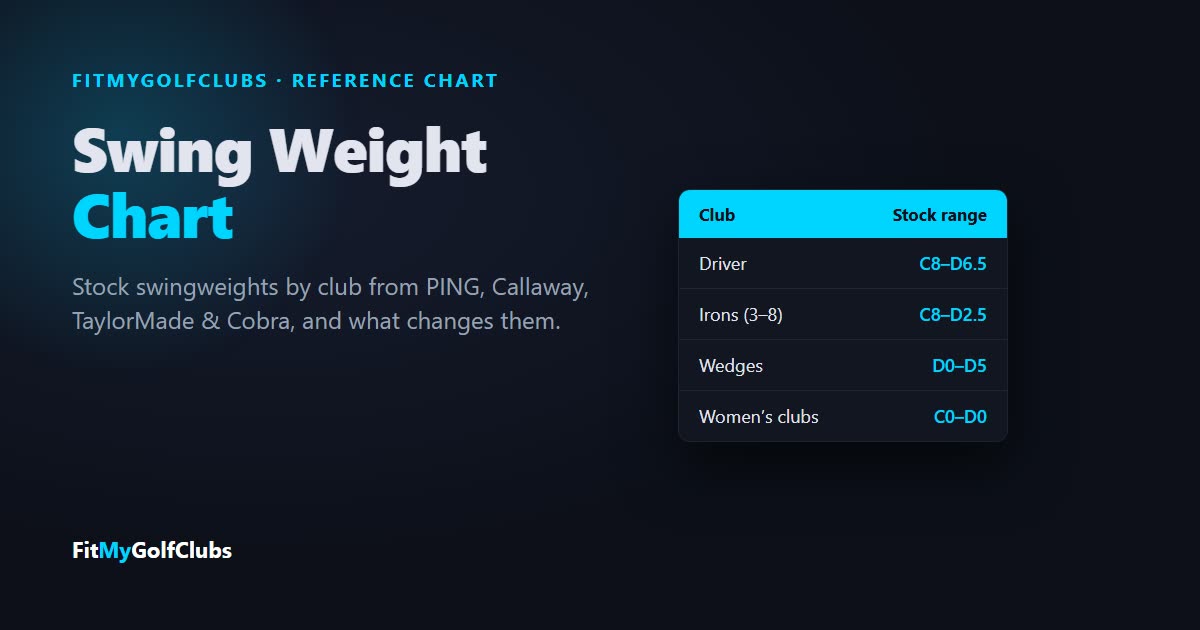
Swing Weight Chart: Standard Swingweights by Club and Brand
Swing weight chart: the A0–G9 scale, stock swingweights for drivers, irons and wedges from PING, Callaway, TaylorMade and Cobra, and what changes them.
Golf Club Fitting
October 8, 2026
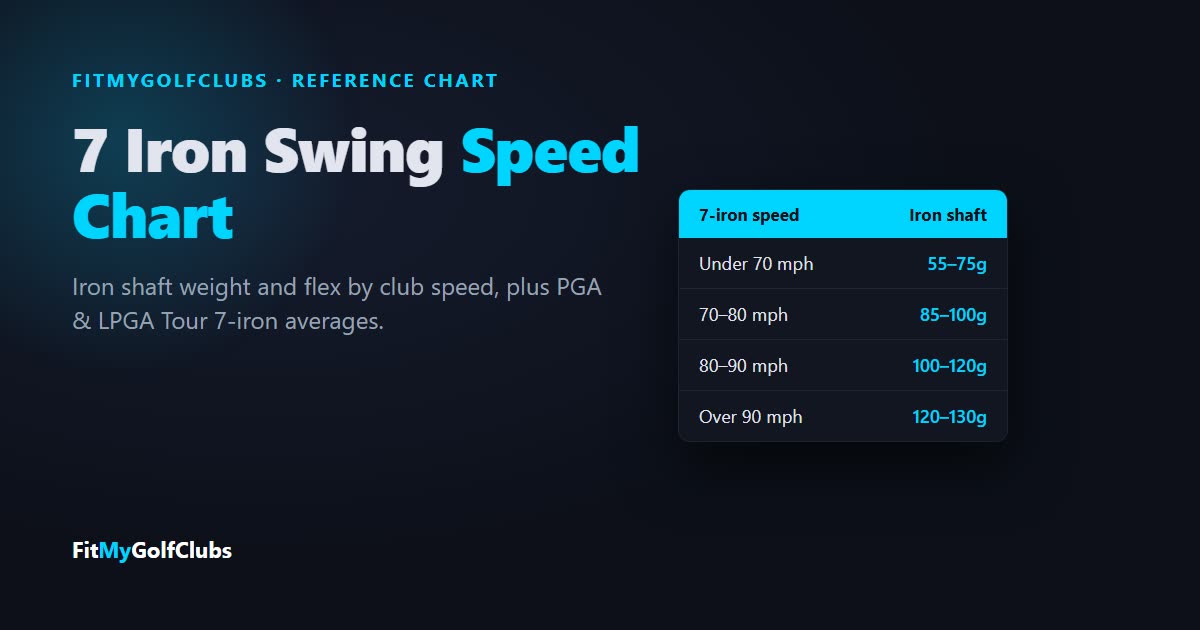
7 Iron Swing Speed Chart: Iron Shaft Weight, Flex & Carry
7 iron swing speed chart: iron shaft weight and flex by club speed, PGA (92 mph) and LPGA (78 mph) Tour averages, and 7-iron carry by speed.
Golf Club Fitting
October 8, 2026
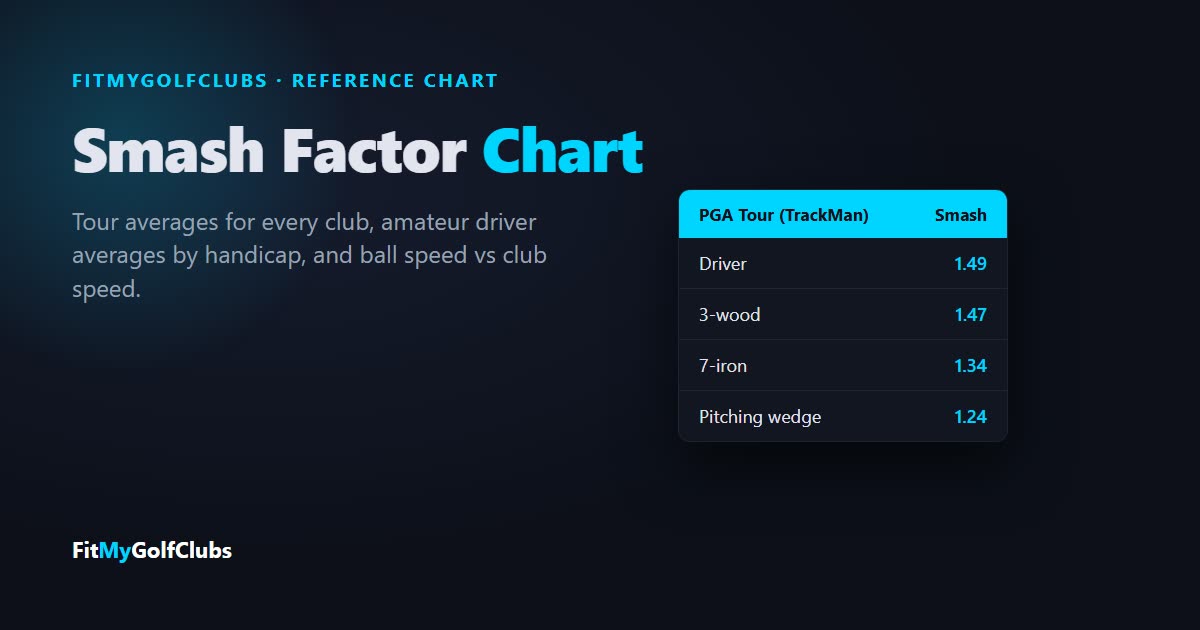
Smash Factor Chart: Tour Averages by Club + Ball Speed
Smash factor chart by club from TrackMan PGA and LPGA Tour averages, amateur driver averages by handicap, and a club speed to ball speed table.


© 2026 FitMyGolfClubs. All rights reserved. | Patent Pending
Contact: sean@fitmygolfclubs.com