
Golf Club Fitting
April 23, 2026
Project X Shaft Selector Chart: Flex by Swing Speed
Project X doesn't use Regular, Stiff, and X-Stiff. It uses 5.0, 5.5, 6.0, 6.5, and 7.0 — and those numbers don't line up with other brands the way you'd expect.
Most swing-speed-to-flex charts online treat Project X like it's just another letter-flex shaft with a different label on it. It isn't. Project X shafts play firmer than their stated flex versus comparable brands, and the numeric system carries weight and trajectory information the letter system doesn't.
Here's what your driver swing speed actually translates to across every current Project X model — and the caveats your fitter will tell you before you hand over a credit card.
Project X Shaft Selector: The Quick Chart
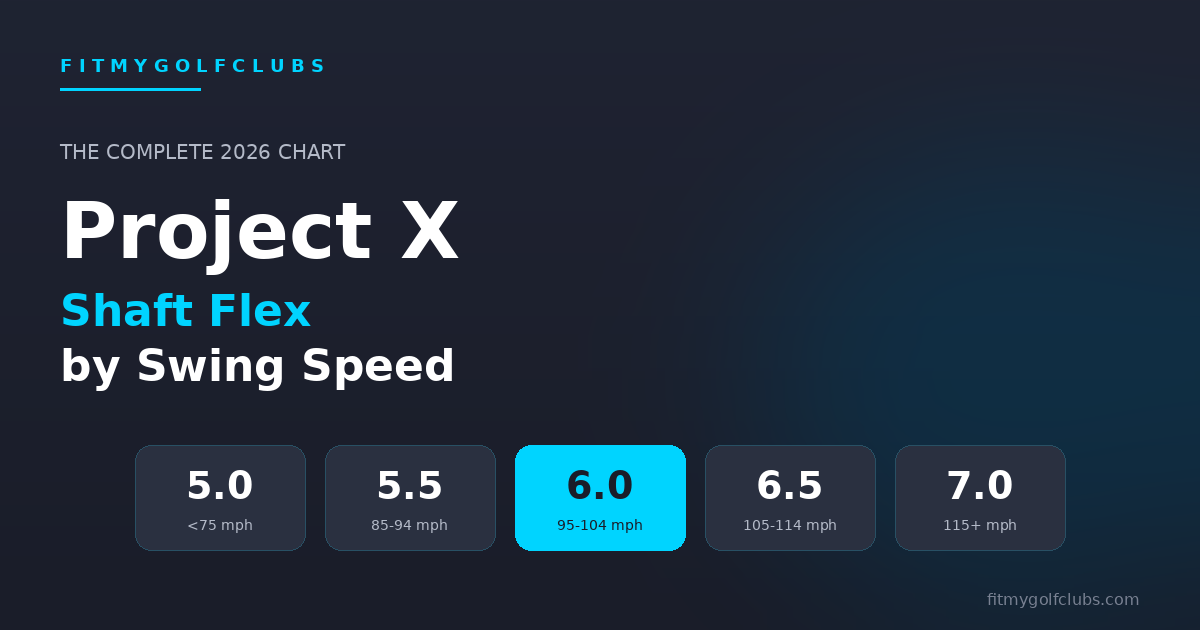
Match driver swing speed to Project X flex: under 75 mph = 5.0 (or 4.0 where the model offers it), 75–90 = 5.0, 90–100 = 5.5, 95–110 = 6.0, over 110 = 6.5, and 115+ = 7.0 or TX. Project X plays about a half-flex firmer than most brands — if you are between numbers, size down. The 90–100 mph stretch is the borderline: a smooth transition stays at 5.5, a quick one goes to 6.0.
⚡ Skip the chart: get a live recommendation.
Enter your driver swing speed into our free Swing Speed → Shaft Flex Calculator and get your flex band in one click, plus a free AI analysis that factors in tempo, typical miss, and handicap. Takes 30 seconds. Try it free →
Shaft Flex Calculator
FREE — NO SIGNUPEnter your driver swing speed — get your flex band instantly.
Don’t know your speed? Rough guide: 200-yd carry ≈ 90 mph, 220-yd ≈ 100 mph — or read it off the chart below.
The Project X numeric flex system, decoded
Project X codes each flex as a number instead of a letter. There is a rough translation, but it's rough — the exact flex each number maps to shifts by model:
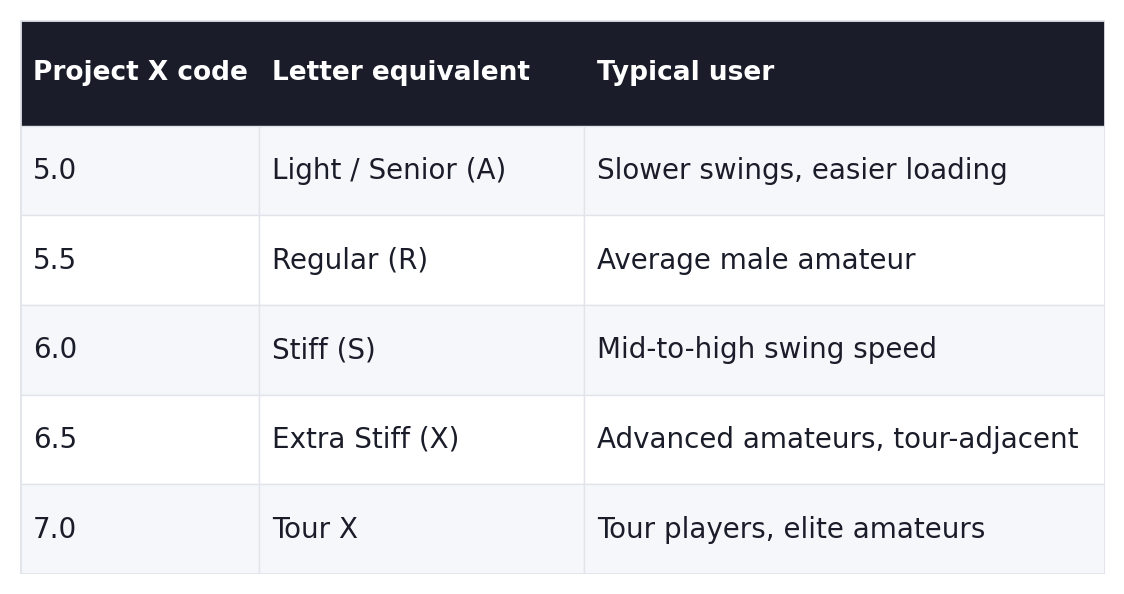
There are two reasons the numeric system exists. First, each flex has its own weight. In the Project X IO steel iron shaft, for example, 5.5 weighs 105g, 6.0 weighs 110g, and 6.5 weighs 115g. That 5-gram-per-flex progression is deliberate — you're not just getting a stiffer shaft as you go up, you're getting a stiffer and heavier shaft, with trajectory tuned to match. (For more on how shaft weight independently affects ball flight, see our Golf Shaft Weight Guide.)
Second, each flex has its own trajectory profile. Stiffer Project X flexes are geometrically modified to launch lower. Softer flexes launch higher. A letter system can't tell you that. A number can.
The tricky part: even True Temper (Project X's parent company) doesn't publish a single unified chart. The mapping between number and letter shifts between the iron shafts, the HZRDUS driver line, and the legacy models. The table above is your 80% answer. The sections below are the 20% that actually matters.
🎯 Already know your driver swing speed?
Plug it into our Shaft Flex Calculator for a flex band plus tempo-adjusted recommendations in under a minute. Try the calculator →
Project X shaft flex by driver swing speed
Start here. This is the master chart across most current Project X models, based on driver clubhead speed:

Not sure of your number? Check our driver swing speed chart to find your club head speed range before picking a Project X flex.
Now the caveat that makes this chart actually useful: Project X plays firmer than the label. A Project X 6.0 has a reputation — backed up by independent testing from MyGolfSpy and years of fitter feedback — of playing closer to a "stiff-plus" compared to brands like KBS or Nippon. The HZRDUS Black line is the clearest example. MyGolfSpy's lab work showed HZRDUS Black 6.0 frequency-testing closer to 6.5–6.8.
What that means for you: if you're hovering in a gray zone — say, a 95-mph swing that could go either R or S in most brands — default down a half-flex in Project X. A 95-mph player who'd be a comfortable Stiff in a Fujikura Ventus might be better off in a Project X 5.5 than a 6.0. A 105-mph player on the border of X-Stiff should probably demo 6.0 before jumping to 6.5. (For the deeper read on how to navigate these gray zones, see Stiff vs Regular Flex: Which Do You Actually Need?)
The table above assumes average tempo and transition. If either of those is unusual, the flex band shifts — which is the exact problem the AI layer on our free Shaft Flex Calculator is built to solve.
Project X shaft flex by model
The master chart gets you close. The model-specific tables below get you exact.
Project X Steel & Project X LZ (irons)
The original Project X steel shaft and Project X LZ ("Loading Zone") are the two most-played Project X iron shafts in the world. Every LZ weight, torque figure and speed band is in the Project X LZ shaft chart. Both use the same numeric system, weight progression, and swing-speed guidance — the LZ just has a slightly more active tip section for feel.

Note the iron weights. Project X steel iron shafts are on the heavier end of the market — the 6.0 is 120g. Players used to lighter iron shafts (90g or 105g) will feel this. If you love the feel but need less weight, the Riptide or IO families are the logical next stop. And if you do reshaft, log the new shaft's real specs so your fit grade matches what you actually play.
Project X IO (irons, lighter alternative)
IO is the modern successor to the older PXi. The Project X IO shaft chart has the full weight table, the three flexes it was made in, and what to buy now True Temper has dropped the line. Softer tip than standard Project X, available in three flexes only, and built to launch higher than the Steel/LZ line.
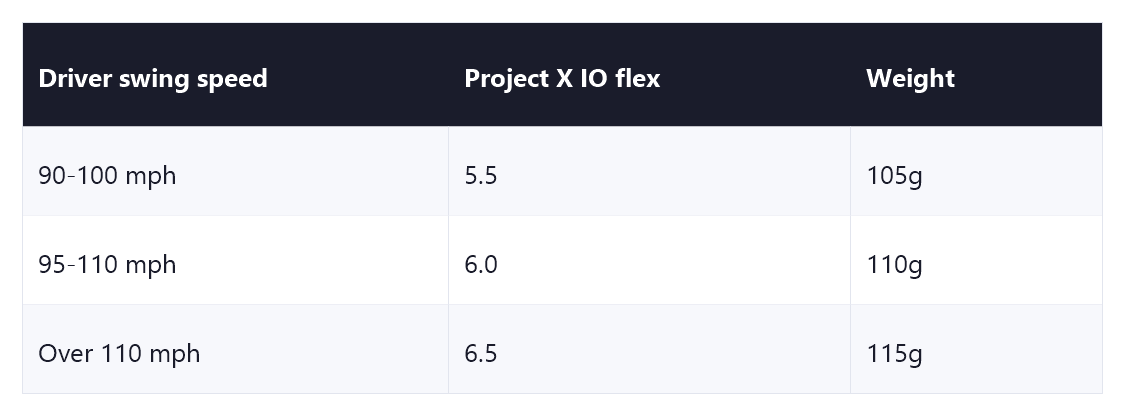
IO is the right pick if you like Project X feel but want to lose 10–15 grams off your iron shafts versus the standard line.
Project X HZRDUS Black (driver, low launch / low spin)
HZRDUS Black is the firm-playing, low-launch, low-spin driver shaft — the tour player's HZRDUS. Available in 60g, 70g, and 80g, with flexes 5.5, 6.0, 6.5, and TX (the 80g drops the 5.5).
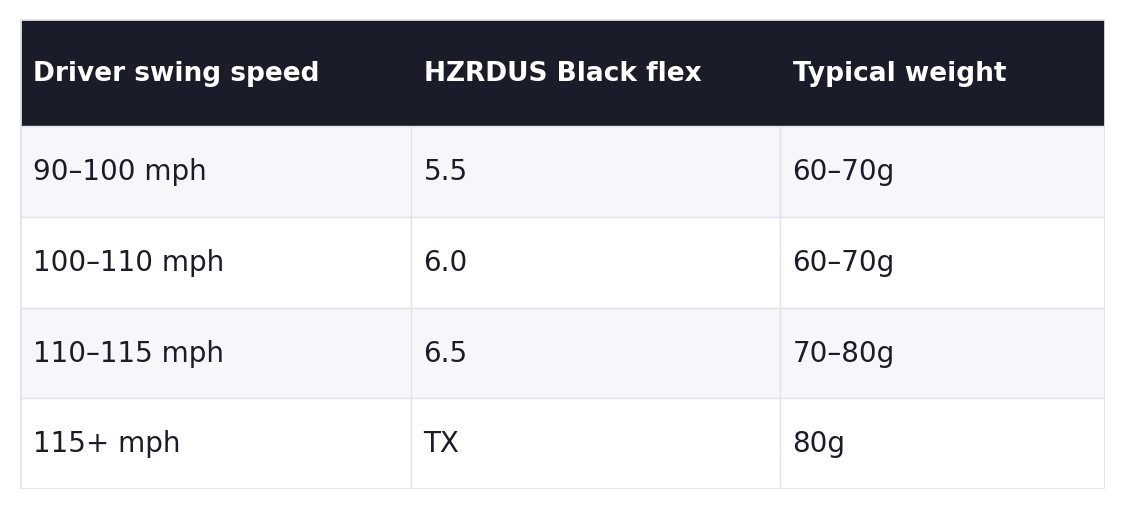
This is the line where the "plays firmer" warning matters most. Several well-documented cases of 110-mph-plus players gaming HZRDUS Black in 6.0 (not 6.5) because the shaft's stiff midsection and low torque already add firmness beyond the flex label. If you typically play X-Stiff and you're demoing HZRDUS Black, try the S first. You may be surprised.
Project X HZRDUS Red (driver, mid launch)
HZRDUS Red is the higher-launch, slightly softer-tip sibling to Black. Better for players fighting low launch, less drop-kick feel, still stable enough for faster swings.
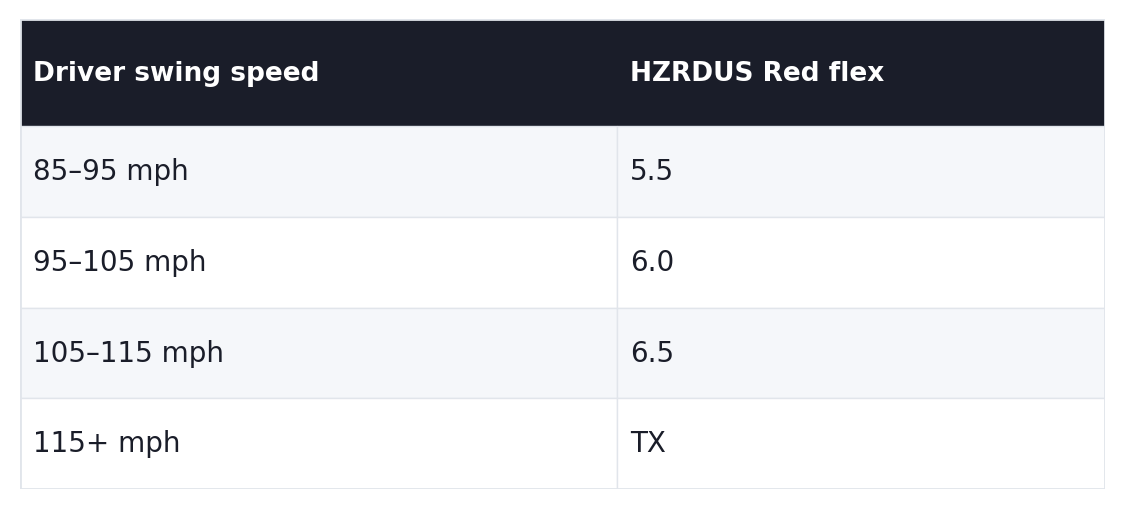
Project X EvenFlow & Riptide (driver, mid-forgiving)
Every EvenFlow line — Riptide, Blue, Black and T1100 White — is charted by launch, weight and torque in the Project X EvenFlow shaft chart, including what replaces it now the line is discontinued.
EvenFlow uses a constant bend profile across the full shaft — you load the whole thing rather than just the tip. Good for smoother tempos. Riptide is similar but counter-balanced for lighter swing weights.
The flex-to-swing-speed mapping tracks the master chart above, but default down a half-flex versus HZRDUS Black because these shafts feel softer through the swing.
⚖️ Comparing across brands?
Use our free Shaft Flex Calculator to translate any swing speed into a flex band, then come back here for the Project X-specific adjustments. Or browse our broader Swing Speed → Shaft Flex Chart covering all major shaft brands.
Project X vs other brands at the same flex
Here's the shortcut version of "how does Project X compare to what I'm playing now":
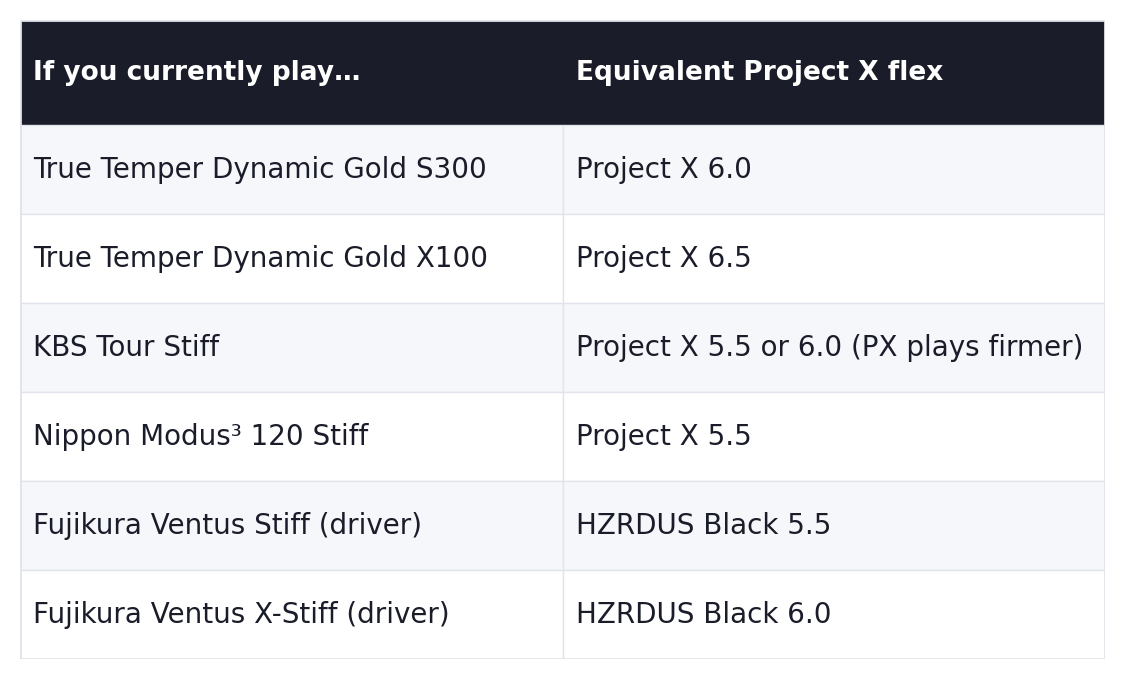
These equivalences hold for roughly 80% of players. Swing tempo, transition, and typical miss will shift the answer — which is why a proper fitting will always beat a table.
What swing speed alone doesn't tell you
Swing speed is the single biggest input to flex selection, but it's not the only one. Two 100-mph players can need different Project X flexes if their tempos differ:
- A 100-mph player with a quick transition may overload a 5.5 — stay at 6.0 or firmer.
- A 100-mph player with a smooth tempo may find 6.0 too stiff to compress properly — 5.5 or even 5.5-soft-stepped may play better.
- A 100-mph player who fades the ball gets different help from shaft torque than a 100-mph player who draws it.
Our free Swing Speed → Shaft Flex Calculator takes care of the swing-speed math instantly. If you add your email, the free AI layer factors in tempo, typical miss, and handicap for a personalized read. Runs in under a minute, no account required.
🏌️ One shaft is one piece of a 14-club puzzle.
Project X flex is one of 6 fit dimensions across 14 clubs. Grade My Bag grades all of them — flex, weight, length, lie, loft gapping, alignment. Free, ~3 minutes, no fitting fee. Grade my bag free →
🎯 Want the full picture?
See our guide to free golf club fitting tools — check your flex, weight and length, then grade your whole bag free, no launch monitor. See the free tools →
Frequently asked questions
What does Project X 6.0 mean?
Project X 6.0 is the Project X numeric code for Stiff flex. It's their equivalent to "S" in the letter-flex system used by most other shaft brands. In steel iron shafts, 6.0 typically weighs 110–120g and is designed for players with driver swing speeds in the 95–105 mph range.
What swing speed do you need for a Project X 6.0?
A Project X 6.0 is typically recommended for driver swing speeds between 95 and 105 mph — the standard "Stiff" range. That said, Project X plays slightly firmer than the stated flex, so players on the lower end of that range (95 mph with smooth tempo) may be better off in a 5.5.
Is Project X 6.0 stiffer than a True Temper Dynamic Gold S300?
Roughly comparable. Both are "Stiff" flex steel iron shafts, and both are well-regarded tour-played shafts. Project X 6.0 has a slightly lower kick point and often feels a touch firmer through the transition, while Dynamic Gold S300 has a more traditional, classic steel feel. The S300 weighs 130g versus the Project X 6.0's 120g — a meaningful difference.
What's the difference between Project X and Project X LZ?
Same numeric flex system, same weight progression, same swing-speed bands — but Project X LZ has a more active tip section ("Loading Zone") that produces a slightly higher ball flight and more feel in the short irons. The original Project X steel is lower-launching and feels more muted. Players who want control pick the standard; players who want feel pick LZ.
Does Project X come in graphite?
Yes — the HZRDUS family (Black, Red, Yellow, Smoke) and the EvenFlow and Riptide lines are all Project X graphite shafts, used primarily in drivers, fairways, and hybrids. The numeric flex system carries over: 5.5 = Regular, 6.0 = Stiff, 6.5 = X-Stiff, TX = Tour X.
Related reading
- Swing Speed → Shaft Flex Chart (all major brands) — The non-Project-X version. Use this to compare Project X to letter-flex shafts from KBS, Nippon, Fujikura, and more.
- Golf Club Distance Chart — What your swing speed means in carry distance, club by club.
- Stiff vs Regular Flex: Which Do You Actually Need? — How to navigate the gray zones between flex categories.
- Golf Shaft Weight Guide — Project X iron shafts run heavier than market average. This guide covers why weight matters as much as flex.
- How to Know What Flex You Need — Let your favorite club reveal your real flex.
- How Do I Know If My Golf Clubs Fit Me? — Signs your current shafts do not fit.
- How to Build Your Digital Golf Bag — Every club's shaft specs tracked in one place — the 5-minute setup behind your fit grade.
- Project X Shaft Weights & Specs Chart — Every gram figure by flex and model: PX 113–130g, LZ, IO, and LS compared.
- HZRDUS Shaft Chart: Every Model — The full graphite wood family sorted by launch, spin, and weight.
- Dynamic Gold Shaft Chart — The other tour staple decoded: why S200/S300/S400 are the same flex.
- Golf Club Length by Height — Flex matches your swing; length and lie match your body. Find your ideal iron length from your height and wrist-to-floor.
- KBS Shaft Chart — The main steel-iron alternative to Project X — Tour, C-Taper and $-Taper by weight and flex.
- Nippon Modus & N.S. Pro Shaft Chart — How Modus 120 compares to a PX 6.0 on weight, feel and flight.
On a computer? You can also grade your bag in your browser — no app to install.
Wondering whether your Project X shaft actually fits the rest of your bag? Grade every club with the FitMyGolfClubs app across eight professional fitting factors — no launch monitor needed.
Related reading
- Golf Club Fitting Chart — Length and lie by height, flex by swing speed, and every chart we publish in one place.
- Project X Titan Shaft Chart — flex by swing speed for the Titan line.
- Project X Denali Shaft Chart — The current premium wood line: Blue, Black and Red by weight and flex code, and what FROST changes.
- Project X Cypher Shaft Chart — The ultralight 40–70g graphite line, where the weight number and the flex code move together.
Related Articles
Golf Club Fitting
October 23, 2026
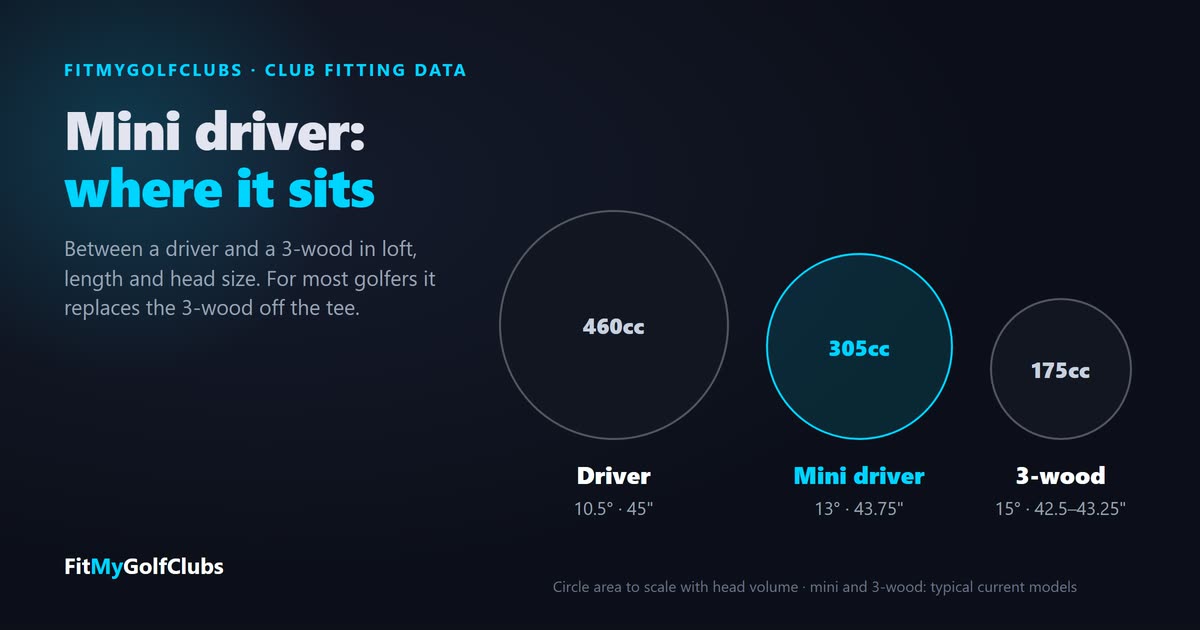
Mini Driver: Lofts, Lengths and Specs by Brand, vs a 3-Wood
What a mini driver is, every current model's loft, length and head size, how it compares with a driver and a 3-wood, and whether your bag has room for one.

Golf Club Fitting
October 23, 2026
Fairway Wood vs Hybrid: Lofts, Distances, Iron Equivalents
7-wood or 4-hybrid? 5-wood or 3-hybrid? Real lofts and distances for every fairway wood and hybrid, and what 263 graded golf bags actually carry.

Golf Club Fitting
October 22, 2026
FitMyGolfClubs Launches an AI-Guided Live Demo for Golf Pros and Club Fitters
Try the pro side of FitMyGolfClubs with no account: an AI assistant walks you through a sample pro account by voice, 15 or 30 minutes, from one link.


© 2026 FitMyGolfClubs. All rights reserved. | Patent Pending
Contact: sean@fitmygolfclubs.com