
Golf Club Fitting
April 13, 2026
Most golfers obsess over shaft flex. Stiff or regular? It's the first question everyone asks.
Shaft Weight Calculator
FREE — NO SIGNUPEnter your driver swing speed — get your driver and iron gram ranges instantly.
Don’t know your speed? A typical male amateur is 85–95 mph; 200-yd carry ≈ 90 mph.
But here's what experienced fitters know: shaft weight has a bigger impact on your consistency than flex does.
The wrong weight creates timing problems that no swing change can fix. Too light and you lose control on the back nine. Too heavy and you're leaving distance on the table — grinding through 18 holes when the club should be doing the work.
This guide gives you clear shaft weight guidelines for every club in your bag, explains how weight affects your swing, and helps you figure out if the shafts you're playing right now are actually right for you.
Golf Shaft Weight Chart: Driver & Irons at a Glance
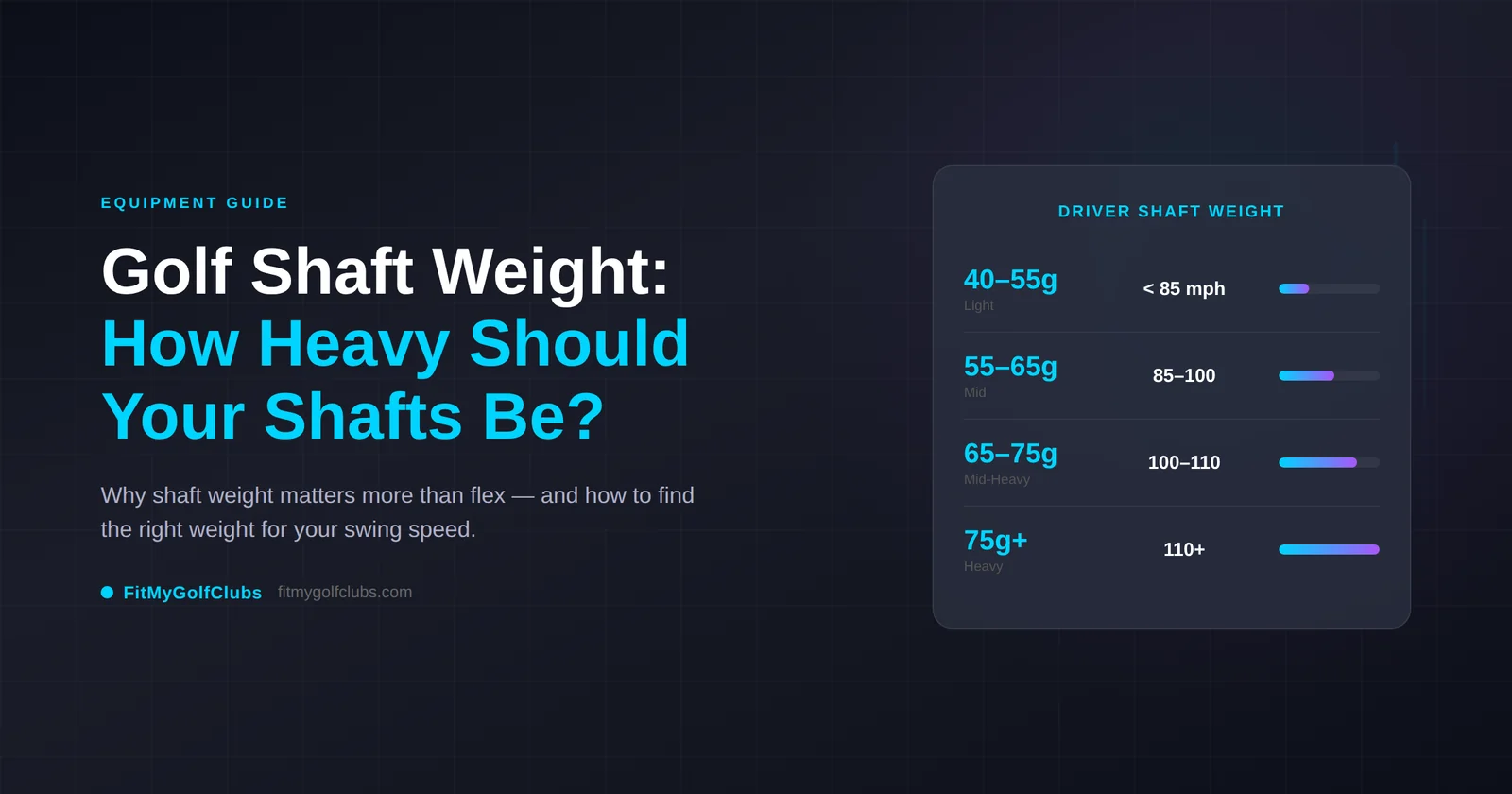
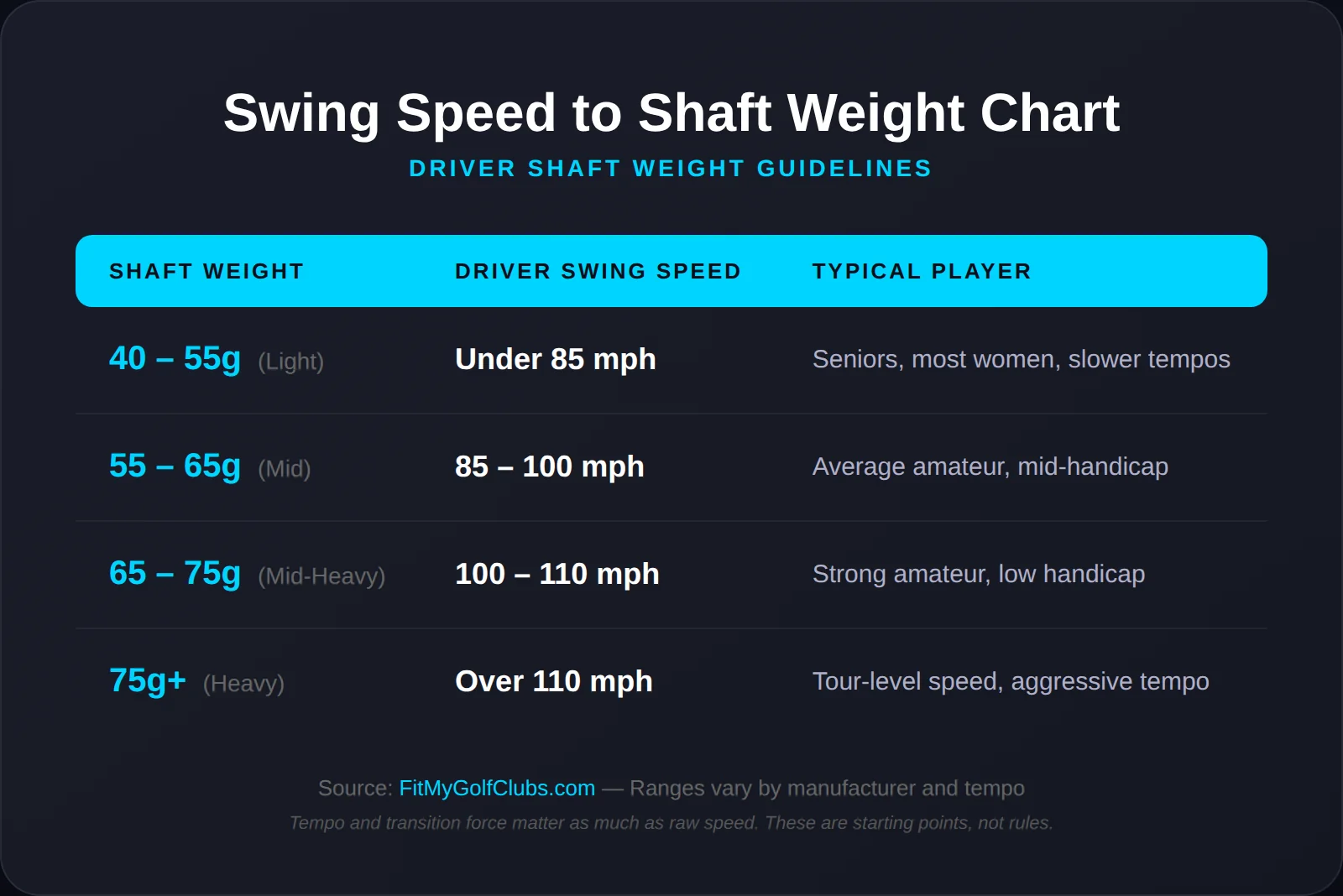
Match shaft weight to swing speed. Driver shafts run 40–80g+: under 85 mph fits 40–55g, 85–100 mph fits 55–65g, 100–110 mph fits 65–75g, and over 110 mph fits 75g+. Iron shafts run 55–130g, matched to your 7-iron speed below.
Driver shaft weight by swing speed
Iron shaft weight by 7-iron swing speed
⚡ Skip the chart lookup.
Plug your driver swing speed into our free Shaft Weight Calculator and get a personalized gram range in 10 seconds. Try it free →
Why Shaft Weight Matters More Than You Think
Shaft flex gets all the attention because manufacturers print it on the club. You can see "Stiff" or "Regular" without looking anything up. Weight? You'd need a gram scale.
But weight directly controls three things that determine how consistent you are:
Swing tempo. A shaft that's too light lets your hands get ahead of the club, creating an inconsistent release point. A shaft that's too heavy forces you to muscle the club, which destroys your natural rhythm. The right weight lets you swing at your tempo without fighting the club.
Energy transfer. Heavier shafts load more energy in the downswing and deliver it more consistently to the ball. Lighter shafts can increase speed but at the cost of stability. There's a sweet spot for every golfer where you're maximizing speed without sacrificing control.
Fatigue over 18 holes. This is the one nobody talks about. A shaft might feel great on the range for 20 balls. But by hole 14, that extra 10 grams in every club adds up. If your clubs feel heavier on the back nine than the front, your shafts might be too heavy for your fitness level and swing speed.
🎯 Find your weight range now.
Don't guess from a static chart. Our Swing Speed → Shaft Weight tool factors in your transition force and feel preference for a real range — driver and irons. Get my range →
Driver Shaft Weight Chart
Driver shafts are graphite and typically range from 40 to 80+ grams. Here's a general guide based on your driver swing speed:
Want an interactive version? Our free Swing Speed → Shaft Weight Calculator gives you an exact weight range based on your driver speed.
A few things to keep in mind:
Tour pros average 65–75g driver shafts. Not 50g. The "lighter is better" marketing pitch works for 5-shot demo sessions at the golf store, but most tour players actually play heavier shafts than the average amateur because they value control over raw speed.
Stock shafts are usually 50–60g. Manufacturers default to lighter shafts because they test well in demos — golfers swing faster, hit it farther, buy the clubs. But over 18 holes, many players would be more consistent with a heavier option.
The overlap zones matter. If you swing 95 mph, you could play anywhere from 55g to 70g depending on your tempo and transition force. A player with an aggressive, fast transition often needs more weight than their swing speed alone would suggest.
Iron Shaft Weight Guide: Steel vs. Graphite
Iron shafts come in two materials with very different weight ranges. Steel shafts typically run 85–130g. Graphite iron shafts run 55–85g.
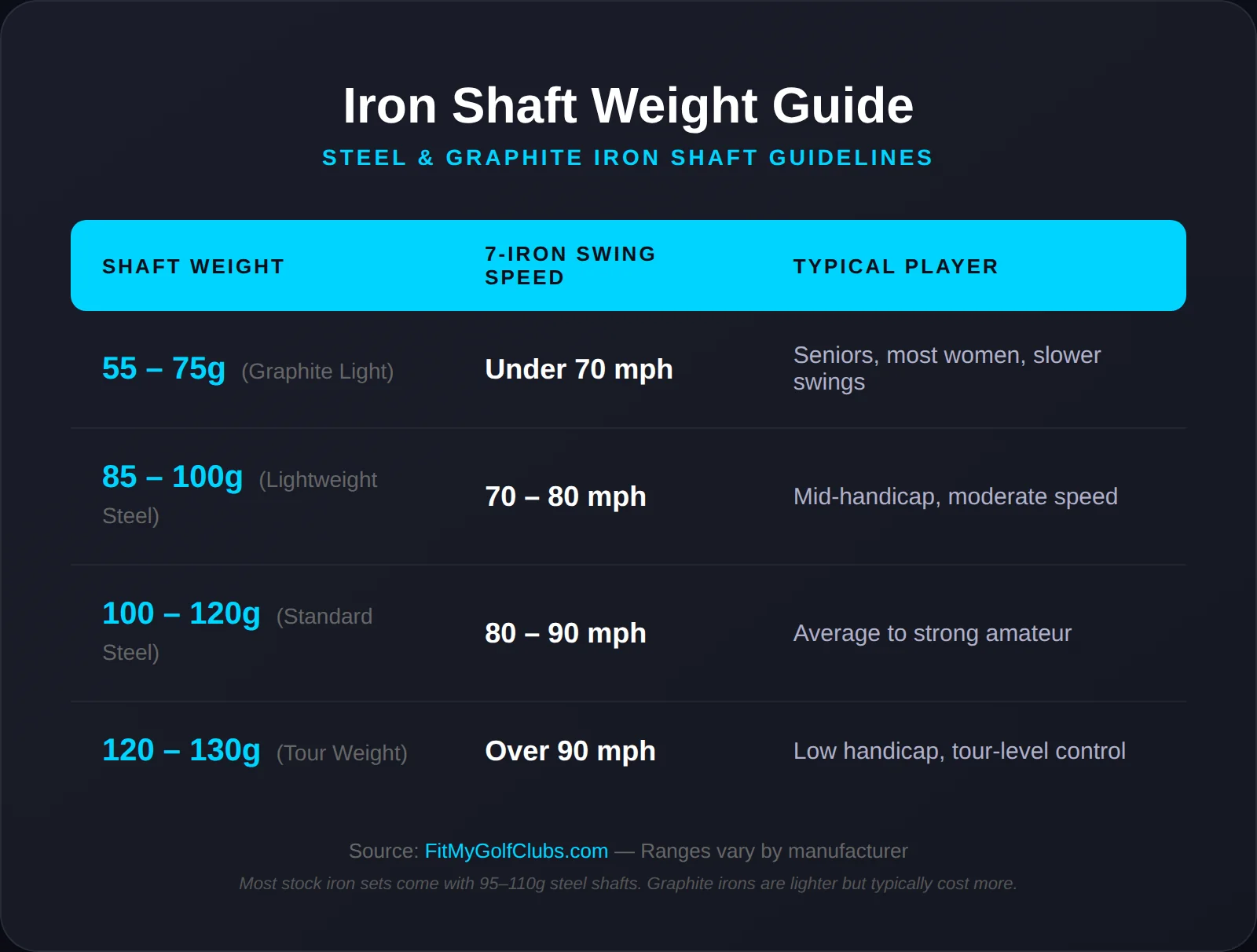
Most stock iron sets ship with 95–110g steel shafts. This is the "safe middle" that works for the widest range of golfers. But if your swing speed is under 75 mph or over 95 mph, you're probably not in the right weight class.
Graphite iron shafts aren't just for seniors anymore. Modern graphite shafts in the 75–85g range offer excellent stability while reducing fatigue. If you play 36 holes in a day or your iron accuracy drops off significantly on the back nine, lighter graphite could help without sacrificing control.
Steel vs. graphite isn't a skill question. It's a weight and feel question. Tour pros have played graphite iron shafts. Beginners play steel. The right choice depends on your swing speed, desired feel, and how many holes you typically play.
🏌️ One number tells you nothing about your bag.
Weight is one of 8 fit factors. Grade My Bag analyzes all 14 clubs across all 8 — including the progression problem we cover next. Free, no launch monitor, no fitting fee. Grade my bag free →
The Weight Progression Problem
Here's where shaft weight gets really interesting — and where most golfers have issues they don't know about.
Your shaft weights should increase progressively from driver through wedges. A typical well-fitted bag might look like this:
- Driver: 65g
- 3-Wood: 75g
- Hybrid: 85g
- Irons: 105g (steel)
- Wedges: 120g (steel)
Each step up in weight is smooth and gradual. Your body adapts naturally from one club to the next, maintaining consistent tempo throughout the bag.
Now here's what actually happens in most amateur bags:
- Driver: 50g (stock lightweight shaft)
- 3-Wood: 85g (completely different brand/shaft)
- Hybrid: 60g (graphite, lighter than driver)
- Irons: 120g (standard steel — 60g jump from hybrid)
- Wedges: 130g
See the problem? There are massive jumps, backwards progressions, and weight gaps that create tempo inconsistencies between clubs. You might hit your driver great, then struggle with your 3-wood, and wonder why your hybrid feels completely different from everything else.
This is one of the 8 factors FitMyGolfClubs analyzes when grading your bag. Weight progression is rarely the single weakest link — the weakest factor in just 6% of bags in our data — but when it's off, it's one of the easiest problems to fix. (The most common fitting-spec weakness across 230+ graded amateur bags is loft gapping — see the data.)
5 Signs Your Shaft Weight Is Wrong
Not sure if your current shaft weight is right? Here are five symptoms to watch for:
1. You're inconsistent with one specific club. If you hit 12 clubs great but one club always feels "off," the shaft weight is the most likely culprit — especially if it's a different brand or was purchased separately from the rest of the set.
2. Your accuracy drops on the back nine. If your first 9 holes are solid but you lose control late in the round, your shafts may be heavier than your body can sustain for 18 holes. This is particularly common with players using 120g+ steel iron shafts who don't have the fitness or swing speed to support that weight.
3. You "choke down" on certain clubs. When golfers unconsciously grip down an inch or two, they're often compensating for a club that's too heavy. The choked grip shortens the lever arm and makes the club feel lighter. Your body is telling you something — listen to it.
4. Your tempo changes between clubs. If you have a smooth, controlled driver swing but suddenly get quick and handsy with your irons, the weight difference between your woods and irons is probably too large. A 60g jump from hybrid to irons creates a completely different feel.
5. You hit your old clubs better than your new ones. This happens more often than you'd think. New clubs come with stock shafts in a "default" weight. If your old clubs had shafts that happened to be closer to your ideal weight, the upgrade actually made things worse — even if the club heads are better.
🔍 Have one club that always feels off?
Drop its specs into our Single-Club Fit Grader and get an AI fit grade for that one club — shaft weight, flex, length, and lie all checked at once. Grade one club →
How to Find Your Ideal Shaft Weight
Shaft weight and swing speed go hand in hand — if you don’t know your club head speed yet, start with our golf swing speed chart to find your number and the flex that goes with it. Then check the golf club distance chart to see how far every club should go at that speed.
You don't need a $400 fitting to evaluate your shaft weights. Here's a practical approach:
Step 1: Check what you're currently playing. Look at the shaft on each club. Most shafts have the weight printed on them (e.g., "Ventus Blue 6S 65g" or "KBS Tour 120"). Write down the weight for every club in your bag. If a club has been reshafted or bent since it left the factory, log its real specs — the printed number no longer applies.
Step 2: Check the progression. Do your weights increase smoothly from driver to wedges? Any backwards jumps (lighter shafts in longer clubs)? Any huge gaps (30g+ between adjacent clubs)?
Step 3: Compare to the charts above. Based on your swing speed, are you in the right weight range? Most common issue: golfers playing shafts that are too light in their driver and too heavy in their irons.
Step 4: Test at a demo day. Manufacturer demo days are free and let you hit clubs with different shaft weights on a launch monitor. Hit 10 shots with your current weight and 10 with one weight class up or down. Track carry distance AND dispersion — don't just chase distance.
For a deeper self-assessment, our guide on how to fit your golf clubs at home walks through the full DIY process, including shaft evaluation.
⚖️ Weight is half the equation. Flex is the other half.
Run your speed through our Shaft Flex Calculator too — weight + flex together is what actually defines your shaft fit. Check my flex →
How Weight and Flex Work Together
Shaft weight and flex are related but measure different things. Flex is about how much the shaft bends. Weight is about how heavy it is. Both affect your swing, but they interact in ways that matter:
A heavier shaft in the same flex will play stiffer. If you switch from a 55g Stiff shaft to a 75g Stiff shaft, the heavier shaft will feel noticeably firmer even though both say "Stiff" on the label. The extra mass resists bending more.
This is why flex alone doesn't tell the whole story. Two "Stiff" shafts from different manufacturers can weigh 20g apart and play completely differently. When someone says "I need Stiff flex," that's only half the equation. Stiff in what weight?
This effect is especially extreme with certain shaft families — Project X shafts, for example, play firmer than their flex label suggests because of how weight and stiffness profile combine.
If you're not sure what flex you need, our swing speed to shaft flex chart gives you a starting point. And our guide on stiff vs. regular flex breaks down the differences in detail. When you're ready to dial in both specs together, our golf shaft fitting guide covers what a fitting measures, what it costs, and how to do it free online.
Weight and flex are the two shaft specs your swing sets. Your body sets two more — club length and lie angle. If you’ve never checked those, start with our golf club length by height chart.
The Bottom Line
Shaft weight is one of the most overlooked equipment variables in golf. The wrong weight creates timing and consistency problems that lessons can't fix. The right weight lets your natural swing do the work.
Start by checking what you're playing now. Compare it to the charts in this guide. If your weights are wildly different from the guidelines for your swing speed — or if your weight progression has big jumps and backwards steps — that's a likely source of inconsistency in your game.
The most expensive mistake in golf isn't buying the wrong clubs. It's not knowing what's wrong with the clubs you already have.
Stop guessing. Get the full picture.
FitMyGolfClubs grades all 14 clubs across 8 professional fit factors — including weight progression. No fitting appointment, no launch monitor required.
🎯 Want the full picture?
See our guide to free golf club fitting tools — check your flex, weight and length, then grade your whole bag free, no launch monitor. See the free tools →
Frequently asked questions
What shaft weight should I use for my driver?
Most golfers fit between 50 and 80 grams. A rough guide by driver swing speed: under 85 mph suits 50-60g, 85-100 mph suits 60-70g, and 100+ mph suits 70g or heavier. Tour players average 65-75g — heavier than the 50g stock shafts most amateurs are sold — because added weight improves control and consistency over 18 holes.
Does shaft weight matter more than flex?
For consistency, often yes. Flex controls how much the shaft bends; weight controls tempo, timing, and how the club feels through the swing. The wrong weight creates timing problems no swing change can fix, and two shafts of the same flex can weigh 20g apart and play completely differently.
How heavy should my iron shafts be?
Steel iron shafts typically run 85-130g and graphite iron shafts 55-85g. Most stock sets ship with 95-110g steel. If your swing speed is under 75 mph or your accuracy fades on the back nine, lighter graphite in the 75-85g range can help; faster, aggressive swingers usually want the heavier end.
What is shaft weight progression and why does it matter?
Your shaft weights should increase gradually from the driver (lightest) through the wedges (heaviest). Big jumps or backwards steps — like a 50g driver next to an 85g 3-wood — disrupt tempo between clubs, and most golfers never notice them.
Related reading
- Project X Shaft Flex by Swing Speed: The Complete 2026 Chart — Exact PX flex by swing speed for irons (LZ, IO, Red) and drivers (HZRDUS Black, Red, Smoke).
- Swing Speed to Shaft Flex Chart — Pair this weight guide with our flex chart for a complete shaft fit picture.
- Golf Shaft Fitting: What It Costs & How to Do It Free Online — What a fitting measures, 2026 prices, and the free DIY route.
- Golf Club Distance Chart: How Far Should You Hit Each Club — Average distances for every club, by swing speed, skill level, and age.
- Golf Ball Compression Chart — The same swing speed that sets your shaft weight also picks your ball compression.
- Golf Club Length Chart — Standard lengths for every club, driver to wedge, and when to go longer or shorter.
- Golf Club Replacement Frequency — Wedges every 2-3 years, drivers 3-5, irons 5-10. When to upgrade each club in your bag.
- How Do I Know If My Golf Clubs Fit Me? — 7 warning signs your gear does not match your swing.
- How Much Does Golf Club Fitting Cost? — What a shaft/full fitting runs — and a cheaper way.
- How to Build Your Digital Golf Bag — Every club's shaft weight, flex, and length tracked in one place — the 5-minute setup behind your fit grade.
- KBS Shaft Chart — The steel line where weight rises with flex — Tour R 110g through X 130g, with R+ and S+ in between.
- Nippon Modus & N.S. Pro Shaft Chart — Modus 105 / 120 / 130 by weight and flex, plus the 950GH lightweight-steel benchmark.
- UST Mamiya Shaft Chart — What a 68g Recoil does to a set built for 120g steel — and the F1–F5 flex system decoded.
On a computer? You can also grade your bag in your browser — no app to install.
Want your shaft weights checked automatically — for all 14 clubs, alongside seven other fitting factors? Grade your bag with the FitMyGolfClubs app — free to start, no launch monitor required.
Related reading
- Golf Club Fitting Chart — Length and lie by height, flex by swing speed, and every chart we publish in one place.
- Dynamic Gold Shaft Chart — the classic iron shaft, by weight and flex.
- KBS Tour Lite Shaft Chart — Lightweight steel at 95–105g — the middle option before leaving steel altogether.
- SteelFiber Shaft Chart — Composite iron shafts from 55g to 125g with torque figures closer to steel than to graphite.
- AutoFlex Shaft Chart — The 39–57g driver shaft sold by swing speed instead of flex letter, both series side by side.
- Newton Shaft Chart — Motion vs. Fast Motion: a standard-weight and a lightweight driver shaft in the same Dots, checked against the weight bands on this page.
- Graphite vs Steel Shafts — Real iron shaft weights and prices, and which to play by swing speed.
- PING Alta CB Shaft Chart — Weight and launch for every ALTA CB flex, and which PING clubs they come in.
- Swing Weight Chart — The swingweight scale, stock swingweights by club and brand, and what changes them.
- 7 Iron Swing Speed Chart — Iron shaft weight by 7-iron speed, tour 7-iron averages, and 7-iron carry by speed.
Related Articles
Golf Club Fitting
October 8, 2026
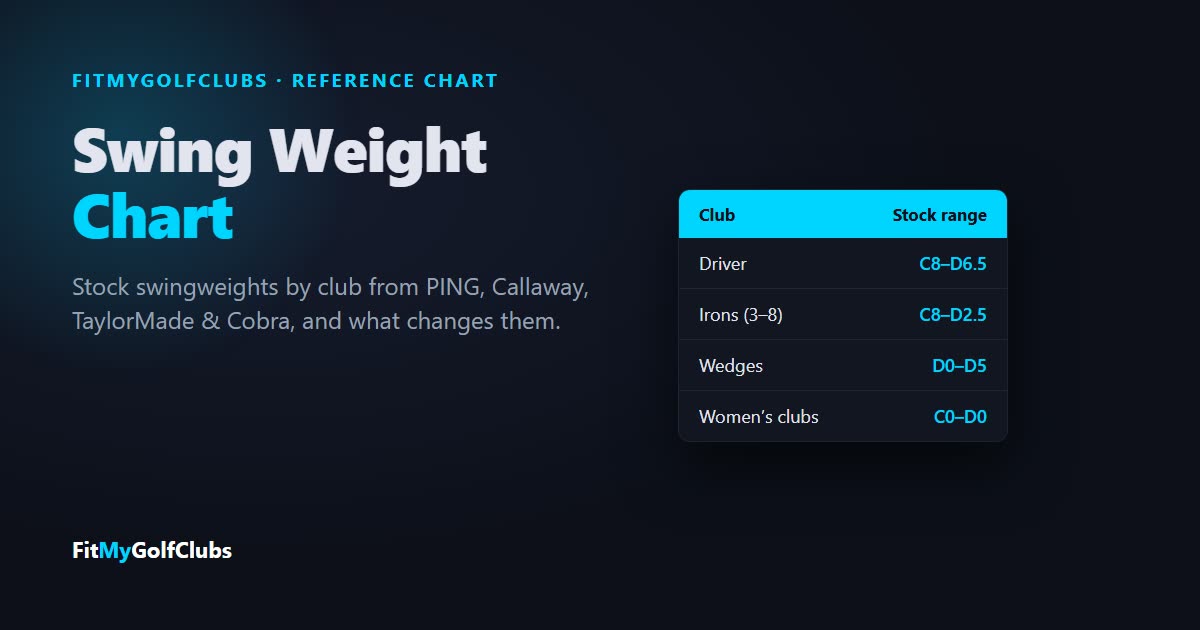
Swing Weight Chart: Standard Swingweights by Club and Brand
Swing weight chart: the A0–G9 scale, stock swingweights for drivers, irons and wedges from PING, Callaway, TaylorMade and Cobra, and what changes them.
Golf Club Fitting
October 8, 2026
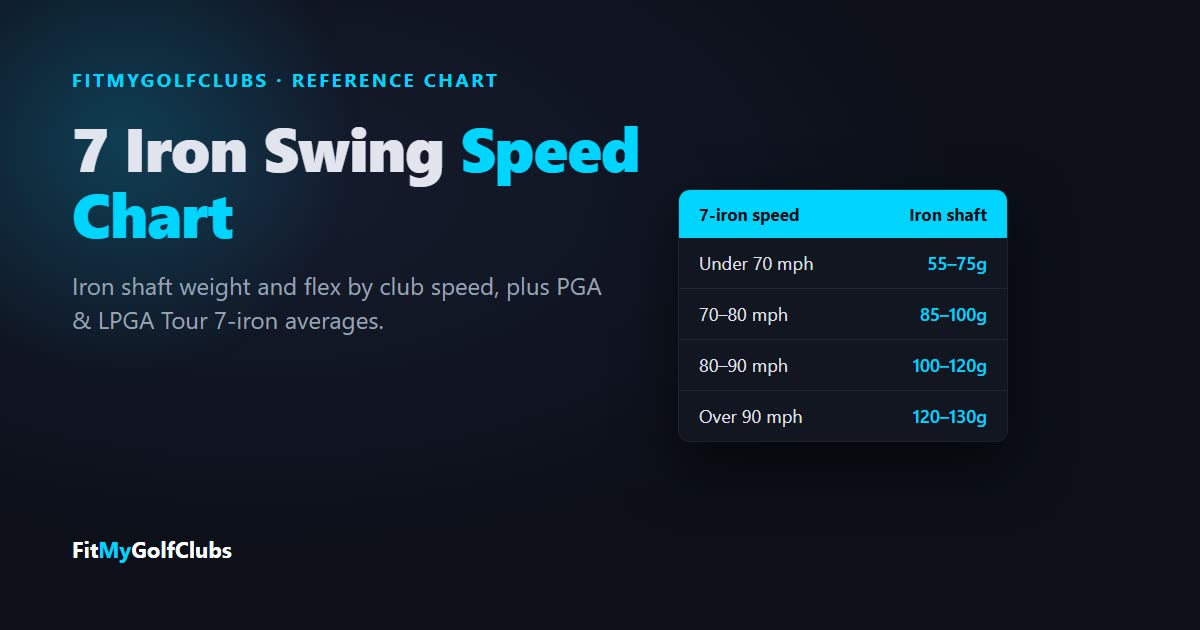
7 Iron Swing Speed Chart: Iron Shaft Weight, Flex & Carry
7 iron swing speed chart: iron shaft weight and flex by club speed, PGA (92 mph) and LPGA (78 mph) Tour averages, and 7-iron carry by speed.
Golf Club Fitting
October 8, 2026
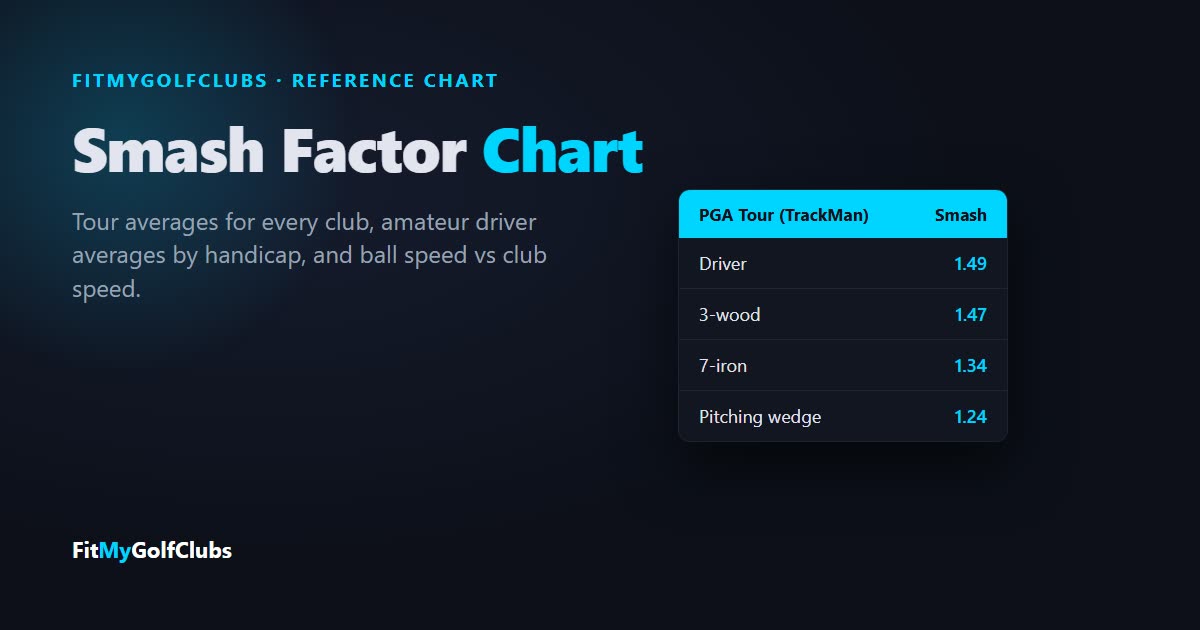
Smash Factor Chart: Tour Averages by Club + Ball Speed
Smash factor chart by club from TrackMan PGA and LPGA Tour averages, amateur driver averages by handicap, and a club speed to ball speed table.


© 2026 FitMyGolfClubs. All rights reserved. | Patent Pending
Contact: sean@fitmygolfclubs.com