

Golf Club Fitting
July 30, 2026
What Five Club Fittings and $4,600 Taught Me About Golf Equipment
In 2020 I went to a club fitter hoping to salvage the bag I already had. I walked out having bought all of it — about $3,000 worth. Pandemic delays meant the clubs didn't actually arrive until late 2021. So for the better part of a year I was a golfer who owned two bags: the one I played, and the one I'd been told I should be playing.
I want to be clear about something up front, because this isn't that kind of story: the fitting wasn't wrong.
What the fitting got right
The physics was real, and it was thorough. Shaft weight matched to my swing. Flex and bend point progression through the set. Loft gapping so no two clubs did the same job. Length worked out from wrist-to-floor measurements. He watched me hit my favorite club and built outward from it. He even measured my hands for grip size.
Every one of those variables is a real thing that real fitters check, and getting them right genuinely matters. The process works. Anyone who tells you club fitting is a scam hasn't paid attention to what's being measured.
What I never got
Here's what I couldn't have done on the drive home: explained why any of those specific clubs were mine. I knew the fitting had happened. I couldn't have told you what the reasoning was, which specs were load-bearing, or what would change if my swing changed. I trusted the guy, and I bought.
That's the gap. A fitting is a one-off event, and the reasoning walks out the door with the fitter. You're left holding the conclusion — several thousand dollars of conclusion — with no way to inspect the argument.
Five years later, same room
In 2025 I went back. Same fitter, same process, now at a national chain, and prices had gone up. This time I could only afford three hybrids: about $1,600, roughly double retail, because they carried off-market custom shafts.
The interesting part is where the specs came from. He took the club I'd named as my favorite — a 75-gram stiff shaft in my 4-hybrid — and interpolated outward from it. If that club worked, the clubs around it should share its DNA. That's established professional practice, and it's smart.
Afterward, working it out with AI tools, I understood what had actually happened for the first time. And once I understood it, I could act on it: I sourced the same make and model of shaft myself for my 6- and 7-hybrids. Same specs as the ones from the chain. Then I bought the irons he'd proposed — his specs, unchanged — from my home club, for less.
Nothing shady occurred in that fitting bay. The information was simply knowable the whole time. It just hadn't been shared, because sharing it isn't how the business gets paid. A fitting is a diagnostic conversation that structurally has to end in a purchase — that's the model, and everyone inside it behaves reasonably. The golfer is the only one who leaves without the reasoning.
The demo day that bugged me for years
One more data point. At a brand demo day in Florida, I hit ten balls with my own driver and ten with one off the demo rack, back to back on the same launch monitor. The demo was noticeably longer.
I couldn't tell you why. I'd been fit for my driver — and I still didn't know enough to check what shaft was in the demo club. The spec that probably explained the whole gap was the one I had no way to see. That's what it means to own the conclusion without the argument.
Add a range session with my teaching pro on a swing-speed device, and a wedge fitting at my home club that put three wedges in my bag, and the tally comes to five fitting encounters, five years, about $4,600 — and at the end of it, no persistent, transparent picture of my own bag that I could inspect and understand. Nobody offers one.
Most golfers never even get this far
I got five fittings because I was curious and willing to spend. Most golfers get zero. They take the recommendation on faith when they do buy, and the rest of the time they play mismatched hand-me-downs and tell themselves they'll upgrade once they improve.
I raced skis at Keene State, Division 1, and that logic is exactly backwards. You'd never hand someone learning to race a pair of rentals with dull edges and tell them to get better first. Equipment isn't magic — golf is hard on any equipment — but it can stop making a hard game harder than it already is.
So I built the thing I couldn't buy
FitMyGolfClubs grades all 13 clubs in your bag — putter excluded, because we don't analyze putters — against eight professional fitting factors: loft gapping, weight progression, club age, length progression, lie angle, kickpoint consistency, shaft flex, and shaft torque. The same variables a fitter checks, applied to every club, consistently, and it shows its work. Every grade comes with the reasoning attached, which is the part I kept paying for and never receiving.
The methodology has been walked through with a working professional club fitter — including the favorite-club baseline that pros actually use, which is the subject of a pending patent. And it exists at all because I'm a solo founder who builds it with AI development tools like Claude Code; that's the only reason one person can run a product this size.
The honest boundary
FitMyGolfClubs does not measure ball flight, and it does not replace a fitting. There is no launch monitor in your phone and I won't pretend otherwise.
What it does is tell you what's actually wrong with your bag before you spend $150 to $3,000 — which clubs are working against you, which are fine, and why. Fittings run anywhere from free to $450+, and maybe knowing what's wrong saves you the purchase entirely. And if you then book a fitting, you'll walk in the way I never did: able to ask better questions, holding the argument instead of just waiting for the conclusion.
Five fittings and $4,600 taught me that the reasoning is the product. So that's what I built.
On a computer? You can also grade your bag in your browser — no app to install.
Related Articles
Golf Club Fitting
September 7, 2026
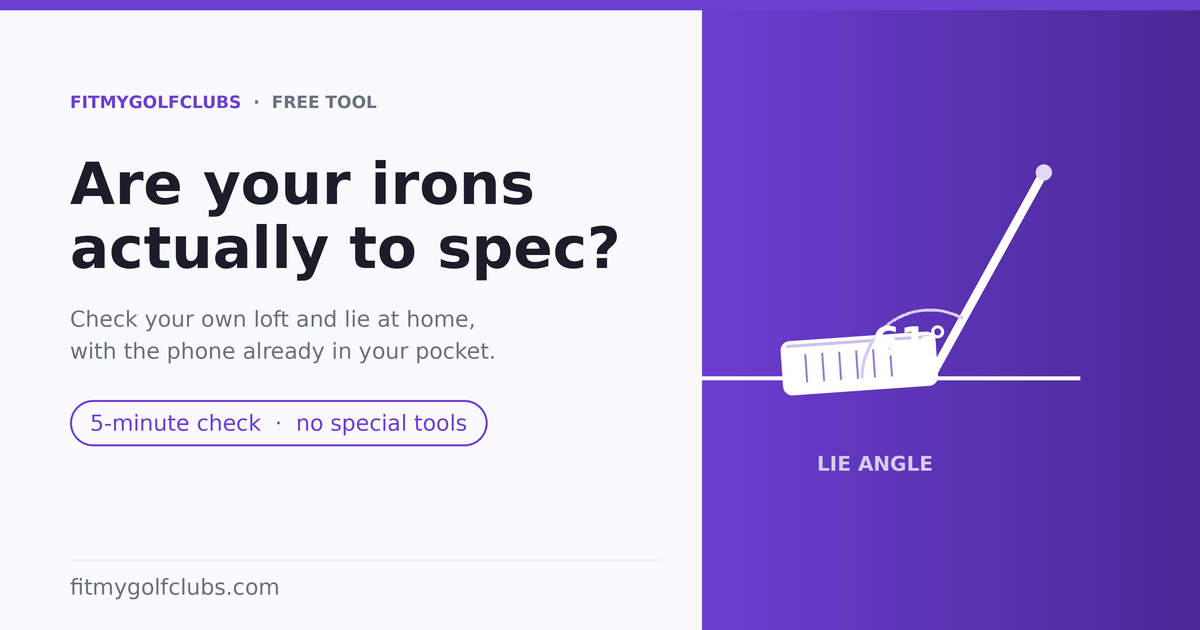
Golf Club Loft Chart + Lie Angle Chart: Check Your Own Free (2026)
Standard loft and lie for every club, driver to lob wedge — plus a free printable way to check your own clubs at home and grade them. No machine needed.

Golf Club Fitting
August 26, 2026
Golf Ball Comparison Chart: 65 Balls Across 19 Brands
Compare 65 golf balls across 19 brands in one chart — compression, swing-speed fit, price, greenside spin, and more. Tour urethane to bulk value, brand-agnostic.
Golf Club Fitting
August 26, 2026
Golf Ball Fitting: Free Tool + Chart to Find Your Ball by Swing Speed
Fit your golf ball in 30 seconds — free fitting tool + chart. The best ball for your swing speed (85, 90, 95, 100+ mph), spin, feel, and budget, with a link to buy.


© 2026 FitMyGolfClubs. All rights reserved. | Patent Pending
Contact: sean@fitmygolfclubs.com