

August 19, 2026
How long should your golf clubs be? Your ideal iron length and lie angle come from your wrist-to-floor measurement, not just your height. Taller golfers — and anyone with longer arms — need slightly longer, more upright irons; shorter golfers need shorter, flatter ones. Use the chart below to estimate, then measure your wrist-to-floor for a real fit.
Why height alone isn’t enough
Almost every “golf club length by height” chart online stops at your height. But two golfers who are both 6'0″ can need different clubs: one has long arms and stands closer to the ball, the other has a shorter reach. Height tells you part of the story — your arm length tells the rest.
That’s why fitters measure wrist-to-floor: the distance from the crease of your wrist to the ground while you stand naturally in flat shoes. It captures both your height and your reach in a single number, and it’s the standard static-fitting measurement used in every in-person fitting. The longer your wrist-to-floor, the longer and more upright your irons should be.
Golf club length by height chart
Use this as a starting estimate. It maps typical height to a wrist-to-floor range and the resulting iron length and lie versus standard. (Standard is roughly a 5'9″–6'0″ golfer.) Your measured wrist-to-floor refines these numbers — see how to measure it below.
Length and lie move together: when a club is built longer, it also plays more upright, so a real fit adjusts both at once.
Need the baseline standard length for every club, driver through lob wedge? See the standard golf club length chart.
How to measure your wrist-to-floor
- Stand up straight on a hard floor in flat shoes (or socks), arms hanging relaxed at your sides.
- Have someone measure from the crease of your wrist (where your hand meets your forearm) straight down to the floor.
- Take it twice and average. Most golfers measure between 29″ and 36″; the fitting baseline — an average-build 5'10″ golfer — is about 31½″.
That single number, plus your height, is enough to estimate your ideal iron length and lie for every club in the set.
Length and lie: the two specs your body sets
Length gets the attention, but lie angle is where the wrong fit quietly costs you strokes. Lie is the angle between the shaft and the ground at address. If it’s too upright for you, the toe sits up and shots pull left (for a right-handed golfer); too flat, the heel sits up and shots push right — even with a perfect swing. Your body geometry sets the right lie the same way it sets the right length, which is why a good fit always solves them together.
Club Length Calculator
FREE — NO SIGNUPYour height + wrist-to-floor measurement → recommended iron lengths (the same static fitting a shop does first).
Measure wrist-to-floor standing straight in flat shoes, arms relaxed — floor to the crease of your wrist. Leave it blank to estimate from height.
Get your personal length and lie — free
A chart gets you close. FitMyGolfClubs gets you exact. In the app’s profile you enter your height and wrist-to-floor, turn on Body Fit, and it computes your ideal length and lie for each iron from your measurements — then grades your current irons against your body instead of against generic standards.
When Body Fit is on, two of the eight fitting factors change: Length Fit and Lie Fit. Each club shows how far it sits from your personal ideal, with a specific target — for example, “your 7-iron plays ¾″ long and 1.5° too upright for your body.” You see exactly which irons to adjust and by how much, which is the difference between “my clubs feel off” and a concrete list you can hand a club-builder. (Shaft flex is another of the eight — the swing speed shaft flex chart covers that one.)
Body Fit currently grades irons (4-iron through pitching wedge), where static geometry is most reliable.
A starting point you can trust — and where it stops
Static body fitting is where every fitting begins, and for most golfers it’s the single biggest accuracy gain over playing standard clubs off the rack. It’s honest about its limits, though: a static measurement can’t see shaft droop, your posture at impact, or how you actually deliver the club. The last mile — your true dynamic lie at impact — is confirmed with a lie board or launch monitor. Body Fit gets you to the right starting point for free, so any in-person session starts from real numbers instead of a blank sheet.
▶ Watch: Body Fit re-grades a set of irons against the golfer’s body — lie drops from an A to an F, with the exact bend spec.
Frequently asked questions
How long should my golf clubs be?
For most golfers, standard length fits a height of about 5'9″ to 6'0″. Below that, irons are typically built ¼″ to 1″ shorter; above it, ½″ to 1″ longer. Your wrist-to-floor measurement refines the exact number — measure it and check the chart above.
What length golf clubs do I need for my height?
Use the chart above to find your height band, then adjust by your wrist-to-floor. A golfer around 5'6″ typically needs irons about ¼″ to ½″ shorter than standard and roughly 1° flat; a 6'2″ golfer typically needs about ½″ longer and 2° upright.
Is wrist-to-floor better than height for club fitting?
Yes. Height alone ignores arm length, so two golfers the same height can need different clubs. Wrist-to-floor captures both in one measurement, which is why fitters use it as the standard static input.
What lie angle do I need?
Your lie angle is set by the same body measurements as your length. Too upright pulls shots left, too flat pushes them right (for a right-handed golfer). A static body fit gives you your starting lie; a lie board or launch monitor verifies it under your real swing.
Can I fit my own golf clubs at home?
You can get most of the way there. Measure your wrist-to-floor, use a length-and-lie chart or the free FitMyGolfClubs app to get your personal targets, then have a club-builder bend or re-length to match. It’s the same static foundation an in-person fitting starts from. For the full process, see our guide to fitting your golf clubs at home, and for every other fitting chart in one place, our golf club fitting chart.
Related Articles
Golf Club Fitting
October 8, 2026
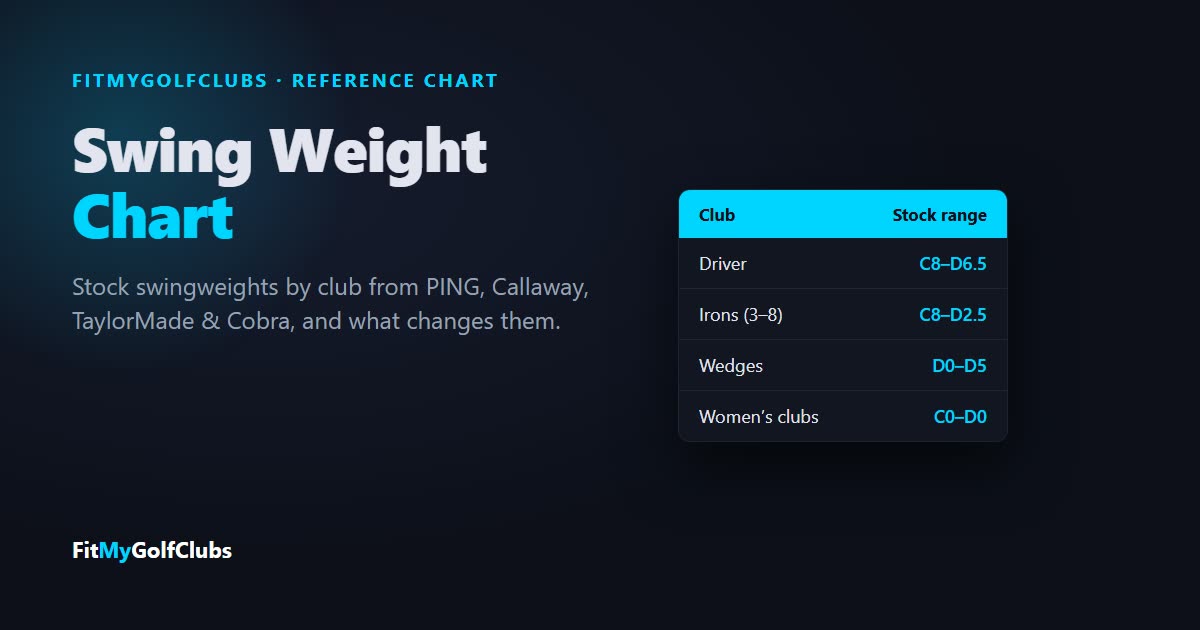
Swing Weight Chart: Standard Swingweights by Club and Brand
Swing weight chart: the A0–G9 scale, stock swingweights for drivers, irons and wedges from PING, Callaway, TaylorMade and Cobra, and what changes them.
Golf Club Fitting
October 8, 2026
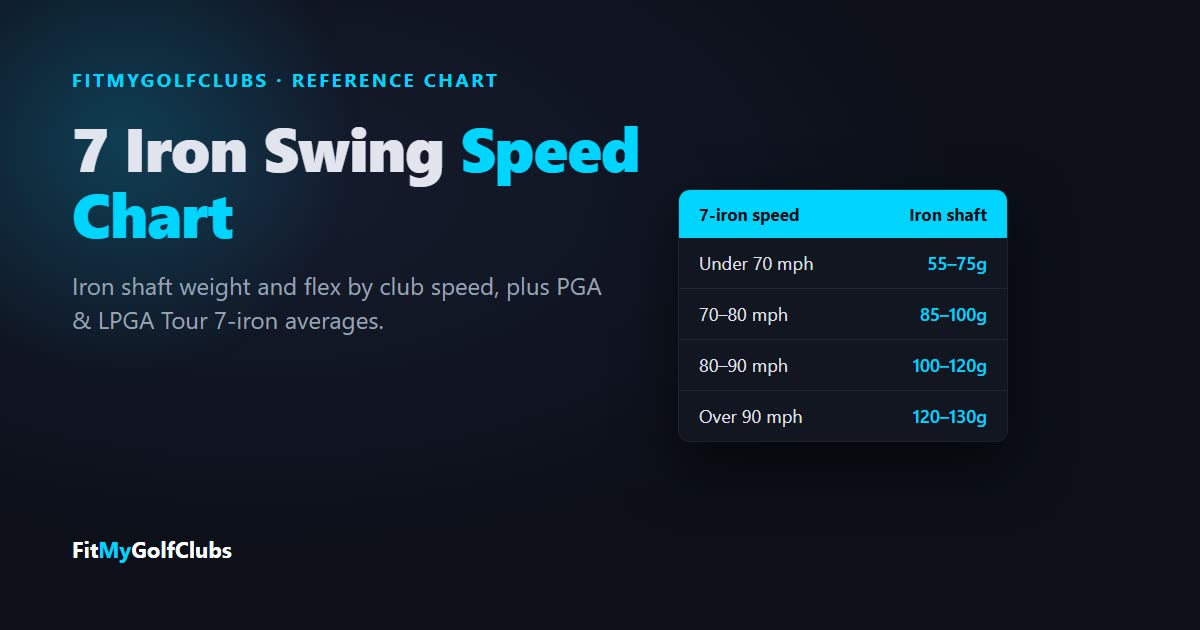
7 Iron Swing Speed Chart: Iron Shaft Weight, Flex & Carry
7 iron swing speed chart: iron shaft weight and flex by club speed, PGA (92 mph) and LPGA (78 mph) Tour averages, and 7-iron carry by speed.
Golf Club Fitting
October 8, 2026
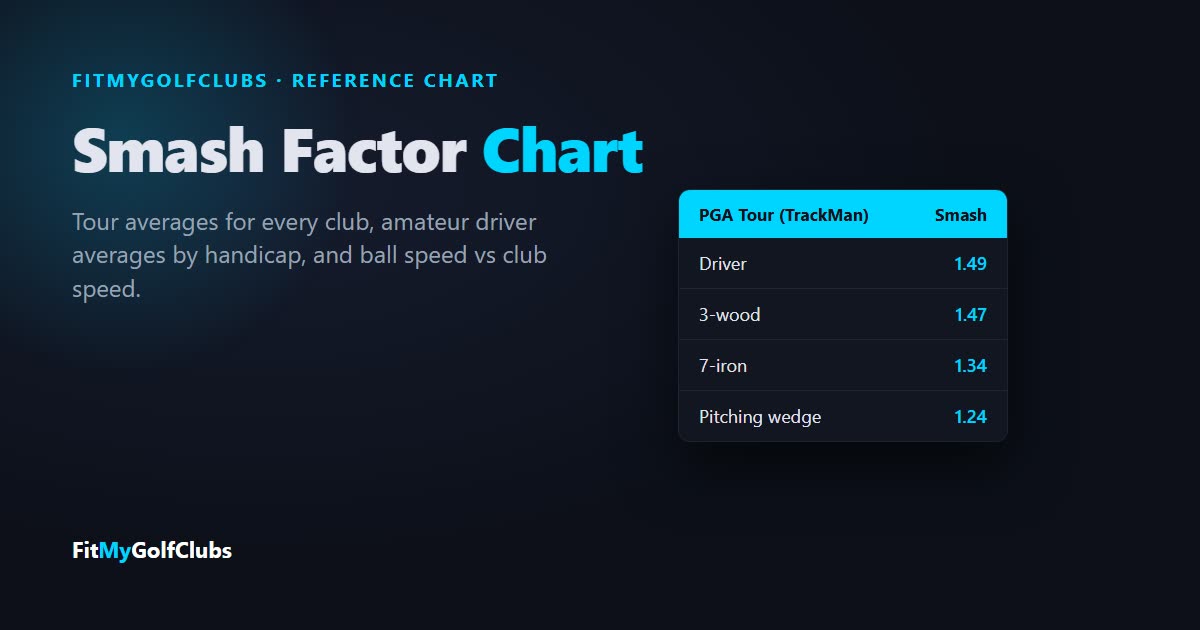
Smash Factor Chart: Tour Averages by Club + Ball Speed
Smash factor chart by club from TrackMan PGA and LPGA Tour averages, amateur driver averages by handicap, and a club speed to ball speed table.


© 2026 FitMyGolfClubs. All rights reserved. | Patent Pending
Contact: sean@fitmygolfclubs.com