
Golf Club Fitting
October 8, 2026
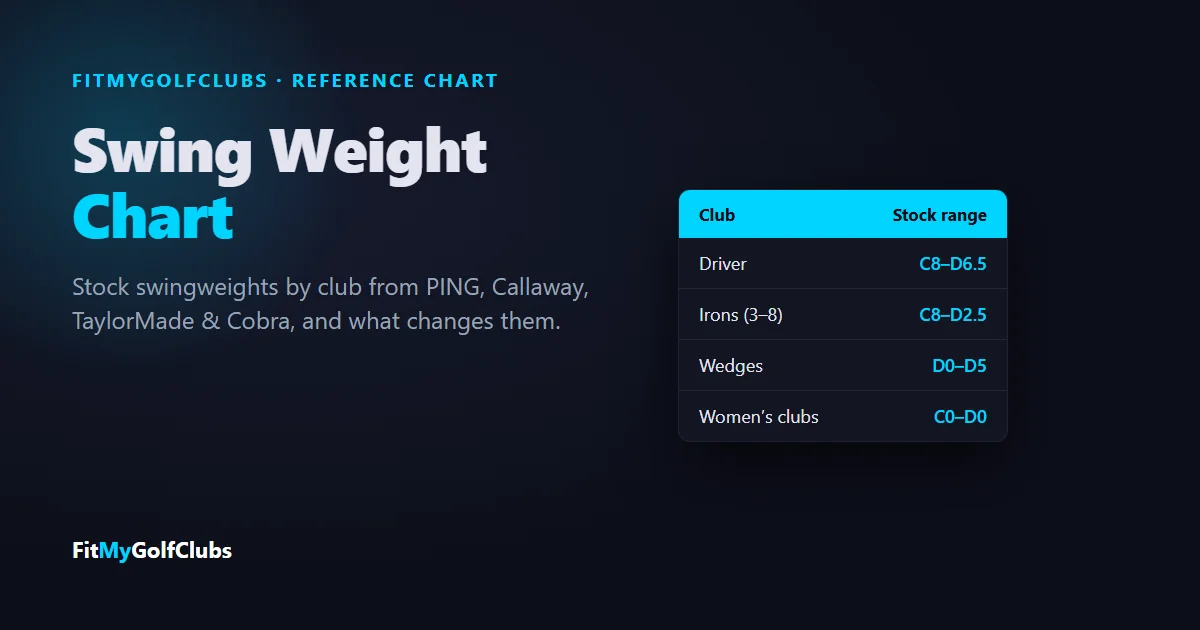
The quick answer: Swingweight is a letter-and-number reading of how heavy the head feels, measured on a scale with a 14-inch fulcrum. Each point is 1.75 inch-ounces. Of the 288 men’s stock specs we tallied from PING, Callaway, TaylorMade and Cobra, 94% sit between D0 and D5, and women’s clubs mostly between C0 and C6.
Drivers run from C8–D6.5 depending on the head and shaft, with D2 the most common. Irons sit lower and wedges higher: PING’s G440 is D0 through the 8-iron, D2 at the pitching wedge and D3 at the 56°. Length, head weight, grip weight and shaft weight all move the number. The full chart, by club and by brand, is below.
Swing Weight Chart by Club
Stock swingweights from the spec pages of PING, Callaway, TaylorMade and Cobra (men’s steel where both are offered). Every model is listed in the brand tables further down.
Titleist and Mizuno don’t print a swingweight in the iron spec tables we checked, so they aren’t in this chart.
The Swingweight Scale: A0 to G9
PXG puts it this way: “There are multiple swing weight ranges from A to G. Each range has 10 specific values within it, from 0 to 9. The lightest possible swing weight is A0 while the heaviest possible swing weight is G9.” In practice the scales clubmakers use stop sooner: Hireko’s conversion chart runs from A0 to F9, and The GolfWorks’ Auditor scale reads A0 to F5.
The reading comes from a scale with a 14-inch fulcrum. Hireko’s chart turns each reading into inch-ounces, and every point is the same step: “For each swing weight higher or lower there is a 1.75 in-oz. difference.”
Every stock swingweight in this post sits in the C or D band. Here is the D range in detail, from Hireko’s chart:
What a Swingweight Point Is
One point is a small change: about 2 grams at the head. Hireko’s numbers: “approximately 2g of head weight is one swing weight. It is closer to 1.6g for a 45″ driver and closer to 2.3g for a wedge.” Tom Wishon of Wishon Golf describes swingweight as “not an actual weight or an actual measurement of a weight or mass” but “an expression that attempts to describe the ratio of the amount of weight in the bottom 2/3’s to the weight in the upper 1/3 of a golf club.”
Driver Swingweights by Brand
PING
PING also prints the head weight, and at the same 46″ the heavier G440 heads carry the higher swingweight: SFT 199 g (D0), MAX and K 203 g (D3), LST 205 g (D4). PING’s notes add that the swingweight moves with the shaft: “Standard swingweight with the Project X Denali Red 60 is 1 point higher than standard.” and “Standard swingweight with the Mitsubishi Tensei 1K Black 65 is 2 points higher than standard.”
Callaway
Callaway lists a swingweight for each stock shaft, and in every driver the heavier weight class gets the same or a higher swingweight: the Quantum Max is D1 (40g), D2 (50g), D3 (60g).
TaylorMade
From TaylorMade’s 2026 custom component booklet. On the Qi4D the swingweight steps down through the bag: D4 in the driver, D3 in the fairway and D2 in the rescue. TaylorMade adds that “stated swingweight targets represent stock build configurations only.”
Cobra
Cobra prints a swingweight for each stock shaft too. On the OPTM MAX-K the same head runs from D3.5 to D6.5 depending on the shaft.
Iron and Wedge Swingweights
PING irons
In every PING set the swingweight never goes down from the longest club to the shortest: it holds flat or close to it through the irons and rises in the scoring clubs. PING’s note on the graphite versions: “Standard swingweights for graphite-shafted clubs are 2 to 3 points lighter than shown, depending on shaft flex.”
Cobra irons
Cobra builds the KING and KING MAX sets at D2.5 in steel from the 4-iron to the sand wedge, with the KBS Tour Lite (105 g). In graphite the swingweight follows the shaft weight: D3 with the KBS PGI 85 (S), D2.5 with the PGI 75 (R) and D1.5 with the PGI 65 (A).
Wedges
Callaway’s graphite wedges are 1 to 5 points lighter than the steel ones, depending on the model. On the Opus SP the 48° to 52° are D3 and the 54° to 60° are D5; Cobra’s KING wedge steps from D2 at 48° to D4 from 54° up.
⛳ Heavy, light or just right? Check your shafts across the bag.
Swingweight is how a club feels; shaft weight and flex are how it fits. Our free bag grade checks shaft weight and flex across every club in your bag, from your specs alone, in about 3 minutes. Check my shafts free →
What Changes Swingweight
Four things move the number: length, head weight, grip weight and shaft weight. These are the component makers’ rules of thumb:
The grip makers don’t agree to the gram: Golf Pride says “for every 4 grams heavier your grip is than your current grip, your swing weight decreases 1 point,” while Hireko uses 5 grams. Either way, a heavier grip lowers the swingweight and a lighter one raises it. Hireko also notes that a shaft’s flex is designed around a 50–52 g grip and “normal swingweights (C9-D3)” at men’s standard lengths.
Shaft weight and swingweight
Hireko’s worked example: a 200 g driver head, a 50 g grip and a 45″ length, with only the shaft weight changing (balance point in the middle of the shaft):
That’s one point for every 6.5 g of installed shaft. Where the shaft’s weight sits matters as much: in the same driver, Hireko found “nearly a 5 swingweight point differential just by the balance point change.” Our Swing Speed to Shaft Weight Calculator suggests a shaft weight range for your speed.
Swingweight vs Total Weight
They are different measurements. Titleist’s Vokey glossary defines total weight as “the actual weight of the club measured by a standard weight scale” and swingweight as the club’s balance between head and grip, adding: “Swingweight and Total weight are often incorrectly used interchangeably.”
Cobra’s OPTM MAX-D shows how the two move apart. The standard driver weighs 293 g (Vanquish) to 300 g (Kai’li) at D0 to D1. The Lite build uses an 8 g lighter head weight and a 6.4 g lighter grip, is up to 15 g lighter overall, and comes in at C6 to C7: 4 points lower. A lighter grip on its own pushes the swingweight up, so with a grip about 25 g lighter Hireko’s advice is “to create a club that is lighter overall, but a swingweight @ 5 point higher than standard so the flex of the club is retained.”
How to Find Your Swingweight
To measure it, use a swingweight scale. Hireko describes the reading: “the club is placed onto the scale and a sliding weight is moved back and forth until the club balances about the pivot point. Then the swingweight is read from the sliding scale (for example C9, D2, D5, etc.)”
To choose one, there is no single right number. Titleist’s fitting research “shows that headweight has a significant influence on feel and that golfer preference was widely spread among all weights.” Tom Wishon’s advice: whenever you change the length or the shaft weight, “you have to go through trial and error testing to determine what swingweight best matches your natural sense of swing tempo, timing and rhythm. This is what lead tape is for.”
Frequently asked questions
What is a normal swing weight for a driver?
In the makers’ current specs, men’s drivers run from C8–D6.5, with D2 the most common. PING’s G440 MAX is D3, TaylorMade’s Qi4D is D4, and Callaway and Cobra change it with the stock shaft.
What happens if swing weight is too heavy?
The club feels heavy and takes more effort to swing. Tom Wishon writes that a golfer with a smooth tempo using too high a swingweight will “struggle with the club(s) feeling too heavy and require too much effort to swing.” Too low a swingweight has the opposite problem for a fast, forceful swinger: a harder time keeping a repeating tempo, and more off-center hits.
How do I measure the swing weight of my golf club?
Put the club on a swingweight scale, which balances it on a 14-inch fulcrum, slide the weight until the club balances, and read the letter and number (C9, D2, D5).
How do I know what swing weight to use?
Start from your clubs’ stock spec and adjust by feel. Titleist’s research found golfer preference “widely spread among all weights,” so it’s found by testing. Tom Wishon recommends trial and error with lead tape on the head until the weight matches your tempo.
Does a heavier grip lower swing weight?
Yes. Golf Pride says every 4 grams heavier lowers the swingweight by 1 point, and every 4 grams lighter raises it by 1 point. Hireko uses 5 grams per point.
How much does shortening a club change swing weight?
About 3 points for every half inch, according to Hireko; PXG says 3 to 5 points. Lengthening it by the same amount adds them back.
Is swing weight the same as total weight?
No. Total weight is what the club weighs on an ordinary scale. Swingweight is how that weight is balanced between the head and the grip. A club can get lighter overall and still have a higher swingweight, for example with a lighter grip.
Sources: the spec tables on PING, Callaway and Cobra product pages; TaylorMade’s Custom Component Booklet; Hireko Golf (swing weight chart, shaft weight, lighter shafts, grip weight); Golf Pride; PXG; The GolfWorks; Wishon Golf; the Vokey glossary; and Titleist’s SureFit guide. Checked October 9, 2026.
Related reading
- Golf Club Fitting Chart — Length and lie by height, flex by swing speed, and every chart we publish.
- Golf Shaft Weight Guide — What shaft weight suits your swing, driver to wedges.
- Golf Club Length Chart — Standard club lengths for every club in the bag.
- Golf Grip Size Chart — Grip sizes by hand measurement from Golf Pride, PING and Winn.
- Graphite vs Steel Shafts — Weights, feel and price, side by side.
- PING Iron Loft Chart — Loft, lie, offset and length for every current PING iron.
- What 231 Amateur Golf Bags Show — Where real bags miss on fit, by factor.
Related Articles
Golf Club Fitting
October 8, 2026
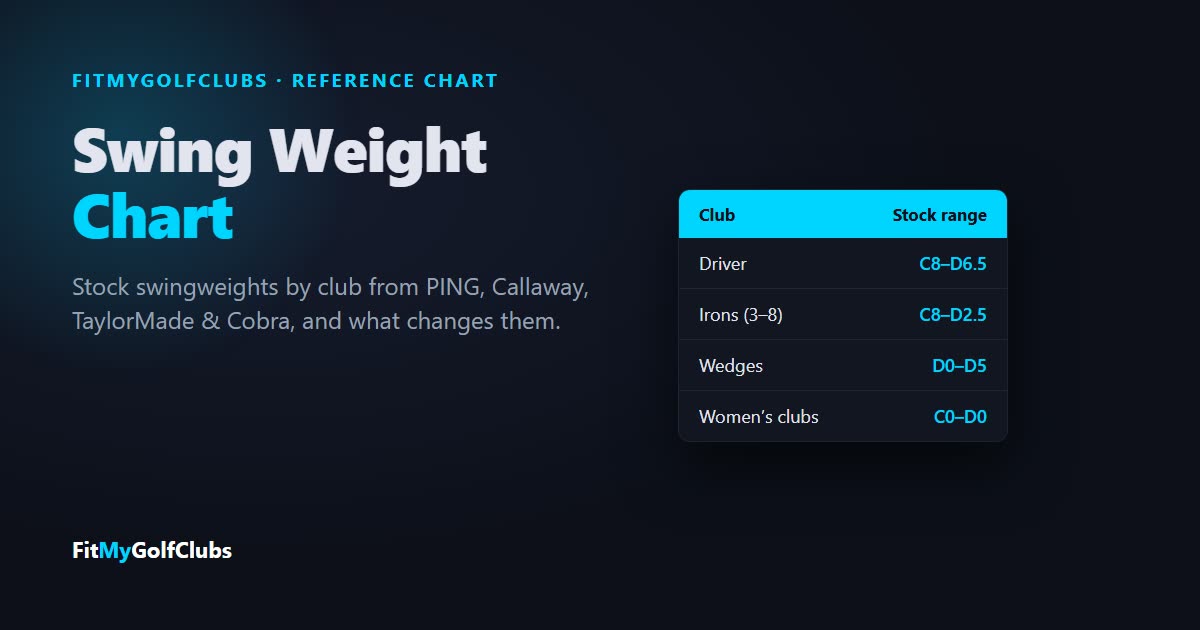
Swing Weight Chart: Standard Swingweights by Club and Brand
Swing weight chart: the A0–G9 scale, stock swingweights for drivers, irons and wedges from PING, Callaway, TaylorMade and Cobra, and what changes them.
Golf Club Fitting
October 8, 2026
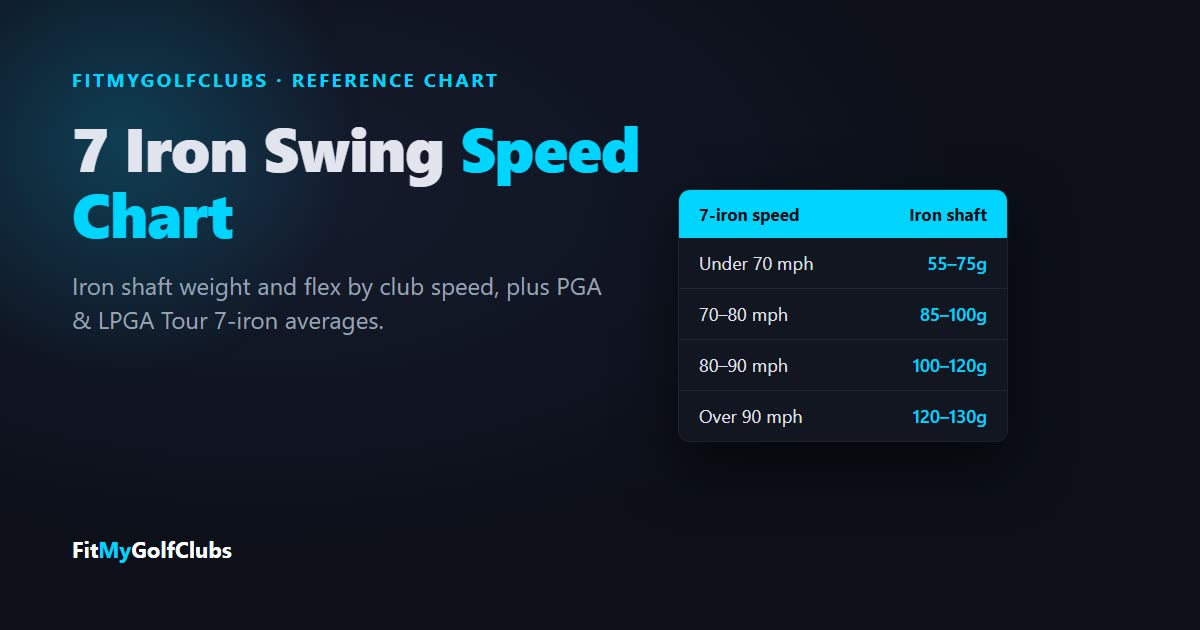
7 Iron Swing Speed Chart: Iron Shaft Weight, Flex & Carry
7 iron swing speed chart: iron shaft weight and flex by club speed, PGA (92 mph) and LPGA (78 mph) Tour averages, and 7-iron carry by speed.
Golf Club Fitting
October 8, 2026
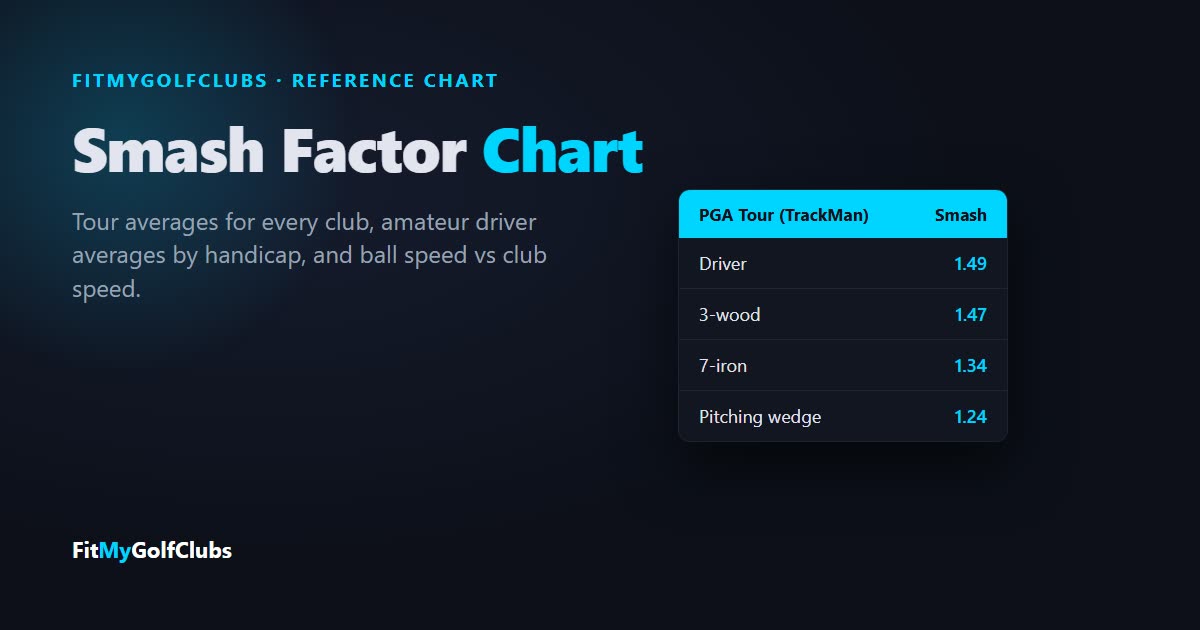
Smash Factor Chart: Tour Averages by Club + Ball Speed
Smash factor chart by club from TrackMan PGA and LPGA Tour averages, amateur driver averages by handicap, and a club speed to ball speed table.


© 2026 FitMyGolfClubs. All rights reserved. | Patent Pending
Contact: sean@fitmygolfclubs.com