
Golf Club Fitting
October 8, 2026
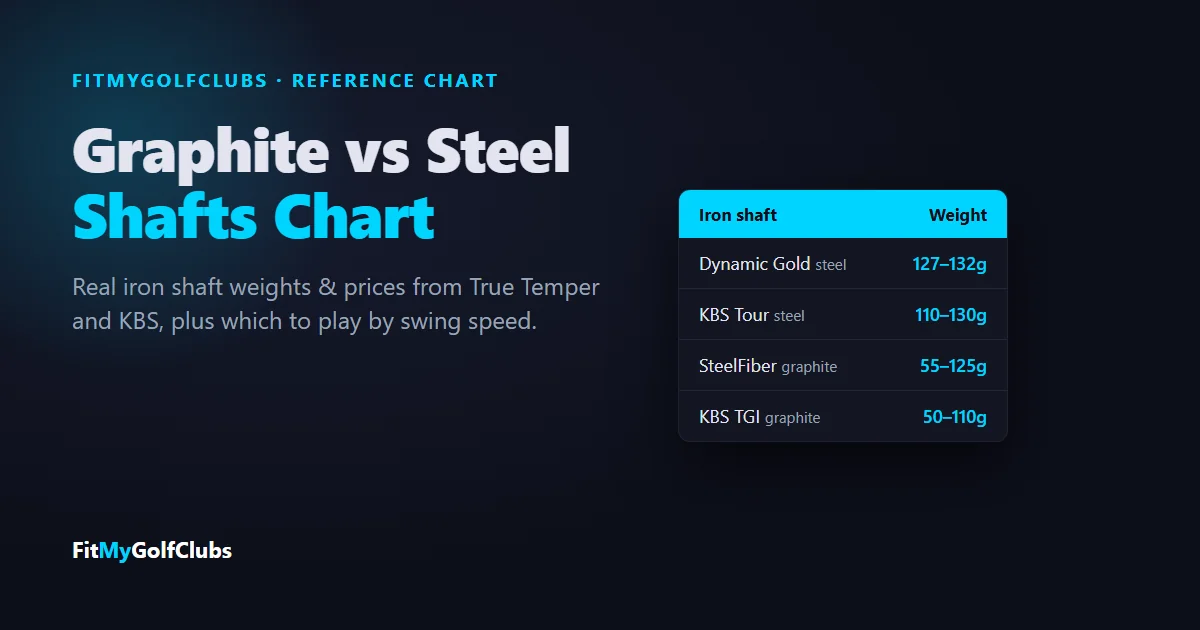
The quick answer: steel iron shafts weigh 95–132 grams and graphite iron shafts 45–125 grams in the True Temper and KBS spec tables below, and every driver shaft in our table is graphite at 47–85 grams. Graphite is lighter, softer on the hands and costs more: $54.95–$69.95 a shaft against $32.99–$44.95 for steel.
Between 95 and 125 grams you can buy either, so for most golfers the real choice is the weight, not the material. If you swing in the senior or ladies range, it’s graphite: none of these steel shafts is made in those flexes.
Graphite vs Steel Shafts Chart: Real Weights by Model
Two makers that sell both, so the comparison is like for like. Weights and flexes are from each maker’s spec table; prices are the per-shaft list price on the maker’s own store (before fitting and installation).
True Temper sells SteelFiber by weight class (55g to 125g); the exact weight moves a few grams by flex. KBS weights are its taper-tip spec. A flex with a + is KBS’s step between two flexes (R+ sits between Regular and Stiff).
Which Should You Play? Graphite or Steel by Swing Speed
Find your driver swing speed, then read across. The flex bands are the same ones as our swing speed shaft flex chart; the shaft lists are every model above that is made in that flex.
Between 90–99 mph you’re on the Regular/Stiff line, and tempo decides more than the speed number. Don’t know your speed? Our free Shaft Flex Calculator gives it a flex, and the Shaft Weight Calculator gives a starting weight for your driver and irons.
Graphite or steel by goal
⛳ Are your irons the right weight for your swing?
Steel or graphite, what matters is a shaft weight that suits your speed and steps down evenly from the irons to the hybrids and woods. Our free bag grade checks shaft flex and weight on every club, from your specs alone, in about 3 minutes. Grade my shafts free →
Weight: How Much Lighter Is Graphite?
The same maker, steel against graphite:
The lightest steel iron shaft here is 95g (KBS Tour Lite Regular, which KBS calls “a 20% lighter version of the KBS TOUR Shaft”). Graphite goes down to 45g. Above 95g the two overlap: a 95g SteelFiber and a 97g Dynamic Gold 95 weigh about the same. For the right weight at your swing speed, see our golf shaft weight guide.
Feel and Vibration
Graphite is the softer material. True Temper describes SteelFiber as “a graphite composite core [that] dampens vibration,” with a steel-fiber outer mesh that “resists twisting on off-center strikes, similar to steel.” Steel sends more of the strike up the shaft, which some players like because a miss feels like a miss.
Torque, the shaft’s resistance to twisting, is the other difference. True Temper rates all its Dynamic Gold steel just “Low”; SteelFiber runs 1.8° to 5.1° depending on weight, and the 95g Stiff is 2.0°. The heavier the graphite, the closer it gets to steel.
Distance
A lighter shaft is easier to swing faster, and more speed means more distance. That’s the whole case for graphite distance, and it only works if you can still find the middle of the face with the lighter club. The material itself doesn’t add yards. A 95g graphite and a 97g steel shaft give you the same weight to swing. The only distance number on these makers’ pages is a sales claim (KBS’s for Tour Lite against other brands), so we don’t quote one.
Accuracy and Dispersion
Steel is the traditional choice for control because it’s heavier and twists less. Newer graphite iron shafts are built to close that gap: KBS says its PGI gives “the same optimal tight tolerances, dispersion and control as the KBS Tour Steel Shaft, just at a lighter weight,” and that the TGI is “designed with the same E.I. curve as our KBS Tour Steel.” Those are maker claims. What matters more is the fit: a shaft that’s too light or too soft for your swing scatters shots in either material.
Cost
Prices are the shaft alone on each maker’s store, checked October 8, 2026; fitting, grips and installation are extra, and retailers may differ. Some options cost more: KBS lists the TGI at $71.95 in its taper tip and the PGI at $81.95. Every graphite iron shaft here costs more than every steel one.
Durability
Steel is the harder-wearing material. It shrugs off bag chatter and cart-path knocks that can chip a graphite shaft’s paint, and a scratch on graphite is worth checking before you keep swinging it. We don’t quote a lifespan for either: the maker spec pages we used don’t give one.
Graphite Irons for Seniors and Slower Swings
This is where graphite clearly wins. Every Lite and A (senior) flex in the tables is graphite: KBS MAX Graphite at 45g (Lite) and 55g (A), KBS TGI and PGI at 50g, and SteelFiber’s Amateur flex in the 55 and 70g classes. KBS says the MAX Graphite gives “players with lower swing speeds the ability to hit the ball at a higher launch/spin with accuracy.”
Age doesn’t pick the shaft, speed does. A 65-year-old who still swings the driver at 95 mph can play steel; a 45-year-old at 70 mph usually shouldn’t. If your irons have started to feel heavy late in the round, or your long irons won’t get airborne, that’s the sign to try graphite.
Driver Shafts: Graphite Almost Everywhere
Steel driver shafts are rare today; modern drivers ship with graphite. Three current Project X driver shafts from True Temper, by weight:
The heaviest driver shaft here (85g) is still lighter than the lightest steel iron shaft (95g). For driver flex and weight by speed, see the swing speed shaft flex chart.
Mixed Sets: Graphite Woods, Steel Irons
Most bags are already mixed: graphite in the driver, woods and usually the hybrids, steel in the irons and wedges. That works as long as the weight steps up smoothly from club to club. The problem is a jump, like a 60g hybrid shaft next to a 130g steel 4-iron. Some golfers go graphite in the long irons only, or graphite through the set with steel wedges. Whatever you mix, keep the weights in order; our shaft weight guide shows how.
Frequently asked questions
Are graphite or steel shafts more expensive?
Graphite. On the maker stores we checked, steel iron shafts cost $32.99–$44.95 each and graphite iron shafts $54.95–$69.95. For an 8-piece set that’s $263.92–$359.60 in steel against $439.60–$559.60 in graphite, before installation.
Do steel or graphite shafts go farther?
Graphite can, because a lighter shaft is easier to swing faster. The material doesn’t add distance on its own: a graphite and a steel shaft of the same weight give you the same club to swing. The gain only counts if you still hit the middle of the face.
Do most pro golfers use graphite or steel shafts?
In irons, steel has been the tour standard; True Temper says Dynamic Gold is “trusted by more tour players than any other shaft in history.” In drivers and woods, graphite. Heavy graphite iron shafts like SteelFiber and KBS TGI are made for tour players too.
Should I choose steel or graphite shafts?
Choose by swing speed and weight. Senior or ladies flex: graphite. Regular: either, so pick the weight first. Stiff and X-Stiff: steel, or graphite in the 95g-plus classes if you want a softer feel or have joint pain.
What is the best golf shaft for a beginner?
One that matches your swing speed. Most beginners fit Regular or softer, and many do better with lighter irons; graphite or a light steel like KBS Tour Lite (95–105g) or Dynamic Gold 95 (97g). Our free Shaft Flex Calculator gives you a flex in seconds.
How much lighter are graphite iron shafts than steel?
In the True Temper and KBS spec tables, steel iron shafts weigh 95–132g and graphite 45–125g. Like for like, KBS TGI runs 50–110g against 110–130g for KBS Tour steel.
Sources: the spec tables, descriptions and store prices on True Temper’s product pages (Dynamic Gold, Dynamic Gold 120, Dynamic Gold 105, Dynamic Gold 95, SteelFiber, Project X Cypher 2.0, Project X Denali Blue, Project X HZRDUS G5 Black) and KBS’s (KBS Tour, KBS Tour Lite, KBS TGI, KBS PGI, KBS MAX Graphite Iron), checked October 8, 2026.
Related reading
- Golf Club Fitting Chart — Length and lie by height, flex by swing speed, and every chart we publish.
- Golf Shaft Weight Chart — Driver and iron shaft weight by swing speed.
- Swing Speed Shaft Flex Chart — Driver and iron flex by swing speed, with a free calculator.
- Golf Shaft Fitting — What a shaft fitting costs and how to do one yourself.
- Stiff vs Regular Flex — Which flex you need, and the signs you’re in the wrong one.
- SteelFiber Shaft Chart — Every SteelFiber weight and flex, i-series to H Plus.
- KBS Shaft Chart — Tour, C-Taper, $-Taper and TGI weights and flex.
- Dynamic Gold Shaft Chart — S300, X100 and every Dynamic Gold flex decoded.
- Swing Weight Chart — The swingweight scale, stock swingweights by club and brand, and what changes them.
- 7 Iron Swing Speed Chart — Iron shaft weight by 7-iron speed, tour 7-iron averages, and 7-iron carry by speed.
Related Articles
Golf Club Fitting
October 8, 2026
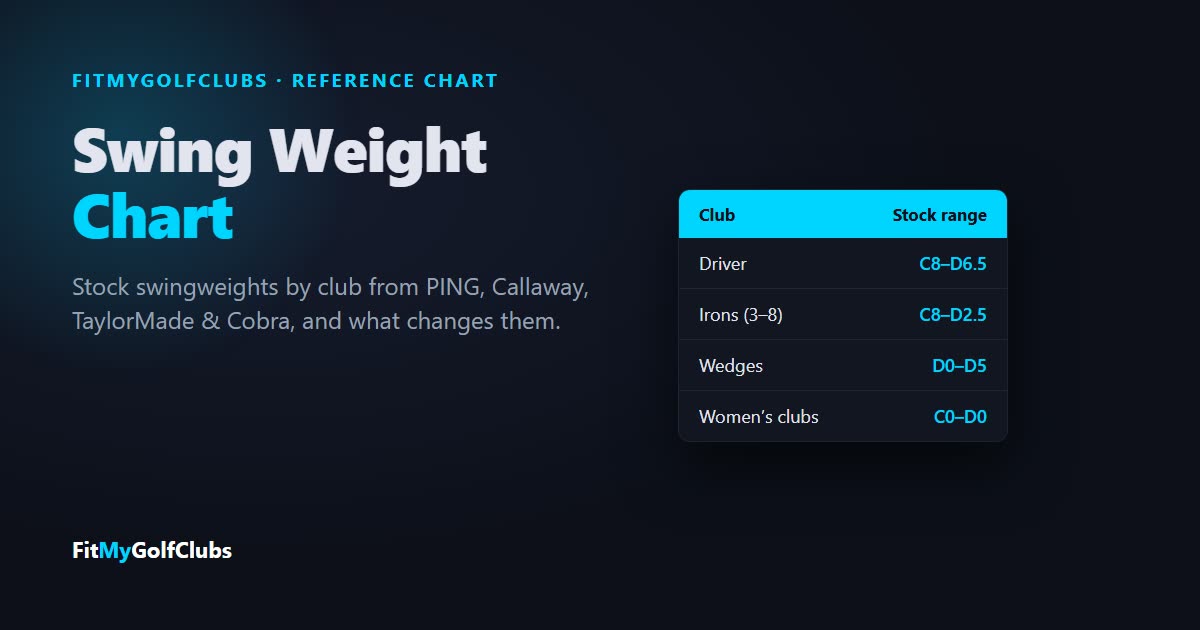
Swing Weight Chart: Standard Swingweights by Club and Brand
Swing weight chart: the A0–G9 scale, stock swingweights for drivers, irons and wedges from PING, Callaway, TaylorMade and Cobra, and what changes them.
Golf Club Fitting
October 8, 2026
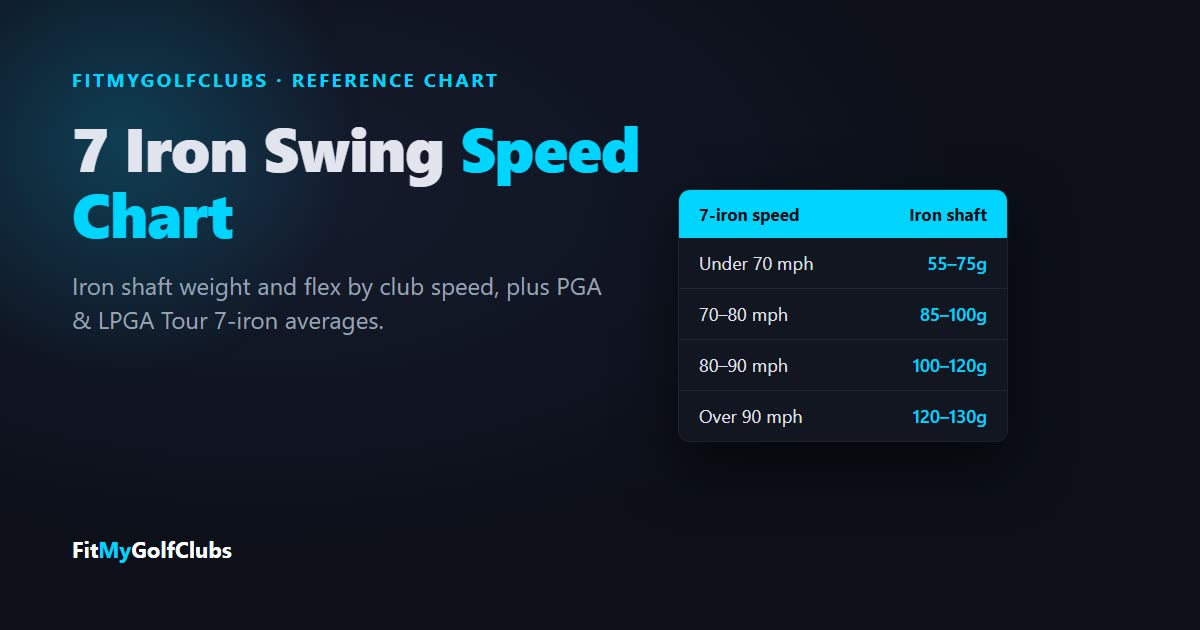
7 Iron Swing Speed Chart: Iron Shaft Weight, Flex & Carry
7 iron swing speed chart: iron shaft weight and flex by club speed, PGA (92 mph) and LPGA (78 mph) Tour averages, and 7-iron carry by speed.
Golf Club Fitting
October 8, 2026
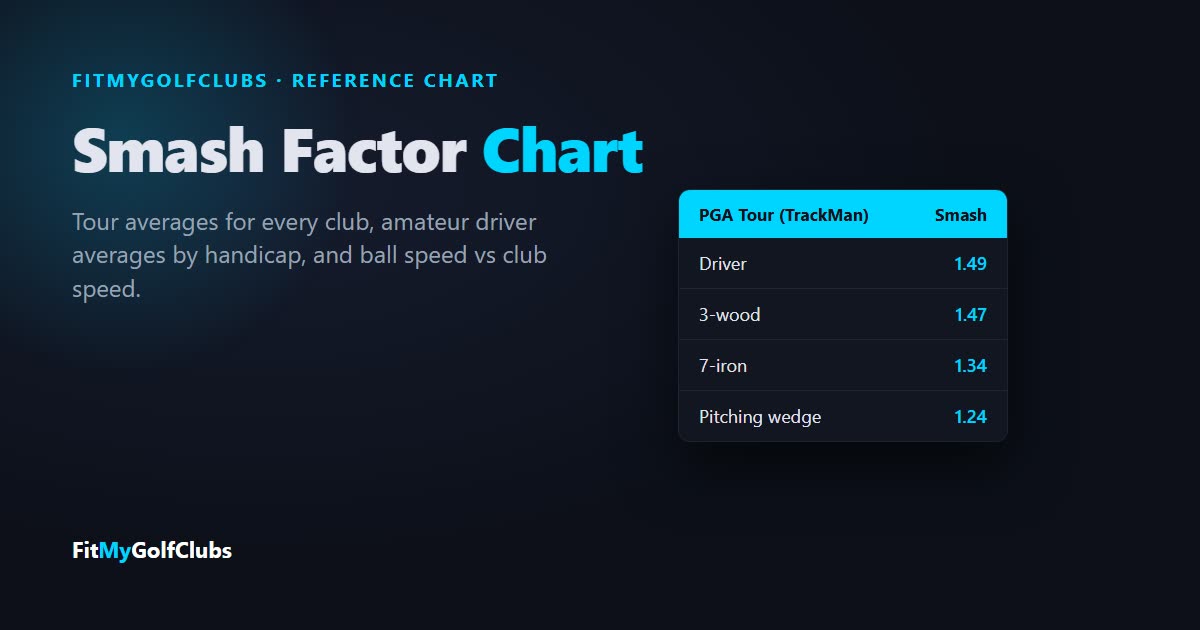
Smash Factor Chart: Tour Averages by Club + Ball Speed
Smash factor chart by club from TrackMan PGA and LPGA Tour averages, amateur driver averages by handicap, and a club speed to ball speed table.


© 2026 FitMyGolfClubs. All rights reserved. | Patent Pending
Contact: sean@fitmygolfclubs.com