
Golf Club Fitting
August 11, 2026
A shaft fitting is the highest-leverage equipment decision in golf. The shaft is the only part of the club that transfers your swing to the ball — and most golfers are playing one matched to a stock spec sheet, not to their swing.
This guide covers what a golf shaft fitting actually measures, what it costs, how to know if you need one — and how to do most of it yourself, free, starting from a single number: your swing speed.
Golf shaft fitting — the short answer: a shaft fitting matches your shaft's flex, weight, and length to your swing speed and tempo. An in-person fitting typically runs $75–$200 — around $100 at big-box retailers (usually credited toward a purchase) and $125–$200 at dedicated studios — takes about an hour, and is worth it for most golfers. But you can get 80% of the answer free online: measure your driver swing speed, then use a flex chart and weight chart to find your ranges — the two specs that matter most.
⚡ Start your free shaft fitting now.
Enter your driver swing speed into our Shaft Flex Calculator and Shaft Weight Calculator — your flex band and gram range in under a minute, no appointment. Get my flex →
Golf Shaft Fitting Chart: Flex & Weight at a Glance
The two core outputs of any shaft fitting are flex and weight, and both key off your driver swing speed. This chart combines them — find your speed band and read across:
These bands are starting points — tempo shifts them. A smooth transition can play softer and lighter than the chart; an aggressive transition usually needs the firm end. That's exactly the judgment call a fitting (in person or AI-assisted) is for. For the deeper dives, see the full golf swing speed chart and golf shaft weight guide.
What Is a Golf Shaft Fitting?
A shaft fitting is a session — at a retailer, a dedicated fitting studio, or online — that matches shaft specifications to your swing instead of accepting whatever shaft came stock in the club. Stock shafts are chosen to suit the widest possible range of buyers, which means they're a compromise for almost everyone.
A proper shaft fitting evaluates:
Flex — how much the shaft bends, matched to your swing speed. Wrong flex costs distance (too stiff) or control (too soft). This is the spec everyone knows, and it's still misfit in a huge share of amateur bags because golfers buy the label, not the fit. If you're stuck between two options, our stiff vs regular flex guide settles it.
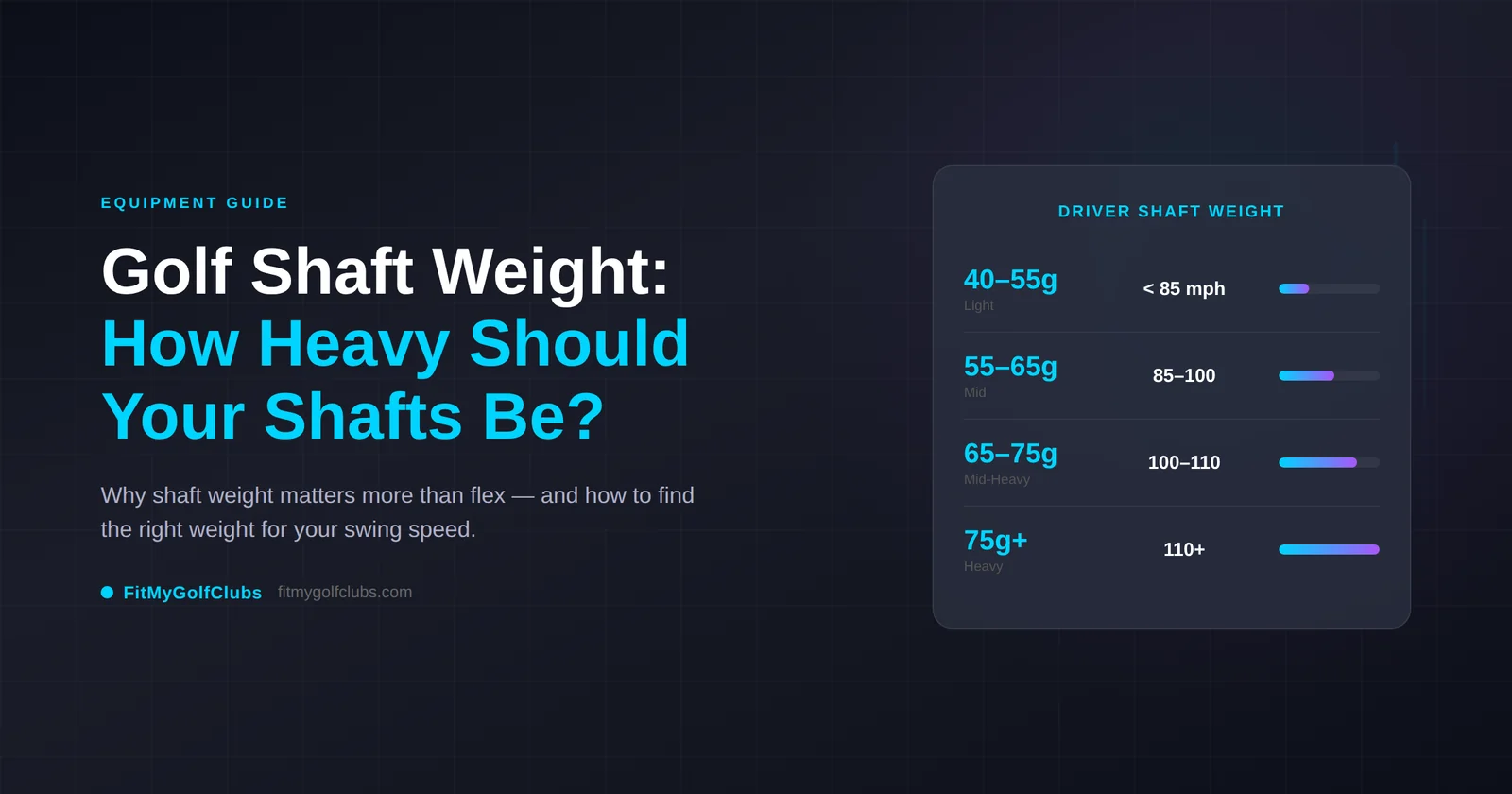
Weight — many fitters consider this more important than flex for consistency. Weight controls your tempo and release timing; the wrong weight creates misses no swing change can fix. Driver shafts run 40–80g+, iron shafts 55–130g.
Length — measured against your height and wrist-to-floor distance. Too long and you lose the center of the face; too short and you're hunched over the ball.
Kick point and torque — the fine-tuning layer. Kick point (where the shaft bends most) influences launch height; torque (how much the shaft twists) influences feel and face control. These matter most at higher swing speeds.
What Does a Golf Shaft Fitting Cost?
Typical prices in 2026:
Retail fitting (Golf Galaxy, PGA TOUR Superstore, club pro shops): around $100 for a club or iron fitting, typically waived or credited toward a purchase within 90 days. You hit on a launch monitor and compare a handful of stock-adjacent shafts.
Dedicated fitting studios (Club Champion, True Spec, GOLFTEC): $125–$200 for a single-club or driver shaft fitting, $250–$350 for full-bag. Far bigger shaft libraries — thousands of head/shaft combinations — but note the fee is usually a flat charge for the fitter's time (not credited toward clubs), and the recommended builds can get expensive fast.
Demo days: free. Manufacturer reps bring fitting carts to ranges; you can test the same head across several shafts with launch monitor feedback.
Online / AI fitting: free to a few dollars. Swing-speed-based calculators get you the right flex band and weight range; AI analysis layers in tempo and miss pattern. It won't replace hitting real shafts side-by-side, but it tells you exactly what to test — which makes any paid fitting shorter and better. Our full guide on golf club fitting costs breaks down every option.
🎯 Do the online fitting first — walk in knowing your specs.
Ten minutes with our free tools gives you a flex band, a weight range, and a fit grade for the club you suspect. Grade one club free →
How to Do a Shaft Fitting Yourself (Free)
You can run the core of a shaft fitting at home in four steps:
Step 1: Get your driver swing speed. A launch monitor is best (any retailer or sim bay). No access? Estimate from carry distance: a 200-yard carry is roughly 90 mph, 220 yards roughly 100 mph. The swing speed chart has the full conversion.
Step 2: Find your flex. Run your speed through the free Swing Speed → Shaft Flex Calculator. The AI layer factors in tempo and typical miss — the same tie-breakers a live fitter uses on borderline speeds.
Step 3: Find your weight range. Same input, different spec: the Swing Speed → Shaft Weight Calculator gives you a gram range for driver and irons. Then check what's actually printed on your current shafts — most golfers have never looked.
Step 4: Grade what you're playing now. Enter a club's specs into the Single-Club Fit Grader for an AI fit grade — flex, weight, length, and lie checked against your swing at once. If one club has always felt off, start there.
What the DIY route can't do is put six physical shafts in your hands on a launch monitor. If your online results say your current shafts are way off, that's when a paid fitting — now focused and short, because you know your ranges — pays for itself.
Signs You Need a Shaft Fitting
Your misses are directional and consistent. A repeating fade/push pattern with dead-feeling contact points to a too-stiff shaft; hooks and ballooning flight point to too soft. Ball flight is fitting data.
You slice the driver but hit your irons fine. Classic shaft mismatch — driver shafts are the most commonly misfit club in the bag. See why you slice your driver but not your irons.
You've never been fit and you're playing stock shafts. The average male amateur swings ~93 mph — squarely in Regular territory — yet buys Stiff because it sounds better. If you picked your flex off the rack, odds are decent it's wrong.
Your swing has changed. Speed shifts with age, fitness, and lessons. Shafts fit five years ago may not fit today — recheck your numbers every couple of seasons.
You're losing distance you used to have. Before blaming your swing, check whether your shafts still match your current speed. A too-stiff shaft quietly bleeds carry — see how speed maps to yardage in our golf club distance chart.
Driver Shaft Fitting vs Iron Shaft Fitting
The driver shaft is where fitting moves the needle most — it's the longest, lightest, fastest club, so spec errors are amplified. If you fit one club, fit the driver.
Iron shaft fitting is about consistency more than distance: one flex through the set, and a smooth weight progression from long irons to wedges. Two extra wrinkles: a 7-iron swings at about 80% of driver speed (your 7-iron speed, not driver speed, keys iron charts), and steel vs graphite is a weight-and-feel decision, not a skill label.
And one trap the spec sticker can't catch: a heavier shaft plays stiffer than the same flex in a lighter weight. Two "Stiff" shafts 20g apart are different shafts. That interaction — flex × weight — is why a real fitting evaluates both together, and why our calculators are built as a pair.
⚖️ Shafts are 2 of the 8 fit factors.
Grade My Bag checks flex and weight on all 14 clubs — plus length, lie, loft gapping, and more. Free, no launch monitor, no appointment. Grade my bag free →
The Bottom Line
A golf shaft fitting matches flex, weight, and length to your actual swing — and it's the cheapest real distance and consistency gain in golf, because it fixes the equipment you already own. Start free: get your swing speed, run it through the flex and weight calculators, and grade your current clubs. If the gap between what you're playing and what fits is big, take those numbers to a live fitting and test shafts with confidence instead of guesswork.
Your shaft fitting starts with one number.
Enter your swing speed and FitMyGolfClubs grades your shafts — and the other 6 fit factors — across all 14 clubs. No fitting appointment, no launch monitor required.
On a computer? You can also grade your bag in your browser — no app to install.
Frequently asked questions
How much does a golf shaft fitting cost?
Around $100 at a big-box golf retailer (usually credited toward a purchase) and $125–$200 at a dedicated fitting studio, where the fee is typically a flat charge for the fitter's time; full-bag fittings run $250–$350. Demo days are free, and online swing-speed-based fitting tools cost nothing — a smart first step that makes any paid fitting shorter and more focused.
Is a shaft fitting worth it?
For most golfers, yes — the shaft is the engine of the club, and the wrong flex or weight costs distance and consistency that no lesson fixes. The highest-value order: fit the driver shaft first, then check that your iron shafts follow a sensible weight progression.
Can I do a shaft fitting online?
You can get most of the way there. Your driver swing speed determines your flex band and weight range — the two most important shaft specs — and free calculators convert speed to both instantly, with AI context for tempo and miss pattern. What online fitting can't do is let you hit physical shafts side-by-side; use it to know exactly what to test.
What do I need to know before a shaft fitting?
Just your driver swing speed and your current shaft specs (flex and weight are usually printed on the shaft). Knowing both before you walk in — or before you buy anything — turns a fitting from open-ended testing into confirming a shortlist.
What swing speed needs a stiff shaft?
Roughly 95–110 mph with the driver. Below 95 mph, regular flex fits most golfers better — and since the average male amateur swings about 93 mph, more players belong in regular than the sales floor suggests.
Related reading
- Golf Swing Speed Chart: Shaft Flex by Club Head Speed — The full flex chart, ladies through X-stiff, drivers and irons.
- Golf Shaft Weight Guide — Why weight beats flex for consistency, with driver and iron charts.
- Stiff vs Regular Flex: How to Know Which You Need — The 95 mph rule and the overlap-zone tie-breakers.
- How Much Does Golf Club Fitting Cost? — Every fitting option priced, from demo days to tour-level studios.
- Golf Club Distance Chart — What your swing speed should produce, club by club.
- Graphite vs Steel Shafts — Real iron shaft weights and prices, and which to play by swing speed.
Ready for the full picture? Grade your whole bag with the FitMyGolfClubs app — shafts plus six more fit factors, free to start.
Related Articles
Golf Club Fitting
October 8, 2026
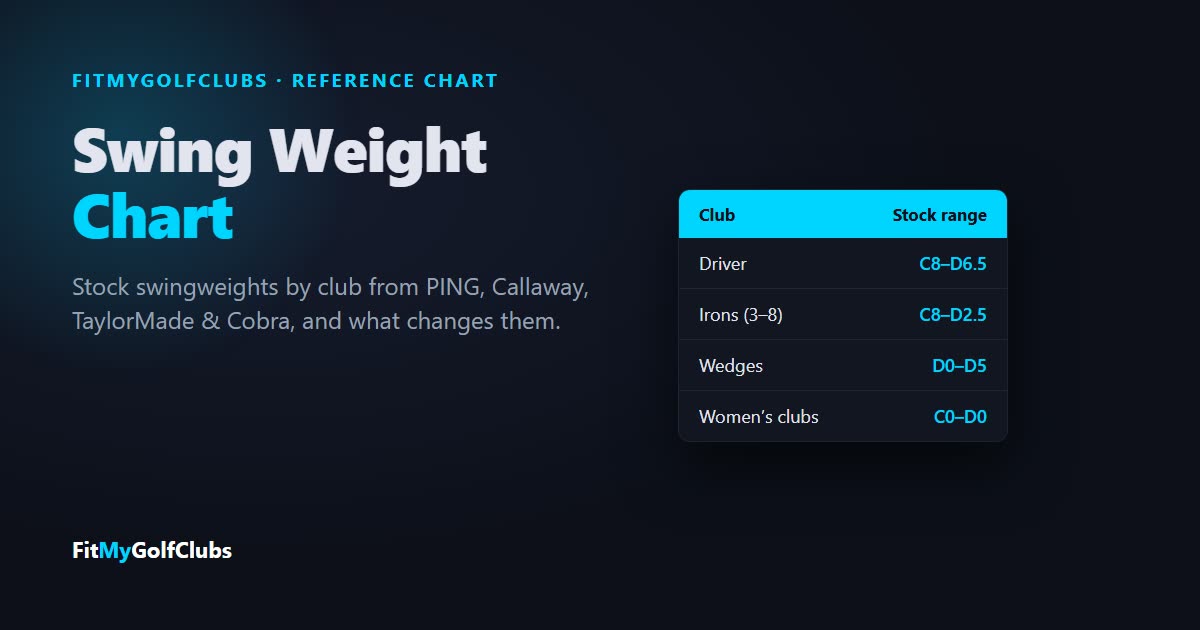
Swing Weight Chart: Standard Swingweights by Club and Brand
Swing weight chart: the A0–G9 scale, stock swingweights for drivers, irons and wedges from PING, Callaway, TaylorMade and Cobra, and what changes them.
Golf Club Fitting
October 8, 2026
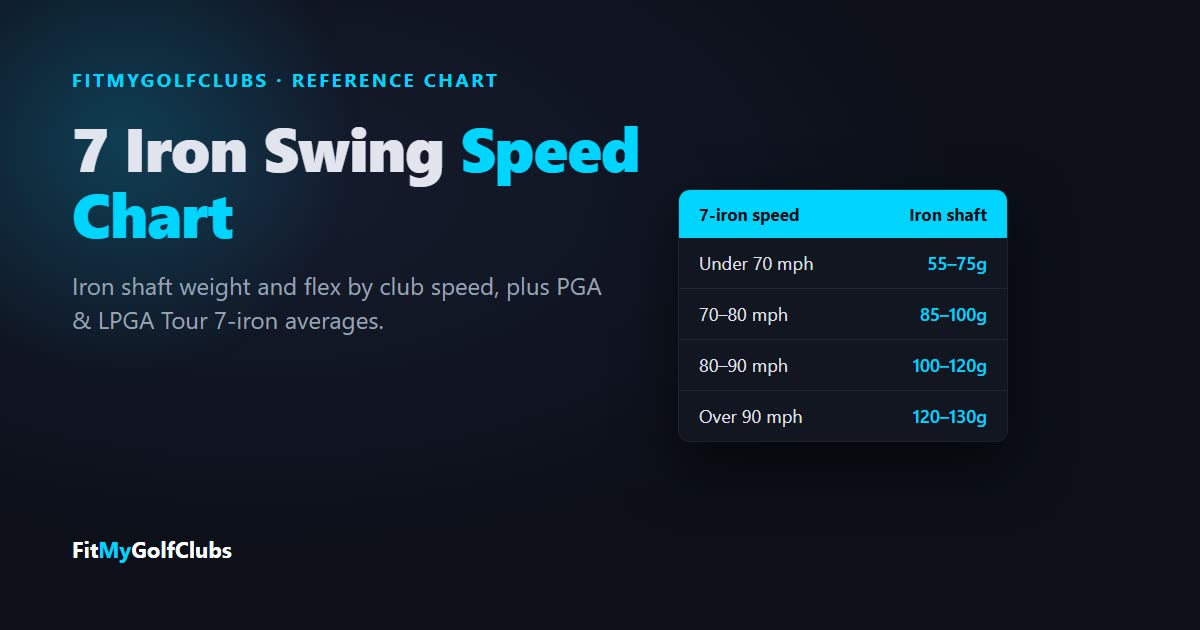
7 Iron Swing Speed Chart: Iron Shaft Weight, Flex & Carry
7 iron swing speed chart: iron shaft weight and flex by club speed, PGA (92 mph) and LPGA (78 mph) Tour averages, and 7-iron carry by speed.
Golf Club Fitting
October 8, 2026
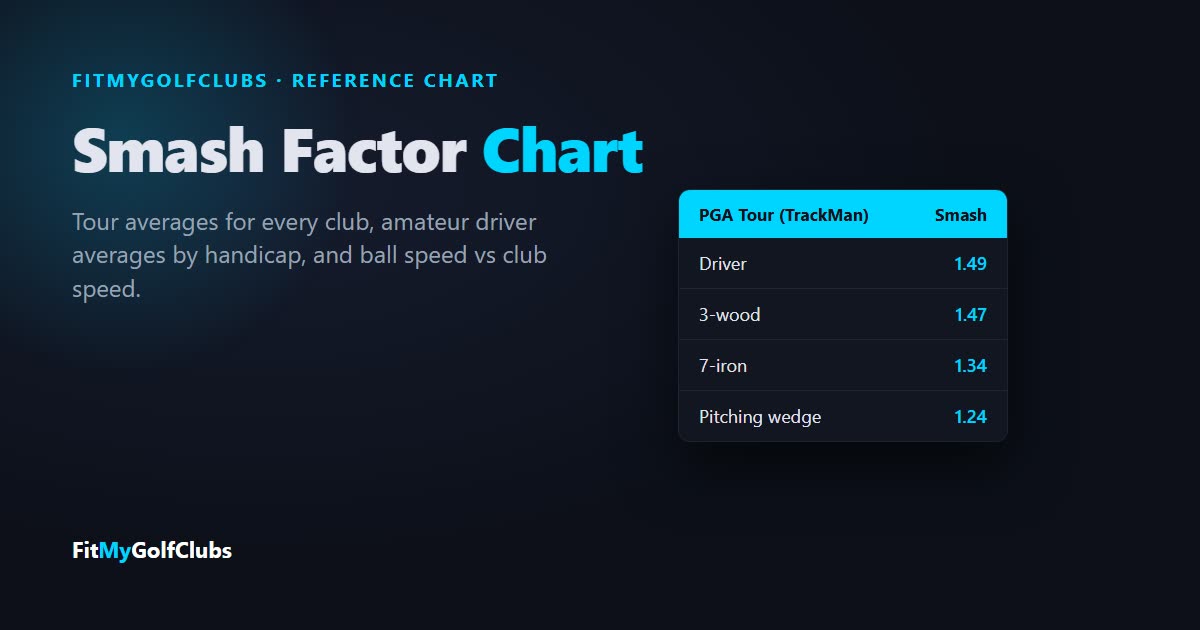
Smash Factor Chart: Tour Averages by Club + Ball Speed
Smash factor chart by club from TrackMan PGA and LPGA Tour averages, amateur driver averages by handicap, and a club speed to ball speed table.


© 2026 FitMyGolfClubs. All rights reserved. | Patent Pending
Contact: sean@fitmygolfclubs.com