
Golf Club Fitting
August 11, 2026
Every golfer wants to know one thing: how far should I be hitting each club? The honest answer is that distance depends far more on your swing speed and strike quality than on your handicap — but averages give you a useful benchmark to measure yourself against.
This guide gives you a complete golf club distance chart for every club in the bag, from driver through lob wedge, plus charts broken down by swing speed, skill level, and age so you can find the numbers that actually match you.
Golf club distance chart — the quick answer: the average male amateur hits a driver around 230 yards, a 7-iron around 140, and a pitching wedge around 110 (total distance), with roughly a 10–15 yard gap between each club. Swing speed matters more than skill: a 100 mph driver swing carries 30–40 yards farther than an 85 mph swing with the same club. Use the charts below to find your numbers by club, swing speed, and skill level.
⚡ Want your real numbers, not averages?
Your distances are driven by swing speed. Find yours with our free Swing Speed Calculator — then read the distance-by-speed chart below. Find my speed →
Golf Club Distance Chart at a Glance
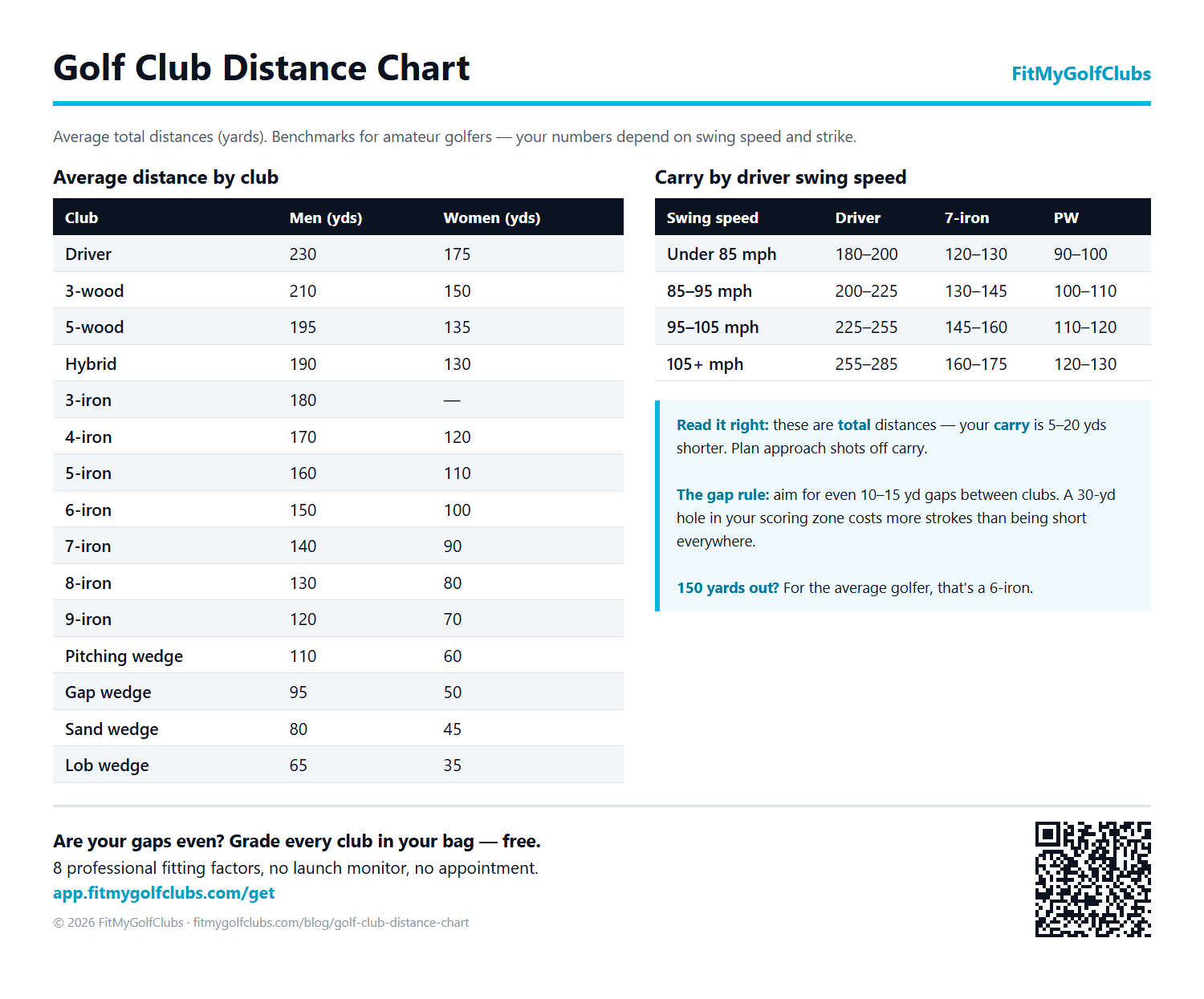
Here are average total distances for every club in the bag, for both men and women. These are starting-point benchmarks for a mid-handicap amateur — see the swing-speed and skill-level charts further down to dial in your own numbers.
🖨️ Take it to the range: download the free printable golf club distance chart (PDF), or save the image version to your phone.
Average Golf Club Distances
The chart above shows total distance — carry plus roll. That distinction matters more than most golfers realize. Your carry distance (how far the ball flies in the air) is what you use to clear a bunker or reach a green; total distance includes the roll after landing, which changes with turf firmness, slope, and conditions.
Two things skew the "average golfer" number. First, most players overestimate their distance — they remember their best strike, not their typical one. Second, published averages often quote total distance on a dry, running fairway, which inflates the figure versus a real carry number. When in doubt, plan your approach shots off carry, not the flattering total.
🎯 Averages are a starting point — your bag is unique.
Inconsistent gaps between clubs cost more strokes than a few missing yards. Grade My Bag checks distance gapping across all 14 clubs. Grade my bag free →
Golf Club Distances by Swing Speed
Swing speed is the single biggest driver of distance — bigger than skill, age, or equipment. This is the chart most distance guides skip, and it's the one that actually tells you what you should be hitting. Find your driver swing speed band and read across for realistic carry numbers.
Don't know your swing speed? You can estimate it from driver carry (a 200-yard carry is roughly 90 mph; 220 yards is roughly 100 mph), or measure it precisely on a launch monitor. Our full golf swing speed chart breaks down speed-to-distance for every club, and the free Swing Speed Calculator turns your number into a shaft and distance profile.
Golf Club Distances by Skill Level
Distance and skill aren't the same thing — plenty of high-handicappers bomb the driver, and plenty of scratch golfers are average length. But skill level does track loosely with distance because better players tend to strike the ball more solidly and generate more speed. Here's how distances typically progress:
The takeaway isn't "hit it farther." It's that the gaps between your clubs should stay consistent no matter your level. A beginner with even 20-yard gaps will score better than a longer hitter with overlapping clubs and a 40-yard hole in the bag.
Golf Club Distances by Age
Swing speed — and therefore distance — naturally declines with age as flexibility and strength change. If your numbers are dropping, it's usually not your technique; it's a few mph of clubhead speed. Here are typical driver and 7-iron averages by age band:
As speed drops, the fix usually isn't swinging harder — it's making sure your shafts (weight and flex) still match your slower speed. A shaft that's too stiff for your current swing quietly costs both distance and consistency. See stiff vs regular flex and our golf shaft weight guide for how to match them.
How Far Should You Hit Each Club?
Here's a closer look at the clubs golfers ask about most, with the averages and what actually moves the number.
Driver Distance
The average male amateur drives it about 230 yards total; women average around 175. But driver distance has the widest spread of any club — from 190 yards for a beginner to 260+ for a low-handicap player and nearly 300 on Tour. Because the driver is the longest, lightest club, small changes in swing speed and strike location produce big changes in distance. Centeredness of contact (smash factor) is as important as raw speed.
Fairway Wood & 3-Wood Distance
A 3-wood averages around 210 yards for men and 150 for women, with the 5-wood 10–15 yards shorter. Many golfers actually carry their 3-wood nearly as far as a poorly-fit driver — if your 3-wood and driver distances are close, that's usually a driver fit problem, not a 3-wood strength.
Hybrid & Long Iron Distance
Hybrids average about 190 yards and have largely replaced the 3- and 4-iron for most amateurs because they launch higher and carry more consistently. If you still bag a 3- or 4-iron and struggle to get it airborne, a hybrid of the same number will almost always carry farther and land softer.
7-Iron Distance
The 7-iron is the reference club most golfers know their number for: about 140 yards for the average man, 90 for the average woman, ranging from 120 (beginner) to 160+ (low-handicap). Because it sits in the middle of the set, it's the best single club to measure your baseline — nail down your 7-iron carry and you can estimate the rest of the bag in 10-yard steps.
Wedge Distances (PW, GW, SW, LW)
Full-swing wedge distances run about 110 yards (pitching), 95 (gap), 80 (sand), and 65 (lob) for men. Wedges are where gapping matters most: if your PW goes 115 and your next wedge only 85, you have a 30-yard hole right in your scoring zone. Even, ~15-yard wedge gaps are the mark of a well-built short game.
🔍 Got a gap or overlap in your bag?
Distance gapping is one of the 8 fit factors we grade. Grade My Bag maps every club's distance and flags the holes. Grade my bag free →
Golf Club Distances for Seniors
Senior golfers typically carry each club about 10–15% shorter than the men's averages above, because clubhead speed declines gradually with age — not because of anything wrong with the swing. A senior man who once drove it 240 often settles around 200–215 as his driver swing speed drifts from the mid-90s into the mid-80s mph, which is still plenty to score well with modern lightweight shafts and higher-launching heads.
As a quick reference, a typical senior man carries the driver about 200 yards, a 7-iron about 125, and a pitching wedge about 90 — with senior women roughly 25–30% below those figures, in line with the women's column above. The numbers track swing speed far more than age itself, so the fastest way to find your real yardages is to check your current driver speed against our swing speed to shaft flex chart. And if your distance dropped off suddenly rather than gradually, it is often a sign your shafts have gotten too stiff or too heavy for your current speed — a free bag grade flags that in minutes, and switching to a lighter, softer shaft can hand a senior back 5–10 yards without a single swing change.
What Actually Determines Your Distance
Averages tell you where you stand. These four factors tell you why — and which ones you can change.
Swing Speed
The number-one factor by a wide margin. Every extra 5 mph of driver speed is worth roughly 12–15 yards. It's also the input for choosing the right shaft. Find yours with our swing speed chart — and it picks your ball too: see the golf ball compression chart for the compression range that matches your speed.
Strike Quality (Smash Factor)
Two players at the same swing speed can be 20 yards apart if one finds the center of the face and the other doesn't. Centered contact transfers more energy to the ball — often a faster route to distance than swinging harder.
Shaft Fit — Flex and Weight
A shaft that's too stiff won't load and costs carry; one that's too heavy slows your speed. Matching both to your swing recovers distance you're already capable of. See stiff vs regular flex and the shaft weight guide. Length matters too — a club built too long or too short for your body costs you center-face contact; check the golf club length chart to see where you should be.
Loft & Gapping
Modern "strong" lofts have inflated iron distances on paper, which is why a new 7-iron might go farther than your old 6. What matters isn't the number stamped on the club — it's whether your set produces even distance gaps with no overlaps or holes. Loft gapping is the most common fitting-spec weakness across 230+ graded amateur bags — see what the data revealed.
Know your gaps, not just your averages.
FitMyGolfClubs grades all 14 clubs across 8 professional fit factors — including distance gapping. No fitting appointment, no launch monitor required.
On a computer? You can also grade your bag in your browser — no app to install.
The Bottom Line
A golf club distance chart is a benchmark, not a scorecard. The averages here — driver 230, 7-iron 140, pitching wedge 110 for the typical male amateur — give you a reference point, but your real numbers come down to swing speed, strike, and how well your clubs are fit and gapped. Measure your own carry distances, compare them to the swing-speed chart above, and check that your gaps are even. That's what turns a distance chart into lower scores.
Frequently asked questions
How far should the average golfer hit each club?
The average male amateur hits a driver about 230 yards, a 7-iron about 140, and a pitching wedge about 110, with roughly 10–15 yards between each club. Women average about 25–30% shorter. These are total distances; carry distances are shorter, especially with the longer clubs.
How far should I hit a 7-iron?
Most male amateurs carry a 7-iron 130–145 yards; women average around 90. Low-handicap players reach 160+. Because the 7-iron sits in the middle of the set, it's the best club to establish your baseline — then estimate the rest of your bag in roughly 10-yard steps up and down.
What's the difference between carry distance and total distance?
Carry is how far the ball flies in the air; total distance adds the roll after it lands. Total is usually 5–20 yards longer depending on the club and how firm the ground is. Plan approach shots off carry — that's the number that clears hazards and holds greens.
Does swing speed or skill matter more for distance?
Swing speed matters more. Distance tracks swing speed far more tightly than handicap — plenty of higher-handicap players out-drive scratch golfers. What better players do consistently is strike the center of the face and keep even gaps between clubs, which is where scoring, not raw distance, comes from.
How many yards should there be between each golf club?
Aim for consistent gaps of about 10–15 yards between irons and 15 yards between wedges, with no overlaps or holes. A missing 30-yard gap in your scoring zone costs more strokes than being a little short overall — which is exactly what a bag grade is built to catch.
Related reading
- Golf Club Fitting Chart — Length and lie by height, flex by swing speed, and every chart we publish in one place.
- Golf Club Loft & Lie Chart — standard specs for every club, plus a free way to check your own at home.
- Golf Swing Speed Chart: Shaft Flex by Club Head Speed — Distance is driven by speed. Find your swing speed and the flex that matches it.
- Golf Ball Compression Chart: Ratings by Swing Speed — Which compression range fits your speed, plus the softest balls ranked.
- Stiff vs Regular Flex: How to Know Which You Need — A mismatched shaft quietly costs distance. Settle the stiff-vs-regular question.
- Golf Shaft Weight Guide — Weight affects speed and consistency as much as flex does.
- How to Build Your Digital Golf Bag — Track every club's distance and specs in one place — the setup behind your fit grade.
- Vokey Grind Chart — Every SM11 loft, bounce and grind, and what each grind is for.
- Wedge Distance Chart — Pitching, gap, sand and lob wedge yardages, plus wedge loft gapping.
- Smash Factor Chart — TrackMan tour smash factor by club, amateur averages, and ball speed from club speed.
Want your distance gaps checked automatically across all 14 clubs? Grade your bag with the FitMyGolfClubs app — free to start, no launch monitor required.
Related Articles
Golf Club Fitting
October 8, 2026
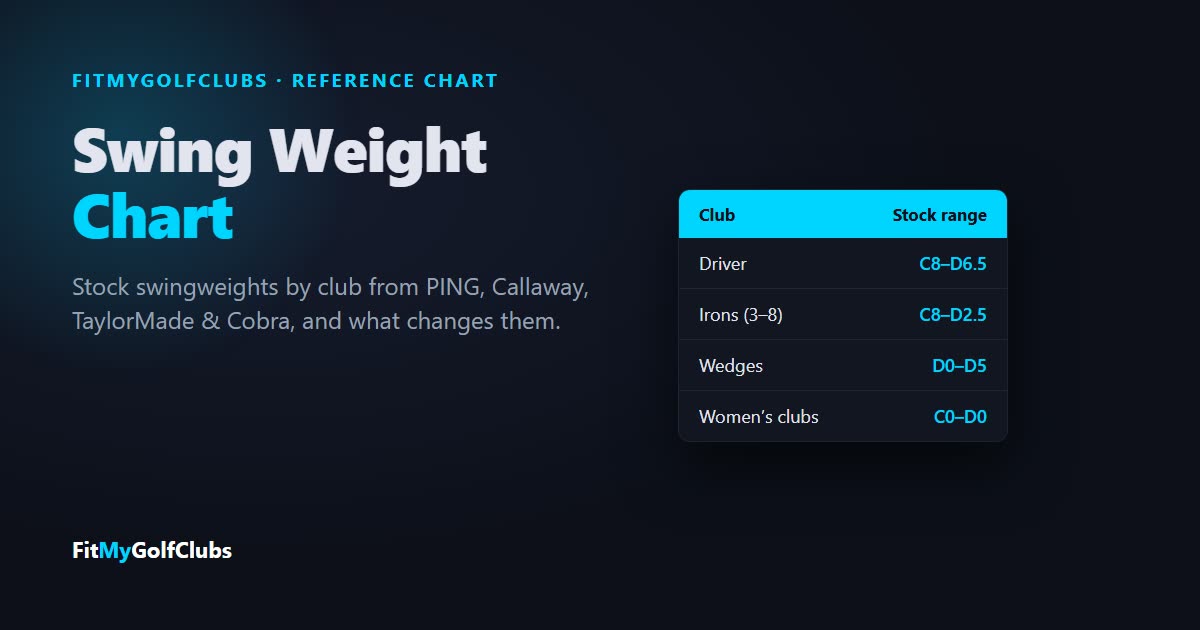
Swing Weight Chart: Standard Swingweights by Club and Brand
Swing weight chart: the A0–G9 scale, stock swingweights for drivers, irons and wedges from PING, Callaway, TaylorMade and Cobra, and what changes them.
Golf Club Fitting
October 8, 2026
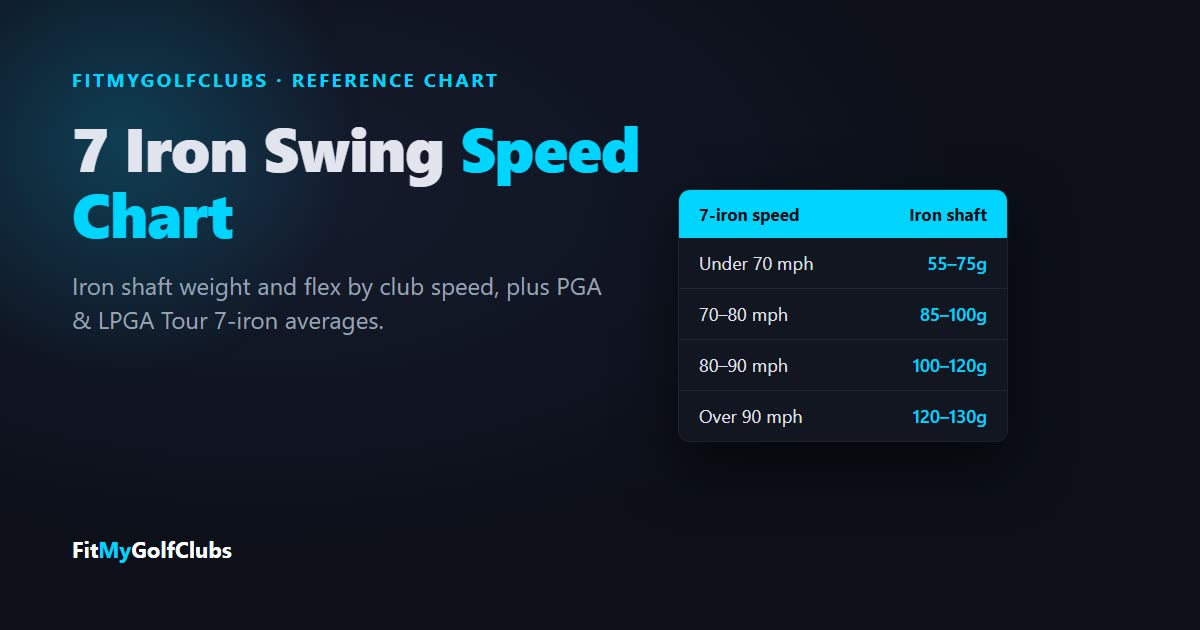
7 Iron Swing Speed Chart: Iron Shaft Weight, Flex & Carry
7 iron swing speed chart: iron shaft weight and flex by club speed, PGA (92 mph) and LPGA (78 mph) Tour averages, and 7-iron carry by speed.
Golf Club Fitting
October 8, 2026
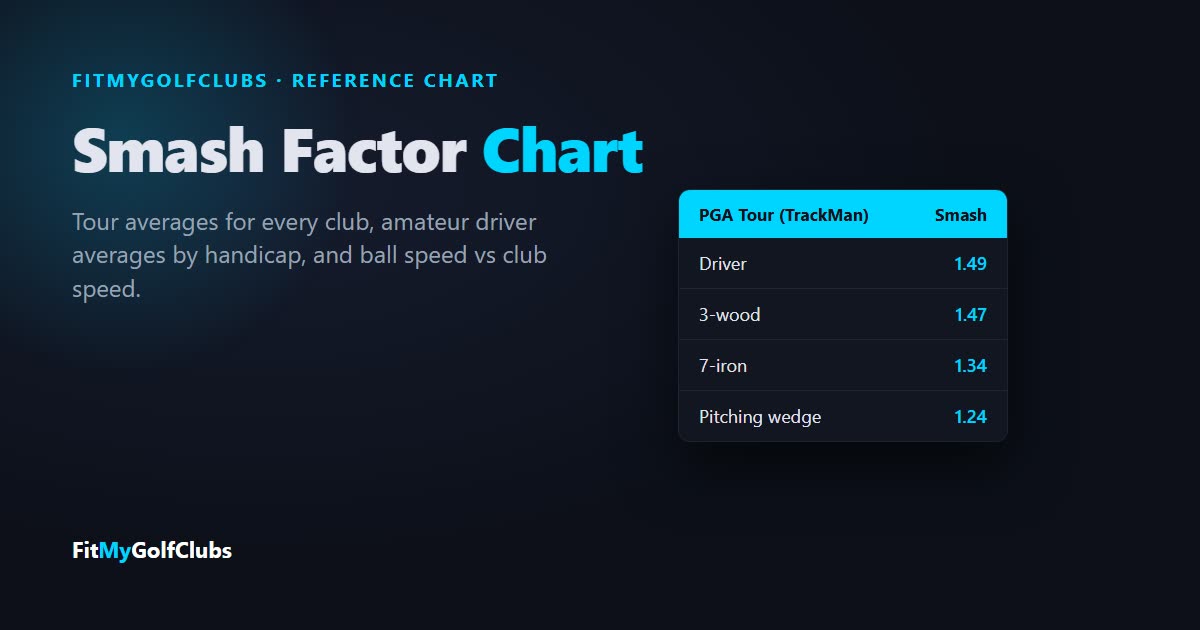
Smash Factor Chart: Tour Averages by Club + Ball Speed
Smash factor chart by club from TrackMan PGA and LPGA Tour averages, amateur driver averages by handicap, and a club speed to ball speed table.


© 2026 FitMyGolfClubs. All rights reserved. | Patent Pending
Contact: sean@fitmygolfclubs.com