
Golf Club Fitting
October 8, 2026
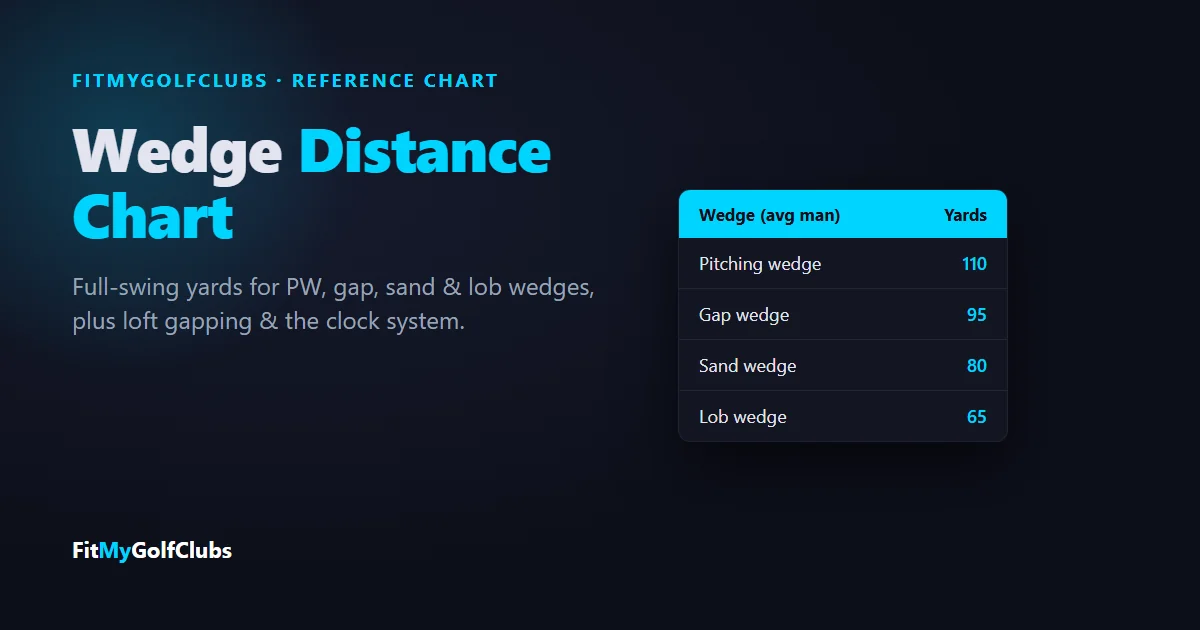
The quick answer: the average male amateur hits a full pitching wedge about 110 yards, a gap wedge 95, a sand wedge 80 and a lob wedge 65: an even 15 yards between each. The average woman hits them 60, 50, 45 and 35 yards.
Vokey puts a pitching wedge at 44°–48° of loft, a gap wedge at 48°–52°, a sand wedge at 54°–56° and a lob wedge at 58°–60°, and recommends 4° to 6° between wedges. Your own numbers depend on swing speed and on the lofts in your bag, so the charts below go by swing speed and skill, then show you how to build your own chart, partial swings included.
Wedge Distance Chart (Men and Women)
Average full-swing distance for each wedge. These are the same averages as our golf club distance chart, which covers every club from driver down; they’re total distances (carry plus roll), benchmarks for a mid-handicap amateur.
The loft column is the range Vokey gives for each wedge type. Your own pitching wedge may sit outside it: set pitching wedges run from 40° to 46° in the current sets below, and Vokey notes that “Most iron sets include a set-matched pitching wedge, but loft, grind, and bounce can vary widely from set to set.”
Pitching Wedge Distance by Swing Speed
Swing speed moves your wedge numbers more than anything else. Find your driver swing speed and read across for a realistic pitching wedge carry:
Your other wedges: start from your pitching wedge carry and step down by your gaps. A well-built wedge set keeps even gaps of about 15 yards. For example, a golfer in the 85–95 mph band who carries the pitching wedge 105 yards and has even 15-yard gaps would carry the gap wedge about 90, the sand wedge 75 and the lob wedge 60. If your numbers bunch up or leave a hole, it’s usually the lofts, not the swing (see the gapping section below). Don’t know your speed? Our swing speed chart shows how to estimate it.
Pitching Wedge Distance by Skill Level
Better players hit it farther mainly because they strike it more solidly and swing faster, but the gaps matter more than the length: even steps between wedges are what let you hit a number.
Women’s and Seniors’ Wedge Distances
The average woman hits a full pitching wedge about 60 yards, a gap wedge 50, a sand wedge 45 and a lob wedge 35. A typical senior man carries a pitching wedge about 90 yards. In both cases the number follows swing speed far more than age or gender, so the swing-speed chart above is the better guide to your own.
Wedge Lofts and Gapping
Distance gaps between wedges come from loft gaps. “Vokey recommends 4° to 6° of loft separation between wedges.” Vokey’s own examples: “For example, a 44° pitching wedge pairs with a 48° or 50° gap wedge.” and “If your gap wedge is 50°, a 54° sand wedge creates the right spacing. If your gap wedge is 52°, go with 56°.” “The 56° is the most-played loft on tour.”
Set-ups that keep every gap between 4° and 6°:
Start with your pitching wedge loft
Your pitching wedge sets where the wedge gaps start, and set pitching wedges vary a lot. Here are the pitching wedge and next set wedge in current iron sets, from each maker’s spec page:
A 40° or 42° pitching wedge followed by a 52° wedge is a gap of 10° or more, well past Vokey’s 6° upper limit, and it shows up as a hole in your yardages. PING’s own G440 set puts a 47° wedge in between: 42°, 47°, 52°, 56°.
⛳ Is there a hole in your wedge gaps?
Loft gapping is the #1 fitting flaw in the 231 bags we've graded. Our free bag grade checks every loft gap from driver to wedge in about 3 minutes, from your specs alone, and the Loft & Lie Checker compares your irons and pitching wedge against standard. Check my wedge gaps free →
Wedge lofts by model
Every loft each maker sells in its current wedges, in 2° steps:
For bounce and grind by loft, see our Vokey grind chart.
Partial Wedge Distances: the Clock System
Most wedge shots aren’t full swings, and there is no honest average for a half-swing sand wedge: it depends on your loft, your speed and how you swing. That’s why the clock system is a method, not a chart of numbers. Picture yourself in the middle of a clock face. Swing your lead arm back to 7:30, 9:00 or 10:30, keep the same tempo every time, and let the length of the backswing set the distance. Three backswings times four wedges gives you twelve yardages before you ever need a full swing.
Fill in your own chart (the full-swing column shows the men’s average for reference):
How to Build Your Own Wedge Distance Chart
- Write down your lofts. Read them off each wedge and your pitching wedge, or look up the set on the maker’s spec page.
- Measure carry, not total. Carry is the number that clears a bunker and holds a green; use a launch monitor, a range with targets, or a GPS on the course.
- Hit several balls with each swing (7:30, 9:00, 10:30 and full) and write down your typical carry, not your best one.
- Check the gaps. Even steps of about 15 yards between full wedges mean the lofts are working. A step of 25 or 30 yards is a hole; two wedges within 5 yards are doing the same job.
- Fix holes with loft, not swing. Keep 4° to 6° between wedges, starting from your pitching wedge loft.
- Keep the chart with you and re-check it when you change wedges or your swing speed changes.
Frequently asked questions
How far should you hit each wedge?
The average male amateur hits a full pitching wedge about 110 yards, a gap wedge 95, a sand wedge 80 and a lob wedge 65. The average woman hits them 60, 50, 45 and 35 yards. Swing speed changes these more than anything else.
Does a 50 or 60 degree wedge go further?
The 50°. Less loft sends the ball lower and farther. A 50° is a gap wedge and a 60° a lob wedge; the average man hits a gap wedge about 95 yards and a lob wedge about 65.
Do I need a 52, 56 and 60 degree wedge?
It depends on your pitching wedge loft. Vokey recommends 4° to 6° between wedges, so 52°, 56° and 60° fit a pitching wedge of about 46°–48°. With a stronger pitching wedge, such as the 42° in PING’s G440 set, the jump to 52° is 10°, and you need another wedge in between.
How many degrees should there be between wedges?
4° to 6°, according to Vokey. For example, a 44° pitching wedge pairs with a 48° or 50° gap wedge, a 50° gap wedge with a 54° sand wedge, and a 52° gap wedge with a 56°.
How far should a 60 year old man hit a pitching wedge?
A typical senior man carries a pitching wedge about 90 yards. Swing speed matters more than age: a driver swing speed under 85 mph usually means a 90–100 yard pitching wedge carry.
Is a 58 wedge easier to hit than a 60?
On full swings, usually. Vokey says a 58° launches a touch lower and is more forgiving on full swings, while a 60 degree wedge produces a higher arc and stops faster on the green.
What is the clock system for wedges?
A way to control partial wedge shots. You swing your lead arm back to 7:30, 9:00 or 10:30 on an imaginary clock face with the same tempo, and record the carry for each wedge. Three backswings with four wedges give you twelve yardages.
Sources: wedge distances from our golf club distance chart; wedge lofts and gapping from Vokey’s SM11, pitching, gap, sand and lob wedge pages (checked September 30, 2026); PING s159 and s259, Cleveland RTZ 2 and CBZ, and Callaway Opus SP spec tables (checked October 8, 2026); set pitching wedge lofts from PING, Titleist and Mizuno iron spec pages (checked September 30, 2026).
Related reading
- Golf Club Fitting Chart — Length and lie by height, flex by swing speed, and every chart we publish.
- Golf Club Distance Chart — Average distance for every club in the bag, by swing speed, skill level and age.
- Vokey Grind Chart — Every SM11 loft, bounce and grind, and what each grind is for.
- Golf Club Loft & Lie Chart — Standard loft and lie for every club, plus a free way to check your own.
- What 231 Graded Bags Show — Loft gapping is the #1 fitting flaw amateurs can fix.
- PING Iron Loft Chart — Loft, lie, offset and length for every current PING iron and PW.
- Titleist Iron Loft Chart — T100, T150, T250 and T350 lofts and lies, wedges included.
- Golf Swing Speed Chart — Find your swing speed and the flex that matches it.
- Callaway Wedge Grind Chart — Every Opus SP, Opus, Platinum and JAWS Raw loft, bounce and grind.
Related Articles
Golf Club Fitting
October 8, 2026
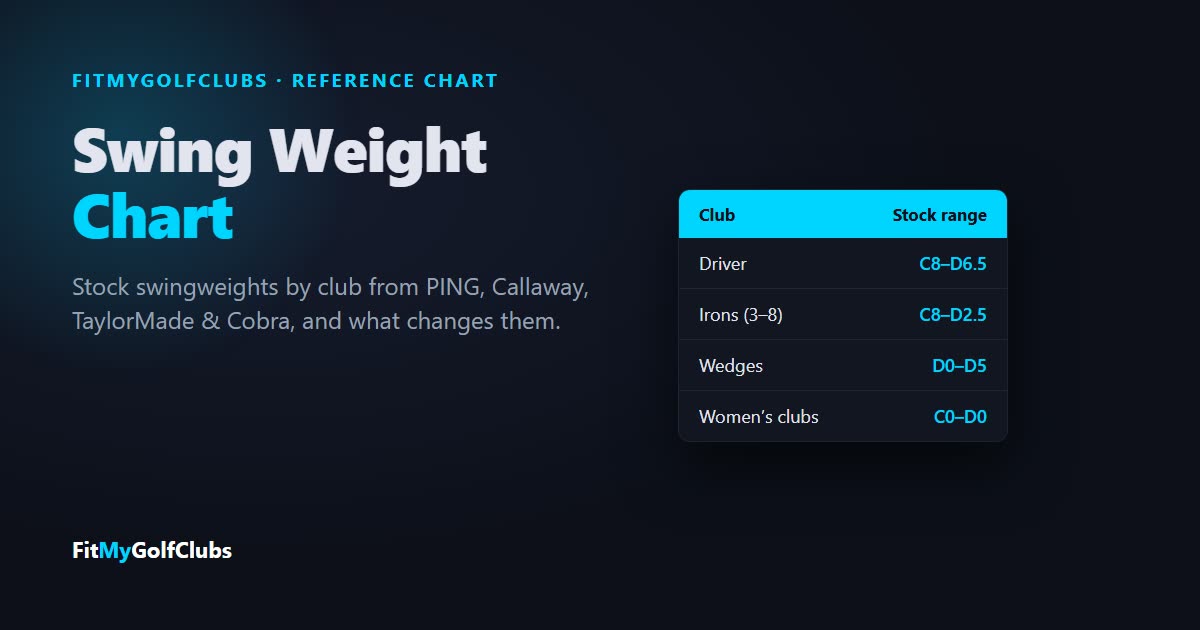
Swing Weight Chart: Standard Swingweights by Club and Brand
Swing weight chart: the A0–G9 scale, stock swingweights for drivers, irons and wedges from PING, Callaway, TaylorMade and Cobra, and what changes them.
Golf Club Fitting
October 8, 2026
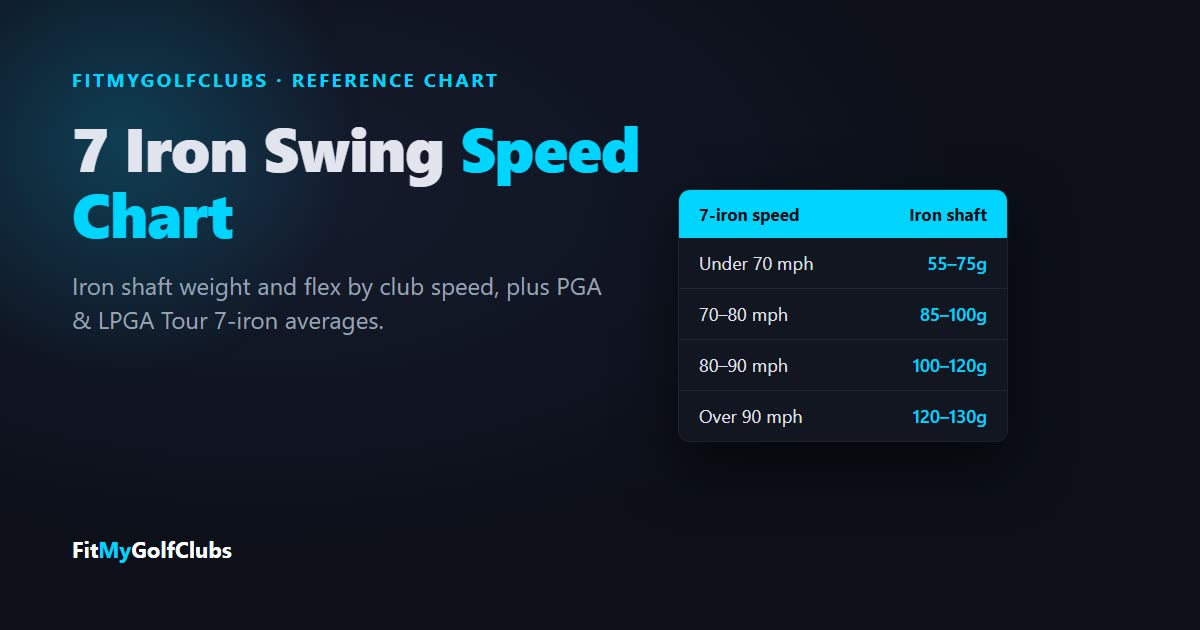
7 Iron Swing Speed Chart: Iron Shaft Weight, Flex & Carry
7 iron swing speed chart: iron shaft weight and flex by club speed, PGA (92 mph) and LPGA (78 mph) Tour averages, and 7-iron carry by speed.
Golf Club Fitting
October 8, 2026
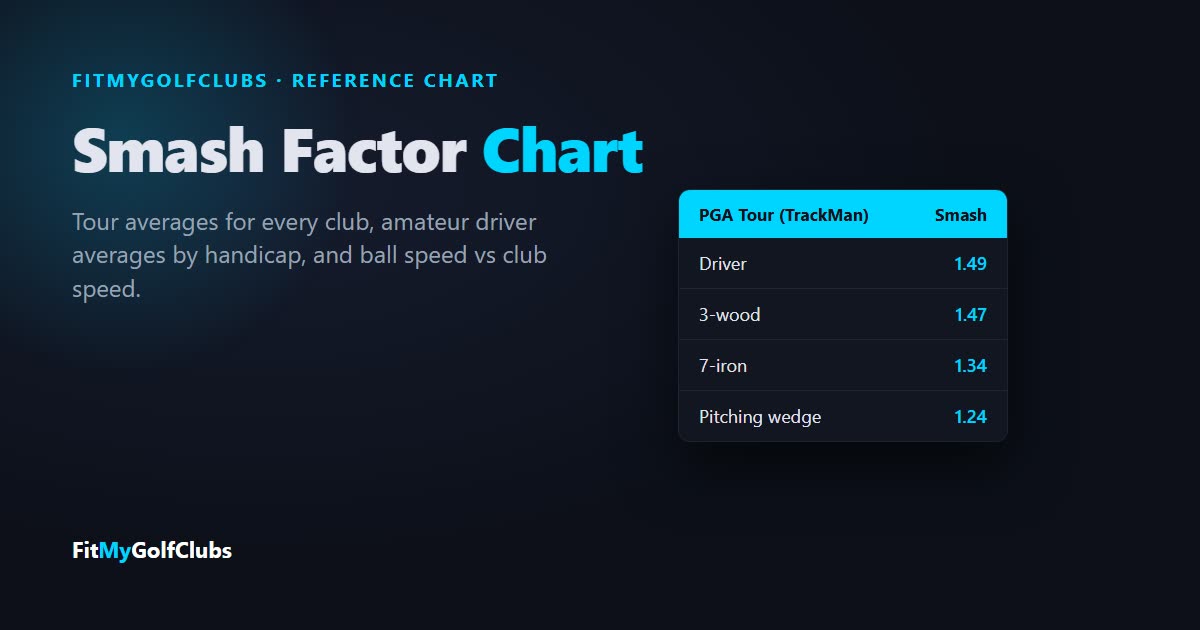
Smash Factor Chart: Tour Averages by Club + Ball Speed
Smash factor chart by club from TrackMan PGA and LPGA Tour averages, amateur driver averages by handicap, and a club speed to ball speed table.


© 2026 FitMyGolfClubs. All rights reserved. | Patent Pending
Contact: sean@fitmygolfclubs.com