
Golf Club Fitting
September 7, 2026
Almost every golf club loft chart online does the same two things: it shows you a table of "standard" numbers, and then it stops. Here is the part those charts leave out — your clubs are almost certainly not those numbers. Two 7-irons stamped the same can sit two degrees apart straight from the factory, and a set that's been bent, dropped, or hit off enough range mats drifts further every season.
So this page does both halves. Below are the standard loft and lie specs for every club from driver to lob wedge — and then a free, brand-agnostic way to check your own clubs at home and see how far off spec they really are. We don't sell loft machines and we're not sponsored by an equipment brand; this is the same honest approach behind our free bag-grading app, which grades your whole bag across the same eight fitting factors a fitter checks.
📄 Prefer it on paper?
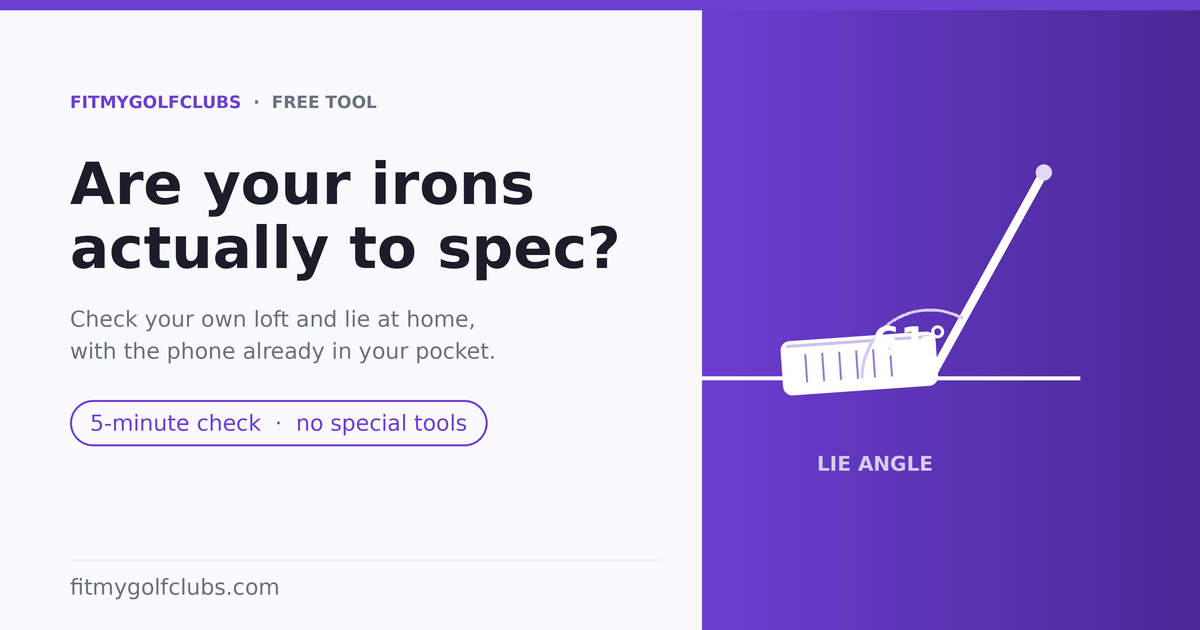
Download the free Club Angle Check Mat (PDF) — print it, and check your own loft and lie with the phone already in your pocket. No machine, no fitting fee.
What loft and lie actually are
Loft is the angle of the clubface tilted back from vertical. More loft means a higher, shorter shot — it's the single biggest reason a 9-iron flies higher and shorter than a 6-iron. Lie is the angle between the shaft and the ground when the club is soled properly. It doesn't change how far the ball goes nearly as much as it changes where it starts: a lie too upright for you pulls shots left, too flat pushes them right (for a right-hander), and the effect grows with the shorter, higher-lofted clubs.
Two things are worth knowing before you read any chart, including this one. First, there is no single industry standard — each manufacturer sets its own numbers, so a "7-iron" is a marketing label, not a fixed loft. Second, the number stamped on the sole is the factory's intention, not a measurement of the club in your hands. That's the whole reason the check-your-own section at the bottom exists.
The complete golf club loft chart (2026)
Typical loft ranges across current-model clubs, driver through lob wedge. Iron rows span the full market — from strong-lofted game-improvement sets at the low end to players' blades at the high end (the category table below breaks that spread out). Carry numbers are rough mid-handicap averages for a right-handed male golfer — use them for relative gapping, not as targets.
| Club | Typical loft | Avg. carry (men) | Category |
|---|---|---|---|
| Driver | 9°–12° | 210–240 yd | Wood |
| 3-wood | 13.5°–16° | 195–225 yd | Wood |
| 5-wood | 17°–19° | 180–210 yd | Wood |
| 7-wood | 20°–22° | 170–195 yd | Wood |
| 3-hybrid | 19°–21° | 170–195 yd | Hybrid |
| 4-hybrid | 22°–24° | 160–185 yd | Hybrid |
| 5-hybrid | 25°–27° | 150–175 yd | Hybrid |
| 4-iron | 19°–25° | 155–180 yd | Iron |
| 5-iron | 22°–28° | 145–170 yd | Iron |
| 6-iron | 25°–31° | 135–160 yd | Iron |
| 7-iron | 28°–35° | 125–150 yd | Iron |
| 8-iron | 32°–39° | 115–140 yd | Iron |
| 9-iron | 36°–43° | 105–130 yd | Iron |
| Pitching wedge | 41°–47° | 95–120 yd | Wedge |
| Gap / approach wedge | 48°–52° | 80–105 yd | Wedge |
| Sand wedge | 54°–56° | 70–95 yd | Wedge |
| Lob wedge | 58°–60° | 55–80 yd | Wedge |
| Putter | 2°–4° | — | Putter |
Iron loft chart: players' vs. game-improvement
The biggest reason two 7-irons can be four degrees apart is category. Game-improvement irons are "de-lofted" — a stronger loft is stamped with a higher number so the club flies farther and sells better. That's why comparing a distance iron to a blade by the number on the sole is meaningless. Compare by loft instead.
One brand's line shows how wide the spread gets: the PXG 0311 XP GEN8 7-iron is 27° and the 0311 T GEN8 7-iron is 32°. Our PXG iron loft chart lays out every current PXG model side by side. Mizuno's spread is almost as wide: the JPX 925 Hot Metal 7-iron is 28° and the Mizuno Pro S-1 7-iron is 34° (see our Mizuno iron specs chart). Titleist's T-Series runs from a 29° T350 7-iron to a 35° T250 Launch Spec 7-iron (see our Titleist iron loft chart), and PING builds most irons in three loft specs: a G440 7-iron is 27.5° in Power Spec, 29° standard and 31° in Retro Spec (see our PING iron loft chart).
| Iron | Players' / blade | Traditional (1990s) | Modern game-improvement |
|---|---|---|---|
| 4-iron | 23°–25° | 25° | 19°–21° |
| 5-iron | 26°–28° | 28° | 22°–24° |
| 6-iron | 29°–31° | 31° | 25°–27° |
| 7-iron | 33°–35° | 35° | 28°–30° |
| 8-iron | 37°–39° | 39° | 32°–35° |
| 9-iron | 41°–43° | 43° | 36°–39° |
| Pitching wedge | 45°–47° | 47° | 41°–44° |
Notice the knock-on effect: a 43° game-improvement pitching wedge sits ten degrees or more from a standard 56° sand wedge — a distance hole that no amount of practice fixes. It's why so many game-improvement sets need a gap wedge the golfer didn't know to buy.
Golf club lie angle chart by iron
Lie gets progressively more upright as clubs get shorter, because you stand closer to the ball with a shorter club. Lie varies less between manufacturers than loft does, but there is still no single standard — so the column below is a representative range, and what matters far more than any single value is whether your set steps evenly. One iron sitting well off its neighbors is almost always the club; a whole set reading a touch flat is almost always the measurement.
| Iron | Standard lie (range) | Reads "upright" | Reads "flat" |
|---|---|---|---|
| 3-iron | 59°–60° | > 60° | < 59° |
| 4-iron | 60°–61° | > 61° | < 60° |
| 5-iron | 60.5°–61.5° | > 61.5° | < 60.5° |
| 6-iron | 61.5°–62.5° | > 62.5° | < 61.5° |
| 7-iron | 62°–63° | > 63° | < 62° |
| 8-iron | 62.5°–64° | > 64° | < 62.5° |
| 9-iron | 63°–65° | > 65° | < 63° |
| Pitching wedge | 63.5°–65.5° | > 65.5° | < 63.5° |
A useful rule of thumb: standard iron sets step lie by half a degree to a full degree per club, so a clean progression matters more than hitting any exact figure. And when you add a club by brand and model in the FitMyGolfClubs app, it uses that model's actual catalog spec rather than these representative ranges. Whether a lie is "right" for you ultimately depends on your height, arm length, and swing — which is why the honest next step is to measure what you have, then compare.
Wedge gapping: building your loft ladder
Wedges are where loft gaps do the most scoring damage, because these are your scoring clubs. The goal is even steps — usually four to six degrees — from your pitching wedge down to your most-lofted wedge. Common setups:
| Setup | Pitching wedge | Gap wedge | Sand wedge | Lob wedge |
|---|---|---|---|---|
| Classic 3-wedge | 46° | 52° | — | 58° |
| Even 4-wedge | 46° | 50° | 54° | 58° |
| Strong-loft GI set | 43° | 48° | 53° | 58° |
| Full-swing specialist | 45° | 50° | 55° | 60° |
Why the number on the sole is a lie
Two forces pull your clubs away from their stamped specs. Factory tolerance: heads leave the line within a tolerance of roughly one to two degrees, so a brand-new set can already have a club or two off its own spec sheet. Drift over time: forged and cast irons alike bend slightly from thousands of impacts, especially off firm range mats, and a single hard strike on a root or cart path can move a club a degree or more in an afternoon.
This is the exact gap loft-and-lie machine makers and fitting studios charge to close — they clamp your club in a machine and read it to a fraction of a degree. That precision is real and worth paying for when you're ready to bend a club. But you don't need a $500 machine or a fitting appointment just to find out which club is off. You can screen your whole bag at home, for free, with the sensor already in your phone.
How to check your own loft and lie at home
Every phone contains an inclinometer — the same sensor that knows which way is up. Rested against a soled club on a level surface, it reads the club's angle from gravity. It's not a fitting gauge and it won't read to a tenth of a degree, but it's more than accurate enough for the job that matters: telling you which club looks out of step so you know what to hand a fitter.
The free Club Angle Check Mat walks through the whole method — leveling the surface, soling the club heel-to-toe, and the one step most people skip (keeping the club from tipping forward or back, which is what actually moves the number). Print it at any size; nothing is measured off the page, so a torn-off sheet works as well as a perfect one.
📄 The free method, step by step
Download the Club Angle Check Mat (PDF) — five pages, phone-inclinometer method, plus a record sheet for your readings.
One honest caveat: lie is the easy one — the shaft is long and straight, so a phone reads it reliably. Loft is trickier, because you're reading off the clubface and small tips of the club shift the number, so expect a wider spread and take the middle of three readings. Never bend a club off a phone reading. The point isn't the exact number — it's spotting the outlier.
Loft & Lie Checker
FREE — NO SIGNUPEnter your irons' measured loft and lie — we'll flag off-standard clubs, wide or overlapping gaps, and broken lie progression. Leave blank what you haven't measured.
| Club | Loft ° | Lie ° | Status |
|---|
Open the full-page Loft & Lie Checker →
Screening check, not a fitting gauge — don't bend anything off these numbers. Standards vary by brand; these mirror the FitMyGolfClubs grader.
Turn your readings into a graded bag
A number on a page doesn't help until you do something with it. This is where the check mat connects to the app: type your measured loft and lie into your FitMyGolfClubs bag, and the grade scores your actual clubs instead of the catalog spec the factory intended.
See how your real specs grade — free
Grade every club in your bag across the eight factors a fitter checks — including Loft Gapping and Lie Angle Progression. Measure with the free mat, type in your numbers, and see exactly which clubs are holding your set back.
In the app, open your bag grade, tap into the Loft Gapping or Lie Angle factor, hit Edit in the Your Clubs header, adjust each club to what you measured, and Save & Regrade (one credit — the free credits you get at signup cover it). Anything you change is marked as your edit, and a reset returns it to the catalog value whenever you want. Leave a club blank rather than guessing — a blank falls back to the spec, which beats scoring yourself against a bad number.
Lie angle is the one fitting problem that doesn’t improve with skill: in our golf club fitting data by handicap, it’s the weakest fit factor in about one bag in four at every handicap level.
Frequently asked questions
What is the standard loft for a 7-iron?
There isn't one universal number. A traditional or players' 7-iron runs around 33°–35°, while a modern game-improvement 7-iron can be as strong as 28°–30°. That spread of six degrees or more is why you should compare irons by loft, not by the number stamped on the sole.
What should my lie angle be for my irons?
Standard iron lie runs from about 59°–60° in the long irons up to roughly 63°–65.5° in the wedges, stepping half a degree to a degree more upright per club. But the right lie for you depends on your height, arm length, and swing — the chart tells you what's standard; a dynamic lie check tells you what's yours.
Does one degree of lie angle really make a difference?
On the shorter, higher-lofted irons, yes — one degree of lie can move the ball a few yards offline at the target, and the effect grows the more loft the club has. On long irons and woods it matters less. It's most worth checking in your scoring irons and wedges.
How accurate are the lofts stamped on my clubs?
Treat them as the factory's intention, not a measurement. Manufacturing tolerance is roughly one to two degrees, and clubs drift further with use, so a real set almost always has a club or two off its own spec sheet. That's exactly what the free check mat is for.
Can I really check loft and lie at home without a machine?
Well enough to screen your bag, yes. Your phone's inclinometer, rested on a soled club on a level surface, reads angle from gravity and will reliably flag which club is out of step. It won't replace a fitter's clamped machine for the fraction-of-a-degree precision you need before bending anything — but it tells you which club to ask about, which is the expensive part to figure out otherwise.
Related reading
- Golf Club Fitting Chart — Length and lie by height, flex by swing speed, and every chart we publish in one place.
- Golf Swing Speed & Shaft Flex Chart — match your speed to the right shaft, the other half of a proper fit.
- Golf Club Distance Chart — how far each club actually goes by age, speed, and skill level.
- PXG Iron Loft Chart — loft, lie, length and offset for every 0311 GEN8, GEN7 and Black Ops iron.
- Golf Club Length Chart — the wrist-to-floor method for the third spec that has to fit your body.
- Golf Ball Compression Chart — every popular ball's compression and the range for your swing speed.
- Titleist Iron Loft Chart — Loft, lie and length for every T100, T150, T250, T250 Launch Spec and T350 iron.
- PING Iron Loft Chart — Loft, lie, offset and length for every G440, G430, i240, i230 and Blueprint iron.
- Vokey Grind Chart — Every SM11 loft, bounce and grind, and what each grind is for.
- Wedge Distance Chart — Pitching, gap, sand and lob wedge yardages, plus wedge loft gapping.
Loft and lie figures are representative standards; there is no universal industry spec, and every manufacturer sets its own numbers — always verify against your clubs. FitMyGolfClubs is brand-agnostic and independent. Last verified September 2026.
Related Articles

Golf Club Fitting
October 22, 2026
FitMyGolfClubs Launches an AI-Guided Live Demo for Golf Pros and Club Fitters
Try the pro side of FitMyGolfClubs without signing up: an AI assistant walks you through a sample pro account by voice, 15 or 30 minutes, from one link.
Golf Club Fitting
October 8, 2026
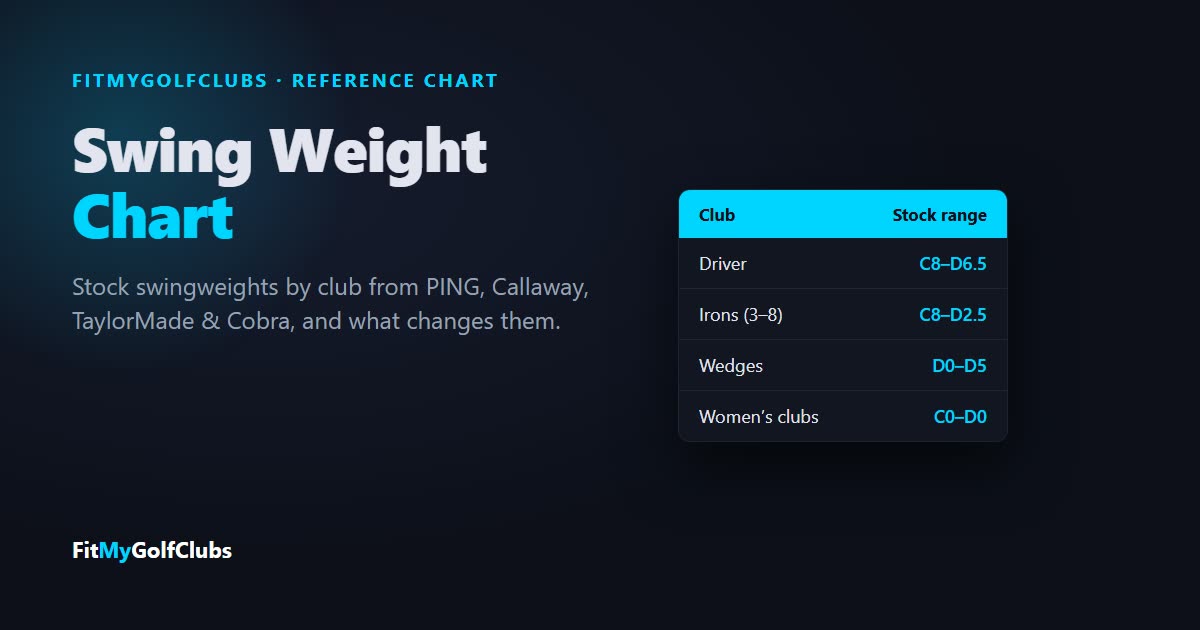
Swing Weight Chart: Standard Swingweights by Club and Brand
Swing weight chart: the A0–G9 scale, stock swingweights for drivers, irons and wedges from PING, Callaway, TaylorMade and Cobra, and what changes them.
Golf Club Fitting
October 8, 2026
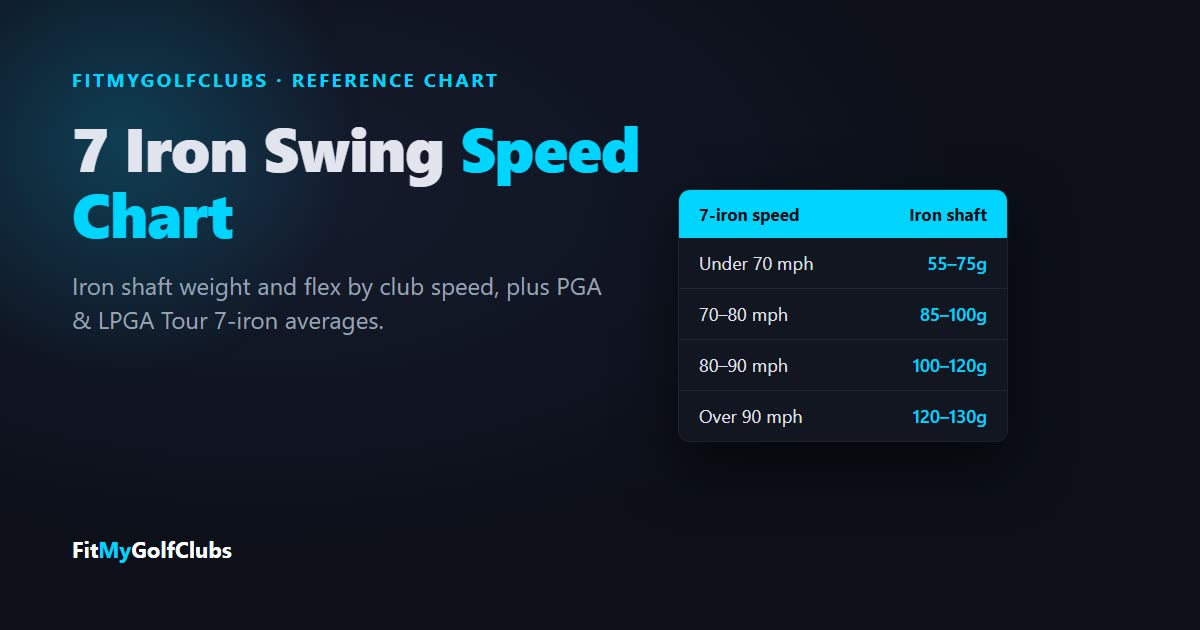
7 Iron Swing Speed Chart: Iron Shaft Weight, Flex & Carry
7 iron swing speed chart: iron shaft weight and flex by club speed, PGA (92 mph) and LPGA (78 mph) Tour averages, and 7-iron carry by speed.


© 2026 FitMyGolfClubs. All rights reserved. | Patent Pending
Contact: sean@fitmygolfclubs.com