
Golf Club Fitting
August 11, 2026
Golf ball compression is the most misunderstood number in golf — partly because manufacturers stopped printing it on the box, and partly because the old "match compression to swing speed or lose distance" rule isn't quite how modern balls work.
This guide gives you a complete golf ball compression chart for the most-played balls, shows which compression range fits your swing speed, and explains what compression actually changes (and what it doesn't).
Golf ball compression — the quick answer: compression measures how much a ball deforms at impact, usually on a scale from about 30 (very soft) to 110 (very firm). As a starting point by driver swing speed: under 85 mph favors low compression (under 70), 85–105 mph fits mid compression (70–90), and 105+ mph can load high-compression balls (90+). Slower swings don't have to play soft balls — but soft balls feel better and spin less for most moderate-speed golfers.
Skip the chart — get your exact ball in 30 seconds
Our free Golf Ball Fitter picks a specific ball for your swing speed, feel, and budget — with a link to buy it.
⚡ Don't know your swing speed?
It's the number that picks your ball, your shaft flex, and your yardages. Get it in one step with our free Swing Speed Calculator. Find my speed →
Golf Ball Compression Chart
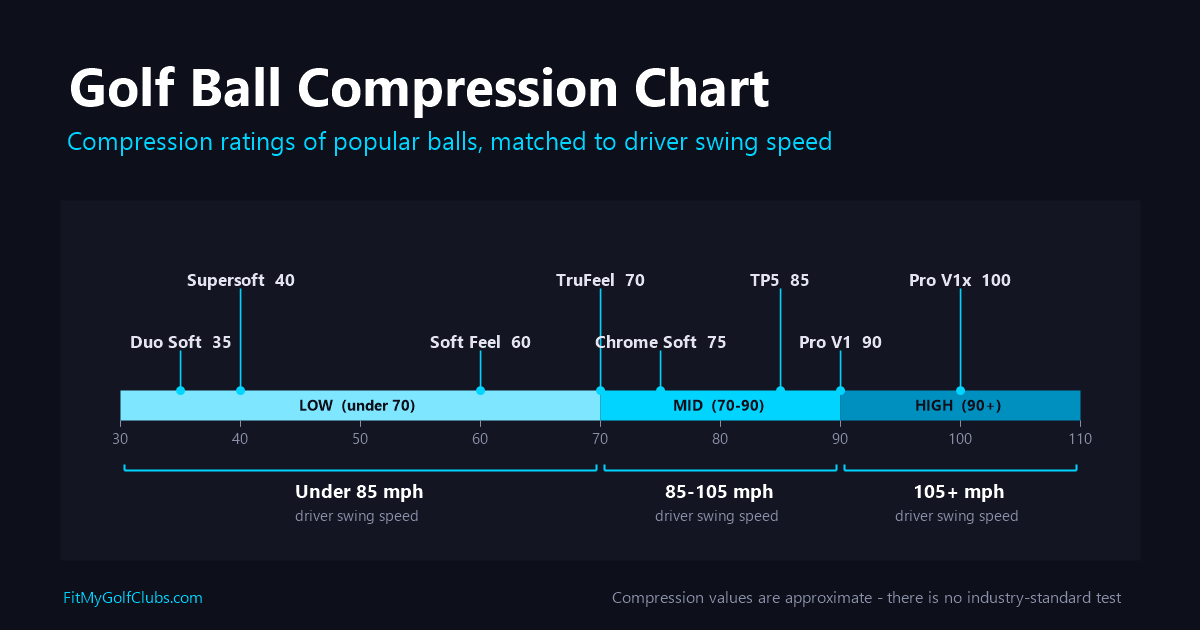
Compression ratings for the most-played golf balls, softest to firmest. There's no industry-standard test, so treat these as good approximations (independent lab numbers vary by a few points):
Want to compare these balls on more than compression? Our golf ball comparison chart puts 65 balls across 19 brands side by side — greenside spin, driver spin, price, alignment aids, bulk packs, and recycled options.
Golf Ball Compression by Swing Speed
Swing speed is the traditional way to pick a compression range — a faster swing compresses a firmer ball fully, while a slower swing gets better feel (and often better spin around the greens) from softer models. Find your driver speed band:
These bands are guidance, not law — plenty of 100+ mph players game soft balls for feel, and plenty of slower swingers play a Pro V1 just fine. If you're between bands, let greenside feel and driver spin break the tie. Not sure of your number? Our golf swing speed chart shows how to measure or estimate it.
Low Compression Golf Balls
Low compression golf balls (roughly 70 and under) deform more easily at impact, which does three things: they feel noticeably softer, they spin less off the driver (straighter for most golfers), and they help slower swings get the ball airborne. The softest widely-played options:
Wilson Duo Soft (~35) — routinely measured as the lowest-compression ball on the market. Maximum soft feel.
Callaway Supersoft (~40) — the best-selling low-compression ball; low spin, easy launch, forgiving on mishits.
Bridgestone e6 (~50) — soft with a slightly firmer cover for more short-game control than the ultra-soft group.
Srixon Soft Feel (~60) and Titleist Tour Soft (~65) — the "soft but not mushy" tier; good middle ground if the ultra-soft balls feel dead on putts.
One honest caveat: very soft balls typically give up a little ball speed at high swing speeds and spin less into greens. If you swing over ~100 mph, low compression usually costs you more than it gives.
🎯 The ball is one variable. Your 14 clubs are the other.
A ball change is worth a few yards — clubs that actually fit your swing are worth far more. Grade My Bag checks all 14 clubs across 8 fit factors, free. Grade my bag free →
Golf Balls for Slow Swing Speeds (Under 85 mph)
If your driver swing speed is under 85 mph — common for seniors, many women, and newer golfers — a low-compression ball is the standard recommendation, and for good reason: easier launch, less slice-aggravating spin, and softer feel at the moderate ball speeds your putter and wedges produce.
Start with the very-low group (Supersoft, Duo Soft) if feel is your priority, or the ~60–70 tier (Soft Feel, Tour Soft, TruFeel) if you want a bit more greenside response. The bigger win at this speed range, though, is usually equipment: a shaft that matches your speed adds more distance than any ball. Check your setup against the shaft weight guide and stiff vs regular flex.
Golf Balls for High Swing Speeds (105+ mph)
Fast swings compress any ball fully, so high-speed players choose on spin and flight instead: firmer, high-compression balls (Pro V1x, TP5x, Z-Star XV, Tour B X) hold their ball speed better, resist ballooning, and give the extra greenside spin strong players can use. A too-soft ball at this speed tends to feel mushy off the driver and can actually lose yards.
If you're carrying your driver 255+ (see what your speed should produce in the golf club distance chart), shop the 90+ compression tier.
What Is Golf Ball Compression?
Compression is a measure of how much a golf ball deforms under load — historically measured by pressing the ball a fixed distance and reading the resistance. Lower numbers = softer, easier-to-deform balls; higher numbers = firmer balls that need more force to compress fully.
Two things most charts don't tell you: there's no standardized industry test — each manufacturer (and each testing outlet) measures slightly differently, which is why published numbers for the same ball can vary by 5–10 points. And compression is a whole-ball property — core, mantle, and cover all contribute, which is why two balls with the same rating can feel different.
Does Compression Actually Matter?
Less than the marketing suggests, and differently than the old rule claims. Modern robot testing has shown that slower swingers don't lose meaningful distance playing high-compression tour balls — the "you can't compress it" story is largely a myth. What compression genuinely changes:
Feel — the biggest real difference. Softer balls feel softer on every shot, especially putts. This is personal preference, and it's a legitimate reason to choose a ball.
Spin and flight — softer two-piece balls generally spin less off the driver (straighter, but less greenside control); firmer multilayer balls spin more where good players want it.
Cold weather — all balls play firmer and shorter in the cold; soft balls keep acceptable feel on winter rounds.
So use the chart as a feel-and-spin guide keyed to your speed — not as a distance rule. And remember the ball is the cheapest variable in your setup: if you're chasing distance or consistency, your shafts and gapping move the needle more. That's what a golf shaft fitting — or a free bag grade — is for.
Ready to pick your ball?
Answer three quick questions and our free Golf Ball Fitter matches you to a specific ball by swing speed, feel, and budget.
Ball sorted. Now check the clubs.
FitMyGolfClubs grades all 14 clubs across 8 professional fit factors — flex, weight, length, lie, and more. No fitting appointment, no launch monitor required.
On a computer? You can also grade your bag in your browser — no app to install.
Frequently asked questions
What compression golf ball should I use for my swing speed?
As a starting point: under 85 mph driver speed suits low compression (under 70), 85–105 mph suits mid compression (70–90), and 105+ mph suits high compression (90+). Treat it as a feel-and-spin guide rather than a hard rule — modern testing shows distance differences between compressions are small at any speed.
Do low compression golf balls go farther for slow swing speeds?
Slightly, sometimes — but the effect is smaller than advertised. The real benefits of low compression for slower swings are softer feel, lower driver spin (straighter flight), and easier launch. If you want meaningful distance, shaft fit and strike quality matter far more than ball choice.
What is the lowest compression golf ball?
Wilson Duo Soft, at roughly 35 compression, is consistently measured as the softest widely-available ball, with Callaway Supersoft close behind around 40. Both are built for maximum soft feel and low driver spin.
What compression is a Pro V1?
The Titleist Pro V1 measures around 90 compression (high), and the Pro V1x around 100 (higher and firmer). Both are designed for players who compress the ball well — though anyone can play them if they like the feel and greenside spin.
Does cold weather affect golf ball compression?
Yes — balls firm up in the cold, playing harder and a little shorter. In winter, many golfers drop one compression tier (for example, from a Pro V1 to a Tour Soft) to keep normal feel and flight.
Are low compression golf balls better for seniors?
Usually, yes. Most senior golfers swing the driver between 70 and 85 mph, and in that range a low-compression ball (under ~70) — like the Wilson Duo Soft (~35), Callaway Supersoft (~40), or Srixon Soft Feel (~60) — is easier to compress, so you keep ball speed and carry instead of losing distance to a ball that is too firm. The trade-off is less greenside spin than a tour ball; seniors who want more short-game bite can step up to a soft urethane ball like the Callaway Chrome Soft (~75).
Which golf balls have around 80 compression?
In the mid-compression band (roughly 75–85), the most common choices are the Titleist AVX (~80), Callaway Chrome Soft (~75), and TaylorMade TP5 (~85). Mid-compression balls fit driver swing speeds of roughly 85–100 mph — enough speed to compress the ball fully, without needing a very high compression tour ball like the Pro V1x (~100).
Related reading
- Golf Club Fitting Chart — Length and lie by height, flex by swing speed, and every chart we publish in one place.
- Golf Ball Fitting: Free Tool + Chart — match a ball to your swing in 30 seconds.
- Golf Club Loft & Lie Chart — standard specs for every club, plus a free way to check your own at home.
- Golf Ball Comparison Chart: 65 Balls Across 19 Brands — every ball's features and price side by side, from tour urethane to bulk value.
- Golf Swing Speed Chart: Shaft Flex by Club Head Speed — The number that picks your ball also picks your shaft. Find it here.
- Golf Club Distance Chart — How far each club should go at your swing speed, skill level, and age.
- Golf Shaft Fitting: What It Costs & How to Do It Free Online — The equipment change worth more than any ball switch.
- Golf Shaft Weight Guide — Why weight beats flex for consistency.
Want the whole setup checked, not just the ball? Grade your bag with the FitMyGolfClubs app — 8 fit factors across all 14 clubs, free to start.
Related Articles
Golf Club Fitting
October 8, 2026
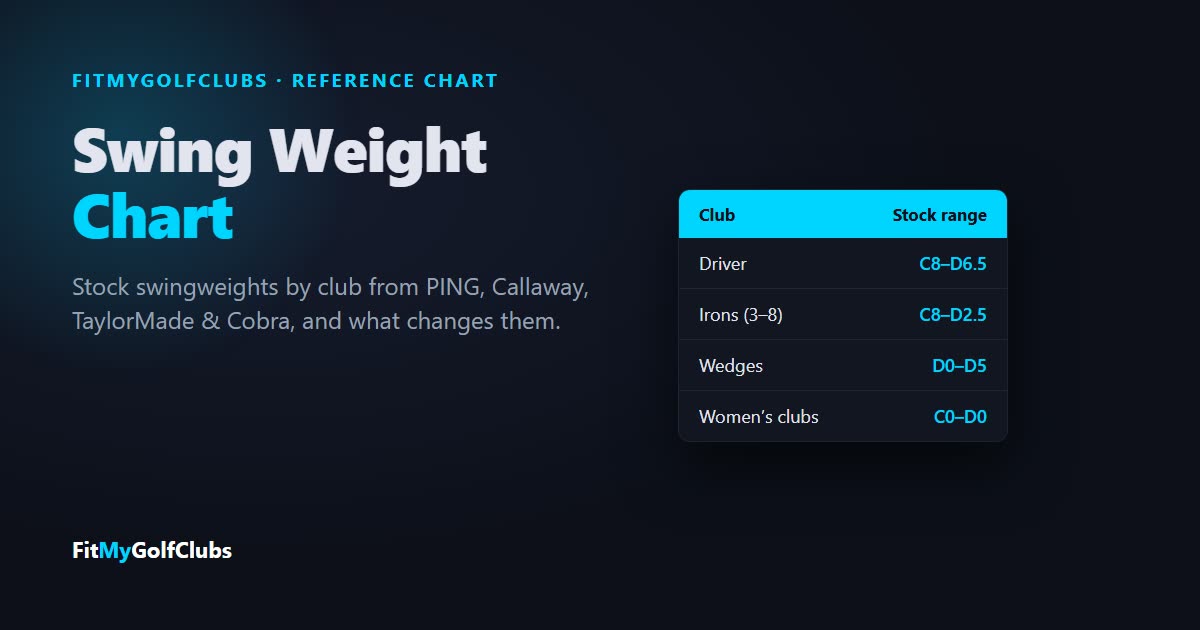
Swing Weight Chart: Standard Swingweights by Club and Brand
Swing weight chart: the A0–G9 scale, stock swingweights for drivers, irons and wedges from PING, Callaway, TaylorMade and Cobra, and what changes them.
Golf Club Fitting
October 8, 2026
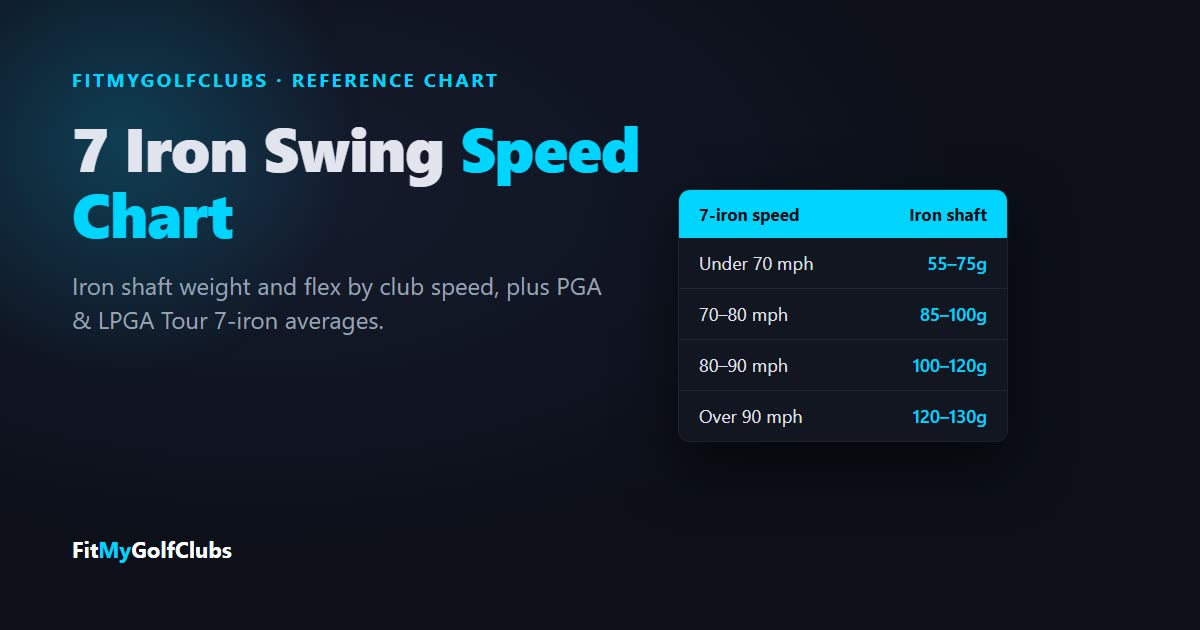
7 Iron Swing Speed Chart: Iron Shaft Weight, Flex & Carry
7 iron swing speed chart: iron shaft weight and flex by club speed, PGA (92 mph) and LPGA (78 mph) Tour averages, and 7-iron carry by speed.
Golf Club Fitting
October 8, 2026
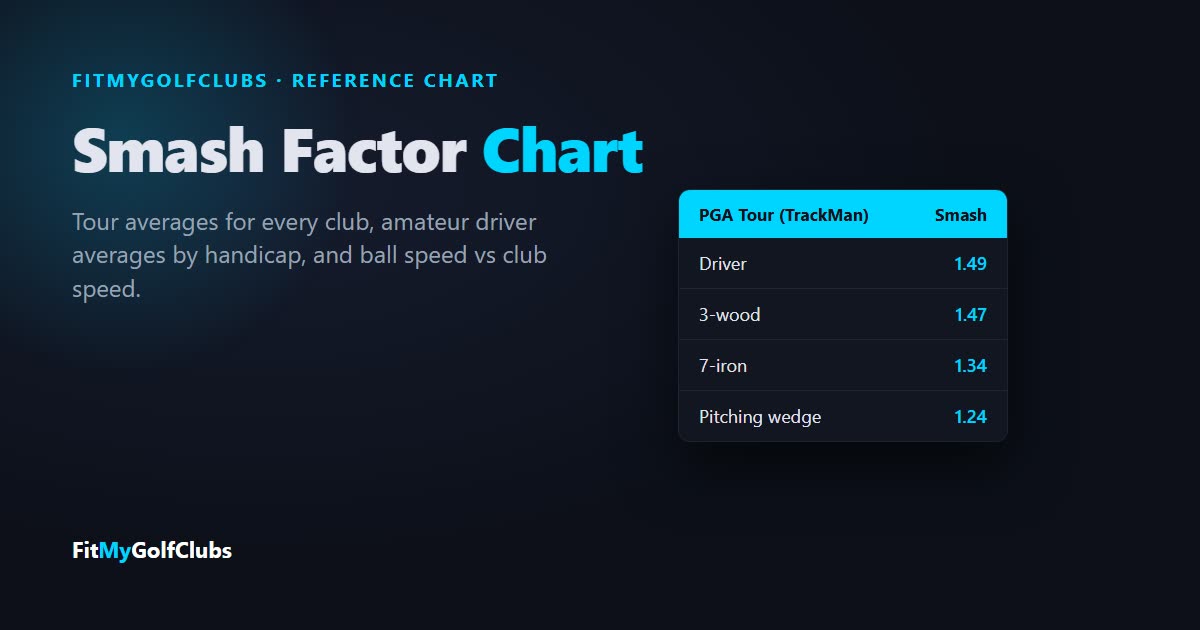
Smash Factor Chart: Tour Averages by Club + Ball Speed
Smash factor chart by club from TrackMan PGA and LPGA Tour averages, amateur driver averages by handicap, and a club speed to ball speed table.


© 2026 FitMyGolfClubs. All rights reserved. | Patent Pending
Contact: sean@fitmygolfclubs.com