
Golf Club Fitting
September 14, 2026
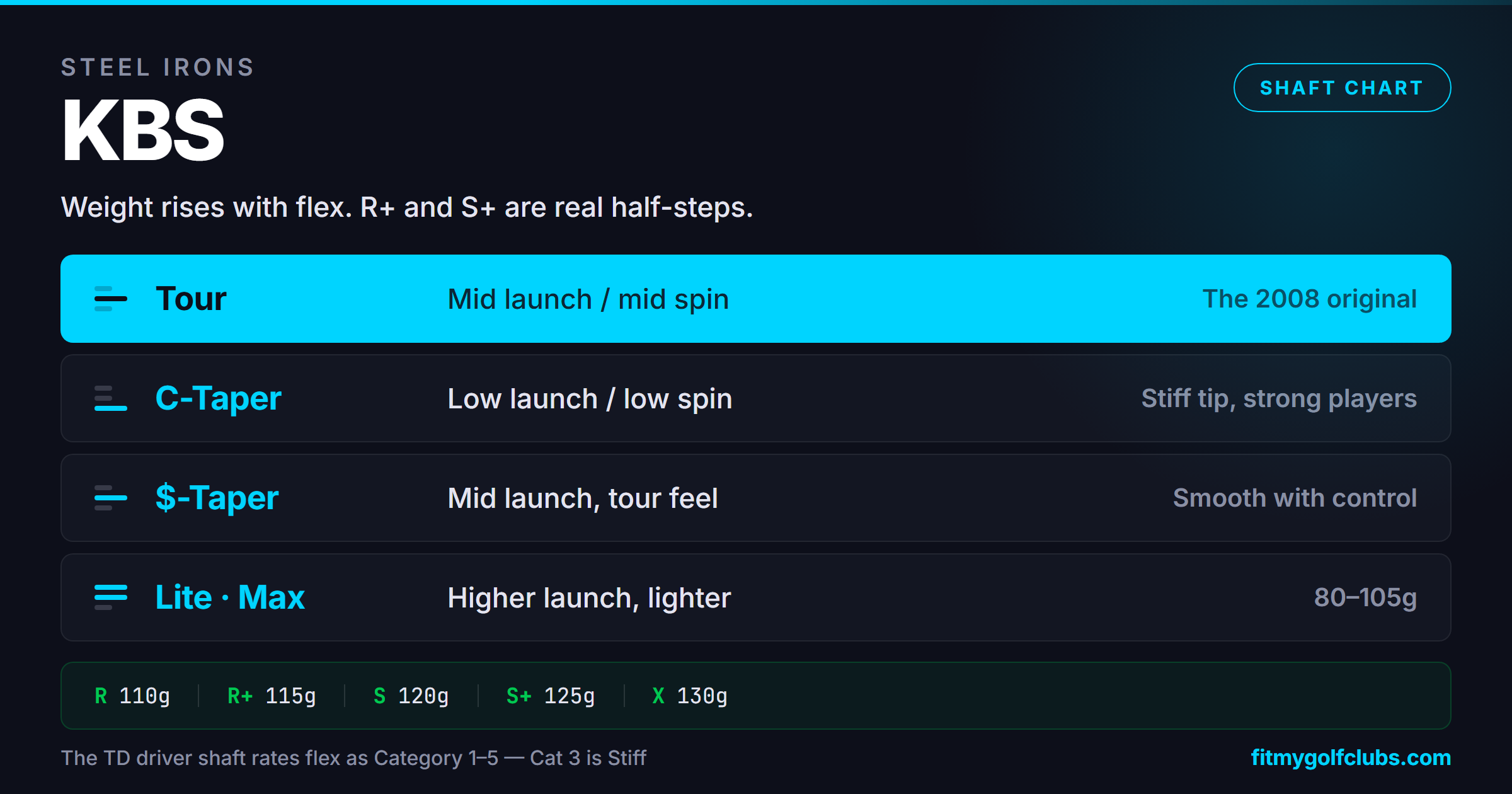
The quick answer: In KBS steel iron shafts, weight rises with flex inside the same model: a KBS Tour is 110g in Regular, 120g in Stiff, 130g in X-Stiff, and the R+ (115g) and S+ (125g) are genuine half-flex steps in between. The model name is the launch profile: Tour is mid launch / mid spin (the 2008 original), C-Taper is low / low with a stiff tip, $-Taper is mid with a smooth tour feel, Tour FLT is flighted (higher in long irons, lower in short), and Tour Lite and Max are the lighter, higher-launching options. The full chart is below.
KBS is the youngest of the big three steel iron-shaft makers — Kim Braly's company launched the KBS Tour in 2008 as a smoother alternative to Dynamic Gold and Project X — and it's now stock in a huge share of forged irons. Its charts are cleaner than True Temper's because KBS uses one system everywhere (weight tracks flex, R+/S+ are half-steps) and actually publishes torque. What confuses people is the number of variants: Tour, Tour 90, Tour 105, Tour Lite, Tour V, Tour FLT, C-Taper, C-Taper Lite, $-Taper, $-Taper Lite, Max, Max MT, plus the graphite TGI and PGI and the TD driver shaft with its "Category" flexes. This chart sorts all of them.
Every weight and torque figure below comes from the same shaft database that powers our club grader, so it matches what the app uses when it scores a KBS in your bag.
KBS Shaft Chart: Every Iron Shaft by Weight and Flex
Read the weight columns as the thing that changes: a KBS Tour S and a KBS Tour X are different shafts by 10 grams as well as by stiffness, which is why swapping flex in a KBS set changes swingweight more than it does in a constant-weight family. The + flexes exist in Tour, C-Taper, $-Taper and Tour FLT; the Lite and Max lines run R/S/X only.
⚡ Not sure which flex you are?
Our free Shaft Flex Calculator turns your swing speed into a flex recommendation in seconds — the AI mode factors in tempo and miss pattern. Get my flex →
What R+, S+, "Lite", "FLT" and the TD Categories Mean
R+ and S+ are true half-flexes: R+ (115g) sits between Regular and Stiff, S+ (125g) between Stiff and X. If you've ever been told you're "a soft stiff" in irons, KBS is one of the few brands where that's an orderable shaft rather than a compromise.
Lite versions (Tour Lite, C-Taper Lite, $-Taper Lite) are the same profile 10–20g lighter, and they launch a little higher because of it. FLT means flighted: the long irons are built to launch higher and the short irons lower, so the set's peak height evens out. Max is KBS's lightweight, high-launch steel for moderate speeds.
TD is KBS's graphite driver shaft, and it uses a different flex system — Category 1 through 5, where Cat 1 = A (senior), Cat 2 = R, Cat 3 = S, Cat 4 = X, Cat 5 = TX. A "TD 60 Cat 3" is a 60-gram stiff. Here are the typical speed bands for the iron shafts, in both driver and 7-iron speed:
These follow our brand-neutral swing speed shaft flex chart, with 7-iron speed taken as driver speed minus about 12 mph. KBS Tour plays true to its letter; C-Taper plays about a half-flex firm because of its stiff tip, so C-Taper players on a borderline usually take the softer step.
Practical shortcut: if KBS shafts are already in your irons, add them to your bag in the app exactly as printed — "KBS Tour S+," "C-Taper Lite R." The app maps the + flexes and Categories to playing flex automatically and grades your set's flex and weight consistency by spec, not by label.
Shaft Flex Calculator
FREE — NO SIGNUPEnter your driver swing speed — get your flex band instantly.
Don’t know your speed? Rough guide: 200-yd carry ≈ 90 mph, 220-yd ≈ 100 mph — or read it off the chart below.
Model by Model
KBS Tour (mid launch, mid spin — the original)
The shaft that started the company in 2008 and still its best seller. Tour has a smooth, active feel — KBS calls it "step-less" energy transfer — with mid launch and mid spin that fits the widest range of iron players. R 110g, R+ 115g, S 120g, S+ 125g, X 130g, torque 1.5–2.8°. It's stock in a lot of forged irons, so there's a good chance you've played one. If Dynamic Gold feels harsh and Project X feels dead, KBS Tour is usually where players land.
KBS C-Taper (low launch, low spin — the stiff-tip tour shaft)
The constant-taper design with the firmest tip in the KBS line, built for strong players who spin the ball too much or want a penetrating flight. Low launch, low spin, torque 1.4–1.8°, same weight ladder as Tour (110/115/120/125/130). C-Taper plays about a half-flex firmer than Tour at the same letter — a C-Taper S is closer to a Tour S+ — so a lot of Tour S players who try C-Taper do better in the R+. Under about 85 mph 7-iron speed it takes launch away faster than spin.
KBS $-Taper (mid launch, mid spin — the smooth tour shaft)
Launched in 2018 as the tour player's alternative to C-Taper: the same stability through impact but a softer, smoother feel from a tapered midsection, with mid launch and mid spin instead of low/low. Weight ladder 110/115/120/125/130, torque 1.5–1.9°. $-Taper is the shaft for the player who liked C-Taper's control but not its feel — and it's become one of the most-played iron shafts on tour for exactly that reason.
KBS Tour FLT (flighted — high in long irons, low in short)
Same weights as Tour (110–130 with R+ and S+) but the bend profile changes through the set: long irons launch higher for carry, short irons launch lower for control, so peak height and descent angle stay consistent from 4-iron to pitching wedge. Torque 1.4–1.8°. FLT is the right answer for players who flight their long irons too low and their wedges too high — a very common pattern in the 85–100 mph driver-speed range.
KBS Tour V (mid launch, firmer, lighter)
A 2012 profile that's lighter than Tour — R 100g, S 110g, X 120g — with a firmer feel and slightly lower spin, torque 1.7–2.0°. Tour V is the choice for players who want Tour-class weight savings without going to a "Lite" and without giving up stability. Not as common as Tour or $-Taper, but a good fit for the 95–105 mph player who finds the 120g Tour S a touch heavy.
KBS Tour Lite, C-Taper Lite and $-Taper Lite (the 95–115g versions)
The same three profiles at lower weight. Tour Lite (R 95 / S 100 / X 105g) is the mid-high launcher for moderate speeds. C-Taper Lite (R 105 / S 110 / X 115g) keeps a firm tip but launches mid-high because of the weight drop — it's a very different shaft from C-Taper despite the name. $-Taper Lite (R 95 / S 100 / X 105g) is the smooth mid-high option. Torque 1.8–2.3° across the three. If you're in the 80–92 mph driver-speed range and fighting a 120g steel shaft, one of these is likely the fix.
KBS Tour 90, Max 80 and Max 85 (lightweight high launch)
The lightest KBS steel. Tour 90 (R 95 / S 98g) is the lightweight version of the original Tour profile. Max 80 (R 80 / S 83g) and Max 85 (R 85 / S 90g) are built for high launch and easy speed for 70–88 mph driver swings — the steel alternative to a Recoil or TGI for players who want steel feel at graphite weight. Torque 2.3–2.5° in Max. There's also a Max MT 85 wedge version and a Max Lite.
KBS TGI and PGI (graphite iron shafts) and TD (graphite driver)
TGI — Tour Graphite Iron — is built to mimic KBS Tour feel in graphite: 50 (A), 60 (A/R), 70 (R/S), 80 (R/S/X), 90 (S) and 100 (X), torque 1.8–4.0°. PGI (Players Graphite Iron, 55–85g) is the lighter, higher-launching graphite line. TD is the KBS driver shaft in 40–80g with the Category 1–5 flex system (Cat 1 = A through Cat 5 = TX); Cat 3 is the standard stiff, and the 60 and 70 weights are where most 95–110 mph players fit. There's also the graphite Max HL driver shaft (40–45g) rated by swing speed right on the label — R2 for 65 mph and under, R1 for 65–72, R for 73–80.
KBS Hi-Rev 2.0 and 610 (wedge shafts)
Hi-Rev 2.0 (R 115 / S 125 / X 135g) is the high-spin wedge shaft — a softer tip designed to add spin and launch on partial shots, torque 1.8–2.2°. 610 (R 115 / S 125 / X 130g) is the opposite: a low-launch, low-spin wedge shaft for players who flight their wedges too high. Most sets use the iron shaft in "wedge flex" (KBS builds the Tour, C-Taper and $-Taper in a dedicated Wedge flex at 120–130g); Hi-Rev and 610 are for players who want a deliberately different wedge flight.
🔍 Already have a KBS in the bag?
Drop the club into our Single-Club Fit Grader and get an AI fit grade — flex, weight, and launch scored against your swing. Grade one club →
KBS vs Dynamic Gold vs Project X: Reading the Weights
The three big steel families rate flex differently, and KBS is the only one where weight moves with flex. Dynamic Gold S300 is 130g and R300 is 127g — the numbers are weight sorts, not flexes, and the whole line lives around 127–134g. Project X uses 5.0 / 5.5 / 6.0 / 6.5 at 113–130g and plays about a half-flex firm. KBS Tour spans 110–130g across R to X and plays true to its letter.
The practical consequence: a player moving from Dynamic Gold S300 (130g) to KBS Tour S (120g) drops 10 grams per iron and gets a softer feel at the same letter — often a good thing, sometimes a swingweight surprise. Moving from Project X 6.0 (120g) to KBS Tour S (120g) keeps the weight but softens the feel noticeably. See our Dynamic Gold shaft chart and Project X weights and specs for the full numbers.
Picking Your KBS: The Two-Question Shortcut
Question 1 — what's your miss? High, spinny irons that balloon → C-Taper (or 610 in the wedges). Low long irons and high wedges → Tour FLT. Irons that launch low and land hard → Tour Lite, $-Taper Lite or Max. Neither extreme → Tour or $-Taper — Tour if you like an active feel, $-Taper if you want tour stability with smoothness.
Question 2 — what's your speed? Use the flex table above and take R+ and S+ seriously; they exist because most players are between letters. Weight follows speed: Max and Tour 90 for 70–88 mph driver speeds, the Lite lines for 85–95, Tour / $-Taper / C-Taper 110–120g for 90–105, 125–130g for 105+.
🏌️ The shaft is one of 8 factors.
A perfectly-fit KBS in a mis-lofted head still costs you strokes. Grade My Bag scores all 14 clubs across the 8 factors pro fitters use — free, from your specs alone. Grade my bag free →
Frequently asked questions
How much does a KBS Tour shaft weigh?
KBS Tour is 110g in Regular, 115g in R+, 120g in Stiff, 125g in S+, and 130g in X-Stiff. Weight rises with flex inside every KBS steel model — the same ladder applies to C-Taper, $-Taper and Tour FLT.
What is the difference between KBS Tour and KBS C-Taper?
Same weights (110–130g), different profile. Tour is mid launch, mid spin with a smooth, active feel. C-Taper has a much stiffer tip for low launch and low spin, and plays about a half-flex firmer at the same letter — a C-Taper S is closer to a Tour S+.
What do R+ and S+ mean on KBS shafts?
They're half-flexes. R+ (115g) sits between Regular and Stiff and fits about 88–96 mph of driver speed; S+ (125g) sits between Stiff and X-Stiff and fits about 102–109 mph. They're available in Tour, C-Taper, $-Taper and Tour FLT.
What swing speed is a KBS Tour S for?
About 95–104 mph of driver speed, or roughly 83–91 mph of 7-iron speed. KBS Tour R fits about 75–89 mph driver speed, Tour X about 105–114 mph. C-Taper wants a few more mph at the same letter.
What is the difference between KBS $-Taper and C-Taper?
Both are tour-stability shafts on the same 110–130g ladder. C-Taper is low launch, low spin with a stiff tip and a firm feel. $-Taper is mid launch, mid spin with a tapered midsection that makes it feel smoother — it was built for players who wanted C-Taper control without C-Taper feel.
What does Category 3 mean on a KBS TD driver shaft?
Category 3 is Stiff. The KBS TD driver shaft uses Categories instead of letters: Cat 1 = A (senior), Cat 2 = R, Cat 3 = S, Cat 4 = X, Cat 5 = TX. A TD 60 Cat 3 is a 60-gram stiff-flex driver shaft.
Related reading
- Dynamic Gold Shaft Chart — The other steel benchmark — why S300 is a weight sort, not a flex.
- Project X Shaft Weights & Specs Chart — Every gram figure for PX, LZ, IO and LS, to compare against the KBS ladder.
- Nippon Modus & N.S. Pro Shaft Chart — The Japanese steel family — Modus 105/120/130 and the lightweight 950GH.
- Golf Shaft Weight Guide — Why the 10g between KBS Tour S and X matters as much as the flex.
Know the shaft. Now check the whole bag. The FitMyGolfClubs app grades all 14 clubs across eight fitting factors — shaft flex and weight included — straight from your specs. Free to start.
Related Articles
Golf Club Fitting
September 14, 2026
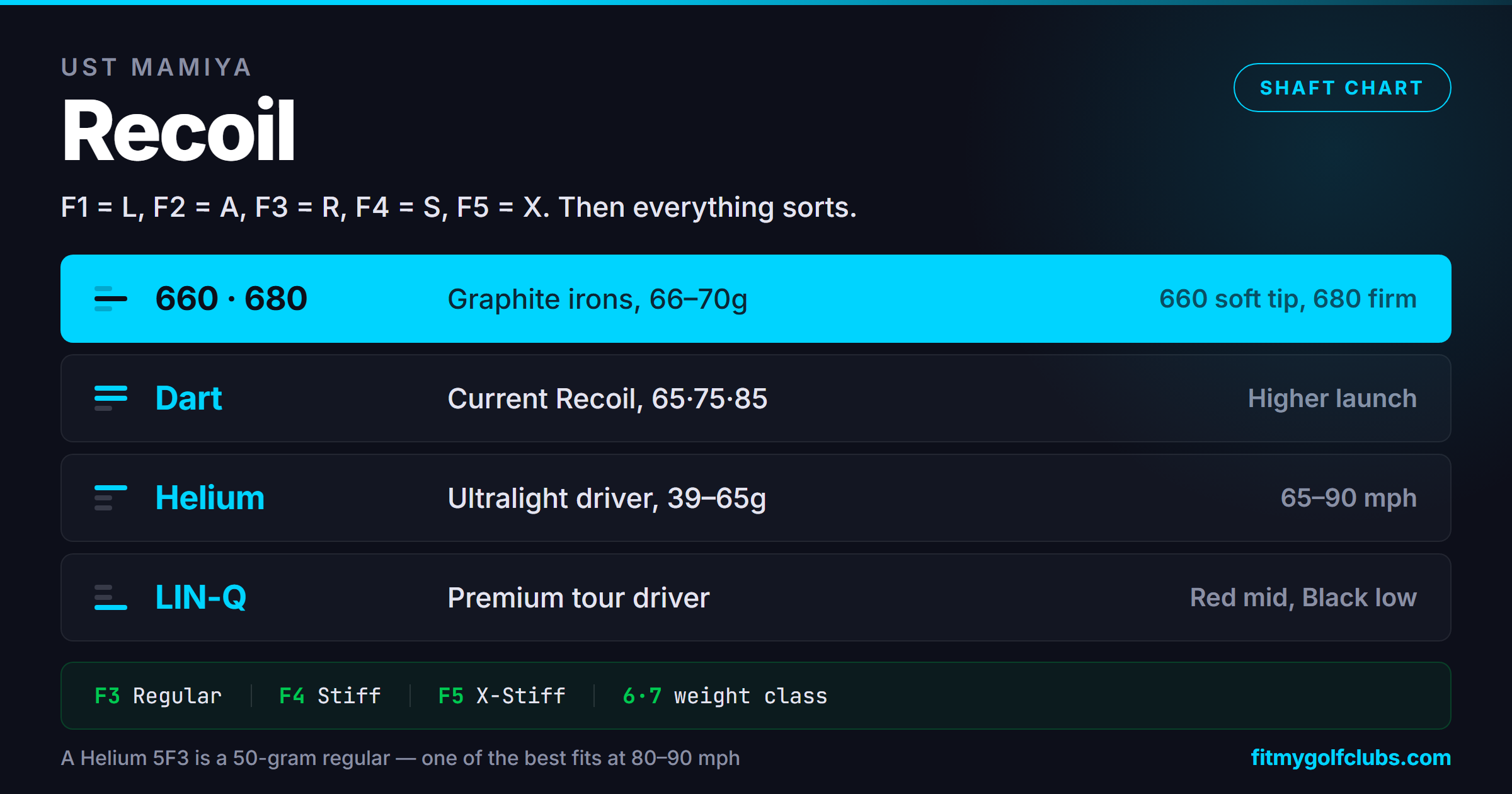
UST Mamiya Shaft Chart: Recoil, Helium, LIN-Q & ATTAS Decoded
UST Mamiya shaft chart: F1–F5 flex decoded (F3 = R, F4 = S), Recoil 660 vs 680 vs Dart, Helium, LIN-Q Red vs Black and ATTAS — weights and torque.
Golf Club Fitting
September 14, 2026
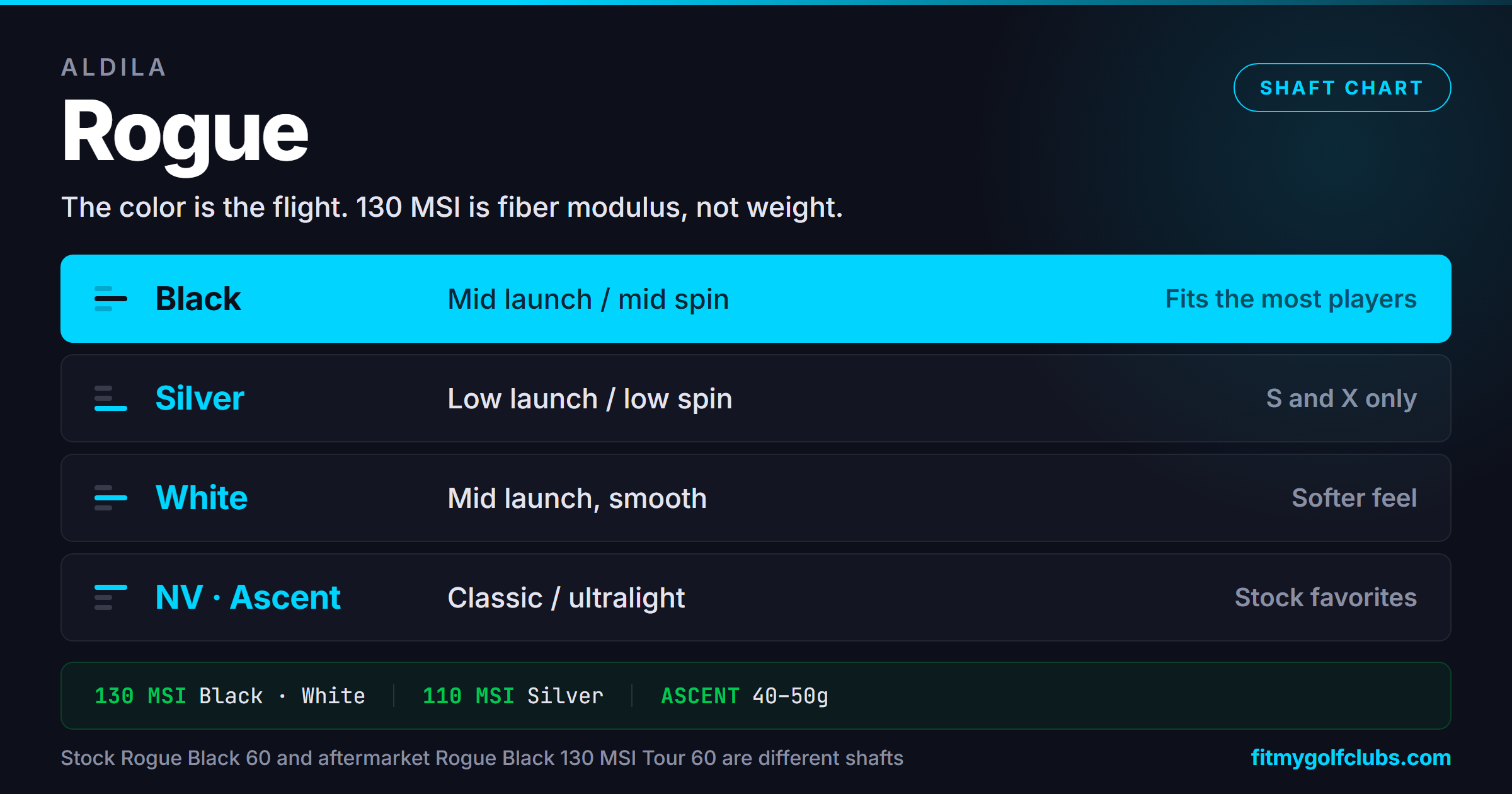
Aldila Shaft Chart: Rogue, NV, Ascent & Synergy by Launch and Weight
Aldila shaft chart: Rogue Black (mid), Silver (low spin), White (smooth), NV, Synergy, Ascent and Quaranta — weights, torque, and what 130 MSI means.
Golf Club Fitting
September 14, 2026
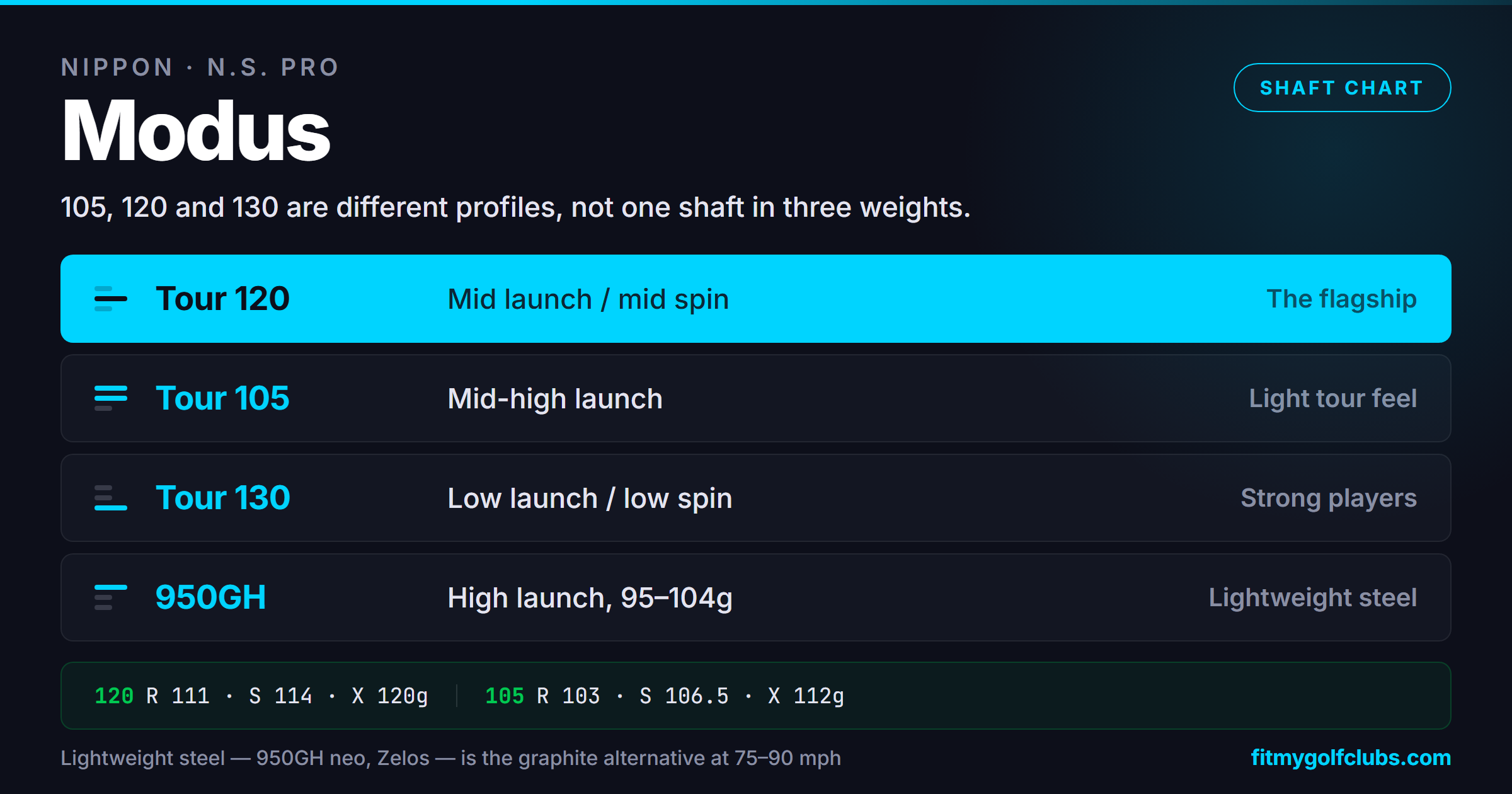
Nippon Modus & N.S. Pro Shaft Chart: 105, 120, 130 & Every GH Weight
Nippon shaft chart: Modus3 Tour 105–130 weights by flex and launch, plus N.S. Pro 950GH, 850GH, 1050GH, 1150GH and Zelos — lightweight steel decoded.


© 2026 FitMyGolfClubs. All rights reserved. | Patent Pending
Contact: sean@fitmygolfclubs.com