
Golf Club Fitting
September 23, 2026
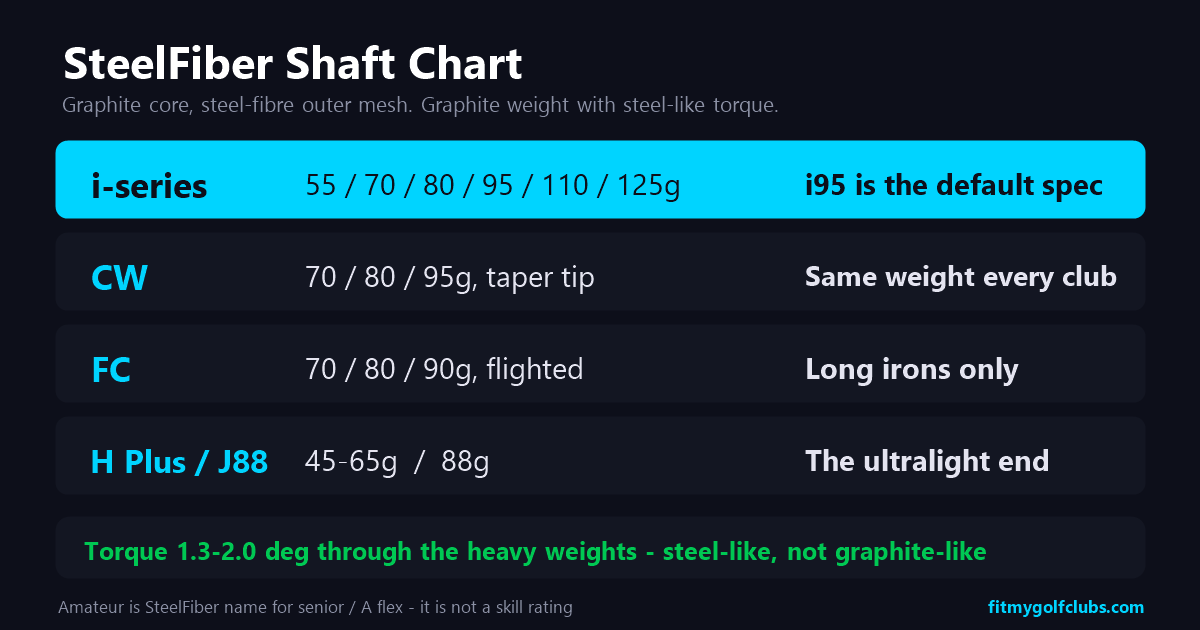
The quick answer: SteelFiber is a composite iron shaft — a graphite core wrapped in a steel-fibre outer mesh — and the number in the name is the weight in grams. The core i-series runs 55, 70, 80, 95, 110 and 125 grams in Amateur, Regular, Stiff and X-Stiff. i95 is the most-played spec at 95–100g. Alongside it sit FC (flighted, higher launch in the long irons), CW (constant weight, taper tip), H Plus (ultralight, 45–65g) and J88 (88g). The full chart is below.
SteelFiber's whole reason for existing is that golfers who need to leave steel usually do not want what graphite traditionally did to an iron. True Temper describes the construction as a graphite composite core that dampens vibration, wrapped in an outer mesh of more than fifty-nine miles of steel fibre that resists twisting on off-centre strikes the way steel does. The result is a shaft that weighs what graphite weighs and behaves much closer to how steel behaves, which is why it has had a genuine tour presence rather than being purely a senior product.
One naming note before the chart. These shafts were built by Aerotech for years and are now sold under True Temper, and the catalogue increasingly lists them by weight ("SteelFiber 95g") where golfers and older shaft bands say i95. They are the same shaft. This chart uses both names throughout. Torque figures come from the same shaft database that powers our club grader.
SteelFiber Shaft Chart: Every Model
Torque is the headline number here, not weight. At 1.3 to 2.0 degrees through the heavier i-series, SteelFiber is as torsionally stable as most steel and far stiffer in torsion than any conventional graphite iron shaft, which typically runs 3 degrees and up. That single figure is why a 95 gram SteelFiber does not feel like a 95 gram graphite shaft, and it is the reason the line exists. A dash in the torque column means our database does not yet hold a measured figure for that model.
Within the i-series, weight also rises slightly with flex inside the same model: our database has i95 at 95g in Regular, 97g in Stiff and 100g in X-Stiff, and i110 at 108 / 110 / 112. So the name is the weight class, and the flex fine-tunes it by a few grams — a different convention from the KBS steel lines where the steps are much larger.
⚡ Not sure which flex you are?
Our free Shaft Flex Calculator turns your swing speed into a flex recommendation in seconds — the AI mode factors in tempo and miss pattern. Get my flex →
Which SteelFiber Weight and Flex Fits You
Two decisions, in this order: weight first, then flex. Weight is the reason anyone buys a SteelFiber, and getting it wrong is the expensive mistake. Flex follows the normal bands.
These are driver swing speeds as the reference, with iron speed running roughly 10–15 mph slower for the same golfer:
These bands follow our brand-neutral swing speed shaft flex chart, and through the 90–99 mph stretch tempo decides rather than the speed number alone. SteelFiber's own "Amateur" flex is simply its name for senior or A flex — it is not a skill rating, and there is nothing amateur about the shaft.
The practical weight rule: a SteelFiber should usually be within about ten grams of the steel shaft it replaces if you like your current flight, and twenty to thirty grams lighter if the point is to reduce load. Jumping from a 120 gram steel shaft to an i70 changes swing weight, tempo and flight all at once. Add the set in the app and the grader scores weight progression across all fourteen clubs, which is where an over-large jump shows up.
Shaft Flex Calculator
FREE — NO SIGNUPEnter your driver swing speed — get your flex band instantly.
Don’t know your speed? Rough guide: 200-yd carry ≈ 90 mph, 220-yd ≈ 100 mph — or read it off the chart below.
Model by Model
SteelFiber i-series (i55 to i125)
The core line and the one most people mean by "SteelFiber". Parallel tip at 0.370 inches, six weight classes from a very light 55 grams up to 125 grams which is genuinely tour weight. The i95 is the volume seller and the natural landing spot for a player coming out of 110 to 120 gram steel who wants roughly twenty grams back without changing how the club behaves. Torque is exceptional through the heavier weights — our database has i125 in Stiff at 1.3 degrees, which is stiffer in torsion than a lot of steel.
SteelFiber CW: constant weight, taper tip
The same construction in a 0.355 inch taper tip with a constant-weight design, offered in 70, 80 and 95 grams. The point is in the name: every shaft in the set weighs the same regardless of length, so a 3-iron and a pitching wedge carry identical weight specs. Conventional shafts get heavier as they get shorter, and some players feel that as an inconsistency through the set. If you have ever said your short irons feel heavy relative to your long irons, CW is the product built for that complaint.
SteelFiber FC: flight control
FC pairs the standard SteelFiber structure with a progressive, variable tip — softer and more active in the long irons for height, firmer in the scoring clubs for control. True Temper's framing is "higher flight where you need it, classic SteelFiber where you do not." It comes in 70, 80 and 90 grams in Amateur, Regular and Stiff, with a heavier 115 gram build in our database at 1.4 degrees of torque. This is the SteelFiber for the player whose 4 and 5 irons will not get airborne but whose wedges are fine.
SteelFiber H Plus and J88
H Plus is the ultralight end, at 45, 55 and 65 grams in Amateur and Regular, described by the maker as a high-launch design for maximum swing speed. At 45 grams it is about as light as an iron shaft gets and is squarely a slower-swing product. J88 is a single 88 gram parallel build in Regular and Stiff, positioned for higher launch with parallel-tip versatility so a builder can tune it. Both sit below the i-series in weight and above conventional graphite in stability.
The hybrid and wedge versions
SteelFiber HLS 780 and HLS 880 are the hybrid-specific shafts, and there are wedge builds in the i95, i110 and i125 weights, plus a Black Label Private Reserve iron and spinner wedge at the premium end. The wedge versions matter more than they sound: if you reshaft irons into SteelFiber and leave factory steel wedges, you have created a twenty to thirty gram step at exactly the clubs where feel is most important. Matching the wedges is part of the job, not an upsell.
🔍 Already have a SteelFiber in the bag?
Drop the club into our Single-Club Fit Grader and get an AI fit grade — flex, weight, and launch scored against your swing. Grade one club →
Composite Versus Steel: What Actually Changes
What you gain: weight, and vibration damping. Dropping from a 120 gram steel shaft to a 95 gram SteelFiber takes roughly 175 grams out of a full set of irons, which is the difference between comfortable and tiring for a lot of players over eighteen holes, and the composite core takes a noticeable amount of the sting out of a thin strike on a cold morning. For anyone with hand, wrist or elbow trouble, that damping is often the whole reason to switch.
What you do not lose: torsional stability, which is the usual cost of going to graphite in an iron. That is what the steel-fibre outer mesh is for, and the torque figures back it up.
What it costs: money, and a fitting. SteelFiber is several times the price of a stock steel shaft, and going lighter changes swing weight and tempo in ways that are worth measuring rather than guessing. The failure mode is a player who buys i70 because lighter sounded better, loses control of the club head, and concludes composite shafts do not work. The shaft was fine; the weight choice was not.
🏌️ The shaft is one of 8 factors.
A perfectly-fit SteelFiber in a mis-lofted head still costs you strokes. Grade My Bag scores all 14 clubs across the 8 factors pro fitters use — free, from your specs alone. Grade my bag free →
Frequently asked questions
What does the number in SteelFiber i95 mean?
It is the weight class in grams. An i95 weighs about 95 grams in Regular, rising a few grams to roughly 97 in Stiff and 100 in X-Stiff. The i-series runs 55, 70, 80, 95, 110 and 125 grams.
Is SteelFiber graphite or steel?
Both, which is the point. It is a composite: a graphite core that dampens vibration, wrapped in an outer mesh of steel fibre that resists twisting on off-centre hits the way steel does. That combination is why a SteelFiber weighs like graphite but has torque figures closer to steel.
What is the difference between SteelFiber i95 and FC?
The i-series has a consistent profile through the set. FC stands for flight control and uses a progressive, variable tip that is softer in the long irons for higher launch and firmer in the scoring clubs for control. Choose FC if your long irons fly too low but your short irons are fine.
What does CW mean on a SteelFiber shaft?
CW is constant weight, in a 0.355 inch taper tip. Every shaft in the set weighs the same regardless of length, so the 3-iron and the pitching wedge carry identical weight specs. Conventional shafts get heavier as they get shorter, and CW removes that variation.
What flex is Amateur in SteelFiber?
Amateur is SteelFiber's name for senior or A flex, suiting roughly 60 to 75 mph of driver speed. It is a flex designation rather than a skill rating, and it sits below Regular in the line-up alongside Stiff and X-Stiff.
Is SteelFiber worth the money?
It is if weight or vibration is your actual problem. The clear cases are a player who finds full-weight steel tiring over a round, or anyone managing hand, wrist or elbow discomfort, because the composite core damps impact noticeably while the steel fibre mesh keeps the stability that conventional graphite iron shafts give up. If you are comfortable in steel and striking it well, the money buys you less.
Related reading
- KBS Tour Lite Shaft Chart — The lightweight steel option if you want to save weight without leaving steel.
- Golf Shaft Weight Guide — How far you can safely drop in iron shaft weight, and what changes when you do.
- Golf Swing Speed Chart: Shaft Flex by Club Head Speed — The brand-neutral flex chart the SteelFiber bands above are built on.
- KBS Shaft Chart — The steel range SteelFiber is most often compared against on weight and torque.
Know the shaft. Now check the whole bag. The FitMyGolfClubs app grades all 14 clubs across eight fitting factors — shaft flex and weight included — straight from your specs. Free to start.
Related Articles
Golf Club Fitting
September 23, 2026
SteelFiber Shaft Chart: i95, i110, FC and CW Weights by Flex
SteelFiber shaft chart: the i-series from 55g to 125g, plus FC flighted, CW constant weight, H Plus and J88 - weights, torque and who each fits.
Golf Club Fitting
September 23, 2026
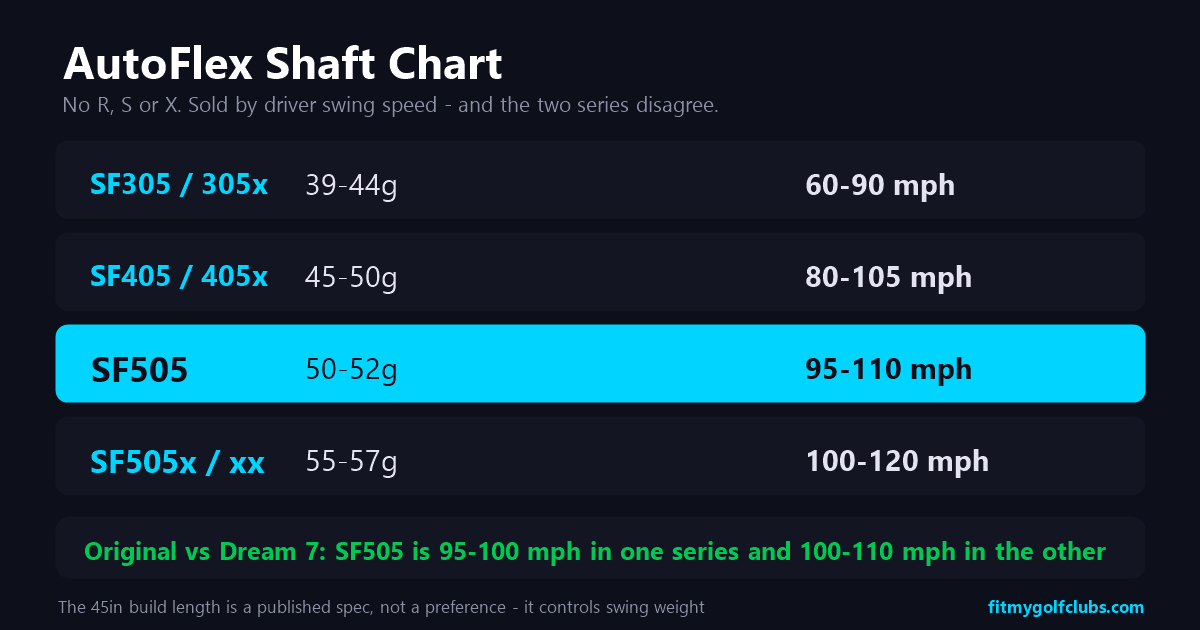
AutoFlex Shaft Chart: SF305 to SF505xx by Swing Speed and Weight
AutoFlex shaft chart: every SF code by driver swing speed and weight, for the Original and Dream 7 series, and why SF505 means two different speeds.
Golf Club Fitting
September 23, 2026
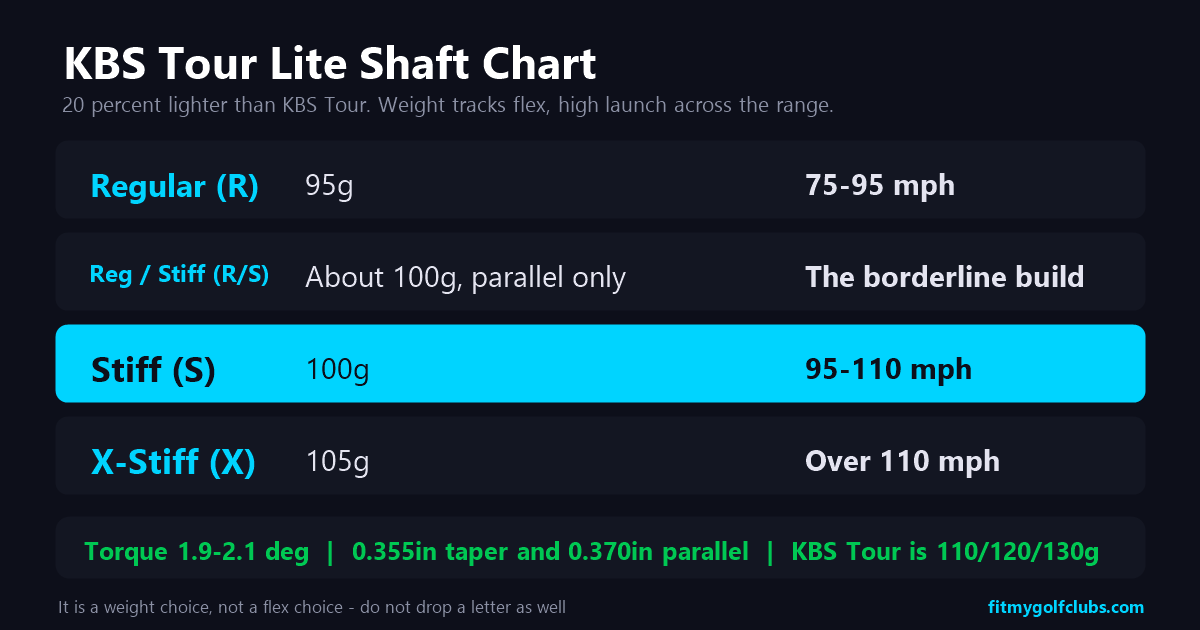
KBS Tour Lite Shaft Chart: 95g R, 100g S, 105g X Weights and Flex
KBS Tour Lite chart: Regular is 95g, Stiff 100g, X-Stiff 105g — 20% lighter than KBS Tour, higher flight, more spin. Swing speeds, torque and how it compares.


© 2026 FitMyGolfClubs. All rights reserved. | Patent Pending
Contact: sean@fitmygolfclubs.com