
Golf Club Fitting
September 23, 2026
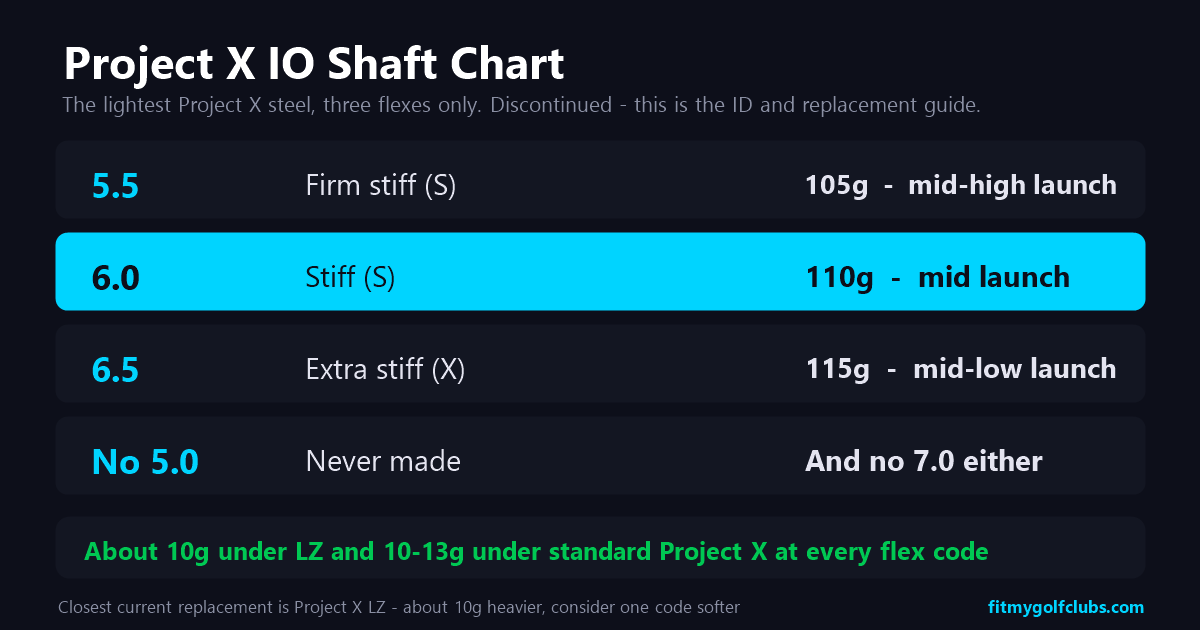
The quick answer: Project X IO is the lightest of the Project X steel iron shafts, and like the rest of the family weight climbs with flex: 5.5 is 105g, 6.0 is 110g and 6.5 is 115g — three flexes only, with no 5.0 and no 7.0. It launches higher than standard Project X and a shade higher than LZ, especially in the long irons. True Temper no longer lists IO in its current range, so this is a page about identifying and replacing one rather than ordering one. The chart is below.
IO was the answer to a specific complaint: players wanted Project X control without Project X weight. Standard Project X starts at 113g and climbs to 130g, which is a lot of shaft for anyone whose iron speed is moderate. IO took ten to thirteen grams out at each flex code and softened the tip, which lifted launch into mid-high territory in the long irons while keeping the stout Project X handle feel that the brand is known for.
If you are reading this, it is almost certainly because you found "IO" printed on an iron shaft and want to know what you have. This chart tells you the weight, flex and launch of the shaft in your hands, what swing speed it was built for, and which current shaft to specify if you need to replace one. Weights are True Temper's published specs. True Temper does not publish torque for its steel iron shafts, so you will not find an invented figure here.
Project X IO Shaft Chart: Weight by Flex
Read the launch column, not just the weight. IO is not one launch profile across the range — it walks from mid-high at 5.5 down to mid-low at 6.5, because the stiffer codes carry more tip stiffness along with the extra five grams. That is why "IO launches high" is only true of the softer end of the line.
IO is a taper-tip (0.355") shaft supplied in per-iron lengths. If you are pricing a single replacement, that matters: you need the shaft for that specific iron number, not a parallel blank to trim.
⚡ Not sure which flex you are?
Our free Shaft Flex Calculator turns your swing speed into a flex recommendation in seconds — the AI mode factors in tempo and miss pattern. Get my flex →
What Swing Speed Each IO Flex Fits
IO uses the standard Project X numeric codes. The full system across every Project X model is decoded in the Project X shaft selector chart; this is the IO slice.
As with every published flex chart these are driver speeds used as the reference point. Your iron speed runs roughly 10–15 mph slower for the same swing:
These bands follow our brand-neutral swing speed shaft flex chart. Through the 90–99 mph stretch the code alone stops being decisive and tempo settles it — and in IO that decision also moves you five grams, which is the part most players actually feel.
If you have IO irons in play, add the set in the app with the exact printing. Because IO is lighter than most steel, the common finding is not a flex problem at all but a weight gap between the irons and a much heavier wedge, which the grader scores as part of weight progression.
Shaft Flex Calculator
FREE — NO SIGNUPEnter your driver swing speed — get your flex band instantly.
Don’t know your speed? Rough guide: 200-yd carry ≈ 90 mph, 220-yd ≈ 100 mph — or read it off the chart below.
Identifying and Replacing an IO
How to tell an IO from an LZ or a standard Project X
All three are taper-tip Project X steel with the same numeric codes, so the printed model name is the only reliable tell — look for "IO", "LZ" or nothing beyond "Project X" on the band above the ferrule. If the printing has worn off, weigh the shaft: at a given code IO is about ten grams under LZ and ten to thirteen grams under standard Project X. A 6.0 that weighs around 110g is an IO, around 120g is an LZ, and around 121g is a standard Project X — the IO is easy to pick out on a kitchen scale, the other two are not.
What to buy instead of an IO today
Project X LZ is the closest current shaft in the family — same codes, same taper tip, mid launch, about ten grams heavier at every code. If the weight saving was the reason you were in IO, LZ will feel noticeably heavier and you may want to go one code softer to keep the same feel. If you need to match the weight rather than go up, KBS Tour Lite (95–105g) sits ten grams under IO at each flex, and a composite iron shaft goes lighter again.
Replacing one broken IO in a set
The honest answer is that this is the situation where a discontinued shaft costs you. A single IO in the right iron number and flex code is a used-market hunt, and a mismatched replacement is worse than it sounds — a set with seven IO shafts and one LZ carries both a ten-gram weight step and a different bend profile at exactly one club. If you cannot source the matching IO, reshafting the whole set is the technically correct answer, and the cost of that is the argument for checking the rest of the set at the same time.
🔍 Already have a Project X IO in the bag?
Drop the club into our Single-Club Fit Grader and get an AI fit grade — flex, weight, and launch scored against your swing. Grade one club →
Was IO Ever the Right Shaft?
Yes, for a narrower group than it was sold to. IO earned its place with players who had the transition to load a Project X profile but not the strength or speed to carry 120-plus grams through eighteen holes — which in practice meant a lot of good senior players and a lot of strong juniors. For those golfers IO was the only shaft in the range that worked.
Where it went wrong was as a general "lighter is easier" recommendation. A shaft that is light but still stiff in the tip does not make an iron easier to launch, and mid-handicappers pushed into a 6.0 IO because it was "the light one" often ended up with the same flight problem in a lighter package. If that is the story of your set, the fix is a softer code or a different family, not a lighter version of the same profile.
🏌️ The shaft is one of 8 factors.
A perfectly-fit Project X IO in a mis-lofted head still costs you strokes. Grade My Bag scores all 14 clubs across the 8 factors pro fitters use — free, from your specs alone. Grade my bag free →
Frequently asked questions
How much does a Project X IO 6.0 weigh?
About 110 grams. IO was made in three flexes and weight tracks flex: 5.5 is 105g, 6.0 is 110g and 6.5 is 115g. That makes IO about ten grams lighter than Project X LZ and ten to thirteen grams lighter than standard Project X at the same code.
Is Project X IO discontinued?
True Temper no longer lists Project X IO in its current product range, while standard Project X and Project X LZ are both still listed. Treat IO as a legacy shaft: still perfectly playable if you have it, but not something to specify on a new build.
What swing speed is Project X IO 6.0 for?
Roughly 95 to 110 mph of driver speed, the same as a standard stiff flex. IO 5.5 suits about 90 to 100 mph and IO 6.5 suits over 110 mph. Between about 90 and 99 mph, tempo decides between 5.5 and 6.0 more reliably than speed alone.
What is the difference between Project X IO and LZ?
IO is about ten grams lighter at every flex code and launches a touch higher in the long irons. LZ is the heavier, mid-launch option and is still in production. Both use the same numeric flex codes and the same 0.355 inch taper tip, so they are directly comparable code for code.
What should I replace a Project X IO with?
Project X LZ is the closest current match in the same family, about ten grams heavier at each code with the same taper tip and mid launch. If the light weight was the point, KBS Tour Lite at 95 to 105 grams goes lighter still. Replacing a single broken IO with a different model leaves one club out of step with the set, so matching the whole set is the technically correct fix.
Does Project X IO launch high?
Only at the softer end. IO 5.5 is mid-high launch, 6.0 is mid and 6.5 is mid-low, because the stiffer codes add tip stiffness along with weight. A light shaft is not automatically a high-launching one.
Related reading
- Project X LZ Shaft Chart — The current shaft closest to IO — same codes, about ten grams heavier at each one.
- Project X Shaft Selector Chart: Flex by Swing Speed — The canonical explainer for the 5.0 / 5.5 / 6.0 / 6.5 numeric system.
- Project X Shaft Weights and Specs — Standard Project X steel weights, for the ten-to-thirteen-gram comparison above.
- Golf Shaft Weight Guide — Why a five-gram step between irons and wedges matters more than most players expect.
Know the shaft. Now check the whole bag. The FitMyGolfClubs app grades all 14 clubs across eight fitting factors — shaft flex and weight included — straight from your specs. Free to start.
Related Articles
Golf Club Fitting
September 23, 2026
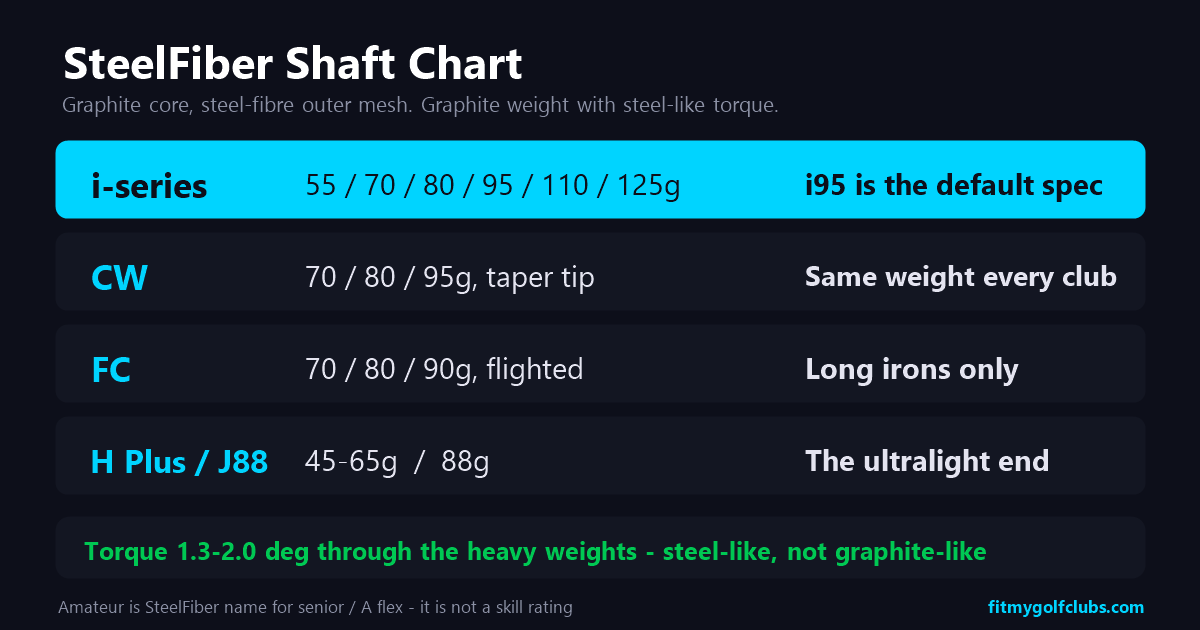
SteelFiber Shaft Chart: i95, i110, FC and CW Weights by Flex
SteelFiber shaft chart: the i-series from 55g to 125g, plus FC flighted, CW constant weight, H Plus and J88 - weights, torque and who each fits.
Golf Club Fitting
September 23, 2026
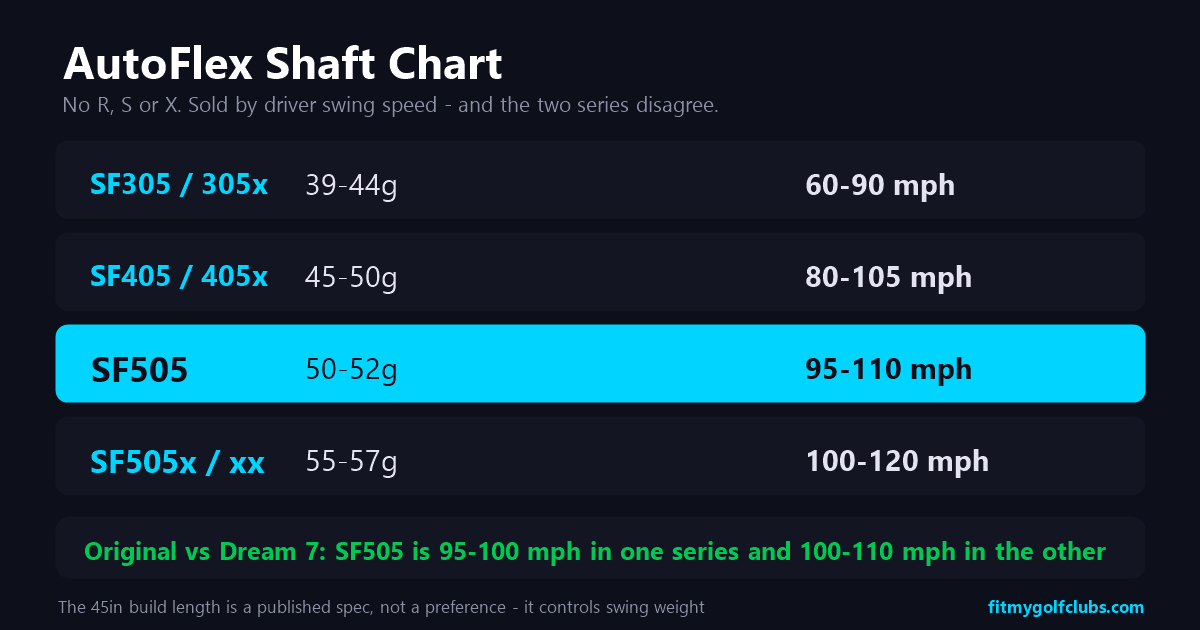
AutoFlex Shaft Chart: SF305 to SF505xx by Swing Speed and Weight
AutoFlex shaft chart: every SF code by driver swing speed and weight, for the Original and Dream 7 series, and why SF505 means two different speeds.
Golf Club Fitting
September 23, 2026
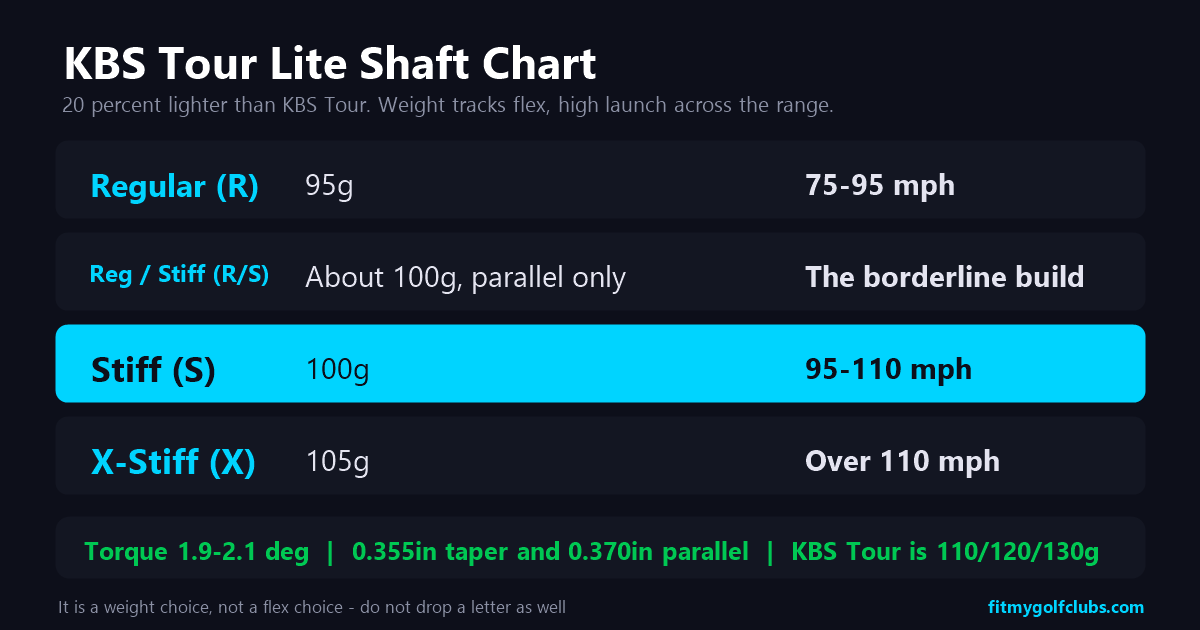
KBS Tour Lite Shaft Chart: 95g R, 100g S, 105g X Weights and Flex
KBS Tour Lite chart: Regular is 95g, Stiff 100g, X-Stiff 105g — 20% lighter than KBS Tour, higher flight, more spin. Swing speeds, torque and how it compares.


© 2026 FitMyGolfClubs. All rights reserved. | Patent Pending
Contact: sean@fitmygolfclubs.com