
Golf Club Fitting
September 23, 2026
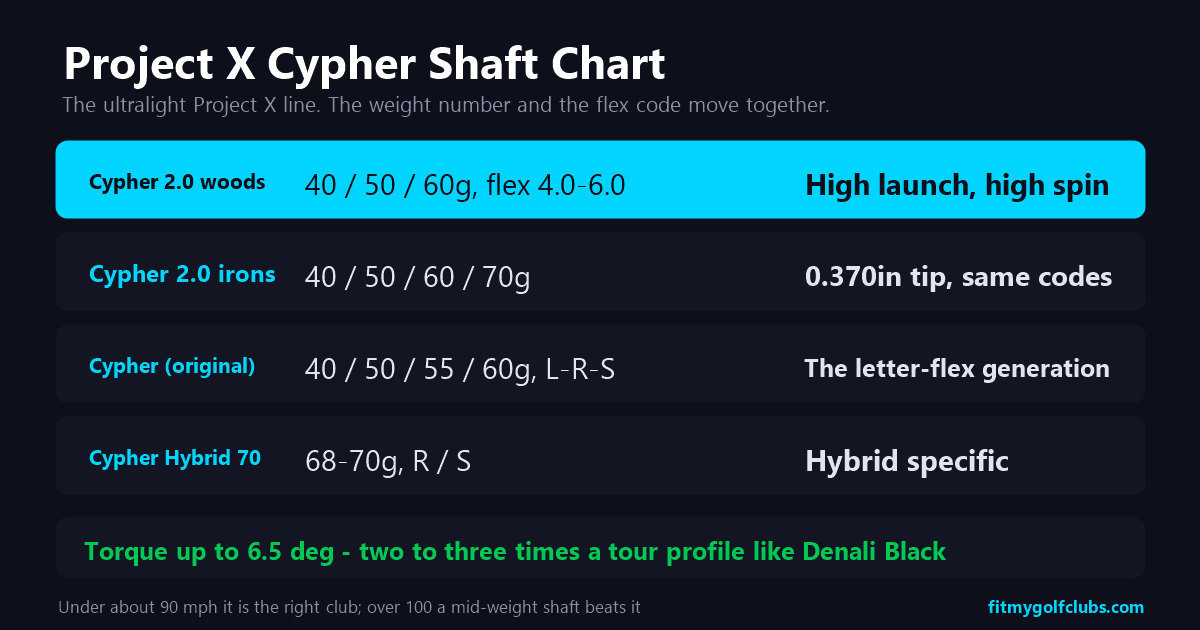
The quick answer: Cypher is the ultralight end of the Project X graphite range, and in Cypher the weight number and the flex code move together. The current Cypher 2.0 wood shafts run 40g to 60g in flexes 4.0, 5.0, 5.5 and 6.0; the iron and hybrid version runs 40g at 4.0 up to 70g at 6.0. It is a high-launch, high-spin design aimed squarely at generating speed, not at controlling it. The chart is below.
Every major shaft maker has a lightweight line, and the honest way to describe Cypher is that it is the one Project X built for players its other shafts actively do not fit. Denali, HZRDUS and standard Project X all assume you have speed to control. Cypher assumes the opposite — that the fastest route to more distance is a shaft light enough to let you swing quicker, launch higher and carry further. True Temper's own description is "designed to maximize distance through higher launch and increased swing speed."
Cypher 2.0 is the current generation, built with what the company calls a 5% lighter weave than the original, which is where the "pushes the limit on what lightweight stability means" line comes from. This chart covers both generations, splits the wood and iron versions properly, and gives the swing speeds each flex code actually fits. Weights and torque come from the same shaft database that powers our club grader.
Cypher Shaft Chart: Every Weight and Flex
Torque is the number to notice here, not weight. At 6.5° in the lightest wood shafts, Cypher is two to three times more torsionally active than a tour-profile shaft like Denali Black at 2.3°. That is not a defect — high torque is part of how a light shaft helps a moderate swing square the face. But it does mean Cypher will feel loose to anyone with real speed, and no amount of stepping up the flex code fixes that.
Note that the iron version goes one weight class heavier than the wood version (70g versus 60g). That is the right way round: iron shafts should be heavier than the wood shafts in the same bag, and a set built with 60g woods and 70g irons has a sensible progression.
⚡ Not sure which flex you are?
Our free Shaft Flex Calculator turns your swing speed into a flex recommendation in seconds — the AI mode factors in tempo and miss pattern. Get my flex →
What Swing Speed Each Cypher Flex Fits
Cypher 2.0 uses the Project X numeric codes, but only the lower half of the range — there is no 6.5 and no TX, because a player who needs those codes should not be in a 40–60g shaft. The full numeric system is decoded in the Project X shaft selector chart.
The original Cypher used letter flexes (L, R, S) instead. Both are mapped below:
These bands follow our brand-neutral swing speed shaft flex chart, and the 90–99 mph stretch is where tempo decides rather than the number. In Cypher specifically, there is a second question the chart cannot answer: at the top of the range you are choosing between a 6.0 Cypher and a properly-fit mid-weight shaft, and for most players over about 100 mph the mid-weight shaft is the better club even though the Cypher is technically available.
If a Cypher is in your bag, add the club in the app with the printed weight and flex. Light shafts are the most common source of a weight-progression flag across a whole set, because a 50g driver shaft paired with standard steel irons is a very large step.
Shaft Flex Calculator
FREE — NO SIGNUPEnter your driver swing speed — get your flex band instantly.
Don’t know your speed? Rough guide: 200-yd carry ≈ 90 mph, 220-yd ≈ 100 mph — or read it off the chart below.
Model by Model
Cypher 2.0 woods (40g, 50g, 60g)
The current lightweight wood shaft in the Project X range, offered in 4.0 through 6.0 across three weight classes. The 40g in 4.0 is genuinely light — the kind of shaft that adds measurable club head speed for a player in the senior-flex band — while the 60g in 6.0 is a normal driver shaft weight that happens to be built on a high-launch profile. The 50g sits in the middle of the range, where the speed gain and the control loss are still in sensible balance.
Cypher 2.0 irons and hybrids (40g to 70g)
The 0.370" tip version, and the more interesting half of the line. A 70g graphite iron shaft is dramatically lighter than any steel option — standard Project X starts at 113g — so this is the shaft for a player who genuinely cannot carry steel through a round. The trade is the same as with the woods: high launch, high spin and an active tip. Weight tracks flex neatly here (4.0 is 40g, 5.0 is 50g, 5.5 is 60g, 6.0 is 70g), which makes specifying a set simple.
Original Cypher (the letter-flex generation)
The first-generation Cypher used L, R and S letters rather than numeric codes and ran 40 to 60 grams in the woods. If you have a driver with a shaft marked "Cypher 50 R" and no "2.0", that is this generation. It plays a touch softer and with higher torque than the equivalent Cypher 2.0 — our database has the original 40g at 7.0 degrees of torque against roughly 6.5 for the 2.0 equivalent. Playable, but it is the older shaft, and a fitter will steer you to 2.0 on a new build.
Cypher Hybrid 70
The dedicated hybrid shaft at around 68–70g in R and S, sitting between the wood and iron versions in both weight and torque. Hybrid shafts should be heavier than the fairway shaft in the same bag, and this one gets that right. If you are building a full Cypher bag, the progression that works is roughly 50g driver, 60g fairway, 70g hybrid and 70g irons.
🔍 Already have a Cypher in the bag?
Drop the club into our Single-Club Fit Grader and get an AI fit grade — flex, weight, and launch scored against your swing. Grade one club →
Who Cypher Is Actually For
The genuine fit: driver speed under about 90 mph, a smooth or slow transition, and a ball flight that is too low rather than too high. That is a large group of golfers — a big share of players over sixty, most juniors, and a lot of women playing off-the-rack men's clubs — and for them a 40 or 50 gram high-launch shaft is not a compromise, it is the correct club. The speed gain from a lighter shaft is real and measurable at these speeds.
The bad fit: a strong player who wants "more distance" and reads light as free speed. Above roughly 100 mph a Cypher will feel loose at the top of the swing, the high torque will exaggerate an off-centre strike, and the extra launch and spin will cost carry rather than add it. If that is you, the shaft that adds distance is the one that matches your speed, not the lightest one on the rack.
The in-between case is a player in the 90s who has lost speed with age and is thinking about going lighter. That is a real and sensible move, but it is worth doing one weight class at a time rather than jumping from a 70g shaft to a 50g one — the swing weight and feel change is larger than the number suggests.
🏌️ The shaft is one of 8 factors.
A perfectly-fit Cypher in a mis-lofted head still costs you strokes. Grade My Bag scores all 14 clubs across the 8 factors pro fitters use — free, from your specs alone. Grade my bag free →
Frequently asked questions
What is Project X Cypher?
Cypher is the ultralightweight graphite line in the Project X range, built for higher launch and more club head speed rather than control. Current Cypher 2.0 wood shafts run 40 to 60 grams and the iron and hybrid version runs 40 to 70 grams, in flexes 4.0, 5.0, 5.5 and 6.0.
How much does a Project X Cypher 50 weigh?
About 50 grams, which is the weight class in the name. Across the line the weight number and the flex code move together, so a Cypher 2.0 wood in 5.0 is a 50 gram shaft and a 6.0 is 60 grams. The iron version adds a 70 gram option at 6.0.
What is the difference between Cypher and Cypher 2.0?
Cypher 2.0 is the current generation, built with a weave True Temper describes as 5 percent lighter than the original, and it uses the Project X numeric flex codes. The original Cypher used letter flexes of L, R and S and runs slightly softer with higher torque. If the shaft does not say 2.0, it is the first generation.
What swing speed is a Cypher shaft for?
Mostly under about 95 mph of driver speed. A 4.0 in 40 grams suits roughly 60 to 75 mph, a 5.0 in 50 grams about 75 to 95 mph, and the 6.0 is for 95 to 110 mph players who specifically want a light, high-launching shaft. Above about 100 mph a mid-weight shaft is usually the better club.
Is Cypher a good shaft for seniors?
It is one of the better options, yes. Low weight, high launch and an active tip are exactly what a slower, smoother swing needs to get the ball in the air and carry it, and the 40 and 50 gram builds in 4.0 or 5.0 are genuine senior specifications rather than a softened men's shaft.
Why does Cypher have such high torque?
Because it is light, and because high torque helps a moderate swing square the face. At up to 6.5 degrees in the lightest wood shafts, Cypher is two to three times more torsionally active than a tour profile. That is a design choice rather than a flaw, but it is also why the shaft feels loose to a fast player.
Related reading
- Project X Shaft Selector Chart: Flex by Swing Speed — The full numeric flex system Cypher 2.0 uses the lower half of.
- Project X EvenFlow Shaft Chart — The mid-weight Project X graphite line that sat above Cypher.
- Golf Shaft Weight Guide — What a 50-gram driver shaft against steel irons does to your weight progression.
- Golf Swing Speed Chart: Shaft Flex by Club Head Speed — The brand-neutral flex chart the Cypher bands above are built on.
Know the shaft. Now check the whole bag. The FitMyGolfClubs app grades all 14 clubs across eight fitting factors — shaft flex and weight included — straight from your specs. Free to start.
Related Articles
Golf Club Fitting
September 23, 2026
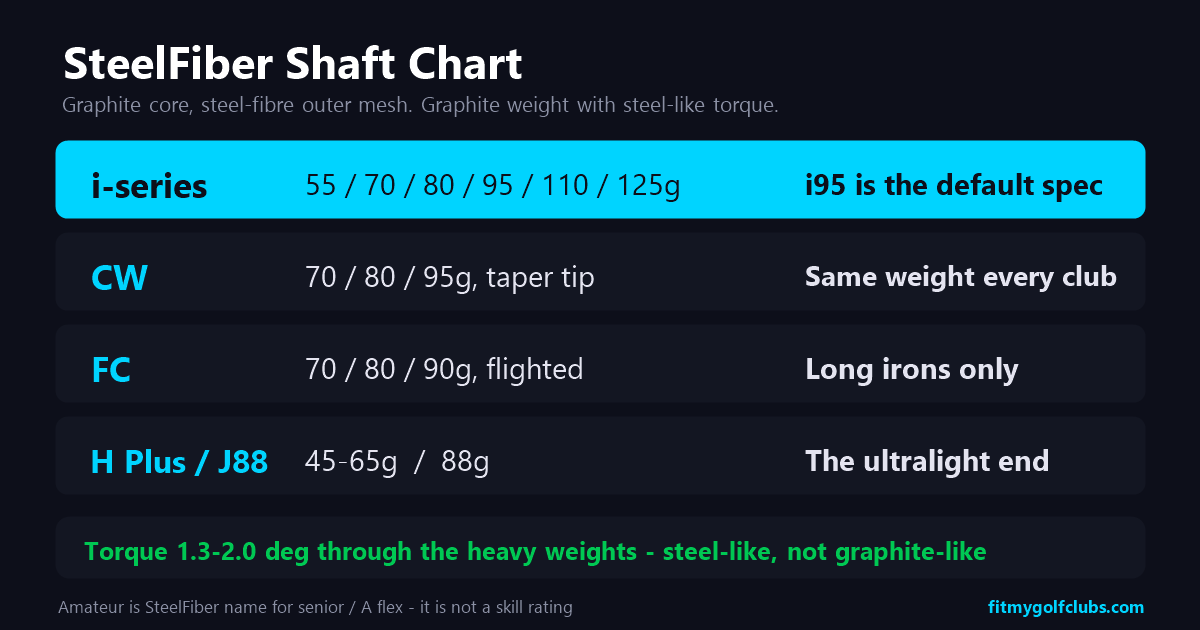
SteelFiber Shaft Chart: i95, i110, FC and CW Weights by Flex
SteelFiber shaft chart: the i-series from 55g to 125g, plus FC flighted, CW constant weight, H Plus and J88 - weights, torque and who each fits.
Golf Club Fitting
September 23, 2026
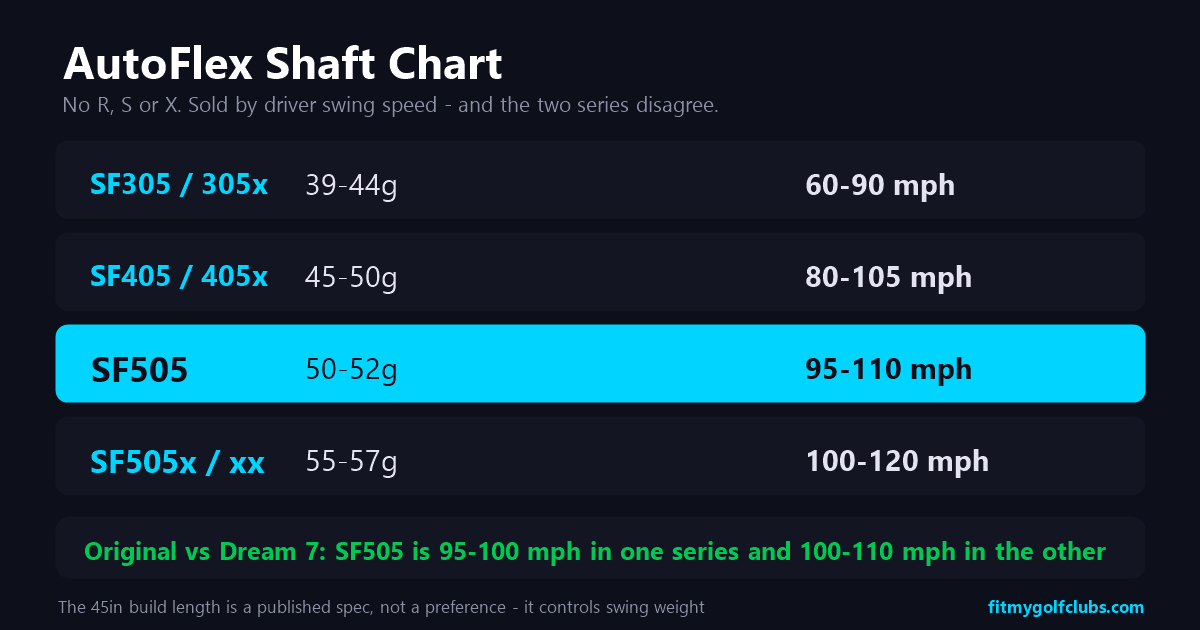
AutoFlex Shaft Chart: SF305 to SF505xx by Swing Speed and Weight
AutoFlex shaft chart: every SF code by driver swing speed and weight, for the Original and Dream 7 series, and why SF505 means two different speeds.
Golf Club Fitting
September 23, 2026
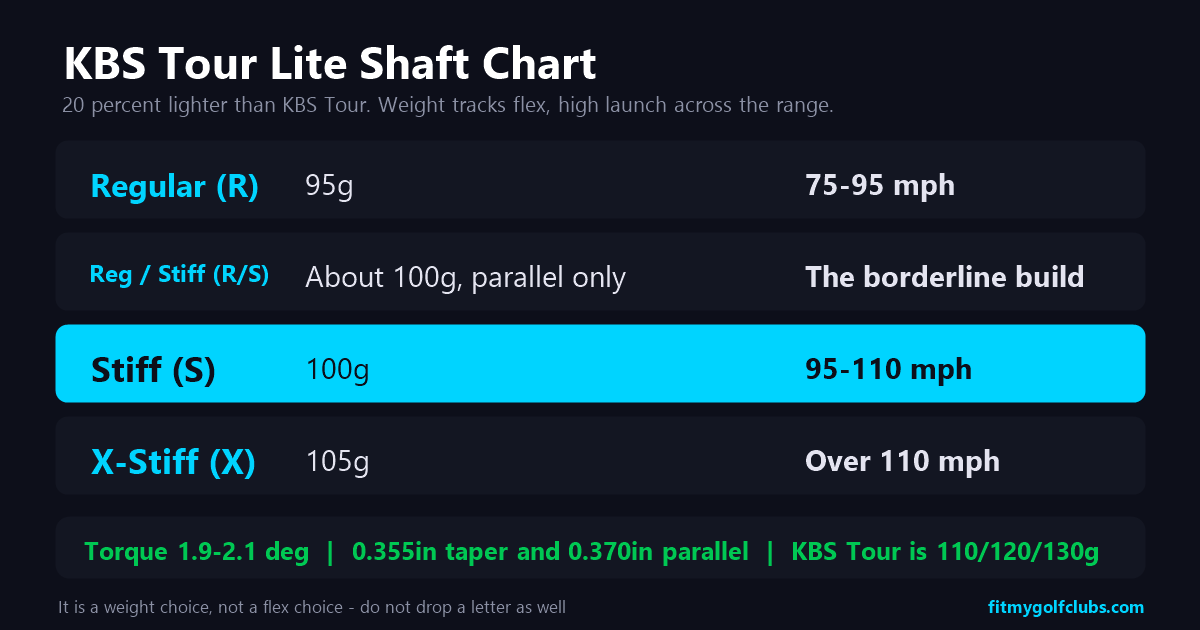
KBS Tour Lite Shaft Chart: 95g R, 100g S, 105g X Weights and Flex
KBS Tour Lite chart: Regular is 95g, Stiff 100g, X-Stiff 105g — 20% lighter than KBS Tour, higher flight, more spin. Swing speeds, torque and how it compares.


© 2026 FitMyGolfClubs. All rights reserved. | Patent Pending
Contact: sean@fitmygolfclubs.com