
Golf Club Fitting
September 14, 2026
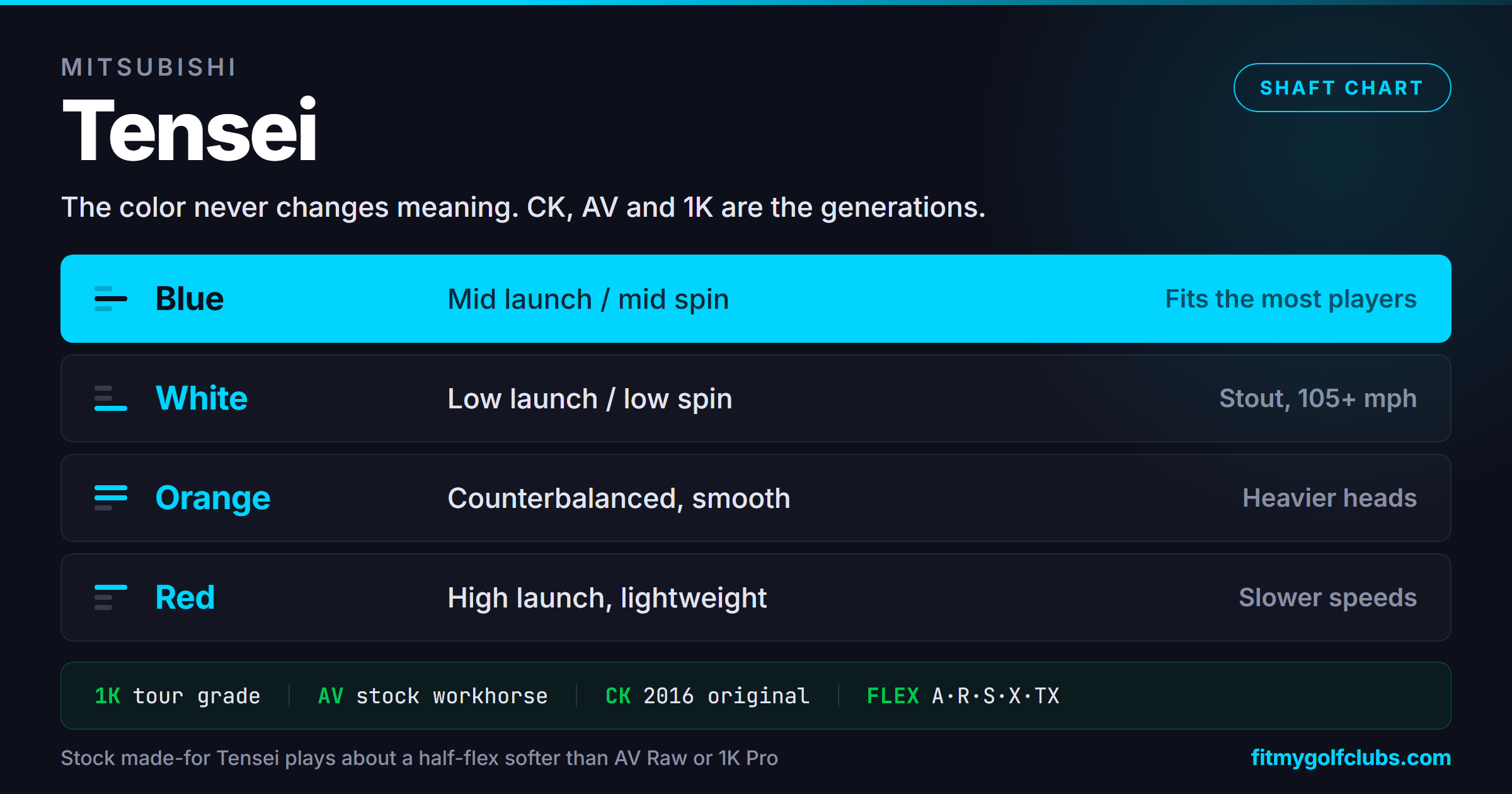
The quick answer: Mitsubishi Tensei uses a color code that stays constant across every generation. Blue is mid launch / mid spin and fits the most players. White is low launch / low spin and stout. Orange is counterbalanced — a smoother-loading profile with the balance point moved toward the grip. Red is the high launcher, lightest and most active. The series name in front of the color — CK, AV, AV Raw, 1K — tells you the generation and construction. The full chart is below.
Tensei is the other half of the tour driver-shaft duopoly with Fujikura Ventus, and it's even more common in stock drivers: Callaway, Titleist, TaylorMade and Ping have all shipped Tensei as a no-upcharge option, usually a made-for version of AV Blue or AV Raw. That's created the same problem HZRDUS and Ventus have — one name, several shafts. This chart sorts every Tensei series and color by launch, torque and weight, then explains which version you actually own.
Weights and torque below come from the same shaft database that powers our club grader, so they match what the app uses when it scores a Tensei in your bag.
Tensei Shaft Chart: Every Series and Color
Flexes run R, S, X and TX in most series, with A (senior) and L (ladies) in the lightweight AM2 and AV Blue versions. The weight number on a Tensei is the class, not the exact gram figure: a "65" is typically 63–68g depending on flex, because Mitsubishi holds the profile and lets the weight drift a few grams between R and X.
⚡ Not sure which flex you are?
Our free Shaft Flex Calculator turns your swing speed into a flex recommendation in seconds — the AI mode factors in tempo and miss pattern. Get my flex →
What the Tensei Names Mean (CK, AV, 1K, Raw, AM2)
A Tensei label reads like Tensei 1K Pro Blue 65 S: series, color, weight class, flex. The color is the bend profile and never changes meaning. The series is the construction generation:
CK (2016) is the original — Carbon Kevlar woven into the tip. AV (2018) replaced the Kevlar with Aluminum Vapor-coated fiber in the tip for a firmer, more stable feel; AV Raw is the same shaft with an unpainted finish; AV Xlink (2024) is the AV Blue with a new resin system. 1K (2020 onward) uses a 1,000-filament carbon weave along the length for the highest stability-to-weight in the family; 1K Pro is the premium aftermarket build. AM2 marks a lightweight made-for version.
Flex letters follow the standard scheme — here are the typical driver speed bands, with the White profiles shifted up because of their stiffer tips:
These follow our brand-neutral swing speed shaft flex chart. Tensei Blue plays true to its letter — a Blue S is a fair Stiff — while White and 1K Black play about a half-flex firm.
Practical shortcut: if a Tensei is already in your bag, add it to your bag in the app exactly as printed, including the series (CK, AV, AV Raw, 1K). The app grades your set's flex and weight consistency by playing spec, not by label.
Shaft Flex Calculator
FREE — NO SIGNUPEnter your driver swing speed — get your flex band instantly.
Don’t know your speed? Rough guide: 200-yd carry ≈ 90 mph, 220-yd ≈ 100 mph — or read it off the chart below.
Series by Series
Tensei 1K Black (mid-low launch, low spin)
The current tour headliner — a low-spin profile that isn't brutally stiff, thanks to the 1K carbon weave doing the stabilizing instead of sheer wall thickness. Weights 60, 70, 80 (63–90g), flexes R, S, X, TX. It sits between Blue and White in flight, which is why it fits so many good players: enough spin control for 100+ mph swings without the launch penalty of a true White. Also available in hybrid weights (85g). If a fitter hands you one shaft to try first at 100–110 mph, it's often this.
Tensei 1K Pro Blue (mid launch, mid spin)
The premium version of the color that fits the most golfers. Smooth loading, mid launch, controlled spin, and noticeably more stable than the AV Blue it sits above. Weights 50, 60, 70 (55–79g), flexes R through X. This is the Tensei answer to Ventus Blue, and the head-to-head is close: Pro Blue tends to feel a touch softer in the handle and launch marginally higher.
Tensei 1K Pro White (low launch, low spin)
The stoutest Tensei. Firm tip, high kick point, lowest torque in the family (2.4–3.6°), flexes S and X only in 60, 70 and 80 weights. Built for aggressive transitions and fast hands that need the shaft to resist. Under about 100 mph it takes launch away faster than it takes spin, so it's a strong-player shaft first and a spin fix second.
Tensei 1K Pro Orange (counterbalanced, mid-high launch)
Orange is Mitsubishi's counterbalanced profile: the balance point is moved toward the grip so it can be built with heavier heads or longer lengths without the swingweight going through the roof. It loads easily and — in the 1K Pro version — launches mid-to-mid-high with moderate spin, in 50, 60, 70 weights (53–75g). The classic Orange player has a smooth tempo, wants a heavier shaft for stability, and doesn't want to give up launch to get it.
Tensei AV Blue, AV Raw Blue and AV Xlink (the stock workhorse)
AV Blue is the most common Tensei on the planet because it's been a no-upcharge stock shaft for most of the major OEMs. Mid launch, mid spin, 55/65/75 weight classes (43–75g including the lightweight A and L versions), flexes L through X. AV Raw Blue is the aftermarket unpainted version, built a bit firmer; AV Xlink Blue is the 2024 update. The made-for stock AV Blue and the aftermarket AV Raw Blue are not identical — see the stock-vs-aftermarket section below.
Tensei AV White and AV Raw White (stock low-spin)
The low-launch, low-spin option in the AV construction. 65 and 75 weights (66–78g), S and X flexes, torque 2.9–3.5°. Commonly seen as a stock upgrade in Titleist and Callaway drivers. Plays a half-flex firm like all the Whites; a 65-S AV White is closer to a Blue 65-X in feel.
Tensei CK Blue, White, Orange, Red (the original 2016 series)
The first Tensei generation, with Carbon Kevlar woven into the tip. The colors mean the same thing they mean today: Blue mid, White low, Orange counterbalanced mid, Red high launch and lightweight. CK shafts are still everywhere on the used market and in older stock drivers, and they're perfectly good — slightly higher torque and a softer feel than the AV and 1K versions of the same color. Treat a CK as roughly one generation softer than the current equivalent.
Tensei Red, White AM2 and AV AM2 (lightweight and made-for)
Red is the high-launch, lightweight profile (48–66g) for players who need help getting the ball up — the CK Red and AV Red AM2 both fit smooth 75–90 mph swings. The AM2 versions (White AM2, AV AM2) are ultra-light 42–55g made-for shafts in A, L, R and S flexes with higher torque (4.8–6.5°), built for the slowest speeds in the OEM stock matrix. Real Tenseis, but tuned for an entirely different golfer than the tour versions.
🔍 Already have a Tensei in the bag?
Drop the club into our Single-Club Fit Grader and get an AI fit grade — flex, weight, and launch scored against your swing. Grade one club →
Stock vs Aftermarket Tensei: Same Name, Different Shaft
Because Tensei is so widely used as a stock shaft, the "made-for" problem is bigger here than with any other brand. A no-upcharge Tensei AV Blue 65 in a stock driver is a made-for-OEM build with a softer profile and higher torque than the aftermarket AV Raw Blue 65 or 1K Pro Blue 60 you'd hit at a fitting. Same color, same weight class, same flex letter — different shaft.
How to tell: aftermarket Tenseis carry the series name in full (AV Raw, 1K Pro) and cost real money; stock versions usually say just "Tensei AV Blue" or "Tensei CK Blue" and came with the driver. Neither is fake. But if you were fit into a 1K Pro Blue and bought a driver with a stock AV Blue expecting the same numbers, you didn't get what you were fit for.
Picking Your Tensei: The Two-Question Shortcut
Question 1 — what's your miss? High, spinny drives that lose distance → White or 1K Black. Low shots that won't carry → Red, or Orange in a lighter weight. Neither extreme → Blue. Want a heavier shaft without the swingweight penalty → Orange.
Question 2 — what's your speed? Use the flex table above; Blue plays true to its letter, White plays firm. Weight follows speed and tempo: 50/55 for smooth or slower swings, 60/65 is the standard driver weight for most 90–105 mph players, 70/75 for strong swings and fairway woods, 80 for tour speeds and hybrids.
🏌️ The shaft is one of 8 factors.
A perfectly-fit Tensei in a mis-lofted head still costs you strokes. Grade My Bag scores all 14 clubs across the 8 factors pro fitters use — free, from your specs alone. Grade my bag free →
Frequently asked questions
What is the difference between Tensei Blue, White, Orange and Red?
The color is the launch profile and stays the same across every Tensei generation. Blue is mid launch, mid spin and fits the most players. White is low launch, low spin and plays firm. Orange is counterbalanced — balance point toward the grip — with a smooth, easy-loading feel. Red is the lightweight high launcher.
What does 1K mean on a Tensei shaft?
1K refers to a 1,000-filament carbon weave used along the shaft for stability without extra weight. The 1K series (2020 onward) is the current top-tier Tensei construction; 1K Pro is the premium aftermarket build. Earlier series were CK (Carbon Kevlar tip, 2016) and AV (Aluminum Vapor-coated fiber tip, 2018).
What swing speed is a Tensei AV Blue 65 S for?
About 95–104 mph of driver speed in the aftermarket AV Raw version. The made-for stock AV Blue 65 S plays softer, so it fits closer to 90–100 mph. Blue plays true to its flex letter; White and 1K Black play roughly a half-flex firmer.
Is Tensei AV Raw the same as Tensei AV Blue?
Not quite. AV Raw is the aftermarket, unpainted version and is built firmer with lower torque than the made-for stock AV Blue that ships in OEM drivers. Same color profile, different build tolerances and feel.
Which Tensei is best for a slice?
A slice is mostly a face and path problem, not a shaft problem, but a shaft that's too stiff or too heavy makes it worse by leaving the face open. If you slice and your Tensei is a White or a heavy Blue, moving to Blue or Red in a lighter weight and softer flex usually helps the face square. Fix the swing first; then match the shaft.
What is the difference between Tensei and Ventus?
Both are premium tour-played graphite wood shafts with color-coded launch profiles. Tensei Blue and Ventus Blue are direct rivals (mid launch); Tensei White and Ventus Black both target low spin; Tensei Red and Ventus Red are the high launchers. Tensei generally has a slightly softer handle feel; Ventus generally feels more one-piece. Neither is better — they fit slightly different feels at the same numbers.
Related reading
- Fujikura Ventus Shaft Chart — Tensei's main rival decoded — Blue, Red, Black, TR, and VeloCore explained.
- Diamana Shaft Chart — Mitsubishi's other family — every Diamana series by launch, spin and weight.
- Golf Swing Speed Chart: Shaft Flex by Club Head Speed — The brand-neutral flex bands the Tensei table above is built on.
- Golf Shaft Weight Guide — Why 55 vs 65 vs 75 changes ball flight more than the flex letter.
Know the shaft. Now check the whole bag. The FitMyGolfClubs app grades all 14 clubs across eight fitting factors — shaft flex and weight included — straight from your specs. Free to start.
Related Articles
Golf Club Fitting
September 14, 2026
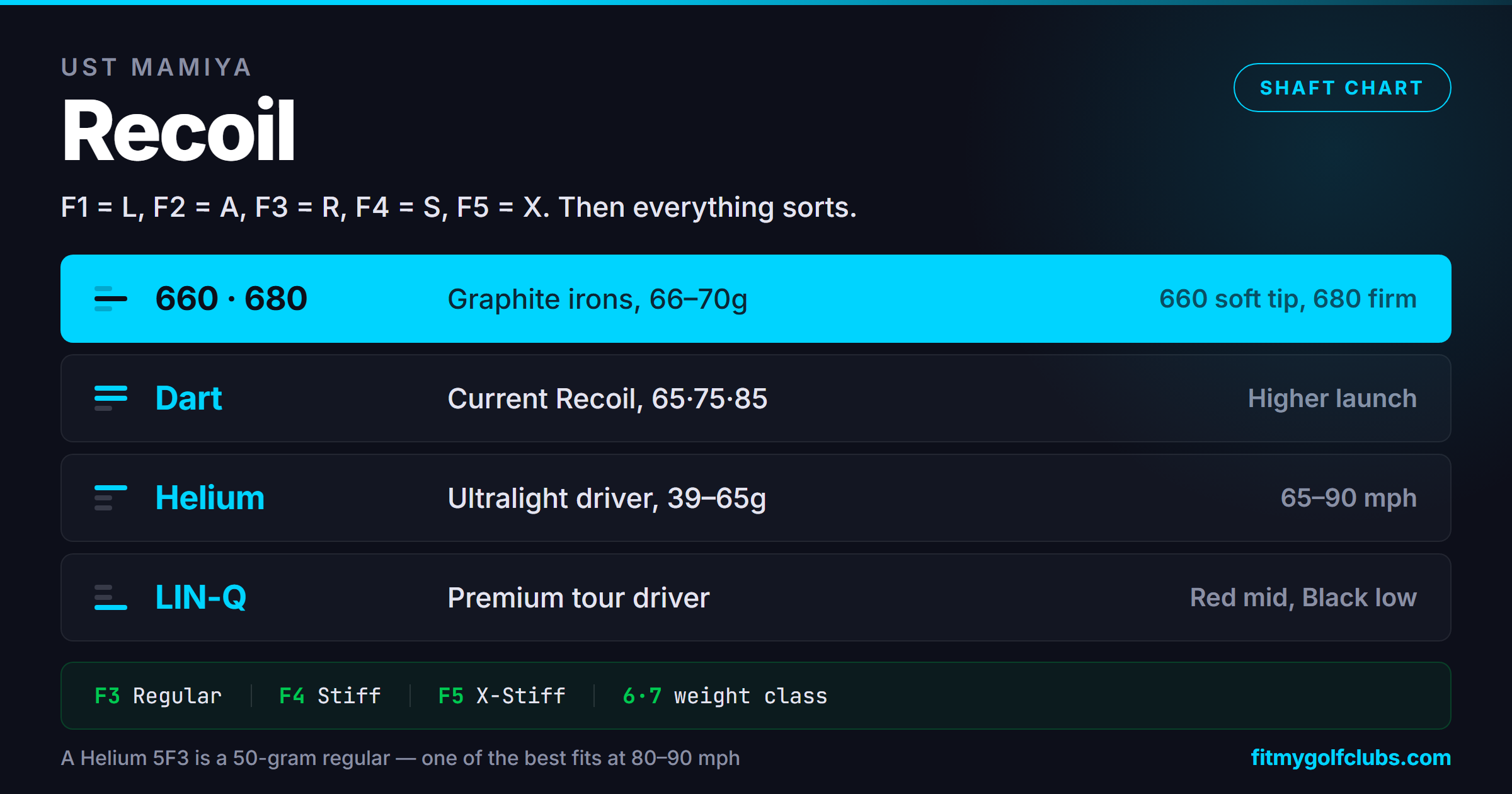
UST Mamiya Shaft Chart: Recoil, Helium, LIN-Q & ATTAS Decoded
UST Mamiya shaft chart: F1–F5 flex decoded (F3 = R, F4 = S), Recoil 660 vs 680 vs Dart, Helium, LIN-Q Red vs Black and ATTAS — weights and torque.
Golf Club Fitting
September 14, 2026
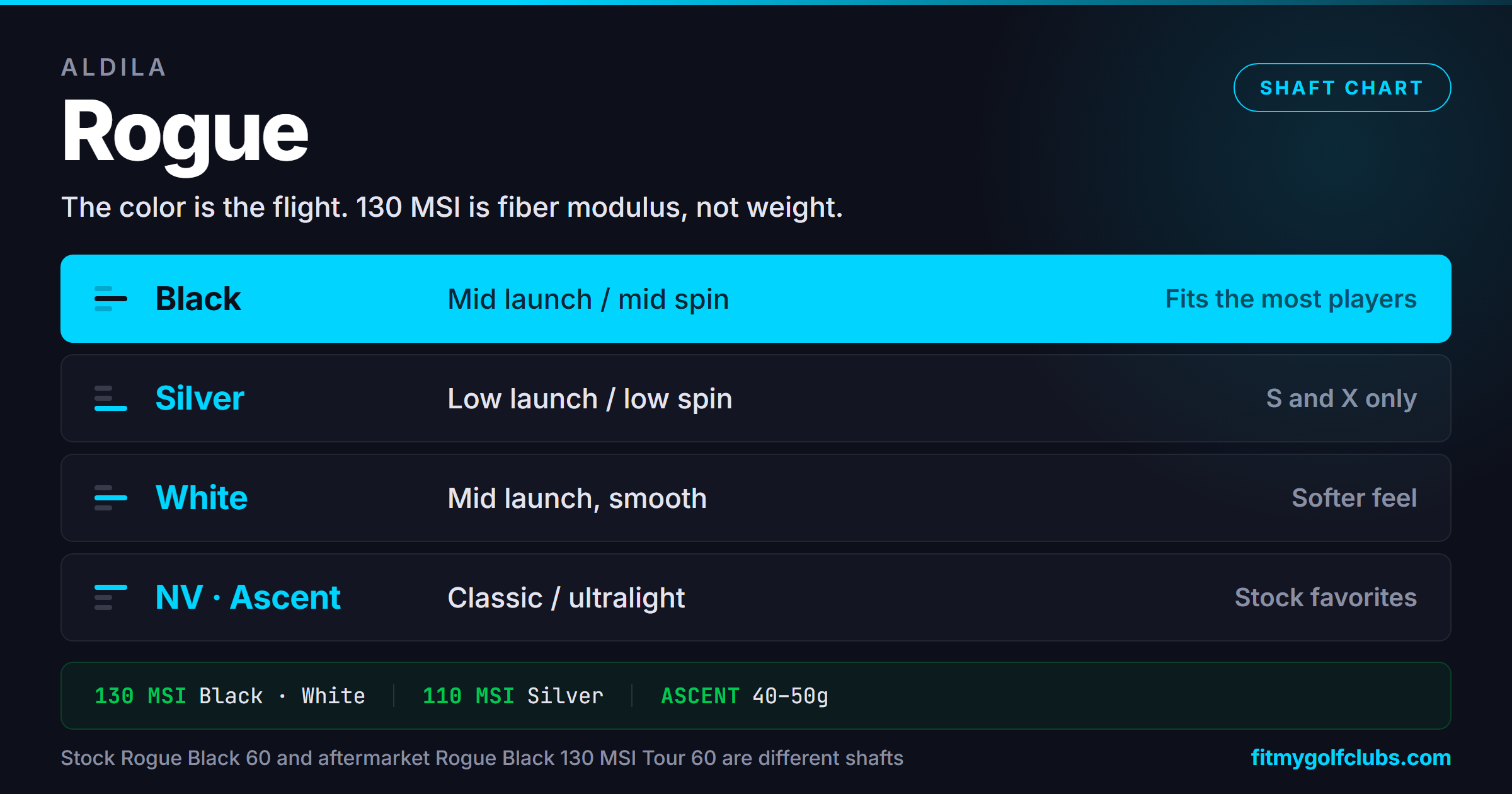
Aldila Shaft Chart: Rogue, NV, Ascent & Synergy by Launch and Weight
Aldila shaft chart: Rogue Black (mid), Silver (low spin), White (smooth), NV, Synergy, Ascent and Quaranta — weights, torque, and what 130 MSI means.
Golf Club Fitting
September 14, 2026
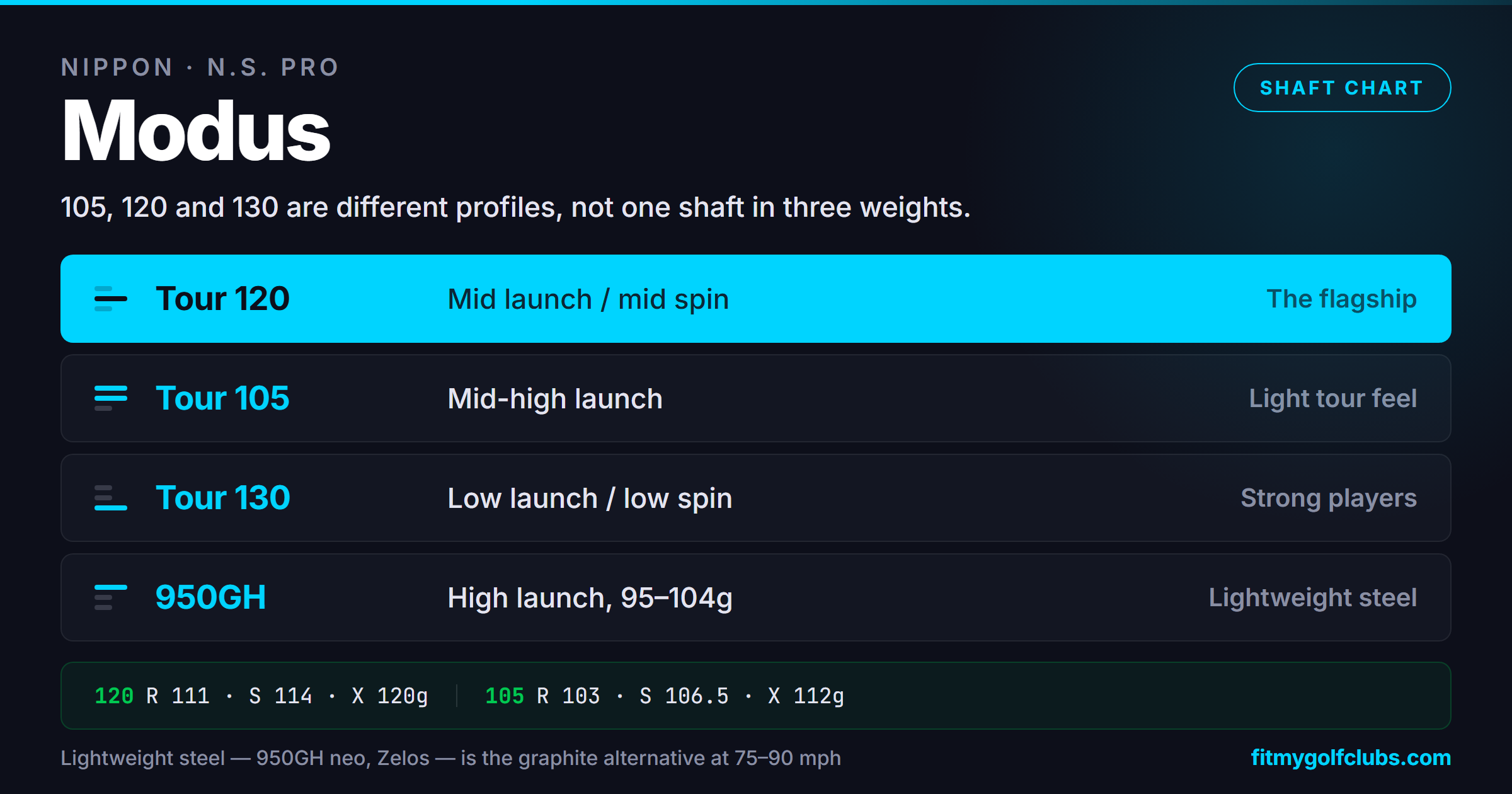
Nippon Modus & N.S. Pro Shaft Chart: 105, 120, 130 & Every GH Weight
Nippon shaft chart: Modus3 Tour 105–130 weights by flex and launch, plus N.S. Pro 950GH, 850GH, 1050GH, 1150GH and Zelos — lightweight steel decoded.


© 2026 FitMyGolfClubs. All rights reserved. | Patent Pending
Contact: sean@fitmygolfclubs.com