

Golf Club Fitting
September 14, 2026
The quick answer: Fujikura Ventus comes in three colors and the color is the flight. Blue is mid launch / mid spin — the do-everything tour default. Red is the high launcher with the most active tip. Black is low launch / low spin, the stoutest profile for fast, aggressive swings. The number after the color (5, 6, 7, 8) is the weight class in tens of grams, and the letter is flex: R2 (soft regular), R, S, X, TX. The full model-by-model chart is below.
Ventus has been the most-played driver shaft on tour since around 2020, which means it's also the most copied, most counterfeited, and most misunderstood. The same "Ventus Blue 6-S" name appears on a $350 aftermarket shaft with VeloCore and on a no-upcharge stock shaft without it, and the two do not perform the same. This chart sorts every Ventus line — original, VeloCore+, TR, the fairway and hybrid versions — by launch, spin, torque and weight, and decodes the naming while we're at it.
Every spec below comes from the same shaft database that powers our club grader, so the weights and torque ranges match what the app uses when it scores a Ventus in your bag.
Ventus Shaft Chart: Every Current Line
Flexes across the family run R2 (soft regular), R, S, X, and TX (Tour X) in the heavier weights. Within any line the lighter weights launch and spin a touch more than the heavier ones — a Blue 5 flies higher than a Blue 7 — and the TR versions launch slightly lower than the standard version of the same color because the handle section is stiffer.
⚡ Not sure which flex you are?
Our free Shaft Flex Calculator turns your swing speed into a flex recommendation in seconds — the AI mode factors in tempo and miss pattern. Get my flex →
What the Ventus Numbers and Letters Mean
A Ventus label reads like Ventus Blue 6 S: the color is the bend profile, the number is the weight class (5 ≈ 55–59g, 6 ≈ 63–68g, 7 ≈ 75–78g, 8 ≈ 84–87g, 9 ≈ 94g+), and the letter is flex. Two things trip people up:
1. R2 is softer than R. Fujikura uses R2 as its senior-leaning regular in the lightest weights; if you're a smooth 80–88 mph driver swing, R2 in a 5 is often the right Ventus, not the R.
2. Black wants more speed than Blue at the same letter. The lower-launching profiles are built with stiffer tips, so a Black 6-S plays stouter than a Blue 6-S. Here are the typical driver swing speed bands, using our standard flex bands with a Blue-to-Black shift:
These bands follow our brand-neutral swing speed shaft flex chart; the Black column is shifted up because of the stiffer tip. On a borderline, Ventus rewards the softer choice in Blue and Red and the stiffer choice in Black — Black players are usually there because they need the shaft to resist, not to help.
Practical shortcut: if a Ventus is already in your bag, add it to your bag in the app with the exact printing — color, number, letter, and whether it says VeloCore. The app grades your set's flex and weight consistency by playing spec, not by label.
Shaft Flex Calculator
FREE — NO SIGNUPEnter your driver swing speed — get your flex band instantly.
Don’t know your speed? Rough guide: 200-yd carry ≈ 90 mph, 220-yd ≈ 100 mph — or read it off the chart below.
Model by Model
Ventus Blue VeloCore+ (mid launch, mid-low spin)
The flagship and the most-played shaft in the family. Blue is the balanced profile — mid launch, controlled spin, a smooth loading feel that still stays stable through impact thanks to the VeloCore full-length pitch-70-ton carbon core. Weights run 5 through 9 (roughly 58–94g), flexes R2 through TX. If you're unsure which Ventus you are and you don't have an obvious spin or launch problem, this is the demo to start with. The 2024 VeloCore+ update added a second full-length layer for a touch more stability; fitting profile is unchanged.
Ventus Red VeloCore+ (mid-high launch, mid spin)
The high launcher. Red keeps the VeloCore handle and midsection but softens the tip so the head releases and launches — for players who need carry height, hit it low, or have a smoother tempo that struggles to load Blue. Weights 5–8 (59–93g). Red is often the right answer for 85–100 mph swings that were talked into a Blue because "everyone plays Blue." Red in a 5 or 6 with R or R2 is one of the most under-fit shafts in golf.
Ventus Black VeloCore+ (low launch, low spin)
The spin-killer, and the stoutest standard Ventus. Black has the firmest tip and highest kick point in the family; it's built for fast, aggressive transitions that spin the ball up and need the shaft to hold. Weights 6–8 (59–93g), flexes S, X, TX only — there is no regular-flex Black, which tells you who it's for. Under about 100 mph it's usually too much shaft, and the launch loss costs more than the spin saving.
Ventus TR Blue, TR Red, TR Black (firmer handle, same colors)
TR stands for the stiffer handle section: Fujikura adds a Spread Tow carbon layer in the butt to resist the twisting that strong-handed players put on the grip end. The color still sets the flight — TR Blue is mid, TR Red is mid-high, TR Black is low — but each TR launches a hair lower and feels more "one-piece" than its standard sibling. Choose TR over standard if you have fast hands, a late release, or the standard version feels loose at the top. TR Blue runs 5–9 (55–98g); TR Red 5–8; TR Black 6–8.
Ventus HB and Ventus FW (hybrid and fairway versions)
Ventus HB is the purpose-built hybrid shaft in 7, 8, 9 (73–87g) with Blue, Red and Black profiles, and lower torque (2.5–3.4°) than the driver versions because hybrid heads are heavier. Ventus FW is a made-for fairway shaft in 5 and 6 (52–68g) that trades some stability for easier launch — it's a good Ventus, but it is not the driver shaft cut down. Most tour fairway builds actually use the driver Ventus in a heavier weight (a Blue 7 or Black 8), not the FW.
Non-VeloCore "Ventus" stock shafts
Titleist, TaylorMade, Callaway, Ping and others ship drivers with shafts labeled Ventus Blue 5-R, Ventus Red 6-S, and so on — at no upcharge. These are real Fujikura shafts, but the no-upcharge versions do not contain VeloCore and are built to a different (softer, higher-torque) profile. A stock Ventus Blue 6-S and an aftermarket Ventus Blue VeloCore+ 6-S are different shafts with the same name. If your driver's Ventus doesn't say "VeloCore" on it, use the color and weight as a rough guide only, and don't expect it to match a fitter's aftermarket demo.
🔍 Already have a Ventus in the bag?
Drop the club into our Single-Club Fit Grader and get an AI fit grade — flex, weight, and launch scored against your swing. Grade one club →
VeloCore vs VeloCore+ vs No VeloCore: Not the Same Shaft
VeloCore is the full-length, ultra-high-modulus core that gives the aftermarket Ventus its stability — it's the reason the shaft feels smooth but doesn't lose the face at impact. VeloCore+ (2024 onward) adds a second core layer; same fitting profile, marginally more stable. No VeloCore is the stock made-for version described above, tuned softer for the average buyer.
The practical rule: if you were fit into a Ventus on a launch monitor, buy the exact version you hit. If you're shopping used, check the shaft graphics — aftermarket VeloCore shafts say VeloCore near the grip, and TR says TR. Price is the other tell: no one sells a genuine VeloCore Ventus for stock-shaft money.
Picking Your Ventus: The Two-Question Shortcut
Question 1 — what's your miss? Ballooning, spinny drives that fall short → Black (or TR Black for fast hands). Low bullets that don't carry → Red. Neither extreme, or you're not sure → Blue.
Question 2 — what's your speed? Use the flex table above and remember R2 exists. Weight follows speed and tempo: 5 for smooth or slower swings, 6 is the standard driver weight for most 90–105 mph players, 7 for strong swings and fairway woods, 8 and 9 for tour speeds and hybrids. If you're between two weights, the lighter one in the stiffer flex is usually closer than the heavier one in the softer flex.
🏌️ The shaft is one of 8 factors.
A perfectly-fit Ventus in a mis-lofted head still costs you strokes. Grade My Bag scores all 14 clubs across the 8 factors pro fitters use — free, from your specs alone. Grade my bag free →
Frequently asked questions
What is the difference between Ventus Blue, Red and Black?
The color is the launch profile. Blue is mid launch and mid-low spin — the versatile tour default. Red has a softer tip for higher launch and more carry. Black has the firmest tip and lowest launch and spin, for fast, aggressive swings. All three share the VeloCore handle in the aftermarket versions.
What do the numbers on a Ventus shaft mean?
The number is the weight class in tens of grams: a Ventus 5 is roughly 55–59g, a 6 is 63–68g, a 7 is 75–78g, an 8 is 84–87g, and a 9 is about 94g. The letter after it is flex — R2 (soft regular), R, S, X, or TX.
What swing speed is a Ventus Blue 6 S for?
Roughly 95–104 mph of driver speed. A Blue 6-R suits about 80–94 mph, a 6-X about 105–114 mph. The same letter in Black wants a few more mph because of the stiffer tip.
What does TR mean on a Ventus shaft?
TR is the firmer-handle version: a Spread Tow carbon layer in the butt section resists twisting from strong hands and late releases. TR Blue, TR Red and TR Black keep the same launch profiles as the standard colors but launch slightly lower and feel more stable at the top.
Is the stock Ventus in my driver the same as the aftermarket one?
Usually not. No-upcharge stock Ventus shafts do not contain VeloCore and are built to a softer, higher-torque profile than the aftermarket VeloCore and VeloCore+ versions, even under the same color, weight and flex. Look for "VeloCore" printed on the shaft.
Which Ventus launches the highest?
Ventus Red — and within Red, the lighter 5-weight in R or R2 launches highest. If you need even more launch than Red gives, the problem is usually the head loft or the weight, not the shaft color.
Related reading
- Golf Swing Speed Chart: Shaft Flex by Club Head Speed — The brand-neutral flex chart the Ventus bands above are built on, plus how to measure your speed.
- Mitsubishi Tensei Shaft Chart — Ventus's main rival decoded — AV, CK and 1K series by color.
- HZRDUS Shaft Chart — The other low-spin family, and how its 5.5 / 6.0 / 6.5 numbers compare to Ventus letters.
- Golf Shaft Weight Guide — Why a Ventus 5 vs 7 changes more than the flex letter does.
Know the shaft. Now check the whole bag. The FitMyGolfClubs app grades all 14 clubs across eight fitting factors — shaft flex and weight included — straight from your specs. Free to start.
Related Articles
Golf Club Fitting
September 14, 2026
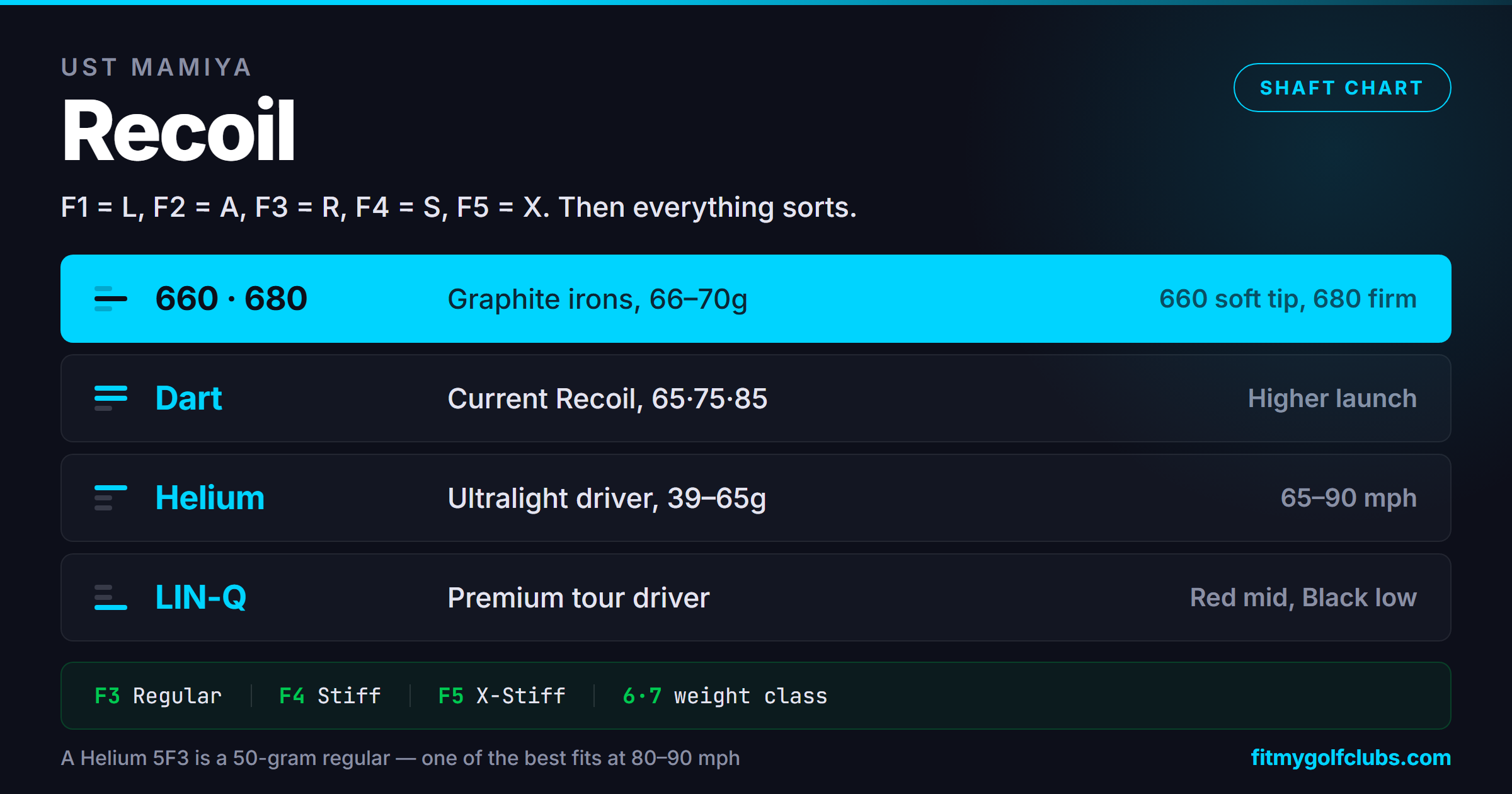
UST Mamiya Shaft Chart: Recoil, Helium, LIN-Q & ATTAS Decoded
UST Mamiya shaft chart: F1–F5 flex decoded (F3 = R, F4 = S), Recoil 660 vs 680 vs Dart, Helium, LIN-Q Red vs Black and ATTAS — weights and torque.
Golf Club Fitting
September 14, 2026
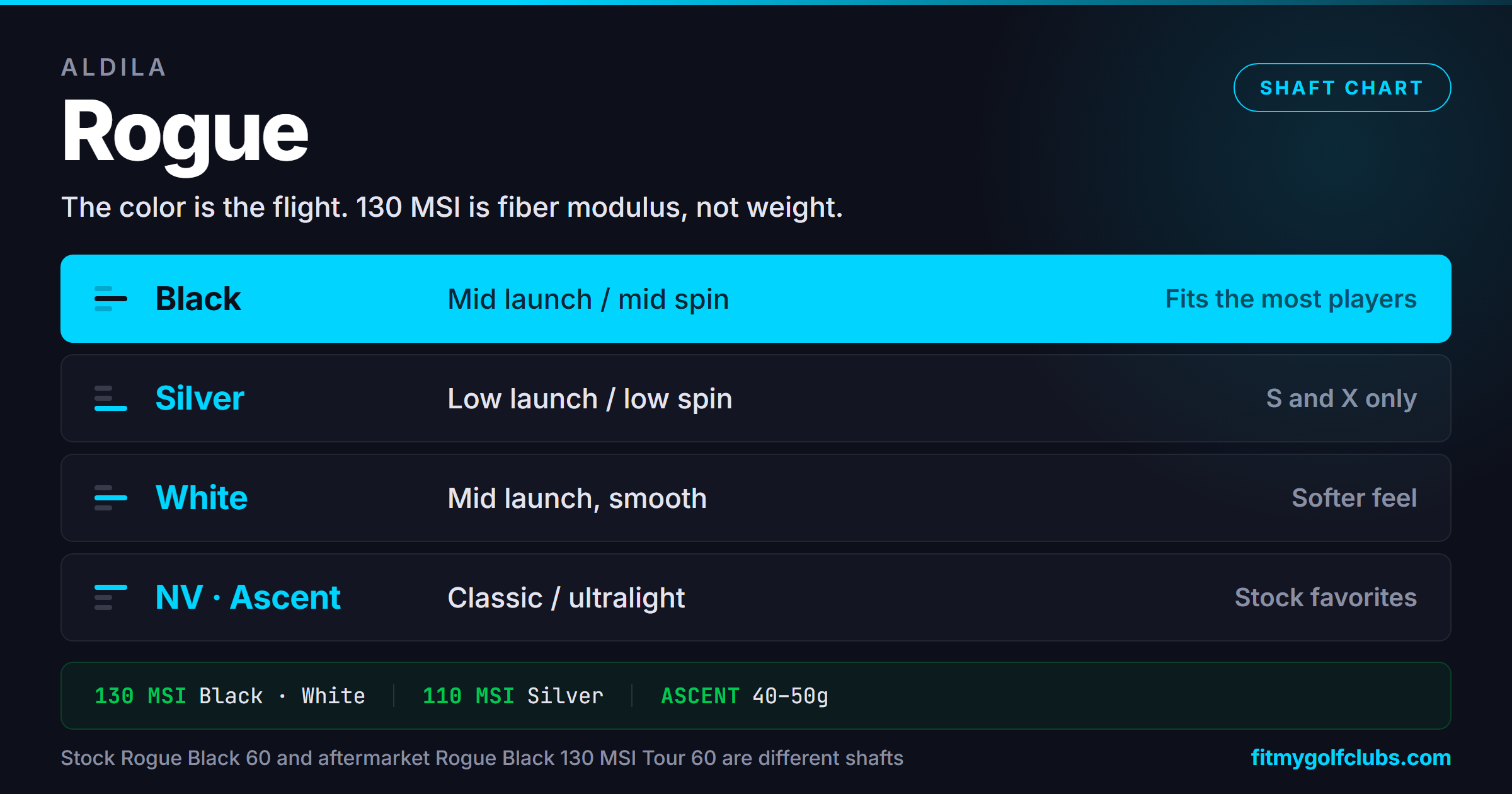
Aldila Shaft Chart: Rogue, NV, Ascent & Synergy by Launch and Weight
Aldila shaft chart: Rogue Black (mid), Silver (low spin), White (smooth), NV, Synergy, Ascent and Quaranta — weights, torque, and what 130 MSI means.
Golf Club Fitting
September 14, 2026
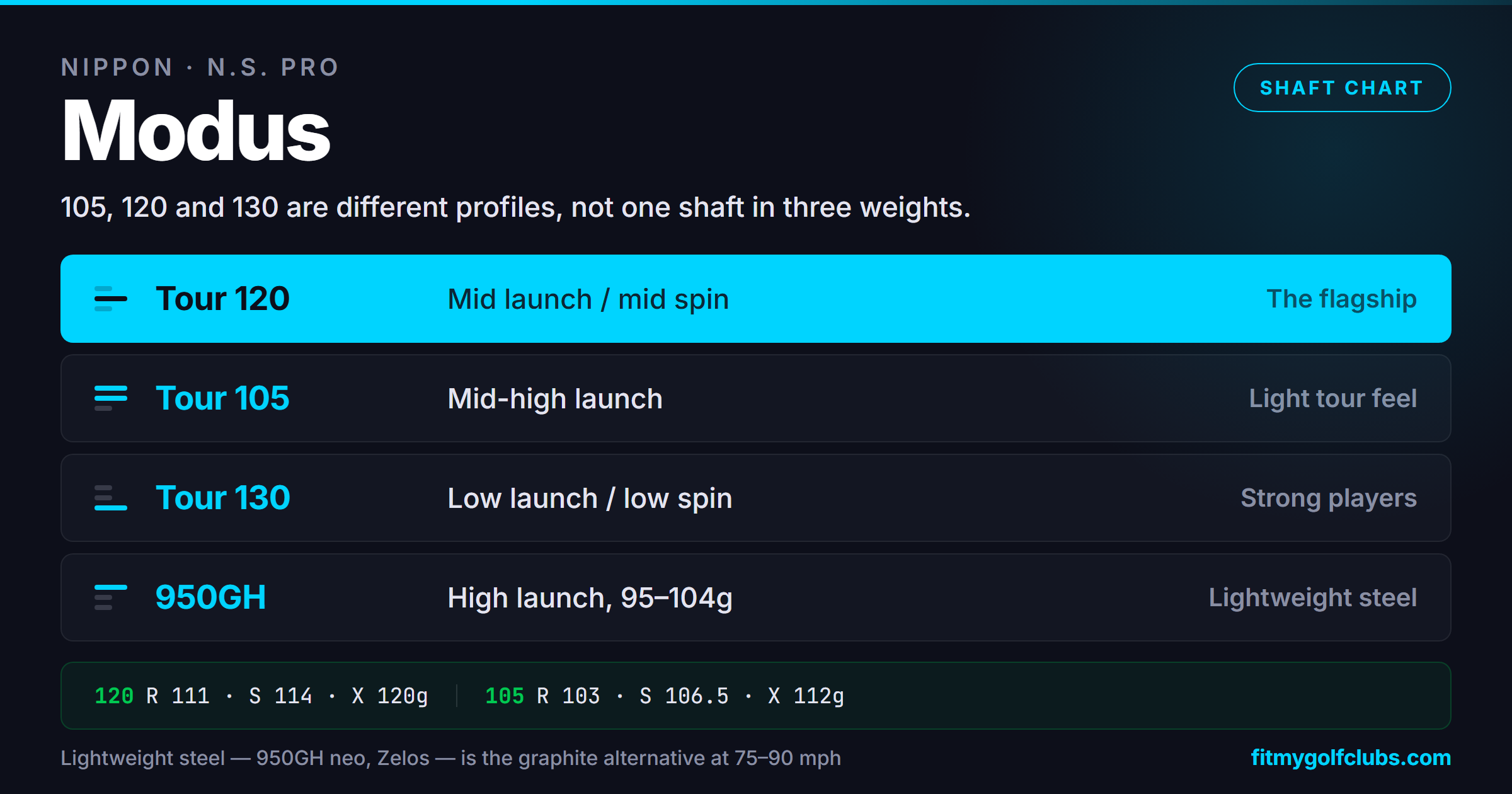
Nippon Modus & N.S. Pro Shaft Chart: 105, 120, 130 & Every GH Weight
Nippon shaft chart: Modus3 Tour 105–130 weights by flex and launch, plus N.S. Pro 950GH, 850GH, 1050GH, 1150GH and Zelos — lightweight steel decoded.


© 2026 FitMyGolfClubs. All rights reserved. | Patent Pending
Contact: sean@fitmygolfclubs.com