
Golf Club Fitting
September 14, 2026
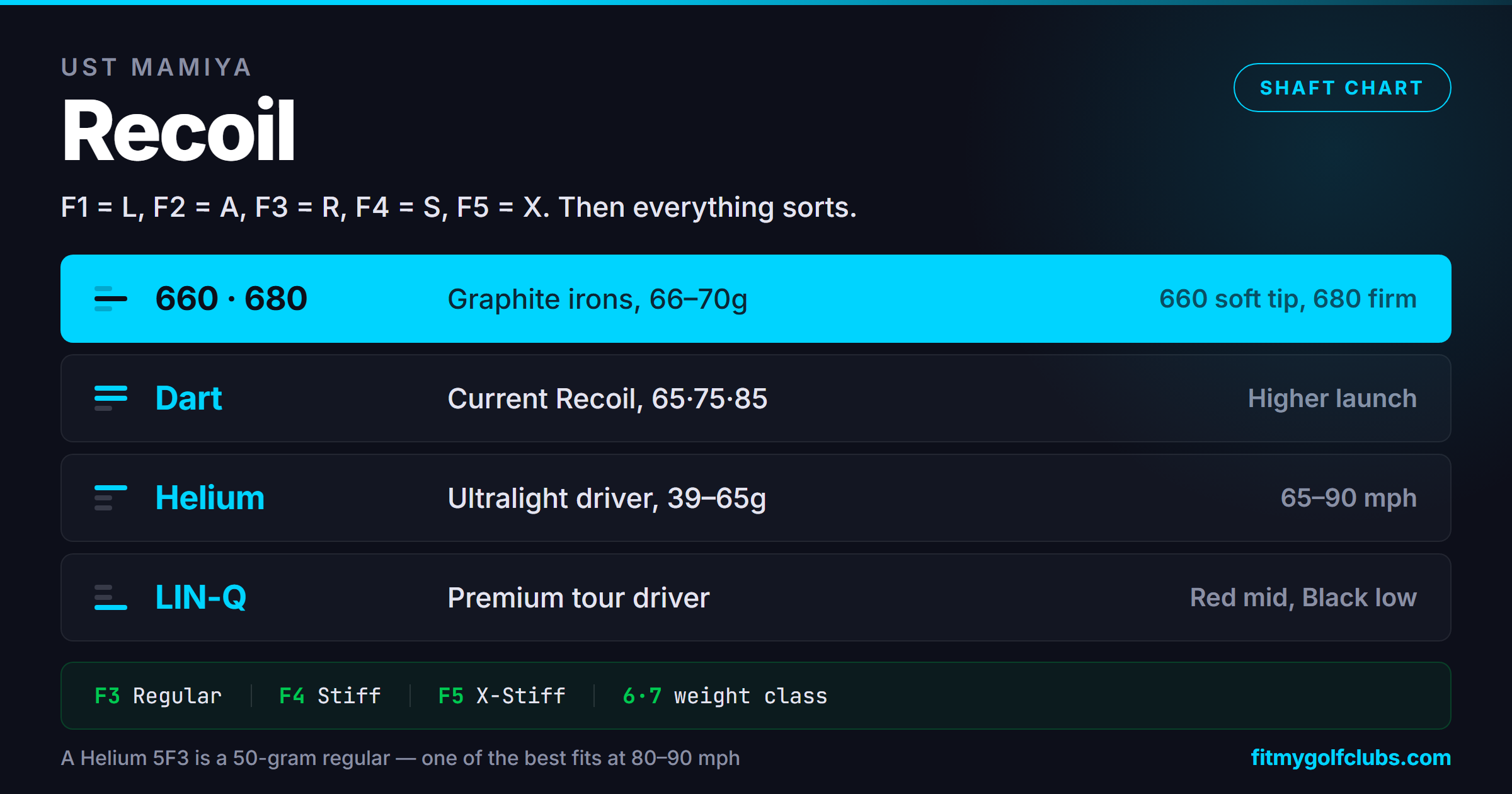
The quick answer: UST Mamiya uses a number system for flex that confuses almost everyone the first time: F1 is ladies, F2 is senior, F3 is regular, F4 is stiff, F5 is extra stiff. Once you know that, the family sorts cleanly. Recoil is the graphite iron shaft line (660/680/760/780/Dart/ES). Helium is the ultralight driver shaft for slower speeds. LIN-Q is the premium tour driver shaft — Red is mid launch, Black is low. ATTAS is the Japanese premium line. The full chart is below.
UST Mamiya is one of the two big stock-shaft suppliers in golf alongside Aldila, and it owns a niche no one else does: graphite iron shafts. If you play graphite in your irons, there's a good chance they're Recoils. It also has the most non-standard naming in the shaft business — a flex ladder that runs F1 to F5, weight codes that look like model numbers, and a made-for program that puts the same names on different shafts. This chart sorts every current line by launch, torque and weight, and decodes the numbers.
Weights and torque below come from the same shaft database that powers our club grader, so they match what the app uses when it scores a UST Mamiya in your bag.
UST Mamiya Shaft Chart: Every Current Line
Flexes in Recoil and Helium run F1 (L) through F5 (X); LIN-Q and ProForce use standard letters R, S, X; ATTAS uses a Japanese 5R/5S/6S/6X code where the digit is the weight class. The Recoil numbers are the most-searched and the most misread — the next section decodes them.
⚡ Not sure which flex you are?
Our free Shaft Flex Calculator turns your swing speed into a flex recommendation in seconds — the AI mode factors in tempo and miss pattern. Get my flex →
What F1–F5, 660/680 and the Helium Numbers Mean
The flex ladder: UST Mamiya rates flex F1 through F5 instead of letters. F1 = Ladies, F2 = Senior (A), F3 = Regular, F4 = Stiff, F5 = Extra Stiff. A "Recoil 660 F3" is a regular-flex Recoil; a "Helium 5F4" is a 50-gram stiff Helium. The number is not a weight and not a "level" — it maps one-to-one onto the letters everyone else uses.
The Recoil numbers: the first digit is the weight class and the rest is the profile. 660 and 680 are both 60-gram-class shafts (about 66–70g): the 660 has a softer tip and launches higher, the 680 has a firmer tip and launches mid. 760 and 780 are the 70-gram-class equivalents (76–90g). Recoil 95 and 110 break the pattern — those are actual weights in grams, for players who want steel weight in graphite. Recoil Dart uses plain weight classes (65, 75, 85) with an F-flex.
The Helium numbers: a Helium 4, 5 or 6 is a 40s, 50s or 60s-gram shaft; "5F3" is a 50-gram regular. Here are the typical driver speed bands for the F-flexes:
These follow our brand-neutral swing speed shaft flex chart. For irons, subtract roughly 10–15 mph from driver speed to get your 7-iron speed — a 95 mph driver swing is about an 82 mph 7-iron swing, which is an F4 (stiff) Recoil.
Practical shortcut: if a UST Mamiya is already in your bag, add it to your bag in the app exactly as printed — "Recoil 680 F4," "Helium 5F3." The app translates the F-numbers to playing flex automatically and grades your set's consistency across steel and graphite alike.
Shaft Flex Calculator
FREE — NO SIGNUPEnter your driver swing speed — get your flex band instantly.
Don’t know your speed? Rough guide: 200-yd carry ≈ 90 mph, 220-yd ≈ 100 mph — or read it off the chart below.
Line by Line
Recoil 660 and 680 (the 60-gram graphite iron shafts)
The Recoils that made graphite iron shafts respectable. Both are 60-gram class (about 66–70g) with steel-like torque (2.3–2.5°) — the point of Recoil is a graphite shaft that doesn't feel loose. The 660 has the softer tip and launches mid-high with mid spin; the 680 has the firmer tip and launches mid. Flexes F2 through F4 in the 660, F3 through F5 in the 680. The 660 F3 is one of the most-fit graphite iron shafts for 80–92 mph driver-speed players; the 680 F4 is the strong-player version.
Recoil 760, 780, 95 and 110 (the heavier Recoils)
The 70-gram class (76–90g) and beyond, for players who want graphite feel at closer-to-steel weight. The 760 is the mid launcher, the 780 the mid-low with the firmest tip, both in F3–F5 with torque down to 1.7°. Recoil 95 and 110 are the true steel-weight options — 95 and 110 grams — for tour-speed iron players who want vibration damping without a weight change. Very few amateurs need these; most who think they do should try a 780 F4 first.
Recoil Dart (the current mid-high launcher)
The current Recoil. Dart moves to plain weight classes — 65, 75, 85 (64–85g) — paired with F-flexes (65 F2, 75 F3, 75 F4, 85 F4/F5), and launches a touch higher than the classic 660/680 with the same low torque (2.5°). There's also a Dart ESX (55–65g) with senior and regular flexes and a Dart wedge version. If you're buying new Recoils today rather than used, Dart is what the fitter will hand you.
Recoil ES, ESX, 460 and 480 (the light and senior Recoils)
ES stands for enhanced stability — the ES versions add a stiffer butt section to the lighter Recoils so they don't feel whippy. Recoil 460 ES / ESX are the 45–50g class in L, A and R for the slowest speeds; 480 ESX is the 75–78g hybrid version; Recoil ESX (65–68g) is a lighter regular-flex option with mid launch. These are the Recoils that make graphite irons genuinely work for 65–85 mph players who'd be fighting steel.
Helium, Helium Black and Helium Nanocore (ultralight driver shafts)
Helium is UST's ultralight driver line — 4, 5 and 6 weight classes (39–65g), F1 through F4 flexes, high launch, high torque (up to 7.5° in the lightest). It's built for one job: helping 65–90 mph swings launch the ball and add speed through lighter weight. Helium Black (43–65g) is a slightly more stable, mid-high-launch version; Helium Nanocore (43–60g) is the current generation with a nano-particle resin for stability at very low weights. A Helium 5F3 is one of the best-fitting driver shafts in golf for the 80–90 mph player — and one of the least-tried, because it doesn't sound like a tour shaft.
LIN-Q M40X Red and Black (the premium tour driver shafts)
LIN-Q is UST's answer to Ventus and Tensei — a premium driver shaft using Toray M40X fiber, in two profiles. Red is the versatile one: mid launch, mid-low spin, 60/70/80 weights (62–84g), R, S, X. Black is the low-spin tour profile: low launch, low spin, high kick point, 70 and 80 weights (74–85g), S and X only. Torque runs 3.0–4.5° in Red and 2.8–3.2° in Black. Fitting-wise, Red lines up against Ventus Blue and Black against Ventus Black, at a lower price.
ATTAS (the Japanese premium line)
ATTAS is UST Mamiya's Japan-market premium series, with a new numbered model most years (ATTAS 11, ATTAS 12 and so on). It uses a Japanese code — 5R, 5S, 6S, 6X — where the digit is the weight class (5 = 50s, 6 = 60s) and the letter is standard flex. Profiles are typically mid launch with a smooth, active feel and torque 3.4–4.8°. ATTAS shows up in a lot of Japanese-spec drivers and in the bags of players who like a livelier shaft than the LIN-Q.
ProForce, ProForce V2 and the Retro Burner Edition
The ProForce was the UST driver shaft of the late 1990s and 2000s — a mid-launch, mid-spin, easy-loading profile that shipped stock in millions of drivers. The Retro Burner Edition (52–58g, R/S/X) is a nostalgia re-issue of the ProForce that came in the original TaylorMade Burner. Perfectly playable shafts, but a generation or two softer and higher-torque than a modern LIN-Q at the same letter; treat a used ProForce S as roughly a modern R+.
🔍 Already have a UST Mamiya in the bag?
Drop the club into our Single-Club Fit Grader and get an AI fit grade — flex, weight, and launch scored against your swing. Grade one club →
Graphite Irons: When Recoil Beats Steel
Graphite iron shafts used to mean "senior set." Recoil changed that by getting torque down to steel levels (1.7–2.5°) while keeping graphite's vibration damping and lighter weight. The honest fit rule: if you have joint pain, a smooth tempo, or a 7-iron speed under about 80 mph, a Recoil 660 or Dart 75 in F3 will very likely beat the steel shaft you're playing. If you're a fast, aggressive iron player over 90 mph 7-iron speed, steel — or a Recoil 780/95 — is still the more consistent choice.
The number that matters is total weight change: moving from a 120g steel shaft to a 68g Recoil 680 takes 50g out of every iron, which changes swingweight and feel dramatically. Fitters usually add head weight or move to a 760/780 to keep the club from feeling like a wand. Don't judge Recoils from a demo club that wasn't reweighted.
Picking Your UST Mamiya: The Two-Question Shortcut
Question 1 — what club and what's your miss? Irons: launching low or losing speed → Recoil 660 or Dart; need more stability → 680 or 780. Driver, slow or smooth swing needing launch → Helium. Driver, mid speed → LIN-Q Red. Driver, fast and spinny → LIN-Q Black.
Question 2 — what's your speed, in F-numbers? Under 75 mph driver → F2. 75–94 → F3. 95–104 → F4. 105+ → F5. For irons, take your driver speed minus 10–15 mph and read the same ladder. Weight follows speed: Helium 4/5 and Recoil 460 for the slowest swings, Helium 6 and Recoil 660/Dart 65 for the 80–95 mph majority, Recoil 780/Dart 85 and LIN-Q 70 for strong players.
🏌️ The shaft is one of 8 factors.
A perfectly-fit UST Mamiya in a mis-lofted head still costs you strokes. Grade My Bag scores all 14 clubs across the 8 factors pro fitters use — free, from your specs alone. Grade my bag free →
Frequently asked questions
What do F2, F3, F4 and F5 mean on UST Mamiya shafts?
They're flex ratings: F1 is ladies, F2 is senior (A), F3 is regular, F4 is stiff, F5 is extra stiff. The number maps one-to-one onto the standard letters — a Recoil 660 F3 is a regular-flex Recoil and a Helium 5F4 is a stiff Helium.
What is the difference between Recoil 660 and 680?
Both are 60-gram-class graphite iron shafts (about 66–70g). The 660 has a softer tip and launches mid-high; the 680 has a firmer tip and launches mid. The 660 suits smoother, slower iron swings; the 680 suits stronger players who want more control. The 760 and 780 are the same pair in the 70-gram class.
What swing speed is a Recoil 660 F3 for?
About 75–94 mph of driver speed, which is roughly 65–80 mph of 7-iron speed. F4 covers about 95–104 mph driver speed (82–90 mph 7-iron), and F2 covers 65–74 mph driver speed for senior players.
Are Recoil graphite iron shafts good?
Yes — they're the graphite iron shafts that made graphite credible for good players, with torque down at steel levels (1.7–2.5°). They're the right choice for players with joint pain, smooth tempos, or 7-iron speeds under about 80 mph. Fast, aggressive iron players over 90 mph 7-iron speed usually still do better in steel or the heavier Recoil 780/95.
What is the UST Helium shaft for?
Helium is an ultralight driver shaft (39–65g) with high launch and high torque, built for 65–90 mph swings that need help launching the ball and gaining speed through lighter weight. The number is the weight class (4 = 40s, 5 = 50s, 6 = 60s) and the F-number is flex — a Helium 5F3 is a 50-gram regular.
Is LIN-Q a good driver shaft?
Yes — LIN-Q M40X is UST Mamiya's premium tour driver shaft and competes directly with Ventus and Tensei. Red is the versatile mid-launch, mid-low-spin profile (like Ventus Blue); Black is the low-launch, low-spin profile for fast swings (like Ventus Black), offered only in S and X.
Related reading
- Aldila Shaft Chart — The other big stock-shaft supplier — Rogue, NV, Ascent and Synergy decoded.
- KBS Shaft Chart — The steel iron shafts Recoil is usually replacing — Tour, C-Taper, $-Taper by weight and flex.
- Golf Swing Speed Chart: Shaft Flex by Club Head Speed — The brand-neutral flex bands the F1–F5 table above maps onto.
- Golf Shaft Weight Guide — Why going from 120g steel to a 68g Recoil changes everything about the club.
Know the shaft. Now check the whole bag. The FitMyGolfClubs app grades all 14 clubs across eight fitting factors — shaft flex and weight included — straight from your specs. Free to start.
Related Articles
Golf Club Fitting
September 14, 2026
UST Mamiya Shaft Chart: Recoil, Helium, LIN-Q & ATTAS Decoded
UST Mamiya shaft chart: F1–F5 flex decoded (F3 = R, F4 = S), Recoil 660 vs 680 vs Dart, Helium, LIN-Q Red vs Black and ATTAS — weights and torque.
Golf Club Fitting
September 14, 2026
Aldila Shaft Chart: Rogue, NV, Ascent & Synergy by Launch and Weight
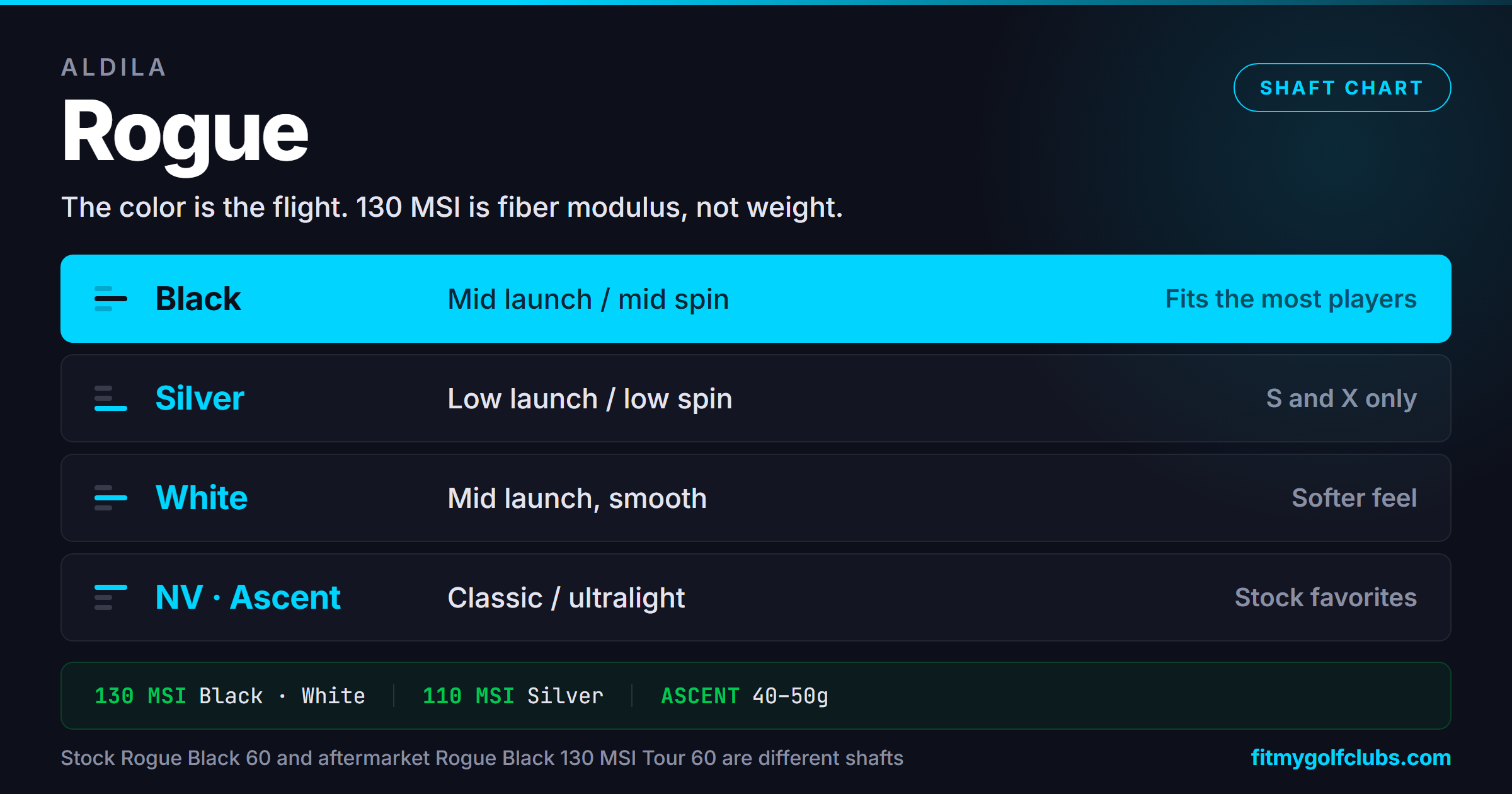
Aldila shaft chart: Rogue Black (mid), Silver (low spin), White (smooth), NV, Synergy, Ascent and Quaranta — weights, torque, and what 130 MSI means.
Golf Club Fitting
September 14, 2026
Nippon Modus & N.S. Pro Shaft Chart: 105, 120, 130 & Every GH Weight
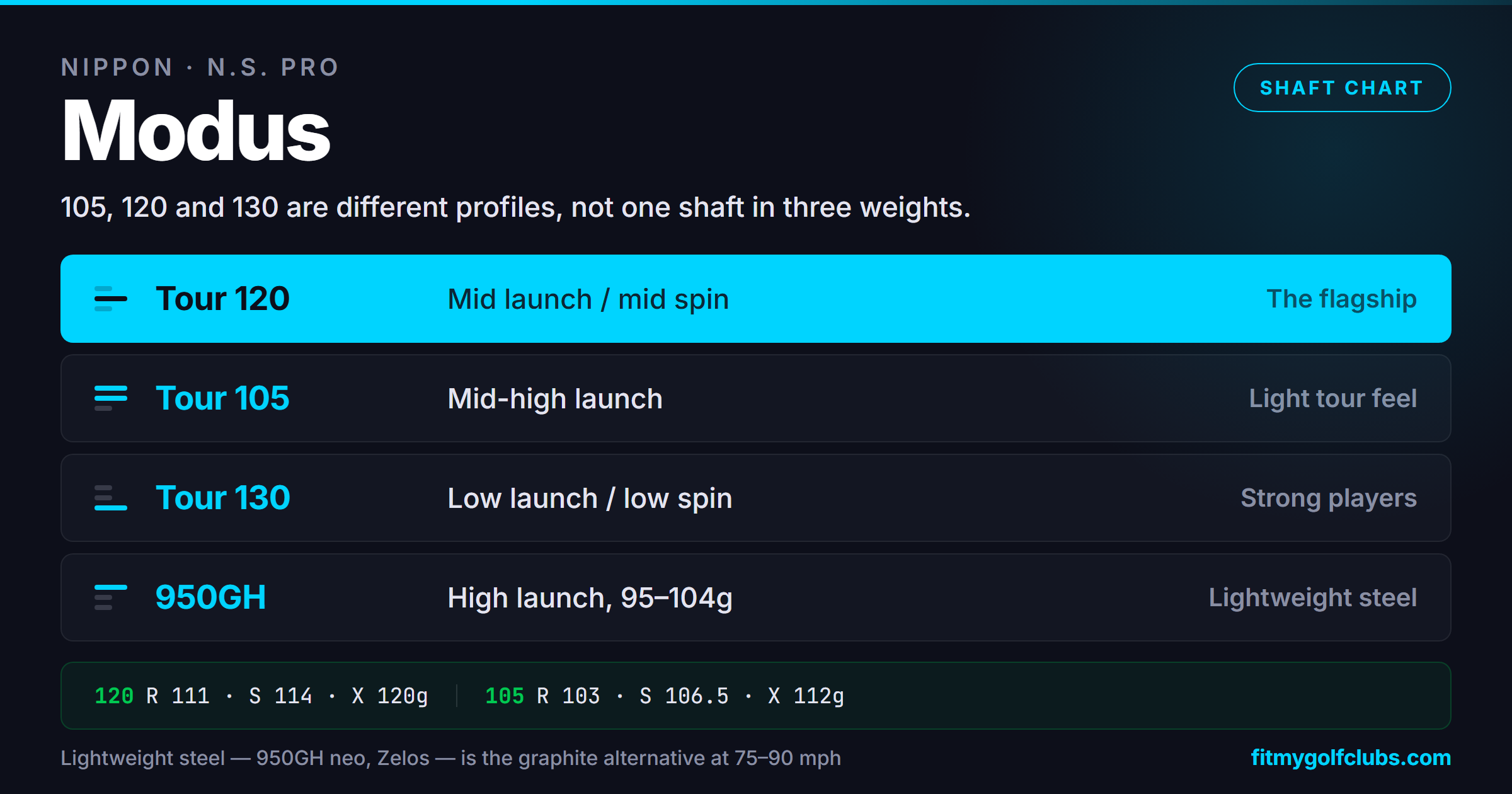
Nippon shaft chart: Modus3 Tour 105–130 weights by flex and launch, plus N.S. Pro 950GH, 850GH, 1050GH, 1150GH and Zelos — lightweight steel decoded.


© 2026 FitMyGolfClubs. All rights reserved. | Patent Pending
Contact: sean@fitmygolfclubs.com