
Golf Club Fitting
September 14, 2026
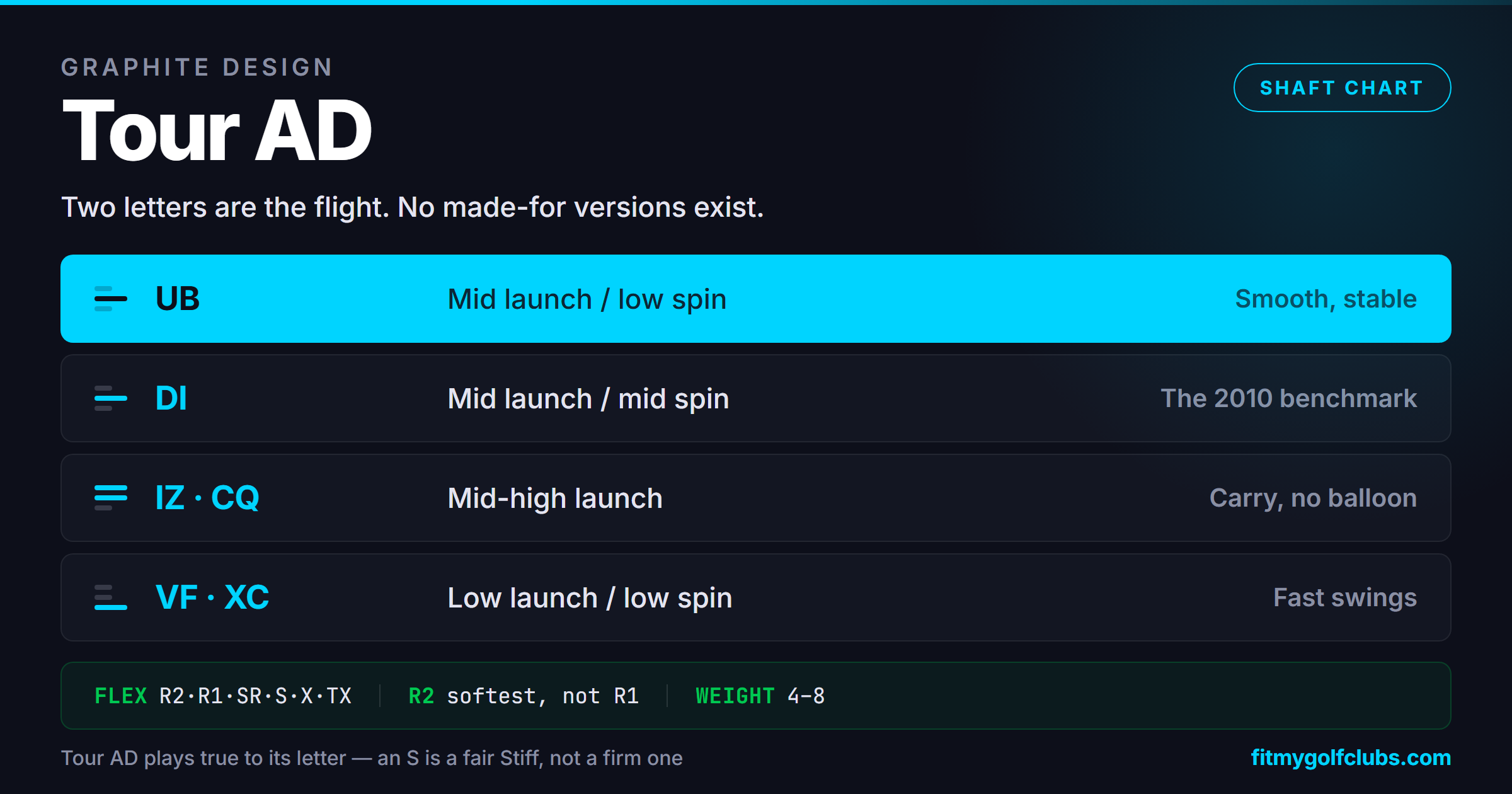
The quick answer: Graphite Design names every Tour AD with two letters, and the letters are the flight. DI is the mid-launch classic that most of the family is measured against. IZ launches higher with low spin. UB is the smooth, stable mid-launch that's dominated recent tour counts. VF and XC are the low launchers for fast swings. CQ is the easy launcher for moderate speeds. The number after the letters is weight class (4, 5, 6, 7, 8 = 40s through 80s), and the flex system runs R2, R1, SR, S, X, TX. The full chart is below.
Tour AD is the Japanese premium shaft family that never chased volume — no no-upcharge stock program, no made-for versions, one factory in Japan — which is exactly why its charts are cleaner than Ventus or Tensei: a Tour AD DI 6-S is a Tour AD DI 6-S, whoever sold it to you. What isn't clean is the sheer number of models. Graphite Design releases a new two-letter profile almost every year and keeps the old ones in production, so the current catalog runs from the 2010 DI to the 2025 GC. This chart sorts all of them by launch, spin, torque and weight.
Weights and torque below come from the same shaft database that powers our club grader, so they match what the app uses when it scores a Tour AD in your bag.
Tour AD Shaft Chart: Every Model
Flexes run R2 (softest), R1, SR, S, X and TX. Every current model is offered in weight classes 4 through 8 (roughly 45–88g), with 9 available in DI, and the hybrid versions run 7 through 10 (65–109g). Within any model the lighter weights launch and spin more than the heavier ones — a UB 5 flies higher than a UB 7.
⚡ Not sure which flex you are?
Our free Shaft Flex Calculator turns your swing speed into a flex recommendation in seconds — the AI mode factors in tempo and miss pattern. Get my flex →
What the Tour AD Letters and Flexes Mean
A Tour AD label reads like Tour AD UB 6 S: model, weight class, flex. The two-letter model is the bend profile — Graphite Design releases roughly one new one a year and keeps the old ones. The number is weight class in tens of grams: 4 ≈ 45–49g, 5 ≈ 54–59g, 6 ≈ 64–69g, 7 ≈ 74–79g, 8 ≈ 82–88g.
The flex system is where Tour AD differs from everyone else: it runs R2 → R1 → SR → S → X → TX, softest to stiffest. R2 is softer than R1 (the opposite of what most people guess), SR is a true half-step between regular and stiff, and Tour AD plays roughly true to its letter — an S is a fair Stiff, not a firm one like Project X or a Diamana white.
Here are the typical driver speed bands, with the low-launch models (VF, XC, MT, VR) shifted up because of their stiffer tips:
These follow our brand-neutral swing speed shaft flex chart. The R2/R1/SR ladder is the best thing about Tour AD for average golfers — there are three real steps between "senior" and "stiff" instead of one, so the 80–97 mph majority can actually be fit instead of rounded.
Practical shortcut: if a Tour AD is already in your bag, add it to your bag in the app exactly as printed — model, number, and R2/R1/SR/S/X. The app decodes the flex ladder automatically and grades your set's consistency by playing flex, not by label.
Shaft Flex Calculator
FREE — NO SIGNUPEnter your driver swing speed — get your flex band instantly.
Don’t know your speed? Rough guide: 200-yd carry ≈ 90 mph, 220-yd ≈ 100 mph — or read it off the chart below.
Model by Model
Tour AD DI (mid launch, mid spin — the benchmark)
The 2010 original that made Tour AD a tour brand, and still one of the most-played. DI has a smooth handle, a lively but controlled tip, and a mid launch with mid spin that suits the widest range of good players. It's the reference point: every later Tour AD is described as "higher/lower launch than DI" or "less spin than DI." Weights 5–9 (54–97g), flexes R1 through TX, plus DI Hybrid in 8–10. If you've never hit a Tour AD, start here.
Tour AD IZ (mid-high launch, low spin)
The high-launch-without-the-spin model. IZ has a softer tip than DI for launch but a firmer midsection that keeps spin down, so the ball flies higher and lands softer without ballooning. Weights 4–8 (46–83g), flexes R2 through TX. The classic IZ player has a mid swing speed, hits it a little low, and doesn't want to give up control to fix it — a big slice of the 88–100 mph population.
Tour AD UB (mid launch, low spin — smooth and stable)
The 2022 profile that took over tour counts. UB is a mid launcher like DI but spins less, with a noticeably stable, one-piece feel through the strike and a smoother handle than XC or VF. It's the "modern DI" for players who found DI a bit active in the tip. Weights 4–8 (45–83g), flexes R2 through TX, plus UB Hybrid. If a fitter puts one Tour AD in your hands first at 95–110 mph, it's often this.
Tour AD VF (low-mid launch, low spin)
The 2023 low launcher. VF has the firmest tip of the recent models and a stable midsection, built for fast, aggressive swings that spin the driver up. Launch is low-mid, spin is low, feel is firm throughout. Weights 4–8 (46–85g), flexes R1 through TX; there's also a VF Driving Iron version at 94–109g. Under about 100 mph it takes away launch faster than spin — it's a strong-player shaft first.
Tour AD XC and Tour AD MT (stiff-tip low launchers)
XC (2020) is the stiff-tip, mid-low launch, low-spin profile with a higher kick point than the rest of the family — for players who want the shaft to resist through impact. MT (2012) is the older take on the same idea: mid-low launch, low spin, firm feel, in weights 5–8. Both are popular with strong hitters who found DI too lively. XC runs 4–8 (47–85g) and has a hybrid version; MT is wood only.
Tour AD HD, FI and GC (stable mids)
HD (2021) is a mid launcher with a firm midsection — "high density" carbon — that gives DI-like flight with a more stable feel. FI (2024) is a balanced mid-launch, mid-spin alternative to DI with a slightly softer handle. GC (2025) is the newest profile: mid launch, mid-low spin, positioned between UB and DI. All three run 4–8 (45–88g) in R2 through TX with hybrid versions. Between them, HD for the stronger player, FI for the smoother one, GC for the player who wants the latest UB-adjacent option.
Tour AD CQ (mid-high launch, easy loading)
The 2024 easy launcher. CQ has the softest overall feel of the current line and the highest torque (up to 6.1° in the light weights), built to load easily and launch mid-high for moderate speeds and smoother tempos. Weights 4–8 (47–83g), flexes R2 through TX. It's the Tour AD for the 80–95 mph player who wants premium construction without a shaft that fights them.
Tour AD VR and the hybrid versions
VR (2020) is a lower-launch, low-spin profile with a softer handle than XC — for players who want XC numbers with more feel — in weights 5–7 (56–78g). The Tour AD Hybrid line offers most wood profiles (DI, IZ, UB, VF, XC, HD, GC, FI) in hybrid-specific builds at 65–109g with low torque (2.0–3.5°); the profile letters mean the same thing they mean in the woods. There's also a Tour AD Iron line (58–114g graphite) and the Raune steel-replacement graphite iron shaft.
🔍 Already have a Tour AD in the bag?
Drop the club into our Single-Club Fit Grader and get an AI fit grade — flex, weight, and launch scored against your swing. Grade one club →
Why Tour AD Charts Are Simpler Than Ventus or Tensei
Graphite Design doesn't build made-for stock shafts. Every Tour AD — the one in a tour bag, the one at your fitter, the one you buy used — is the same Japan-made shaft to the same spec. There is no "non-VeloCore" or "made-for" version to worry about, and no reason to check the graphics for a hidden downgrade. If it says Tour AD UB 6 S, it's a Tour AD UB 6 S.
The trade-off is price and availability: Tour AD is aftermarket-only, so you'll rarely find one as a no-upcharge option. Also note the flex ladder when comparing to other brands — a Tour AD SR is a real half-step that most brands don't offer, and Tour AD S plays truer (softer) than a Project X 6.0 or a Diamana white S.
Picking Your Tour AD: The Two-Question Shortcut
Question 1 — what's your miss? High, spinny drives that lose distance → VF or XC (MT if you like the older feel). Low shots that won't carry → IZ or CQ. Neither extreme → DI, UB, HD, FI or GC — UB if you want the most stable feel, DI if you like an active tip, CQ if you want the softest.
Question 2 — what's your speed? Use the flex table above and take the R2/R1/SR ladder seriously: most 80–97 mph players are an R1 or SR, not an R or S. Weight follows speed and tempo: 4/5 for smooth or slower swings, 6 is the standard driver weight for most 90–105 mph players, 7 for strong swings and fairway woods, 8 for tour speeds.
🏌️ The shaft is one of 8 factors.
A perfectly-fit Tour AD in a mis-lofted head still costs you strokes. Grade My Bag scores all 14 clubs across the 8 factors pro fitters use — free, from your specs alone. Grade my bag free →
Frequently asked questions
What do the letters on Tour AD shafts mean (DI, IZ, UB, VF)?
They're model names, each with its own bend profile. DI is the mid-launch benchmark, IZ launches higher with low spin, UB is a smooth low-spin mid launcher, VF and XC are the low launchers, HD is a stable mid, CQ is the easy launcher, GC and FI are the newest mids. The number after the letters is the weight class in tens of grams.
What is the difference between Tour AD R1 and R2?
R2 is softer than R1. Graphite Design's flex ladder runs R2 → R1 → SR → S → X → TX from softest to stiffest. R2 fits about 72–82 mph of driver speed, R1 about 80–90 mph, and SR about 88–97 mph.
What swing speed is a Tour AD DI 6 S for?
About 95–104 mph of driver speed. A DI 6 SR fits roughly 88–97 mph, a DI 6 X about 105–114 mph. Tour AD plays true to its letter — its S is a fair Stiff, not a firm one.
Which Tour AD launches the highest?
Tour AD IZ and Tour AD CQ. IZ launches mid-high with low spin for carry without ballooning; CQ launches mid-high with a softer, easier-loading feel for moderate speeds. Within either, the lighter weights in R1 or R2 launch highest.
Is Tour AD UB better than DI?
Different, not better. UB launches similarly to DI but spins less and feels more stable through impact; DI has a livelier tip and a bit more spin. Players who found DI too active tend to prefer UB; players who like to feel the tip release tend to stay with DI.
Are there stock or made-for versions of Tour AD shafts?
No. Graphite Design builds every Tour AD in Japan to the same spec and doesn't produce made-for-OEM versions. The shaft in a tour bag, at a fitter, and in a used listing are the same shaft — which makes Tour AD one of the easiest premium shafts to buy used.
Related reading
- Fujikura Ventus Shaft Chart — The tour volume leader decoded — Blue, Red, Black, TR and VeloCore.
- Mitsubishi Tensei Shaft Chart — CK, AV and 1K series by color, plus the stock-vs-aftermarket trap.
- Golf Swing Speed Chart: Shaft Flex by Club Head Speed — The brand-neutral flex bands the Tour AD table above is built on.
- Golf Shaft Weight Guide — Why a Tour AD 5 vs 7 changes more than the flex letter does.
Know the shaft. Now check the whole bag. The FitMyGolfClubs app grades all 14 clubs across eight fitting factors — shaft flex and weight included — straight from your specs. Free to start.
Related Articles
Golf Club Fitting
September 14, 2026
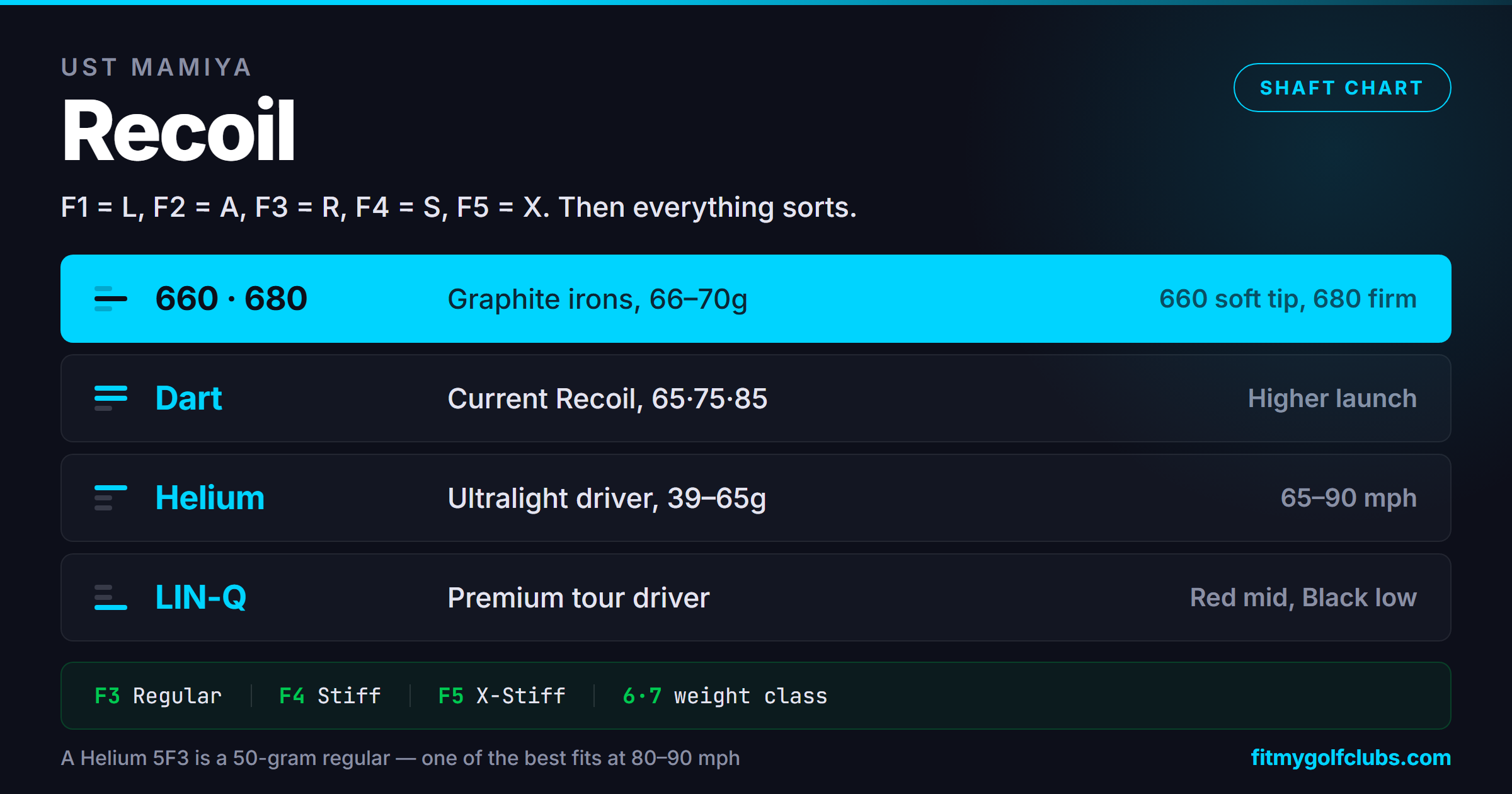
UST Mamiya Shaft Chart: Recoil, Helium, LIN-Q & ATTAS Decoded
UST Mamiya shaft chart: F1–F5 flex decoded (F3 = R, F4 = S), Recoil 660 vs 680 vs Dart, Helium, LIN-Q Red vs Black and ATTAS — weights and torque.
Golf Club Fitting
September 14, 2026
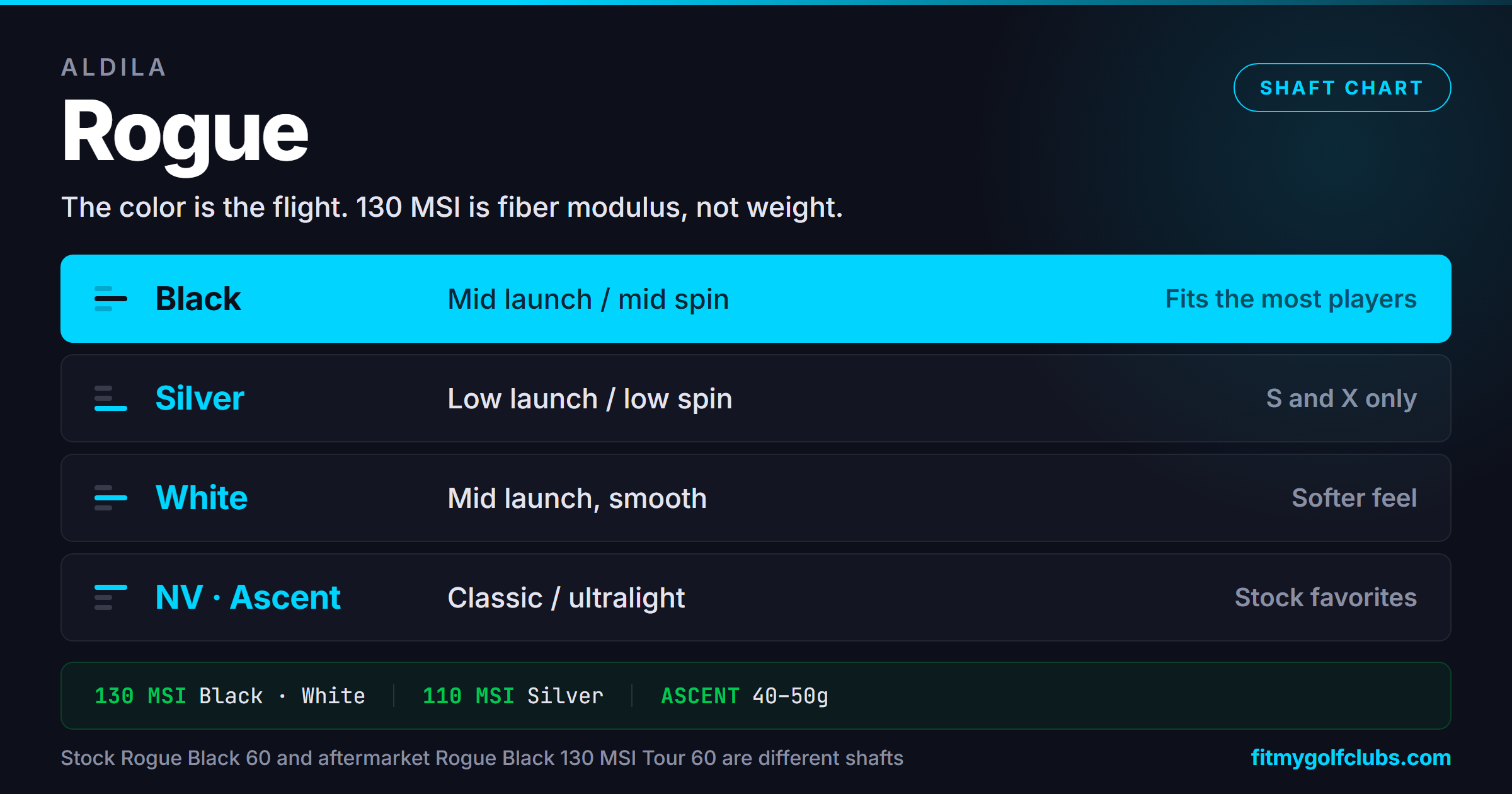
Aldila Shaft Chart: Rogue, NV, Ascent & Synergy by Launch and Weight
Aldila shaft chart: Rogue Black (mid), Silver (low spin), White (smooth), NV, Synergy, Ascent and Quaranta — weights, torque, and what 130 MSI means.
Golf Club Fitting
September 14, 2026
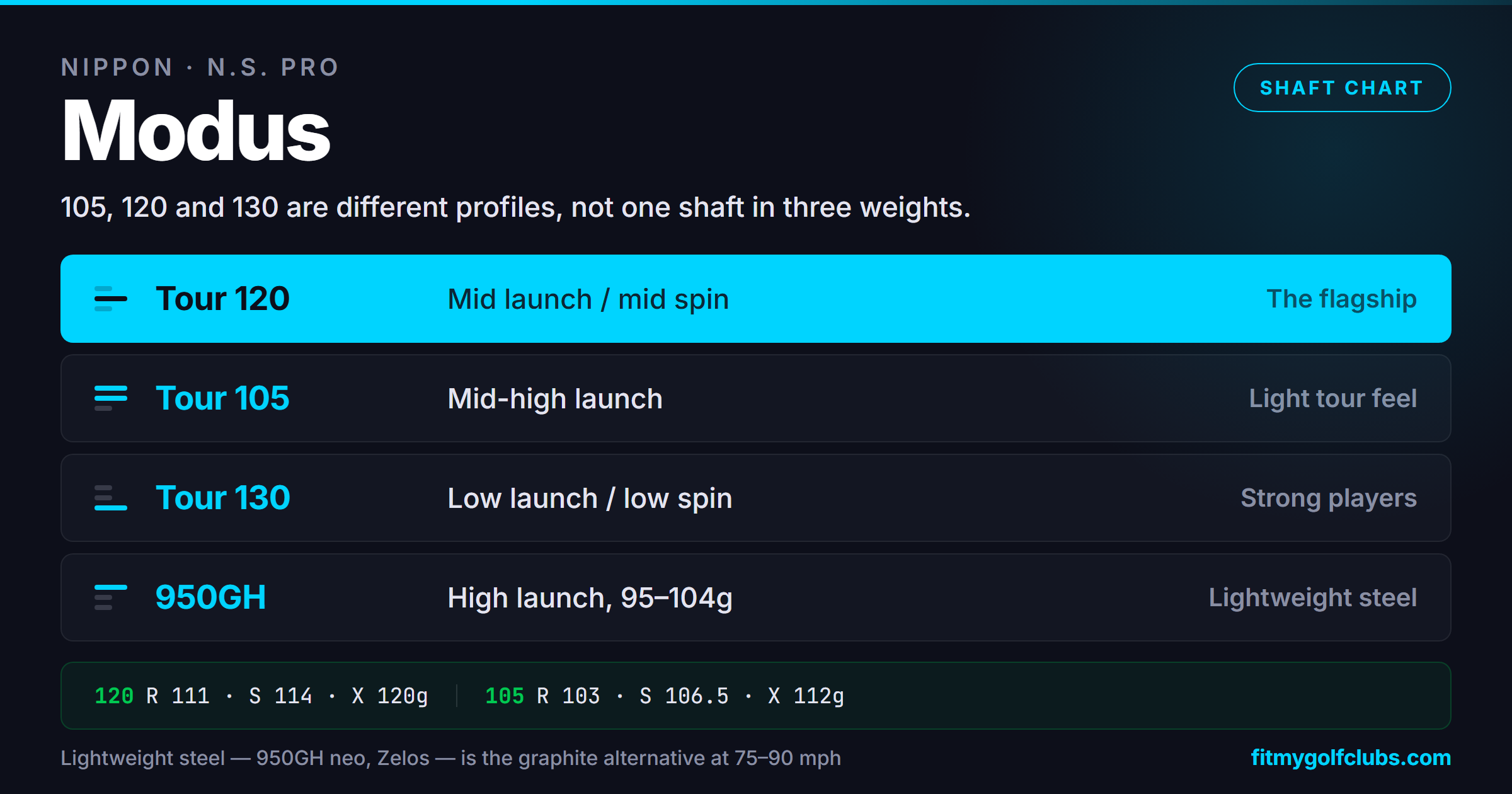
Nippon Modus & N.S. Pro Shaft Chart: 105, 120, 130 & Every GH Weight
Nippon shaft chart: Modus3 Tour 105–130 weights by flex and launch, plus N.S. Pro 950GH, 850GH, 1050GH, 1150GH and Zelos — lightweight steel decoded.


© 2026 FitMyGolfClubs. All rights reserved. | Patent Pending
Contact: sean@fitmygolfclubs.com