
Golf Club Fitting
September 23, 2026
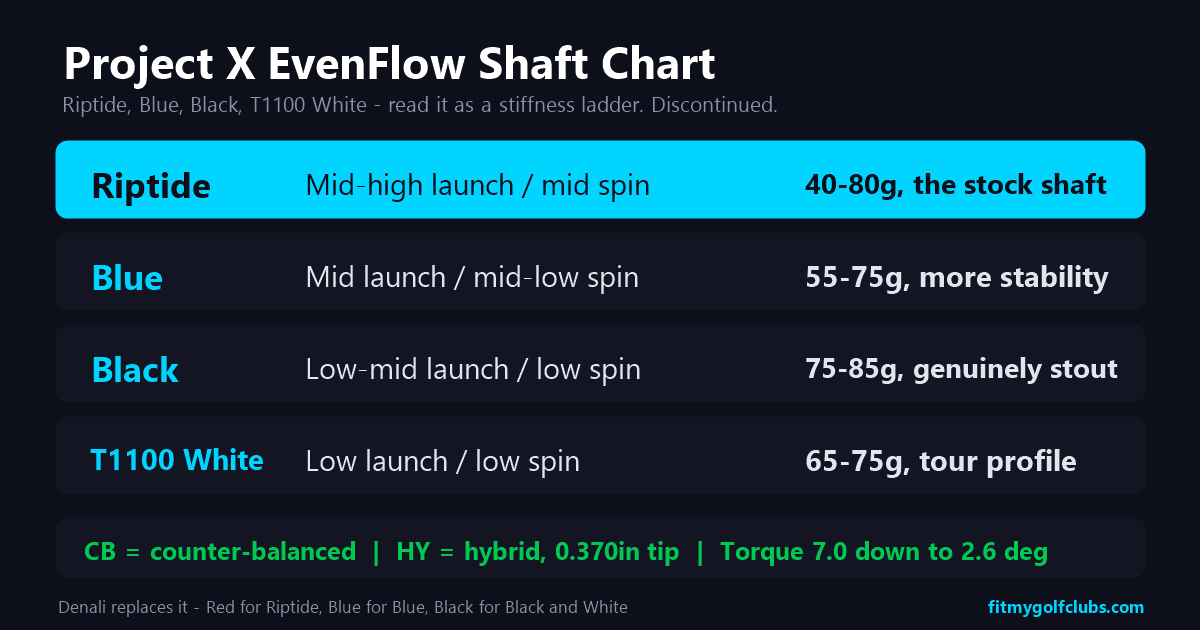
The quick answer: EvenFlow was Project X's mid-weight graphite wood line, and the colour is the flight. Riptide is the high launcher (40–80g), Blue is mid (55–75g), Black is low-mid (75–85g) and T1100 White is the low-spin tour profile (65–75g). The number after the name is the weight class in grams. True Temper no longer lists EvenFlow in its current range, so this is a page for identifying and replacing one. The chart is below.
EvenFlow earned its name from its bend profile: an even, smooth-loading bend rather than the tip-stiff, "hold on tight" character of the HZRDUS shafts sold alongside it. That made it the approachable Project X wood shaft — the one a mid-handicapper could actually load — and it turned up as a no-upcharge stock option on a very large number of drivers and fairway woods for several seasons. That is why so many bags still have one.
The result is a lot of golfers holding a shaft whose name means nothing to them. This chart sorts every EvenFlow line by launch, weight, flex and torque, explains what the CB and HY suffixes mean, and says what to specify now that the line is gone. Every figure comes from the same shaft database that powers our club grader.
EvenFlow Shaft Chart: Every Line
Read this chart top to bottom as a stiffness ladder. Riptide is the softest and most forgiving, Blue is a step up in stability, Black is genuinely stout, and T1100 White is the tour shaft. Torque tracks the same ladder — from 7.0° in the lightest Riptide down to 2.9° in the heavy White — which is a cleaner signal of who each shaft is for than the flex letter is.
The suffixes are worth knowing. CB is counter-balanced (extra mass toward the grip, so a builder can go longer or add head weight without the club feeling heavy). HY is the hybrid version on the 0.370" tip, not the wood shaft cut down. Both appear on Riptide only.
⚡ Not sure which flex you are?
Our free Shaft Flex Calculator turns your swing speed into a flex recommendation in seconds — the AI mode factors in tempo and miss pattern. Get my flex →
EvenFlow Flexes and the Swing Speeds They Fit
EvenFlow was sold with both letter flexes and, on the T1100 White, the Project X numeric codes. The mapping is the standard one — 6.0 is a stiff, 6.5 is an extra stiff — and the full system is decoded in the Project X shaft selector chart.
Weight matters more than the letter in this line, because the range is so wide. A Riptide 40 in L and a Black 85 in X are barely the same category of object:
These bands follow our brand-neutral swing speed shaft flex chart, and the 90–99 mph stretch is the one place where tempo decides rather than the number — a smooth transition stays softer, a quick one goes up.
If an EvenFlow is in your bag, add the club in the app with the exact printing: line, weight number and flex. Because EvenFlow shipped as a stock shaft on so many drivers, it is a common source of a weight mismatch between a light stock driver shaft and the rest of a bag.
Shaft Flex Calculator
FREE — NO SIGNUPEnter your driver swing speed — get your flex band instantly.
Don’t know your speed? Rough guide: 200-yd carry ≈ 90 mph, 220-yd ≈ 100 mph — or read it off the chart below.
Line by Line
EvenFlow Riptide (the one you probably have)
The broadest and most widely fitted EvenFlow, and the version that shipped as a no-upcharge stock shaft on a long list of drivers and fairway woods. It spans 40 to 80 grams and L through TX, which is an enormous range for one name — a Riptide 40 L is a senior shaft and a Riptide 80 TX is a tour shaft, and they share only a bend philosophy. Mid-high launch, smooth loading, and torque that runs from a very active 7.0 degrees in the 40 down to 3.0 in the 80.
EvenFlow Blue
A step up in stability from Riptide at the same nominal flex, running 55, 65 and 75 grams in R, S and X. Launch is mid and spin is mid to low, so this is the EvenFlow for a player who found Riptide a touch loose or too high but is not ready for Black. In our database the Blue 65 in S at 66 grams and 3.8 degrees of torque is the single most sensible all-round spec in the whole line.
EvenFlow Black
The stout one, at 75 grams in R, S and X for woods with an 85-gram hybrid version, and torque down at 2.6 to 3.2 degrees in the wood shaft. Low-mid launch and low spin, built for strong players who were spinning the ball up with the lighter EvenFlows. If you have an EvenFlow Black and you are not a genuinely fast, aggressive swinger, it is worth checking whether you were ever fit into it or simply bought the one that looked the most serious.
EvenFlow T1100 White
The tour profile, named for the T1100G carbon fibre in its construction, offered in 65 and 75 grams in 6.0 and 6.5 only — no regular flex, which tells you the target player. Lowest launch and lowest spin in the family at 2.9 to 3.5 degrees of torque. It also came in an iron-shaft version at 67 grams, which is an unusual and quite specific product. This is the EvenFlow that competed with the tour shafts rather than the stock ones.
Riptide CB and Riptide HY
CB is the counter-balanced Riptide in 40, 50 and 60 grams — extra mass toward the grip end lowers the assembled swing weight, which lets a builder go longer or add head weight without the club feeling head-heavy. HY is the hybrid version in 60, 70 and 80 grams on a 0.370 inch tip, with lower torque than the wood shafts because hybrid heads are heavier and shorter. Neither is a different flight from standard Riptide; both are build options.
🔍 Already have an EvenFlow in the bag?
Drop the club into our Single-Club Fit Grader and get an AI fit grade — flex, weight, and launch scored against your swing. Grade one club →
What to Buy Now EvenFlow Is Gone
Within Project X, Denali is the replacement, and the colour mapping is close to direct: Denali Red for a Riptide or a high-launch fit, Denali Blue for an EvenFlow Blue, and Denali Black for an EvenFlow Black or T1100 White. Denali is the premium tier, so expect a price step up from what an EvenFlow cost as a stock option. The Denali chart has the weights and flex codes side by side.
If you only need to replace one shaft rather than re-fit, the used market still carries EvenFlow in quantity precisely because it was a stock shaft for years — this is one of the easier discontinued shafts to match. Get the same line, weight and flex, and check that a Riptide is not quietly being sold to you as a Riptide CB, because the counter-balance changes the assembled swing weight even though everything else matches.
The one replacement to avoid is a like-for-like weight in a stiffer family. EvenFlow's whole character was that it loaded evenly and smoothly. Swapping a Riptide 60 S for a tip-stiff 60 gram tour shaft keeps the number on the label and changes the club completely.
🏌️ The shaft is one of 8 factors.
A perfectly-fit EvenFlow in a mis-lofted head still costs you strokes. Grade My Bag scores all 14 clubs across the 8 factors pro fitters use — free, from your specs alone. Grade my bag free →
Frequently asked questions
Is Project X EvenFlow discontinued?
True Temper no longer lists EvenFlow in its current product range, while Project X, Project X LZ, Cypher, Denali and HZRDUS are all still listed. Treat EvenFlow as a legacy shaft: still perfectly playable, widely available used, but not something to specify on a new build.
What is the difference between EvenFlow Riptide, Blue, Black and White?
They are a stiffness and launch ladder. Riptide is the softest and highest launching, Blue is mid launch with more stability, Black is low-mid launch and genuinely stout, and T1100 White is the low-spin tour profile. Torque follows the same order, from 7 degrees in the lightest Riptide down to under 3 in the White.
What does CB mean on an EvenFlow Riptide?
CB is counter-balanced. Extra mass is placed toward the grip end, which lowers the assembled swing weight for a given shaft weight and lets a club builder build longer or add head weight without the club feeling head-heavy. It is a build option rather than a different ball flight.
What swing speed is an EvenFlow Riptide 60 S for?
Roughly 95 to 110 mph of driver speed, the same as any stiff flex. Between about 90 and 99 mph the flex letter stops deciding on its own and tempo settles it. In EvenFlow the weight number matters at least as much as the letter, because the line spans 40 to 85 grams.
What replaced Project X EvenFlow?
Denali is the current Project X wood shaft line. The colour mapping is close to direct: Denali Red for a Riptide, Denali Blue for an EvenFlow Blue, and Denali Black for an EvenFlow Black or T1100 White. Denali sits at the premium tier, so it costs more than EvenFlow did as a stock option.
Was EvenFlow a good shaft?
Yes, for what it was. Its even, smooth-loading bend profile made it far more playable for mid handicappers than the tip-stiff HZRDUS shafts sold alongside it, which is why it appeared as a stock option on so many drivers. The caution is that Riptide covers everything from a 40 gram senior shaft to an 80 gram tour spec under one name, so the line on the label tells you much less than the line plus the weight.
Related reading
- Project X Denali Shaft Chart — The current Project X wood line that replaced EvenFlow, with the colour mapping.
- HZRDUS Shaft Chart — The tip-stiff family sold alongside EvenFlow, and why they feel so different.
- Project X Cypher Shaft Chart — The ultralight Project X graphite line that sat below EvenFlow.
- Golf Shaft Weight Guide — Why a 40g and an 80g shaft under the same Riptide name are not the same club.
Know the shaft. Now check the whole bag. The FitMyGolfClubs app grades all 14 clubs across eight fitting factors — shaft flex and weight included — straight from your specs. Free to start.
Related Articles
Golf Club Fitting
September 23, 2026
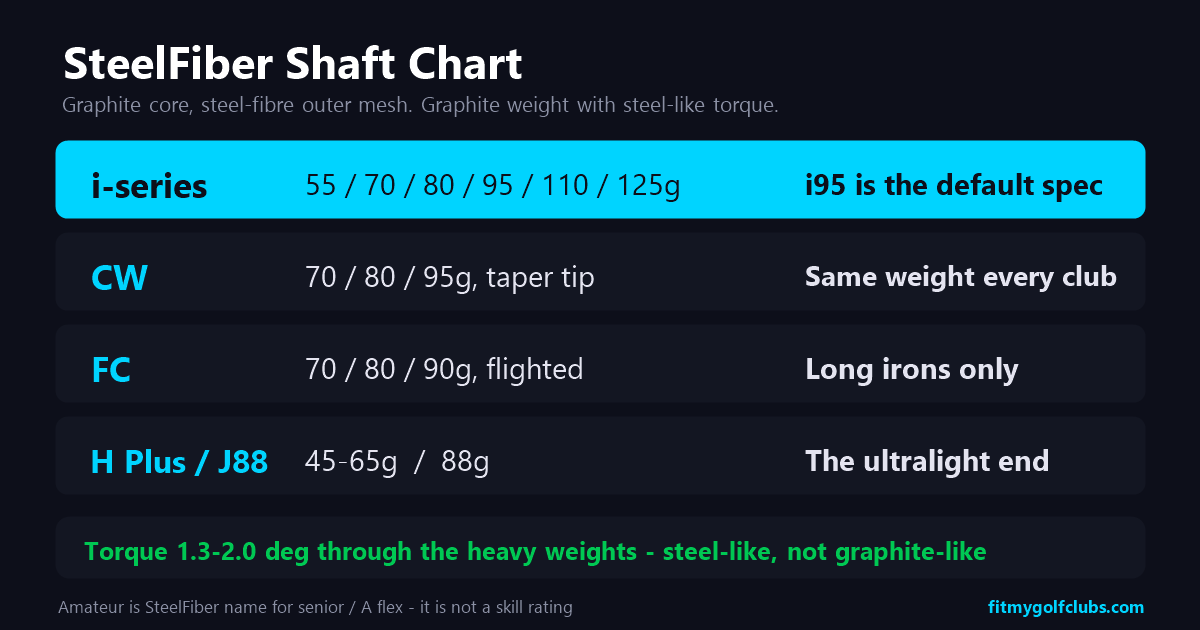
SteelFiber Shaft Chart: i95, i110, FC and CW Weights by Flex
SteelFiber shaft chart: the i-series from 55g to 125g, plus FC flighted, CW constant weight, H Plus and J88 - weights, torque and who each fits.
Golf Club Fitting
September 23, 2026
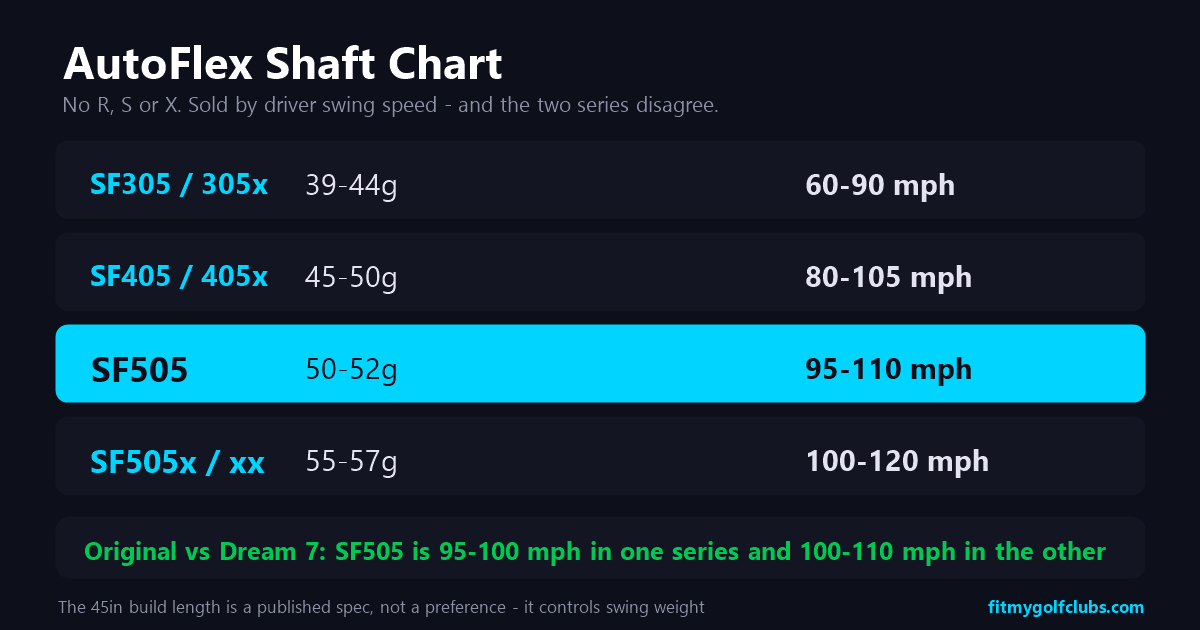
AutoFlex Shaft Chart: SF305 to SF505xx by Swing Speed and Weight
AutoFlex shaft chart: every SF code by driver swing speed and weight, for the Original and Dream 7 series, and why SF505 means two different speeds.
Golf Club Fitting
September 23, 2026
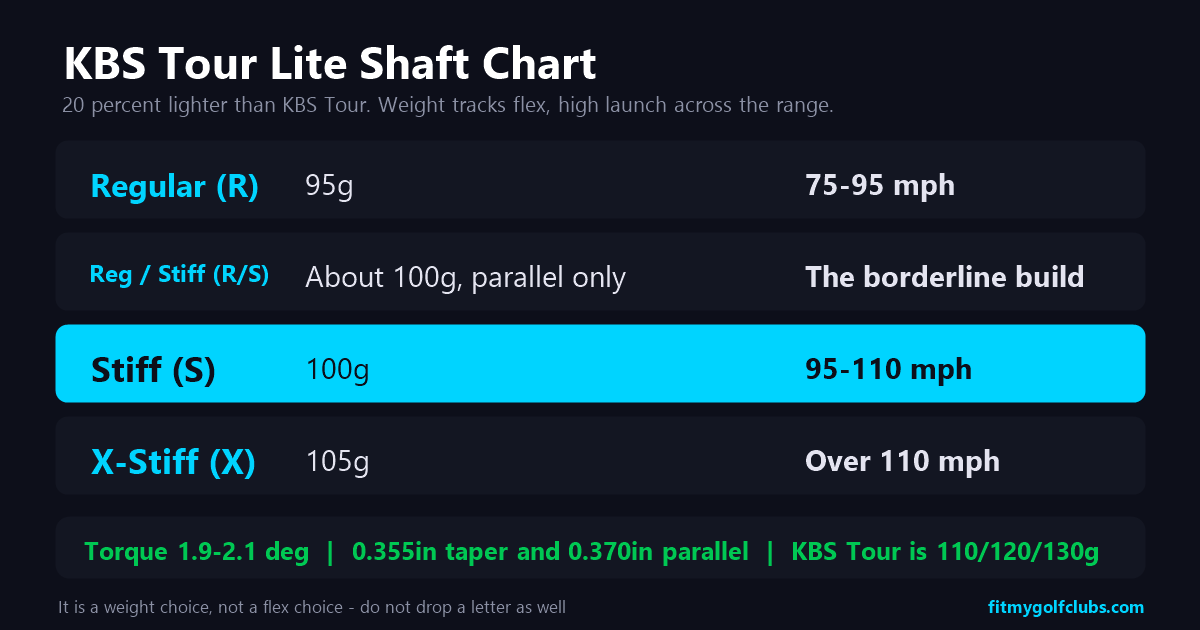
KBS Tour Lite Shaft Chart: 95g R, 100g S, 105g X Weights and Flex
KBS Tour Lite chart: Regular is 95g, Stiff 100g, X-Stiff 105g — 20% lighter than KBS Tour, higher flight, more spin. Swing speeds, torque and how it compares.


© 2026 FitMyGolfClubs. All rights reserved. | Patent Pending
Contact: sean@fitmygolfclubs.com