
Golf Club Fitting
September 23, 2026
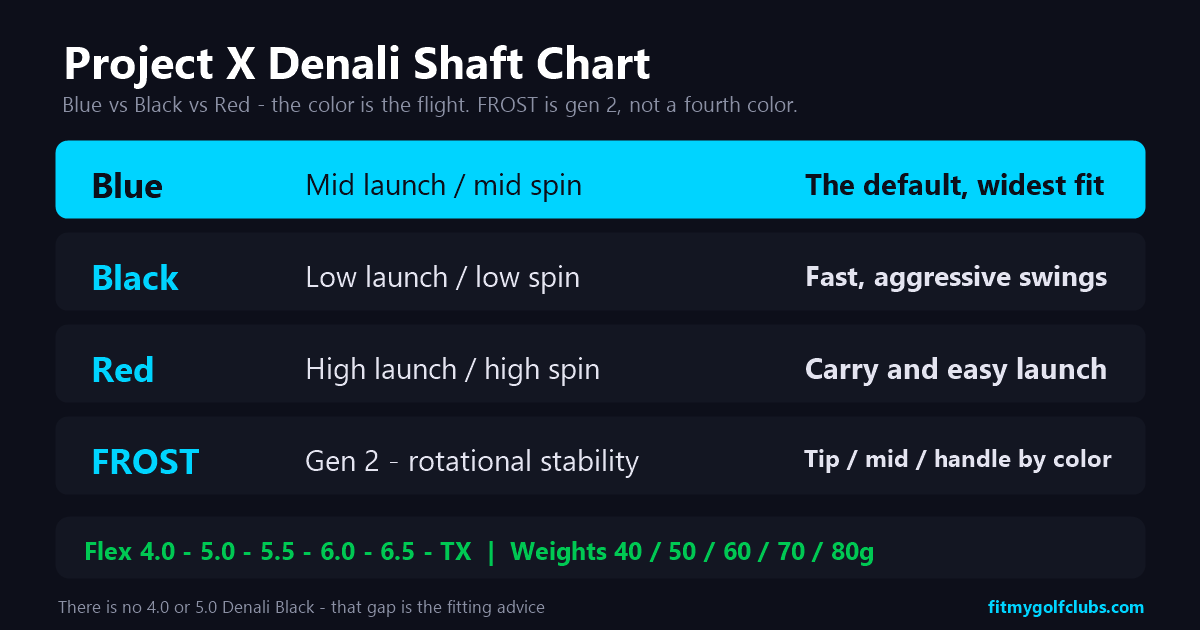
The quick answer: Project X Denali comes in three colors and the color is the flight. Blue is mid launch / mid spin — the all-round default. Black is low launch / low spin, the stoutest profile for fast, aggressive swings. Red is the high launcher, and it is the only Denali that goes down to a 4.0 flex in 40g. Flexes use the Project X numbers — 4.0, 5.0, 5.5, 6.0, 6.5 and TX — and the weight is a separate number in grams: 40, 50, 60, 70 or 80. FROST is the second generation, not a fourth color. The full chart is below.
Denali is True Temper's premium wood shaft line, built after what the company describes as 18 months of blind testing with its tour staff, around a stable butt section and a straight-taper mid section. It sits at the top of the Project X wood range alongside the HZRDUS family, and it is now the shaft you will find in a lot of no-upcharge and custom driver builds — which is exactly why the labels confuse people. A "Denali Blue 60 6.0" and a "Denali FROST Blue 60 6.0" are not the same shaft, and the Red in 40g is a genuinely different product from the Black in 80g.
This chart sorts every current Denali — the three original colors, the four FROST models including the counter-balanced CB, and the three hybrid versions — by launch, flex, weight and torque, and decodes the numbering while we are at it. Torque figures come from the same shaft database that powers our club grader, so they match what the app uses when it scores a Denali in your bag.
Denali Shaft Chart: Every Current Model
Two things to read off that table. First, not every color offers every flex: there is no 4.0 or 5.0 Denali Black, because nobody swinging at senior-flex speed should be in the lowest-launching shaft in the family. Denali Red is the only line that starts at 4.0 / 40g. That gap is the fitting advice, published as a product decision.
A dash in the torque column means our database does not yet hold a measured figure for that model; we would rather show a gap than a guess. Second, weight and flex are independent in Denali, unlike the KBS and Dynamic Gold steel charts where weight climbs with flex automatically. You choose 6.0 and you choose 60g. Inside any one color the lighter weights launch and spin a little more than the heavier ones, so a Blue 50 flies higher than a Blue 70 in the same flex.
⚡ Not sure which flex you are?
Our free Shaft Flex Calculator turns your swing speed into a flex recommendation in seconds — the AI mode factors in tempo and miss pattern. Get my flex →
What the Denali Numbers Mean
A Denali label reads like Denali Blue 60 6.0: color is the bend profile, the first number is the weight class in grams, and the second number is the Project X flex code. That flex code is the same system used across Project X steel, LZ and HZRDUS, and it does not map one-to-one onto R / S / X:
5.5 is the one that catches people. It is not "between regular and stiff" in the casual sense — Project X treats it as a firm stiff, and our grader normalises it to S. If you have been told you are "a 5.5" you are being fit as a stiff, not a regular.
These bands follow our brand-neutral swing speed shaft flex chart. The one place the table oversimplifies is the 90–99 mph stretch, where the flex letter alone stops being the cleanest way to decide — there, tempo settles it. A smooth, gradual transition stays in the softer code; a quick, aggressive one goes up. Denali Black wants a few more mph than the same code in Blue or Red because of its firmer tip.
Practical shortcut: if a Denali is already in your bag, add it to your bag in the app with the exact printing — color, weight number, flex code, and whether it says FROST. The app grades your set's flex and weight consistency by playing spec, not by label.
Shaft Flex Calculator
FREE — NO SIGNUPEnter your driver swing speed — get your flex band instantly.
Don’t know your speed? Rough guide: 200-yd carry ≈ 90 mph, 220-yd ≈ 100 mph — or read it off the chart below.
Model by Model
Denali Blue (mid launch, mid spin)
The one to demo first if you have no obvious launch or spin problem. Blue sits in the middle of the family on both axes and covers the widest range of players — 50 through 80g, 5.0 through TX. It is the Denali that most closely replaces a mid-launch HZRDUS or a Ventus Blue in a fitting line-up, and the 60g in 6.0 is far and away the most common build. If a fitter hands you "a Denali" without saying which, this is almost certainly it.
Denali Black (low launch, low spin)
The spin-killer. Black has the firmest tip and the lowest torque in the family — down to 2.3° in the heavy TX — and it is built for players whose speed and transition spin the ball up. It starts at 5.5 and 60g, with no senior or regular option at all, which tells you who it is for. Below roughly 100 mph it is usually too much shaft, and what you lose in launch costs more than what you save in spin.
Denali Red (high launch, high spin)
The high launcher, and the most under-fit shaft in the line. Red runs from a 4.0 in 40g all the way to TX in 80g, so it is not just a "slow swinger's shaft" — plenty of fast players who hit it low live in a Red 60 or 70. If your miss is a drive that never gets off the ground, or you have lost carry height with age, Red is the demo. The 40g 4.0 is one of the few genuine senior-spec premium shafts on the market.
Denali FROST Blue, FROST Black and FROST Red (the second generation)
FROST is the gen-2 Denali, not a fourth color. The colors keep their flight profiles; what FROST adds is what True Temper calls Focused Rotational Stability Technology — high-modulus carbon placed in one specific section of the shaft to resist twisting on off-centre strikes. Crucially the section differs by color: FROST Black is reinforced in the tip, FROST Blue in the mid section, and FROST Red in the handle. That is why FROST Red still launches high (the stiffening is nowhere near the tip) while FROST Black gets even more tip-stable than standard Black.
Denali FROST Blue CB (counter-balanced)
The counter-balanced build in the FROST line, offered in 60g in 5.5, 6.0 and 6.5. Counter-balancing moves mass toward the grip end, which lowers the assembled swing weight for a given shaft weight and lets a builder add head weight or go longer without the club feeling heavy. If you have been fighting a driver that feels head-heavy at the top, or you want a longer build without losing control, CB is the reason this model exists. It is a build consideration, not a different flight.
Denali hybrid versions (Blue HY, Red HY, FROST Blue HY)
Three purpose-built hybrid shafts on the 0.370" tip, not the driver shaft cut down. Denali Blue Hybrid is 80g only in 5.5 / 6.0 / 6.5. Denali Red Hybrid is the broadest, from a 4.0 in 40g up to a 6.5 in 80g. FROST Blue Hybrid runs 4.0 through 6.0 in 50 to 70g. Torque is lower across all three than the driver versions (2.7–3.8°) because hybrid heads are heavier and shorter — the same reason your hybrid shaft should generally be heavier than your fairway shaft, not lighter.
🔍 Already have a Denali in the bag?
Drop the club into our Single-Club Fit Grader and get an AI fit grade — flex, weight, and launch scored against your swing. Grade one club →
Denali vs FROST: Which One Do You Actually Have?
The two generations share colors, weights and flex codes, so the label is the only tell — the word FROST is printed on the shaft. If it is not there, you have a first-generation Denali. Both are current products that True Temper still sells, so a gen-1 Denali is not "the old one" in any way that should worry you; FROST is a stability refinement, not a replacement.
Where it matters is replacement and matching. If you are buying a second shaft to match one you already play, or replacing a broken one, get the same generation — the FROST reinforcement changes how the shaft resists twisting, and a matched pair is the point. If you are shopping used and the listing just says "Denali Blue 6.0", ask the seller to photograph the shaft band.
Picking Your Denali: The Two-Question Shortcut
Question 1 — what is your miss? Ballooning, spinny drives that fall out of the sky → Black. Low bullets that do not carry → Red. Neither extreme, or you are not sure → Blue. That single question resolves the color, and the color is the biggest decision on this page.
Question 2 — what is your speed and tempo? Use the flex table above for the code, then pick weight by tempo rather than speed alone: smooth swings and slower speeds go lighter (50–60g), quick transitions and faster speeds go heavier (70–80g). If you are between two weights, the lighter one in the stiffer code is usually closer than the heavier one in the softer code.
🏌️ The shaft is one of 8 factors.
A perfectly-fit Denali in a mis-lofted head still costs you strokes. Grade My Bag scores all 14 clubs across the 8 factors pro fitters use — free, from your specs alone. Grade my bag free →
Frequently asked questions
What is the difference between Denali Blue, Black and Red?
The color is the launch profile. Blue is mid launch and mid spin, the versatile default. Black has the firmest tip and the lowest launch and spin, for fast, aggressive swings. Red is the high launcher, with the widest flex range including a 4.0 in 40g.
What does FROST mean on a Project X Denali shaft?
FROST is the second generation of Denali. It adds Focused Rotational Stability Technology, which places high-modulus carbon in one section of the shaft to resist twisting on off-centre hits. The reinforced section differs by color: the tip on FROST Black, the mid section on FROST Blue and the handle on FROST Red.
What do the numbers on a Denali shaft mean?
There are two. The first is the weight class in grams, from 40 to 80. The second is the Project X flex code: 4.0 is senior, 5.0 is regular, 5.5 is a firm stiff, 6.0 is stiff, 6.5 is extra stiff and TX is tour extra stiff. So a Denali Blue 60 6.0 is a 60-gram, stiff-flex, mid-launch shaft.
What swing speed is a Denali 6.0 for?
Roughly 95 to 110 mph of driver speed, the same as a standard stiff. A 5.0 suits about 75 to 95 mph and a 6.5 suits over 110 mph. Between about 90 and 99 mph, tempo decides more than the number does — a smooth transition can stay at 5.5, a quick one goes to 6.0. Denali Black wants a few mph more than Blue or Red at the same code.
What does CB mean on the Denali FROST Blue CB?
CB is counter-balanced. True Temper describes it as the counter-balanced offering in the FROST line. Extra mass toward the grip end lowers the assembled swing weight, which lets a club builder add head weight or build longer without the club feeling head-heavy. It is offered in 60 grams in 5.5, 6.0 and 6.5.
Is Denali a replacement for HZRDUS?
No. Both are current True Temper lines and HZRDUS is still sold in several models. Denali is the newer premium wood shaft and is often the next demo for a HZRDUS player, but nothing has been discontinued. If you play a HZRDUS today, the closest Denali by flight is usually Blue for a mid-launch HZRDUS and Black for a low-launch one.
Which Denali launches the highest?
Denali Red, and within Red the lighter weights launch highest — a Red 40 in 4.0 or a Red 50 in 5.0 is the highest-launching combination in the family. FROST Red keeps that high flight because its reinforcement is in the handle rather than the tip.
Related reading
- Golf Swing Speed Chart: Shaft Flex by Club Head Speed — The brand-neutral flex chart the Denali bands above are built on, plus how to measure your speed.
- HZRDUS Shaft Chart — The line Denali sits above, with the same 5.5 / 6.0 / 6.5 flex codes decoded.
- Project X Shaft Selector Chart: Flex by Swing Speed — The whole Project X numeric flex system, across steel and graphite.
- Golf Shaft Weight Guide — Why choosing a Denali 50 over a 70 changes more than the flex code does.
Know the shaft. Now check the whole bag. The FitMyGolfClubs app grades all 14 clubs across eight fitting factors — shaft flex and weight included — straight from your specs. Free to start.
Related Articles
Golf Club Fitting
September 23, 2026
SteelFiber Shaft Chart: i95, i110, FC and CW Weights by Flex
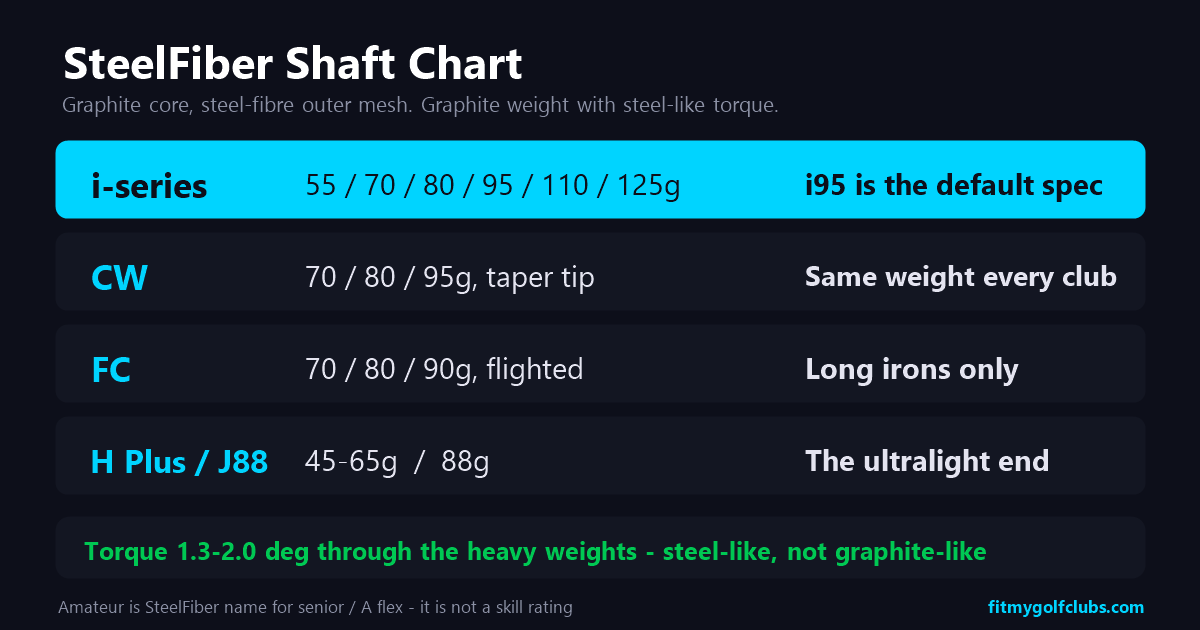
SteelFiber shaft chart: the i-series from 55g to 125g, plus FC flighted, CW constant weight, H Plus and J88 - weights, torque and who each fits.
Golf Club Fitting
September 23, 2026
AutoFlex Shaft Chart: SF305 to SF505xx by Swing Speed and Weight
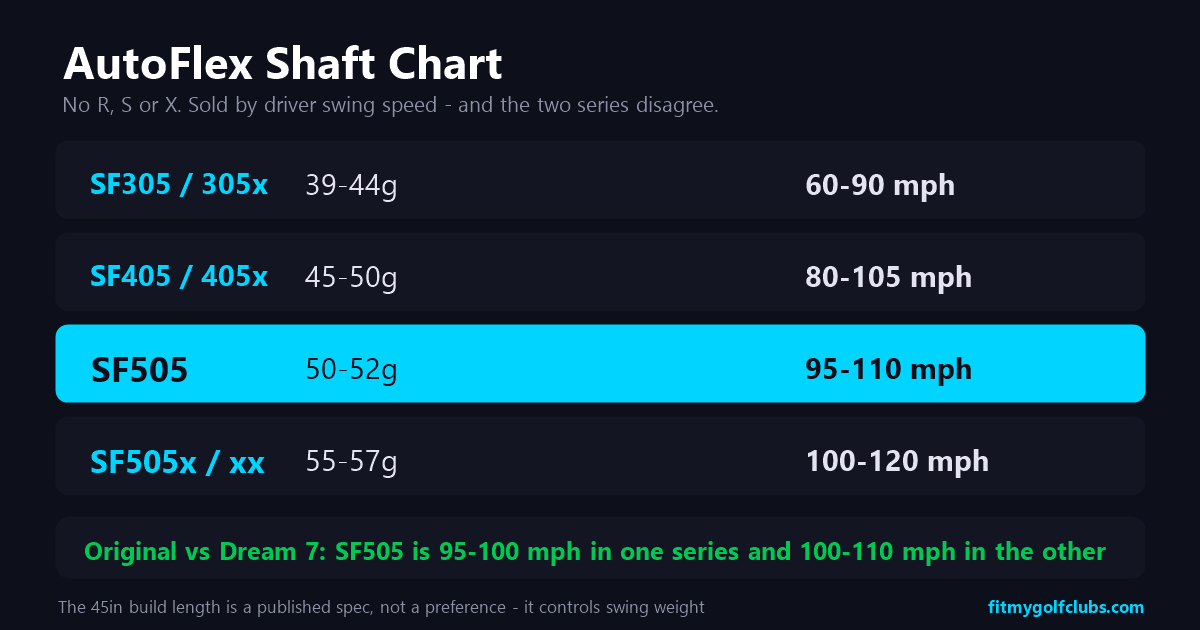
AutoFlex shaft chart: every SF code by driver swing speed and weight, for the Original and Dream 7 series, and why SF505 means two different speeds.
Golf Club Fitting
September 23, 2026
KBS Tour Lite Shaft Chart: 95g R, 100g S, 105g X Weights and Flex
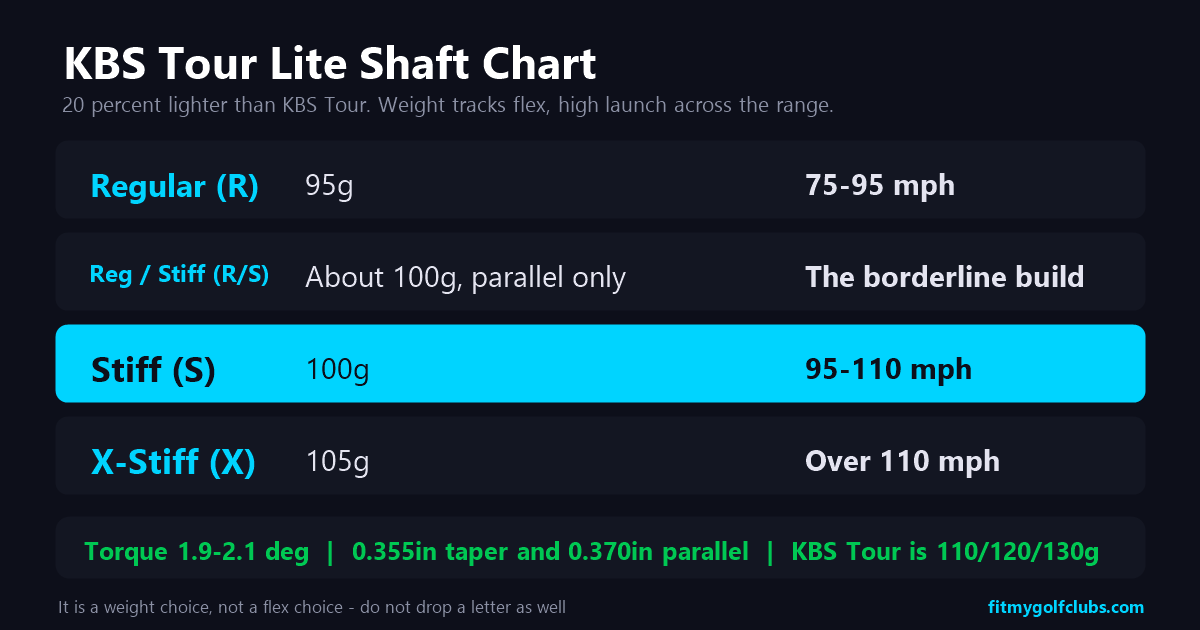
KBS Tour Lite chart: Regular is 95g, Stiff 100g, X-Stiff 105g — 20% lighter than KBS Tour, higher flight, more spin. Swing speeds, torque and how it compares.


© 2026 FitMyGolfClubs. All rights reserved. | Patent Pending
Contact: sean@fitmygolfclubs.com