
Golf Club Fitting
September 23, 2026
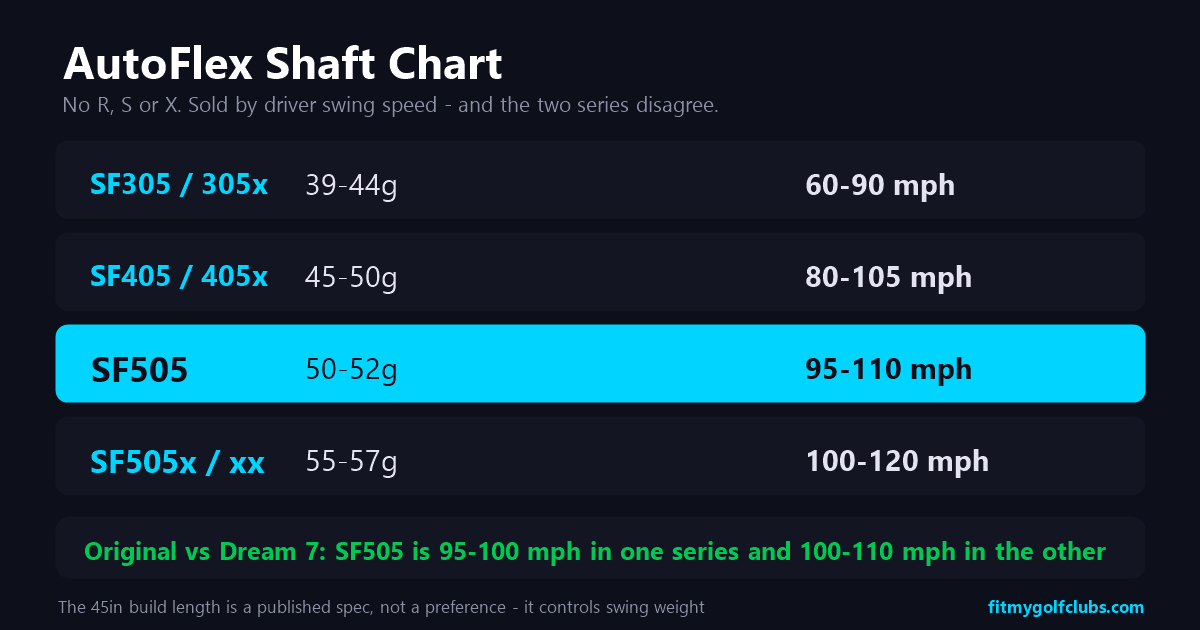
The quick answer: AutoFlex does not use R, S or X. It is sold by driver swing speed, and the SF code is the speed band. In the Original series: SF305x is 70–90 mph, SF405 is 85–100, SF505 is 95–100, SF505x is 100–110 and SF505xx is 110–120. The Dream 7 series uses the same names for different bands — its SF405 is 80–95 and its SF505 is 100–110. Both official tables are below, side by side.
That overlap is the single most important thing on this page. AutoFlex has two current driver lines, the Original and the Dream 7, and they share model names while fitting different speeds. Someone who played an Original SF505 at 98 mph and orders a Dream 7 SF505 has just bought a shaft the manufacturer recommends for 100–110 mph. The name matched; the fit did not.
AutoFlex is also unusual in that the whole product is the fitting method. There is no flex letter to interpret and no weight-versus-flex matrix to navigate — you find your driver speed, you read off the code. That makes it one of the easiest shafts in golf to specify correctly, provided you are reading the right table. Everything below is transcribed from the manufacturer's own published spec tables.
AutoFlex Original Driver Shaft Chart
Tip is 0.335 inches and raw length is 45 inches across the line. AutoFlex specifically recommends a 45 inch build length in order to control swing weight — that is not a general preference, it is a spec, and it matters because these shafts are light enough that a longer build pushes the swing weight out of the recommended range fast.
Note the narrow SF505 band: 95 to 100 mph is a five-mph window, the tightest in the Original line, with SF405 overlapping it from below and SF505x from above. If you are at 98 mph you are legitimately inside three of the five codes, and that is the point at which tempo and build length decide rather than the chart.
⚡ Not sure which flex you are?
Our free Shaft Flex Calculator turns your swing speed into a flex recommendation in seconds — the AI mode factors in tempo and miss pattern. Get my flex →
AutoFlex Dream 7 Driver Shaft Chart
The Dream 7 is the newer series, built with Japanese carbon prepreg and what AutoFlex calls second-generation KHT, and described by the maker as slightly softer than the Original with a new tip section. It has six codes rather than five, adding a full SF305 below and an SF405x in the middle.
Read this table against the one above, not instead of it. Every shared code sits at a different speed:
Same tip (0.335"), same 45 inch raw length, same 45 inch build recommendation. The Dream 7 reaches further down the speed range than the Original — an SF305 at 39 grams for 60–75 mph is a genuinely slow-swing specification — and its codes generally sit higher in speed than the Original code of the same name at the top of the range and lower at the bottom.
Because AutoFlex is fitted by speed rather than by feel, knowing your number is the whole exercise. If you do not have a reliable driver speed, the calculator below will get you a band from the same chart our app uses, and our brand-neutral swing speed shaft flex chart explains how to measure it properly. The usual 90–99 mph caveat applies harder here than anywhere: on the edge between two SF codes, a quick transition goes up a code.
Shaft Flex Calculator
FREE — NO SIGNUPEnter your driver swing speed — get your flex band instantly.
Don’t know your speed? Rough guide: 200-yd carry ≈ 90 mph, 220-yd ≈ 100 mph — or read it off the chart below.
Understanding AutoFlex
Why there are no letter flexes
AutoFlex shafts are built around a very low-stiffness, high-torque design — the marketing name is Korean Hidden Technology, and the practical effect is a shaft that loads far more than a conventional one and recovers quickly. Because the profile does not behave like a conventional regular or stiff, the maker declined to label it with letters at all and publishes speed bands instead. Our own grading database treats AutoFlex SF codes as brand-specific rather than mapping them to R, S or X, for the same reason. Anyone who tells you an SF505 "is basically a stiff" is inventing a conversion the manufacturer does not publish.
What the x and xx suffixes mean
They are stiffness steps within a weight family, not separate families. In the Original line, SF505, SF505x and SF505xx run 50, 55 and 57 grams and 95–100, 100–110 and 110–120 mph respectively — so each x adds both a little weight and a meaningful chunk of speed capacity. In the Dream 7, SF305x sits above SF305 and SF405x above SF405 on the same pattern. Read the suffix as "the faster version of this code."
Original or Dream 7?
The Dream 7 is the newer and, per AutoFlex, slightly softer design with a reworked tip. It also covers a wider speed range overall, reaching down to 60 mph and up to 115. The Original remains available and reaches highest at the top with the SF505xx at 110–120 mph. For most buyers the decision is made by which speed band you land in with a code that exists in that series — and by price, because these are among the most expensive stock driver shafts sold.
Swing weight is a real constraint, not a footnote
AutoFlex publishes a recommended swing weight next to every code, from C5 at the lightest to D2 at the heaviest, and pairs it with a 45 inch build recommendation. Those two numbers are linked: at 39 to 57 grams, these shafts are light enough that build length and head weight move the assembled swing weight much more than they would with a 65 gram shaft. If your AutoFlex build feels unexpectedly whippy or unexpectedly heavy, check the length and the swing weight against the table before blaming the code.
🔍 Already have an AutoFlex in the bag?
Drop the club into our Single-Club Fit Grader and get an AI fit grade — flex, weight, and launch scored against your swing. Grade one club →
Does the Same Code Mean the Same Shaft? No.
This is worth stating plainly because it is the most common AutoFlex buying mistake. SF405 is 85–100 mph in the Original and 80–95 mph in the Dream 7. SF505 is 95–100 mph in the Original and 100–110 mph in the Dream 7 — a full ten mph higher. SF505x is 100–110 in the Original and 105–115 in the Dream 7. Only the weights give you a partial hint, and even those do not line up cleanly.
So when you buy used, or replace a shaft you liked, the code alone is not enough information. You need the series as well. If a listing says "AutoFlex SF505" with no other detail, ask which line it is from, and if the seller does not know, the weight is the tiebreaker: an Original SF505 is 50 grams and a Dream 7 SF505 is 52.
🏌️ The shaft is one of 8 factors.
A perfectly-fit AutoFlex in a mis-lofted head still costs you strokes. Grade My Bag scores all 14 clubs across the 8 factors pro fitters use — free, from your specs alone. Grade my bag free →
Frequently asked questions
What swing speed is the AutoFlex SF505 for?
It depends which series. In the AutoFlex Original the SF505 is recommended for 95 to 100 mph of driver speed. In the Dream 7 the SF505 is recommended for 100 to 110 mph. The same code covers different speeds in the two lines, so check which series you are buying.
What do the AutoFlex SF numbers mean?
They are speed codes, not flex letters. Higher numbers suit faster swings, and the x and xx suffixes are stiffer, slightly heavier steps within the same family. AutoFlex publishes a driver speed band for every code rather than labelling them regular, stiff or extra stiff.
What is the difference between AutoFlex Original and Dream 7?
Dream 7 is the newer series, made with Japanese carbon prepreg and second-generation KHT, and AutoFlex describes it as slightly softer than the Original with a redesigned tip. It offers six codes spanning 60 to 115 mph, while the Original offers five spanning 70 to 120 mph. Shared code names sit at different speeds in each line.
How much does an AutoFlex shaft weigh?
Between 39 and 57 grams depending on the code. In the Original, SF305x is 41g, SF405 is 45g, SF505 is 50g, SF505x is 55g and SF505xx is 57g. In the Dream 7, SF305 is 39g up to SF505x at 57g. These are very light shafts by any standard.
What is the recommended AutoFlex build length?
Forty-five inches. AutoFlex states that a 45 inch build is recommended in order to control swing weight, and publishes a recommended swing weight for each code ranging from C5 to D2. Because the shafts are so light, build length affects the assembled swing weight more than it would with a conventional shaft.
Is an AutoFlex SF505 the same as a stiff flex?
AutoFlex does not publish a conversion to letter flexes, and the design does not behave like a conventional stiff shaft, so there is no honest equivalent to quote. Fit it by the published driver speed band for the series you are buying rather than by trying to translate it into R, S or X.
Related reading
- Golf Swing Speed Chart: Shaft Flex by Club Head Speed — How to measure the driver speed the entire AutoFlex range is fitted from.
- Golf Shaft Weight Guide — What a 39-57g driver shaft does to the weight progression through the rest of your bag.
- Project X Cypher Shaft Chart — The mainstream ultralight alternative, at a fraction of the price.
- What Golf Club Fitting Costs — Worth reading before spending AutoFlex money on a single shaft.
Know the shaft. Now check the whole bag. The FitMyGolfClubs app grades all 14 clubs across eight fitting factors — shaft flex and weight included — straight from your specs. Free to start.
Related Articles
Golf Club Fitting
September 23, 2026
SteelFiber Shaft Chart: i95, i110, FC and CW Weights by Flex
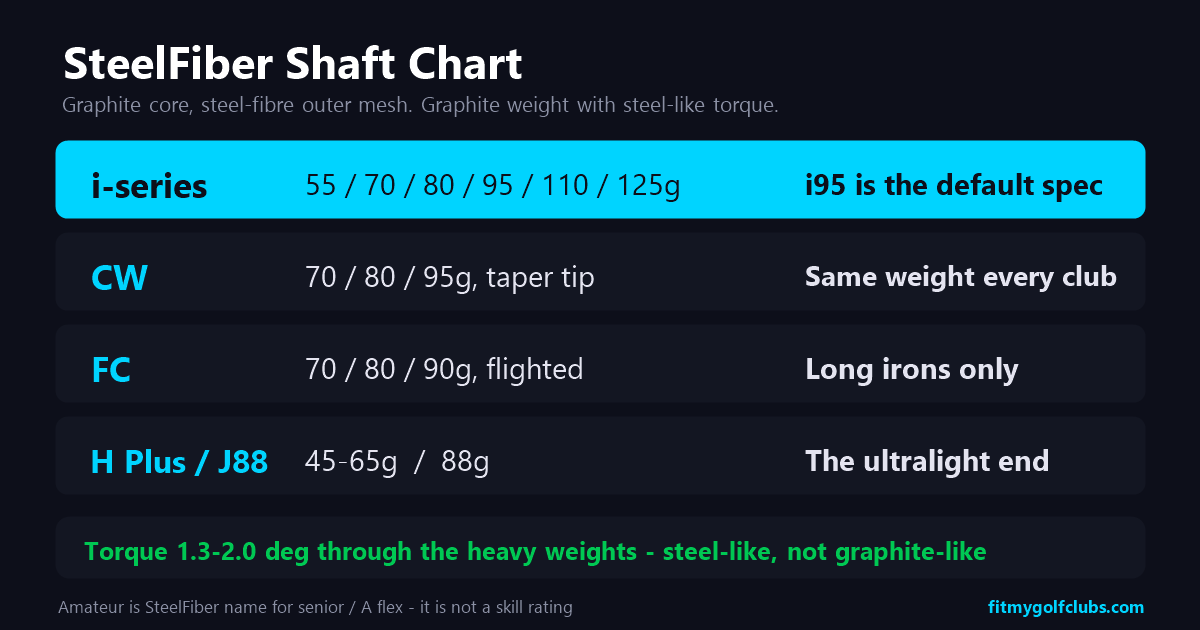
SteelFiber shaft chart: the i-series from 55g to 125g, plus FC flighted, CW constant weight, H Plus and J88 - weights, torque and who each fits.
Golf Club Fitting
September 23, 2026
AutoFlex Shaft Chart: SF305 to SF505xx by Swing Speed and Weight
AutoFlex shaft chart: every SF code by driver swing speed and weight, for the Original and Dream 7 series, and why SF505 means two different speeds.
Golf Club Fitting
September 23, 2026
KBS Tour Lite Shaft Chart: 95g R, 100g S, 105g X Weights and Flex
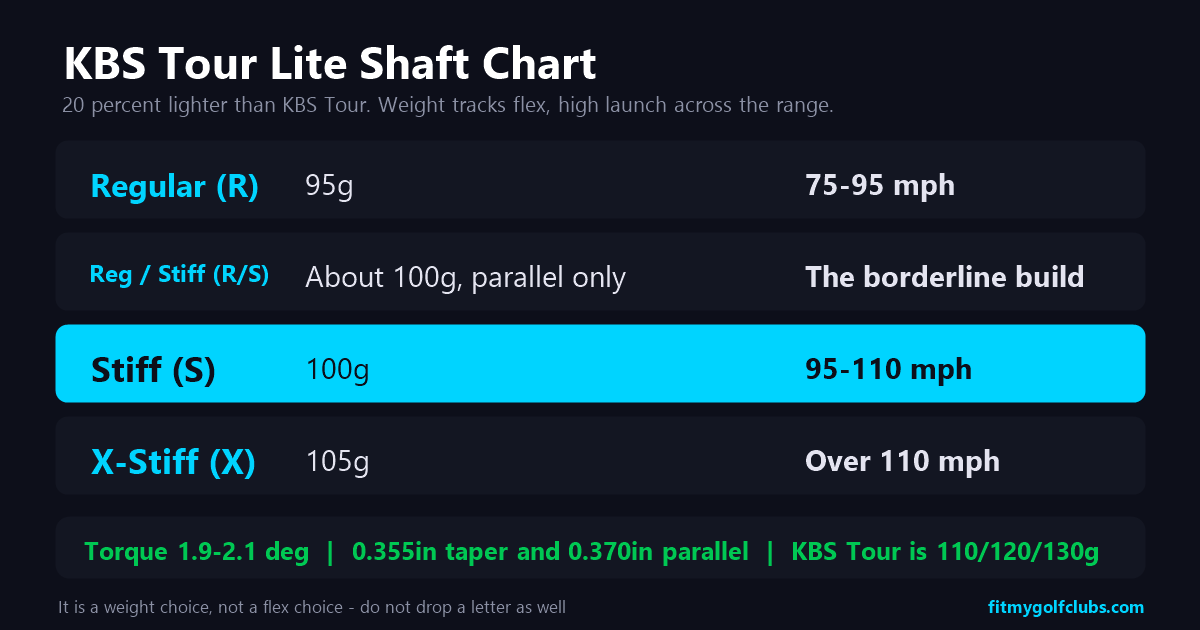
KBS Tour Lite chart: Regular is 95g, Stiff 100g, X-Stiff 105g — 20% lighter than KBS Tour, higher flight, more spin. Swing speeds, torque and how it compares.


© 2026 FitMyGolfClubs. All rights reserved. | Patent Pending
Contact: sean@fitmygolfclubs.com