
Golf Club Fitting
September 14, 2026
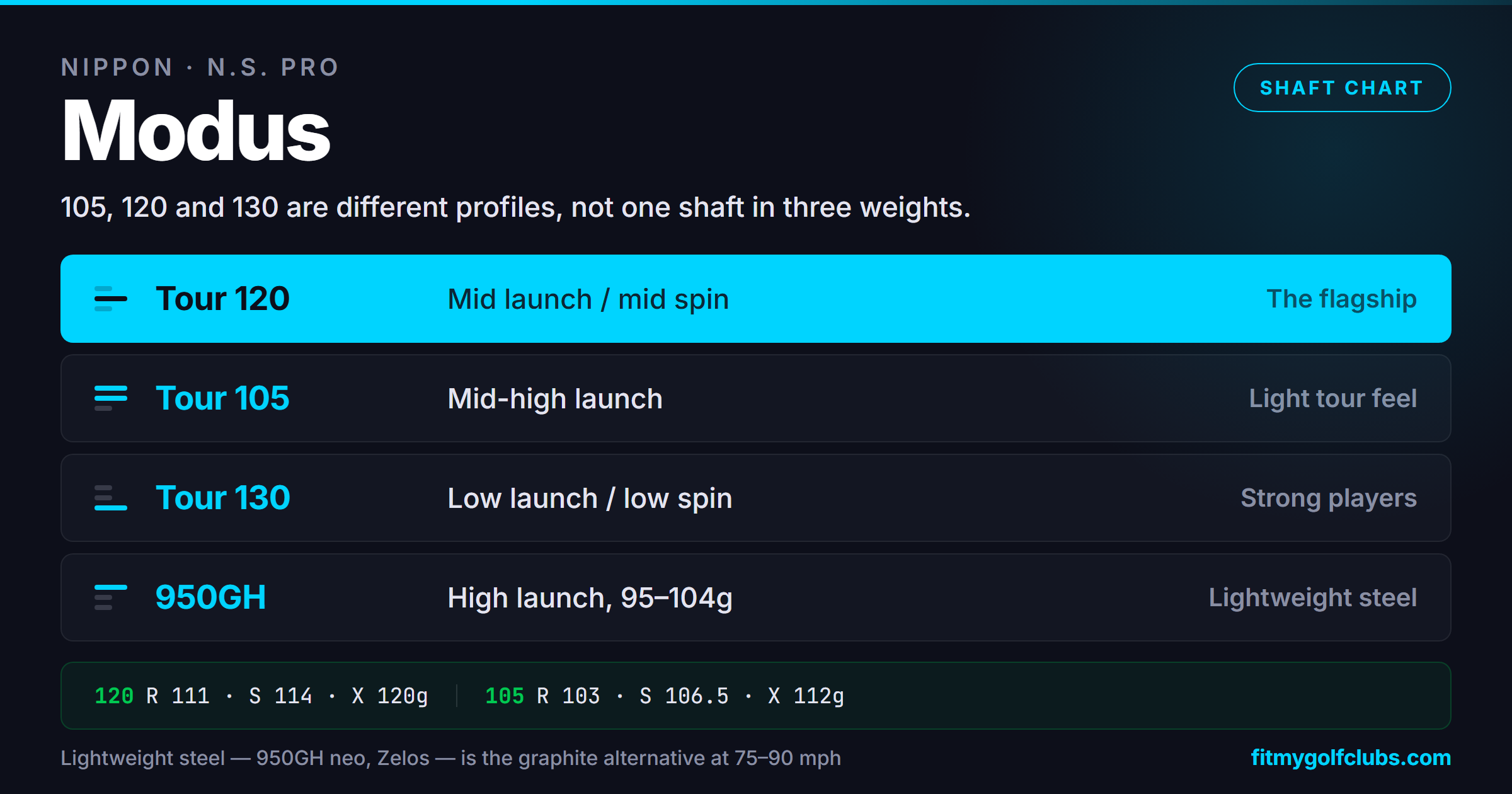
The quick answer: Nippon makes two steel families. N.S. Pro Modus3 Tour is the tour line, and the number is the weight class and the profile: 105 is the light mid-high launcher, 120 is the mid-launch flagship, 130 is the heavy low-spin shaft, with 110, 115 and 125 in between. N.S. Pro GH is the lightweight steel line — 950GH is the best-selling lightweight steel shaft in the world (R 95g, S 98g), with 750GH, 850GH, 1050GH and 1150GH around it and Zelos below 80g. The full chart is below.
Nippon Shaft is the Japanese steel maker that made "lightweight steel" a real category: the N.S. Pro 950GH has been stock in more game-improvement irons than any other shaft for two decades, and the Modus3 Tour 120 is one of the most-played iron shafts on tour. What confuses people is that Nippon's numbers look like weights but behave like model names — a Modus 105 and a Modus 120 aren't the same shaft in two weights, they're two different bend profiles — and that Nippon publishes weights to the half-gram so the same shaft shows up as 106g, 106.5g and 107g depending on the source. This chart sorts every current Nippon by profile, weight and flex.
Every weight and torque figure below comes from the same shaft database that powers our club grader, so it matches what the app uses when it scores a Nippon in your bag.
Nippon Shaft Chart: Modus3 Tour and N.S. Pro GH by Weight and Flex
Two things to read off the table. First, Nippon weights step in small increments (a Modus 120 S is 114g, an X is 120g), so the "number" is a class, not the exact gram figure of every flex. Second, the GH shafts are built for launch: even the 1150GH Tour launches higher than a Modus 120 at similar weight, which is why GH sits in game-improvement irons and Modus in players' irons.
⚡ Not sure which flex you are?
Our free Shaft Flex Calculator turns your swing speed into a flex recommendation in seconds — the AI mode factors in tempo and miss pattern. Get my flex →
How to Read a Nippon Name (Modus3, N.S. Pro, GH, neo, Zelos)
N.S. Pro is the brand name on every Nippon steel shaft. Modus3 Tour (often written "Modus 120") is the tour sub-line; the number is weight class and profile together. GH is the lightweight game-improvement line — 750, 850, 950, 1050, 1150 are the approximate stiff-flex weights. neo marks the current-generation GH with a firmer tip and slightly lower spin than the original. Zelos is the ultralight steel line (60–90g) built to compete with graphite. WF / Wedge versions are heavier, dedicated wedge builds.
Flex letters are standard — R, S, X, with TX in the Modus 120 and SR in the 950GH neo, and L in the lightest GH and Zelos. Nippon plays true to its letter; if anything, the GH line plays a touch soft. Here are the typical speed bands, in both driver and 7-iron speed:
These follow our brand-neutral swing speed shaft flex chart, with 7-iron speed taken as driver speed minus about 12 mph. Note the fit column: for the same letter, the right Nippon depends on how much weight you want — a 95 mph driver swing could be in a 950GH neo S (98g), a Modus 105 S (106.5g) or a Modus 120 S (114g), and the weight, not the flex, is what changes the flight.
Practical shortcut: if Nippon shafts are already in your irons, add them to your bag in the app exactly as printed — "Modus3 Tour 120 S," "N.S. Pro 950GH neo R." The app resolves the weight class and grades your set's flex and weight consistency by spec, not by label.
Shaft Flex Calculator
FREE — NO SIGNUPEnter your driver swing speed — get your flex band instantly.
Don’t know your speed? Rough guide: 200-yd carry ≈ 90 mph, 220-yd ≈ 100 mph — or read it off the chart below.
Model by Model
Modus3 Tour 120 (mid launch, mid spin — the flagship)
The most-played Nippon on tour and the one most players mean when they say "Modus." R 111g, S 114g, X 120g, TX 126g, torque 1.3–1.7°. Tour 120 has a smooth, slightly soft feel through the middle with a stable tip — mid launch, mid spin, and very consistent dispersion. It's the direct alternative to KBS Tour S/X and Dynamic Gold S300 for the 95–110 mph driver-speed player, about 10g lighter than DG and a little softer-feeling than either.
Modus3 Tour 105 (mid-high launch — the light tour shaft)
The lightest Modus: R 103g, S 106.5g, X 112g, torque 1.6–1.9°. Tour 105 launches mid-high with mid spin and a lively feel — it's the tour-caliber option for players who want a 105-gram shaft without going to a game-improvement profile. Extremely popular with 85–98 mph driver-speed players moving down from a 120g shaft, and it's often the right answer when a 950GH feels too soft but a Modus 120 feels too heavy.
Modus3 Tour 130 (low launch, low spin — the heavy one)
The heaviest and most penetrating Modus: R 125g, S 128–130g, X 133g, torque 1.3–1.6°. Tour 130 has a firm tip and a low, boring flight for strong players who spin the ball or play in wind — it's Nippon's answer to Dynamic Gold X100 and Project X 6.5. Rare below 105 mph driver speed for good reason; the weight and tip stiffness take launch away fast.
Modus3 Tour 110, 115 and 125 (the in-betweens)
Tour 110 (R 105 / S 110 / X 115g) is the low-spin lite — mid launch with noticeably lower spin than 105, for players who want a penetrating flight at a lighter weight. Tour 115 (R 108 / S 113 / X 118g) is the balanced middle weight, mid launch and mid-low spin. Tour 125 (R 119 / S 123 / X 128g) is mid-low launch and spin, and shows up a lot in wedges and in the short irons of blended sets. These three fill the gaps for players whose ideal weight isn't 105 or 120.
N.S. Pro 950GH and 950GH neo (the lightweight steel benchmark)
The best-selling lightweight steel shaft in golf and stock in a huge share of game-improvement irons. Original 950GH: R 95g, S 98g (L 92g), high launch, mid spin, torque 1.9–2.3°. The 950GH neo is the current version with a firmer tip and slightly lower spin, adding an SR (97g) and an X (104g). If your irons came with a 950GH, you have a genuinely good shaft — the neo is the upgrade path if you want a touch less spin, and Modus 105 is the step up if you want more tour feel at similar weight.
N.S. Pro 850GH, 750GH and the neo versions (lighter than 950)
The lighter GH steps. 850GH (R 82–84 / S 85–88g) and 750GH (L 72 / R 76–79 / S 80–83g) are high-launch, mid-spin steel shafts for 70–88 mph driver speeds — players who'd otherwise be in graphite but prefer steel's consistency and feel. Torque 2.1–2.8°. The neo versions (750GH neo, 850GH neo) firm up the tip slightly like the 950 neo does. There are also 850FW and 950FW fairway-wood versions of the same profiles.
N.S. Pro 1050GH and 1150GH Tour (heavier GH)
The GH profile at players' weights. 1050GH (R 106 / S 109.5 / X 114g) launches mid with mid spin — a step up from 950 for stronger players who like the GH feel. 1150GH Tour (R 111.5 / S 116 / X 121.5g) is the tour-weight GH with mid launch and mid-low spin, torque 1.4–1.6°. Both sit between the GH and Modus philosophies; if you're choosing between an 1150GH Tour S and a Modus 120 S at nearly the same weight, the GH launches higher and the Modus is more stable.
N.S. Pro Zelos 6, 7 and 8 (ultralight steel)
Nippon's answer to graphite: steel shafts at 60–90g. Zelos 6 (L 60 / S 65g), Zelos 7 (L 70 / R 68.5 / S 74 / X 78g) and Zelos 8 (R 78 / S 83 / X 90g) launch high with mid-high spin and torque 2.3–3.5° — for 65–88 mph driver speeds that want steel's consistency at a weight that lets them swing faster. Zelos 7 R is the most common fit; Zelos is also the usual recommendation for players moving off graphite who found it too loose.
Modus3 Wedge and Modus3 Hybrid
The dedicated builds. Modus3 Wedge comes in 105 (107g), 115 (117g) and 125 (127g) with a softer tip than the iron shaft of the same number for more spin and feel on partial shots; most Modus iron sets pair a Modus 120 iron shaft with a Modus Wedge 125. Modus3 Hybrid (S 92.5 / X 102.5g; Tour S 92.5 / Tour X 112.5g) is the steel hybrid shaft for players who want iron-like flight from their hybrids.
🔍 Already have a Modus in the bag?
Drop the club into our Single-Club Fit Grader and get an AI fit grade — flex, weight, and launch scored against your swing. Grade one club →
Nippon vs KBS vs Dynamic Gold: Where Modus Fits
At the same letter, Modus 120 (S 114g) is about 6g lighter than KBS Tour S (120g) and 16g lighter than Dynamic Gold S300 (130g), and it feels softer through the middle than either while staying stable in the tip. Modus 130 (S 128–130g) lines up against DG S300/X100 and Project X 6.0/6.5 on weight, with a smoother feel. Modus 105 has no direct equivalent in DG and sits near KBS Tour Lite and $-Taper Lite in weight, with more tour stability.
The lightweight steel comparison is simpler: the 950GH (95–98g) is the benchmark everyone else is compared to. KBS Tour 90 and Max 85, True Temper Elevate 95, and Project X IO 95 are all "950GH alternatives." If you're happy in a 950GH, you don't need to change; if you want the same weight with more stability, the 950GH neo or Modus 105 are the steps up. See our KBS shaft chart and Dynamic Gold shaft chart for the full numbers on the alternatives.
Picking Your Nippon: The Two-Question Shortcut
Question 1 — what's your miss? High, spinny irons that balloon → Modus 130, or Modus 110 if you want it lighter. Irons that launch low and land hard → 950GH neo, Zelos 8 or Modus 105. Neither extreme → Modus 120 for players' irons, 950GH or 1050GH for game-improvement heads.
Question 2 — what weight do you want? Nippon's flex letters are true, so choose the weight first: Zelos and 750/850GH under about 88 mph driver speed, 950GH or Modus 105 for 85–98, Modus 115/120 or 1050GH for 95–108, Modus 125/130 or 1150GH Tour above that. Then take the letter from the table.
🏌️ The shaft is one of 8 factors.
A perfectly-fit Modus in a mis-lofted head still costs you strokes. Grade My Bag scores all 14 clubs across the 8 factors pro fitters use — free, from your specs alone. Grade my bag free →
Frequently asked questions
How much does a Nippon Modus 120 weigh?
Modus3 Tour 120 is 111g in Regular, 114g in Stiff, 120g in X-Stiff and 126g in TX. The "120" is a weight class and profile name, not the exact weight of every flex.
What is the difference between Modus 105, 120 and 130?
They're different bend profiles at different weights, not one shaft in three weights. Modus 105 (103–112g) launches mid-high with a lively feel. Modus 120 (111–120g) is the mid-launch, mid-spin flagship. Modus 130 (125–133g) is the low-launch, low-spin heavy shaft for strong players.
What swing speed is a Modus 120 S for?
About 95–104 mph of driver speed, or roughly 83–91 mph of 7-iron speed. Modus 120 R fits about 75–94 mph driver speed and Modus 120 X about 105–114 mph. Nippon plays true to its flex letter.
How much does an N.S. Pro 950GH weigh?
The original N.S. Pro 950GH is 95g in Regular and 98g in Stiff (92g in Ladies). The 950GH neo adds an SR at 97g and an X at 104g. It's the best-selling lightweight steel iron shaft in golf.
What does neo mean on a Nippon shaft?
neo marks the current generation of the N.S. Pro GH line (750GH neo, 850GH neo, 950GH neo). The neo versions have a firmer tip than the originals for slightly lower spin and more stability, and the 950GH neo adds SR and X flexes the original didn't have.
Is Nippon Modus better than KBS Tour?
Different, not better. At the same letter, Modus 120 is about 6g lighter than KBS Tour and feels softer through the midsection with a stable tip; KBS Tour is a little firmer and more "step-less" in feel. Players who find KBS Tour slightly harsh tend to prefer Modus; players who find Modus slightly soft tend to prefer KBS.
Related reading
- KBS Shaft Chart — Tour, C-Taper and $-Taper weights by flex — the main alternative to Modus.
- Dynamic Gold Shaft Chart — The heavy steel benchmark Modus 130 competes with.
- Project X Shaft Weights & Specs Chart — PX, LZ and IO weights to compare against the Modus and GH ladders.
- Golf Shaft Weight Guide — Why the weight class matters more than the letter in a Nippon.
Know the shaft. Now check the whole bag. The FitMyGolfClubs app grades all 14 clubs across eight fitting factors — shaft flex and weight included — straight from your specs. Free to start.
Related Articles
Golf Club Fitting
September 14, 2026
UST Mamiya Shaft Chart: Recoil, Helium, LIN-Q & ATTAS Decoded
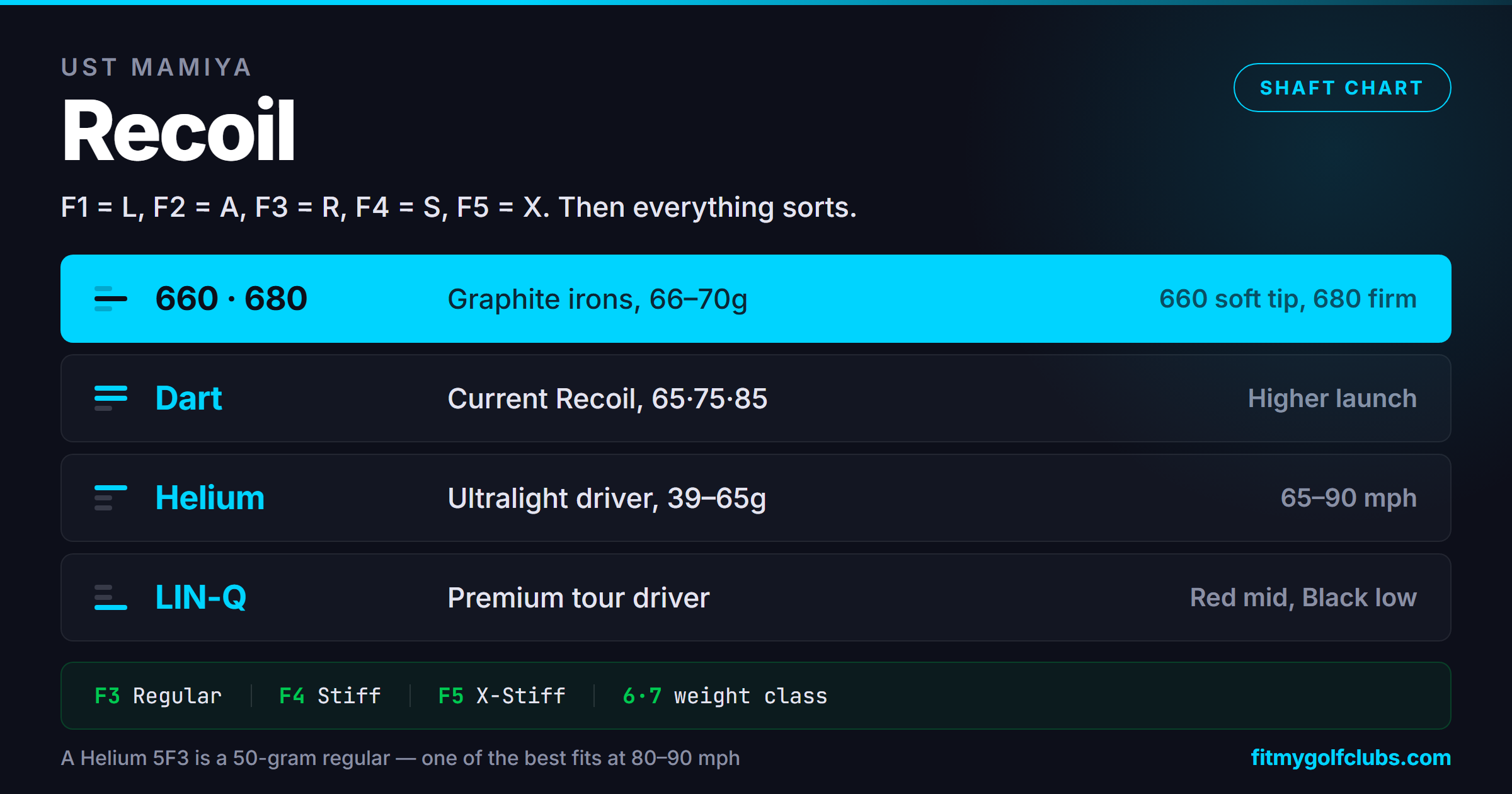
UST Mamiya shaft chart: F1–F5 flex decoded (F3 = R, F4 = S), Recoil 660 vs 680 vs Dart, Helium, LIN-Q Red vs Black and ATTAS — weights and torque.
Golf Club Fitting
September 14, 2026
Aldila Shaft Chart: Rogue, NV, Ascent & Synergy by Launch and Weight
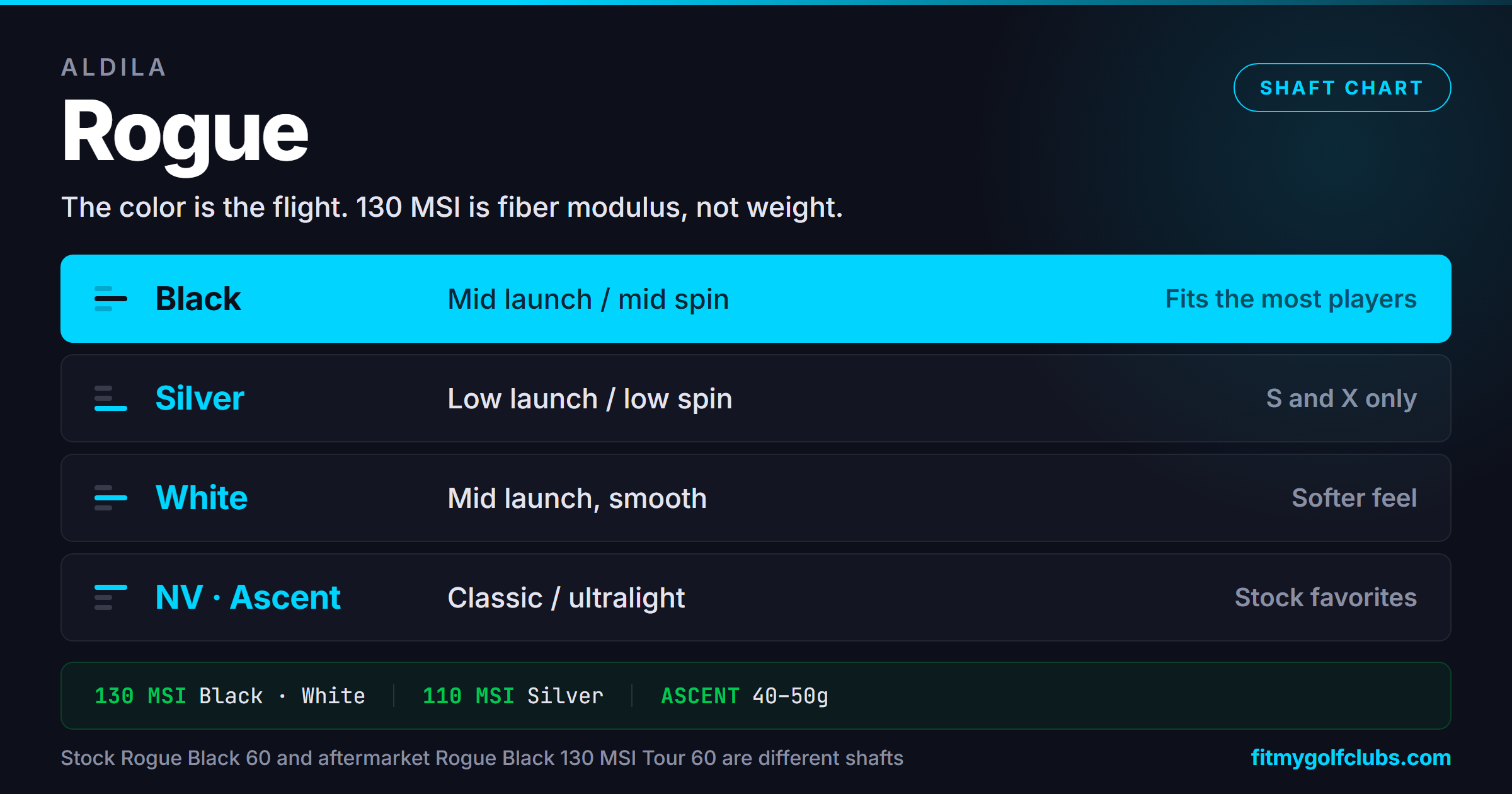
Aldila shaft chart: Rogue Black (mid), Silver (low spin), White (smooth), NV, Synergy, Ascent and Quaranta — weights, torque, and what 130 MSI means.
Golf Club Fitting
September 14, 2026
Nippon Modus & N.S. Pro Shaft Chart: 105, 120, 130 & Every GH Weight
Nippon shaft chart: Modus3 Tour 105–130 weights by flex and launch, plus N.S. Pro 950GH, 850GH, 1050GH, 1150GH and Zelos — lightweight steel decoded.


© 2026 FitMyGolfClubs. All rights reserved. | Patent Pending
Contact: sean@fitmygolfclubs.com