
For Golf Pros
August 13, 2026
Golf lessons are one of the best investments you can make in your game — and one of the most confusingly priced. Two instructors at the same course can charge $75 and $250 an hour, big-box studios sell lessons in packages that make hourly math hard, and nobody posts their rates where you can compare them.
This guide breaks down what golf lessons actually cost in 2026 — by lesson type, instructor credential, and facility — using published 2026 rate cards, not guesses. And because the same numbers matter from the other side of the lesson tee, there's a section for instructors on what to charge.
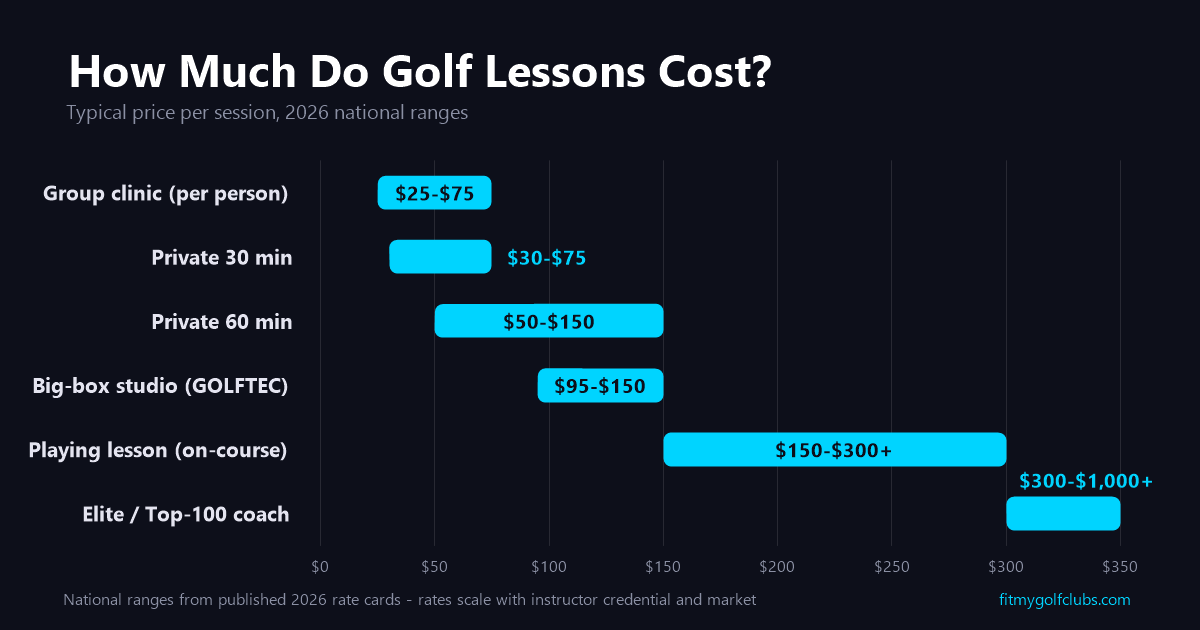
Golf lesson cost — the quick answer: most private golf lessons cost $50–$150 per hour, with the national average around $75–$100. A 30-minute session runs $30–$75, group clinics $25–$75 per person, and big-box studios like GOLFTEC sell lessons in multi-month plans with swing evaluations from $99–$149. Credentialed club pros charge more: published 2026 PGA staff rates run from about $140/hour for a PGA Associate to $300/hour for a PGA Master Professional.
⚡ Before you spend $100 on a lesson, make sure your clubs aren't the problem.
A lesson can't fix a club that doesn't fit — you'll just groove compensations. Grade My Bag checks all 14 clubs across 8 fit factors, free. Grade my bag free →
Golf Lesson Prices at a Glance
Here's what each lesson format typically costs in 2026. Prices vary by market — premium golf metros run 50–100% above small-market rates for the same credential — so treat these as national ranges.
What Actually Determines the Price
Four things move a lesson's price more than anything else: who's teaching, where they teach, what technology is involved, and how you buy.
Instructor Credential
Golf instruction has a real credential ladder, and pricing follows it closely. Here's the pattern — anchored by an actual published 2026 rate card from a university golf club's PGA staff, where the same lesson costs $140 with a PGA Associate and $300 with a PGA Master Professional:
*2026 PGA staff lesson rate card, Duke University Golf Club. A premium facility — small-market rates for the same credentials run meaningfully lower.
Location and Market
The same PGA-certified veteran who charges $175–$250/hour in a premium golf metro like Scottsdale, Naples, or San Diego might charge around $110/hour in a smaller Midwest market. If you're in a big golf market, expect the top of every range in this guide; in a small one, the bottom.
Technology and Facility
Lessons taught with a launch monitor, video analysis, or in a dedicated indoor studio price above range-tee lessons — the instructor is recovering real equipment and bay costs. That's part of why big-box studios and simulator facilities cluster at $95–$150 per lesson rather than $60–$80.
How You Buy: Single Lessons vs Packages
Almost every instructor discounts packages. On published 2026 rate cards the discount is real but modest — roughly 5–10% off the single-lesson rate for a 2- or 4-hour prepaid pack. Big-box studios push this further: GOLFTEC doesn't sell most instruction as single lessons at all, but as 3-, 6-, or 12-month lesson plans, with per-lesson cost dropping as the plan grows.
GOLFTEC, Topgolf, and Big-Box Studio Pricing
The big chains price differently than independent pros, so they're worth their own breakdown:
One structural note: studio chains bundle instruction with technology and a climate-controlled bay, which is genuinely useful for data-driven improvement — but it means you're committing hundreds to thousands of dollars up front. If you're evaluation-shopping, the $99–$149 assessment is a reasonable way to get launch-monitor numbers even if you don't buy a plan. (Those same studios usually sell club fittings from about $95 — a different service that often gets bundled into the pitch.)
Are Golf Lessons Worth It?
At $75–$100 for an average lesson, a handful of sessions costs less than one new driver — and unlike the driver, instruction compounds. For most golfers, 3–6 lessons spaced over a season, each followed by real practice, beats 12 crammed into a month. The common failure mode isn't bad teaching; it's taking lessons faster than you can absorb them.
There's one caveat worth checking before you book: make sure your equipment isn't fighting the fix. If your shafts are the wrong flex or your lie angles are off, a good instructor ends up teaching you compensations for your clubs instead of a better swing. Checking fit costs nothing and takes minutes — grading your bag before a lesson series is the cheapest insurance in golf.
🎯 Spending $400 on lessons? Spend 5 free minutes first.
Grade My Bag flags fit problems — wrong flex, bad gapping, off lie angles — that lessons can't fix. Bring the report to your pro. Check my clubs free →
For Instructors: What Should You Charge for Golf Lessons?
If you teach, the ranges above are your benchmark — but most pros underprice against them. Here's how to set your rate deliberately instead of inheriting whatever the last pro at your facility charged.
Start From the Credential Table, Adjust for Market
Find your row in the credential table above, then adjust for your market: premium golf metro, top of the range or above it; small market, lower half. If you teach with a launch monitor or in a private studio, price the technology in — students expect to pay more for data, and studios that don't charge for it are subsidizing their own equipment.
Sanity-Check With the Income Formula
Work backward from what you need to earn: (target annual teaching income + annual costs) ÷ realistic billable lesson hours = your floor rate. A pro targeting $60,000 from teaching, running 15 lessons a week for 45 weeks (675 hours), needs about $90/lesson before costs — and that's with a genuinely full book. Most pros overestimate billable hours and underestimate no-shows, reschedules, and unpaid admin time, which is why the formula usually says "raise your rate."
Three Pricing Rules Working Pros Use
1. If you're booked over ~80%, raise your rate 10–15%. A full calendar at a too-low price is lost income, not loyalty. 2. Sell packages for retention, not deep discounts. The published 2026 rate cards discount prepaid packs just 5–10% — enough to get commitment, not enough to gut your hourly. A 4-lesson pack also matches how improvement actually works. 3. Charge playing lessons at 2–3× your hourly. On-course time is your scarcest inventory.
Protect the Hours You Don't Bill
The quiet killer of lesson economics isn't the rate — it's the unpaid hours around it: scheduling texts, reschedules, chasing payments, remembering what you worked on with each student, and writing up what they should practice. Five admin hours a week at a $100 lesson rate is $25,000 a year of un-billable time. The fix is systemizing the client side of the business, not working longer.
Teach golf? Run your lesson book in one place.
FitMyGolfClubs for coaches and fitters: schedule and log lessons, manage every client and their bag, and walk into each session with their equipment already graded across 8 fit factors.
The Bottom Line
In 2026, expect to pay $50–$150 for a private golf lesson (average $75–$100), $25–$75 per person for clinics, and package pricing at big-box studios that works out to roughly $95–$150 a lesson. Credentials, market, and technology explain almost all of the spread — a $300 lesson from a PGA Master Professional and a $60 lesson from a range pro are both fairly priced for what they are. Buy lessons at the pace you can practice, check your equipment fit before you start, and if you're the one teaching: benchmark against the published rates above, because they're probably higher than what you're charging.
Frequently asked questions
How much does a golf lesson cost?
Most private golf lessons cost $50–$150 per hour in 2026, with the national average around $75–$100. Thirty-minute sessions run $30–$75, and group clinics cost $25–$75 per person. Rates scale with the instructor's credentials and your market — published PGA staff rates run from $140/hour (PGA Associate) to $300/hour (PGA Master Professional) at premium facilities.
How much are golf lessons for beginners?
Beginners don't need an elite coach — a 30-minute lesson ($30–$75) or a group clinic ($25–$75 per person) with an assistant or associate pro covers fundamentals at the lowest cost. A short series of 3–5 sessions spaced over a couple of months, with practice in between, is the standard recommendation.
How much does GOLFTEC cost?
GOLFTEC starts with a Swing or Game Evaluation at $99–$149, then sells instruction as 3-, 6-, or 12-month lesson plans rather than single lessons. Per-lesson cost inside a plan typically works out to about $95–$150 depending on the center and plan size, with total plan commitments running from several hundred to several thousand dollars.
How many golf lessons do I need?
Most instructors recommend 3–6 lessons spaced over a season for a meaningful, lasting change — each followed by practice time to absorb it. One lesson can diagnose; it rarely fixes. Buying lessons faster than you can practice between them is the most common way golfers waste instruction money.
How much should I charge for golf lessons as an instructor?
Benchmark your credential level against published rates: assistant pros $50–$90/hour, PGA Associates $90–$140, PGA Members $120–$225, and certified or master professionals $175–$300+. Then sanity-check with the income formula — target teaching income divided by realistic billable hours — and raise your rate 10–15% whenever you're booked over about 80%.
Are golf lesson packages worth it?
Usually, but not for the discount — published 2026 rate cards discount prepaid packages only 5–10%. The real value is structural: a package commits you to the multi-lesson arc that improvement actually requires, and locks the rate. Skip any package bigger than you can realistically use in a season.
Related reading
- Golf Lesson Scheduling Software: Run Lessons & Events in One Place — For instructors: reclaim the unpaid admin hours around your lesson book.
- How Much Does a Golf Club Fitting Cost? — The other half of the improvement budget: what fittings cost and when they're worth it.
- Golf Swing Speed Chart: Shaft Flex by Club Head Speed — Know your speed before your first lesson — it's the number your instructor will ask about.
- Golf Club Distance Chart — Benchmark your distances by club, swing speed, and skill level.
- Golf Shaft Fitting Guide — If lessons aren't moving the ball flight, the shaft might be the reason.
Taking lessons — or teaching them? Either way, start with the equipment: grade a bag free with FitMyGolfClubs — 8 professional fit factors, no launch monitor required.
Related Articles
Golf Club Fitting
October 8, 2026
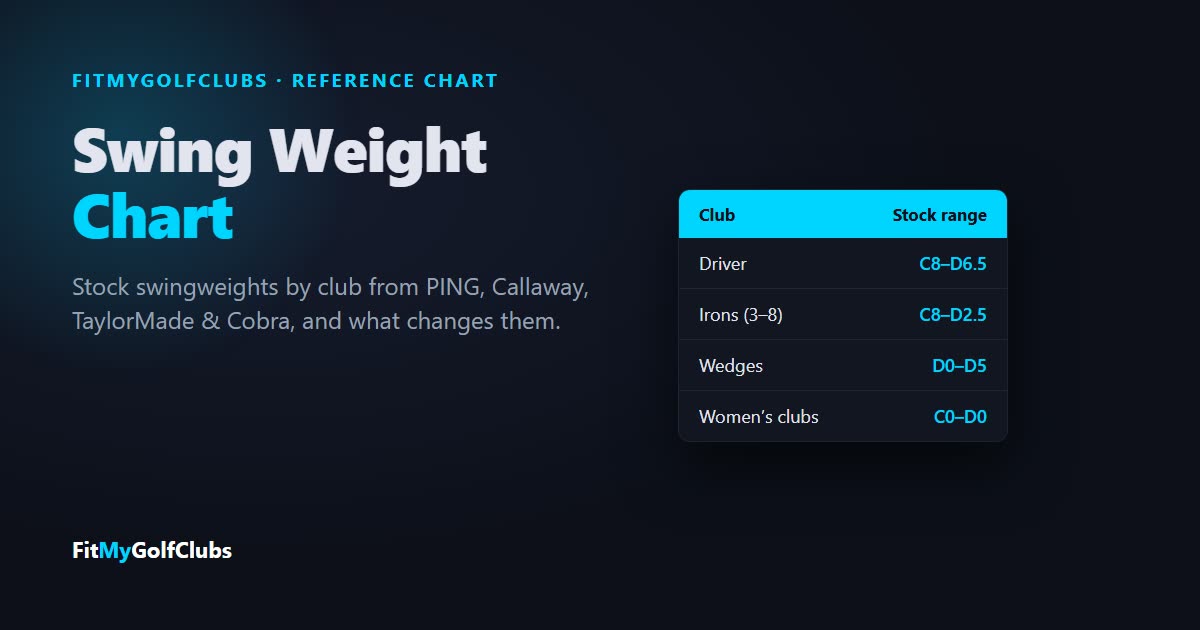
Swing Weight Chart: Standard Swingweights by Club and Brand
Swing weight chart: the A0–G9 scale, stock swingweights for drivers, irons and wedges from PING, Callaway, TaylorMade and Cobra, and what changes them.
Golf Club Fitting
October 8, 2026
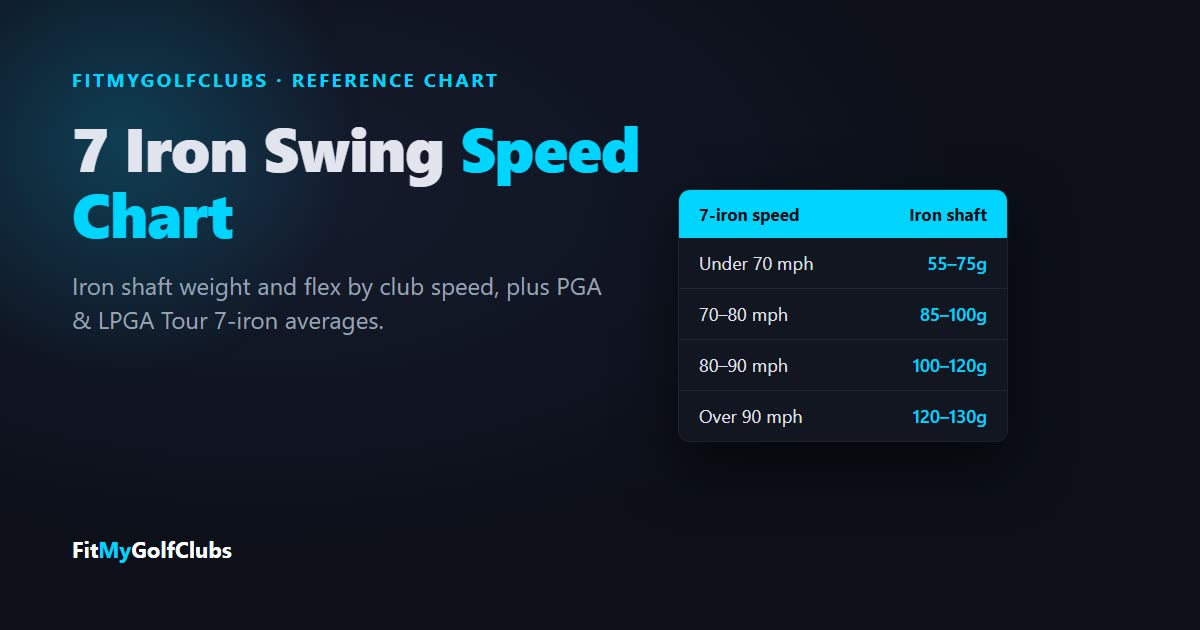
7 Iron Swing Speed Chart: Iron Shaft Weight, Flex & Carry
7 iron swing speed chart: iron shaft weight and flex by club speed, PGA (92 mph) and LPGA (78 mph) Tour averages, and 7-iron carry by speed.
Golf Club Fitting
October 8, 2026
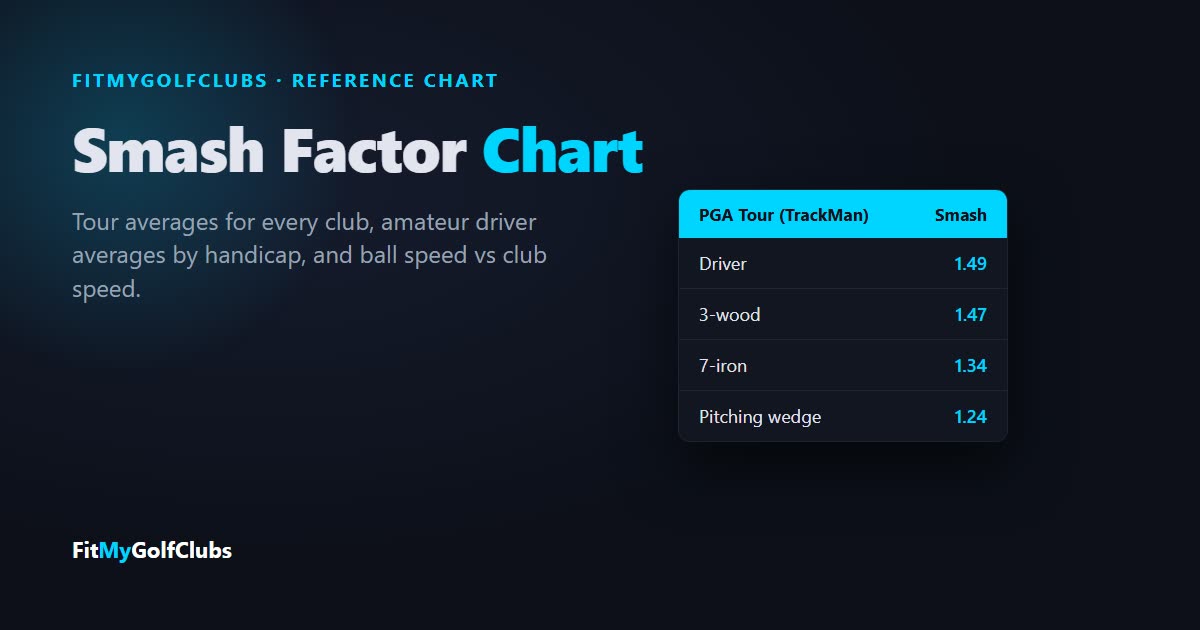
Smash Factor Chart: Tour Averages by Club + Ball Speed
Smash factor chart by club from TrackMan PGA and LPGA Tour averages, amateur driver averages by handicap, and a club speed to ball speed table.


© 2026 FitMyGolfClubs. All rights reserved. | Patent Pending
Contact: sean@fitmygolfclubs.com