
Golf Club Fitting
November 2, 2026
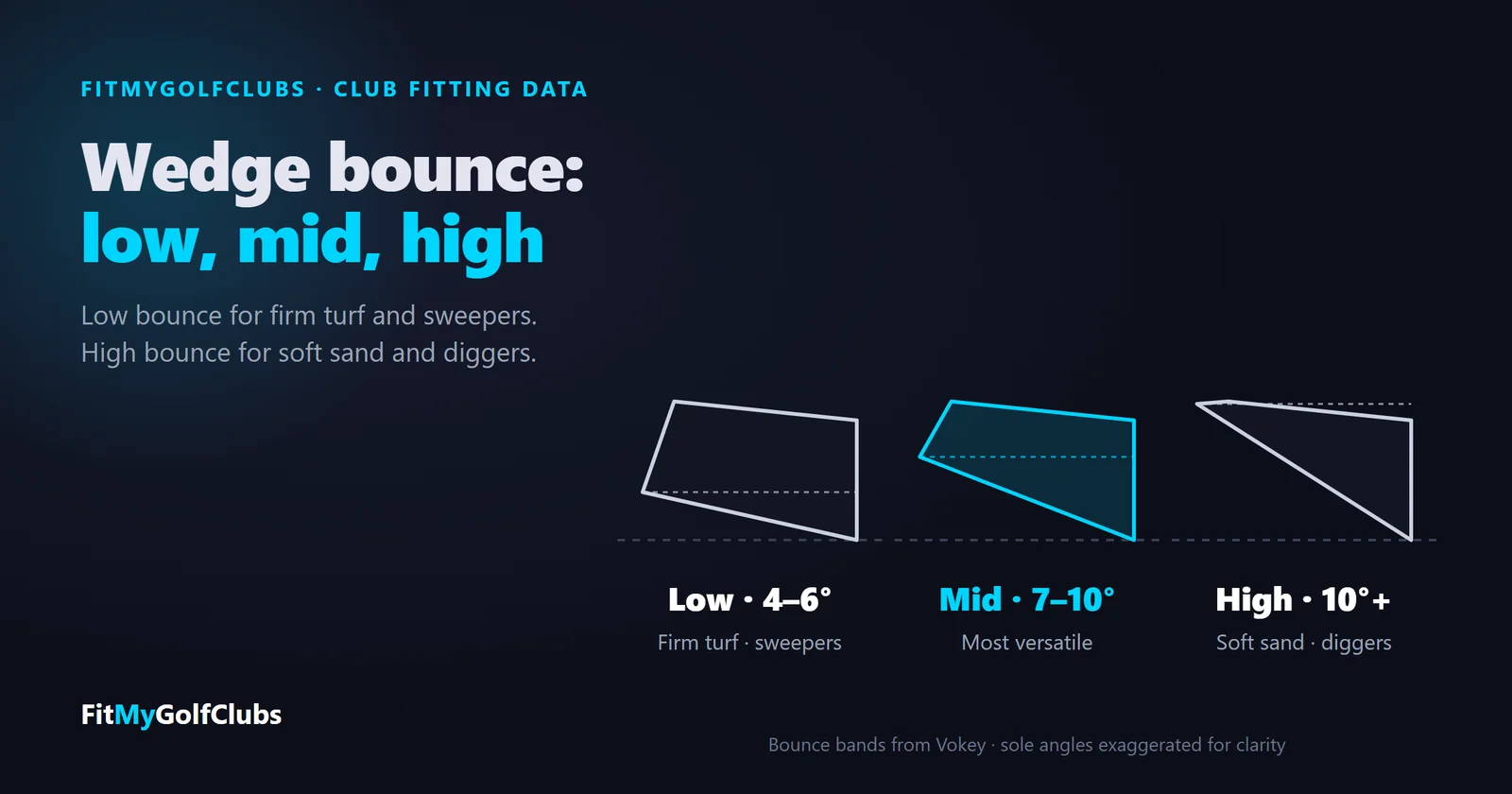
The quick answer: wedge bounce is “the angle between the leading edge and the sole that helps prevent the club from digging” (Vokey). Low bounce: 4° to 6°; mid: about 7° to 10°; high: more than 10°. Low suits firm turf and shallow swings; high, soft sand and steep swings.
Wedge Bounce Chart
Low, mid and high bounce, with the conditions and swing type each suits, from Vokey’s bounce guide:
What Is Wedge Bounce?
“Wedge bounce is the angle between the leading edge and the sole that helps prevent the club from digging, allowing you to make cleaner contact around the green and hit the shots you want based on your swing type.” Picture the sole of a sand wedge: the back edge sits lower than the leading edge. That angle, measured in degrees, is the bounce. More of it keeps the leading edge from digging into soft sand or turf; less of it lets the leading edge sit close to the ground on a firm, tight lie.
The grind is the shaping of the sole around that angle. Vokey’s summary: “Vokey wedge grinds work with bounce by shaping the sole to control how the club interacts with the turf and sand, giving you versatility to open or close the face for different short game shots.” Two wedges with the same bounce number can play quite differently because of the grind; see our Vokey grind chart for every grind explained.
Wedge Bounce by Loft: Vokey SM11
Every bounce Vokey makes at each SM11 loft (bounce, then grind letter). A Vokey stamped 56.14 F is a 56° loft with 14° of bounce and the F grind:
Notice the pattern. The pitching and gap wedges come with 8° to 12° of bounce and only the full F sole, which Vokey describes as “The F Grind is a full sole suited for full wedge shots.” The choice opens up in the sand and lob wedges, from 4° (the T grind on the 58° and 60°) to 14° (the F grind on the 54° and 56°). Vokey says “The 56.14 F is the most popular sand wedge on tour”.
Wedge Bounce by Loft: Callaway Opus SP
Callaway rates each grind by conditions and divot, which maps straight onto bounce:
Full grind descriptions are in our Callaway wedge grind chart.
How to Choose Wedge Bounce
1. Read your divots
Your divot is the best clue to your swing type. Deep, bacon-strip divots mean a steep attack: you are a digger, and you want more bounce. Shallow divots or just a brushed patch of grass mean a sweeper: lower bounce suits you. Vokey’s advice for the sand wedge: “If you have a steep angle of attack resulting in deep divots, a higher bounce is recommended. If you are a sweeper resulting in shallow or no divot, low bounce is recommended.”
2. Think about your course
Soft, wet turf and fluffy bunker sand call for more bounce; firm, dry fairways and firm or coarse sand call for less. If you play one course most of the time, fit your wedges to it.
3. Give each wedge a job
“Each wedge in your bag has a job to do, so there is no one-size-fits-all bounce. If you are a steeper player that takes bigger divots, we recommend at least one high bounce wedge. If you are a shallow player that takes little to no divot, we recommend having at least one low bounce wedge.” One example: a mid-bounce gap wedge, a higher-bounce sand wedge for bunkers, and a lower-bounce lob wedge for tight lies, but your divots and your course decide it.
4. When in doubt, more bounce
Bob Vokey’s own line is “Bounce is your friend.” Vokey’s site adds: “Bounce provides forgiveness, which will benefit all golfers.” If you are not sure, mid to high bounce forgives more mishits than low bounce.
⛳ Bounce sorted. Are your wedge lofts gapped?
Bounce decides how a wedge meets the turf; loft decides how far it goes. Loft gapping is the #1 fitting flaw in the bags we’ve graded, and the free FitMyGolfClubs bag grade checks every loft gap from driver to lob wedge in about 3 minutes, from your specs alone. Check my wedge gaps free →
Low Bounce vs High Bounce
Vokey’s own summary: “Low bounce wedges are great for firm conditions and players that take very little divot. A low bounce wedge will tend to dig or cut into the turf. High bounce wedges are great for softer conditions and players that take a bigger divot. A high bounce wedge will tend to glide through the turf and resist digging.”
For the yardage side of your wedges, see our wedge distance chart.
Frequently asked questions
How much bounce for a sand wedge?
A good bounce for a sand wedge depends on your swing and your sand. Steep swingers who take deep divots and golfers with soft sand do best with high bounce (more than 10°); sweepers and firm sand suit less. Vokey’s most popular sand wedge on tour is the 56° with 14° of bounce.
What is low, mid and high bounce?
Vokey’s bands: low bounce is 4° to 6°, mid bounce about 7° to 10°, and high bounce more than 10°.
What is a standard wedge bounce?
There is no single standard. Vokey says there is not a one-size-fits-all bounce because every player and every course is different. On Vokey’s SM11, pitching and gap wedges come with 8° to 12° of bounce.
Is high bounce better for beginners?
Usually, yes. Bounce adds forgiveness by keeping the leading edge from digging, and Vokey says that benefits all golfers.
What does 56.14 mean on a wedge?
On a Vokey wedge it means 56° of loft and 14° of bounce. The letter after it, such as F, is the grind.
What is the best bounce angle for a 60-degree wedge?
There is no single best: the bounce a lob wedge should have depends on your turf and divots. Low bounce (4° to 6°) suits firm turf, tight lies and flop shots; mid or high bounce (8° to 12°) suits soft courses or deeper divots. Vokey’s SM11 60° comes with 4° to 12° of bounce.
Sources: bounce bands, conditions, swing types and FAQ answers from Vokey’s wedge bounce page; SM11 lofts, bounces and grinds from the SM11 spec table (checked September 30, 2026); Opus SP lofts, bounces and grind chart from Callaway’s Opus SP page (checked October 8, 2026).
Related reading
- Vokey Grind Chart — Every SM11 loft, bounce and grind, and what each grind is for.
- Callaway Wedge Grind Chart — Every Opus SP, Opus, Platinum and JAWS Raw loft, bounce and grind.
- Wedge Distance Chart — Full and partial yardages for every wedge, and loft gapping.
- Golf Club Loft & Lie Chart — Standard loft and lie for every club.
- What Graded Bags Show — Loft gapping is the #1 fitting flaw amateurs can fix.
- Golf Club Fitting Chart — Every chart we publish, in one place.
Related Articles
Golf Club Fitting
November 2, 2026
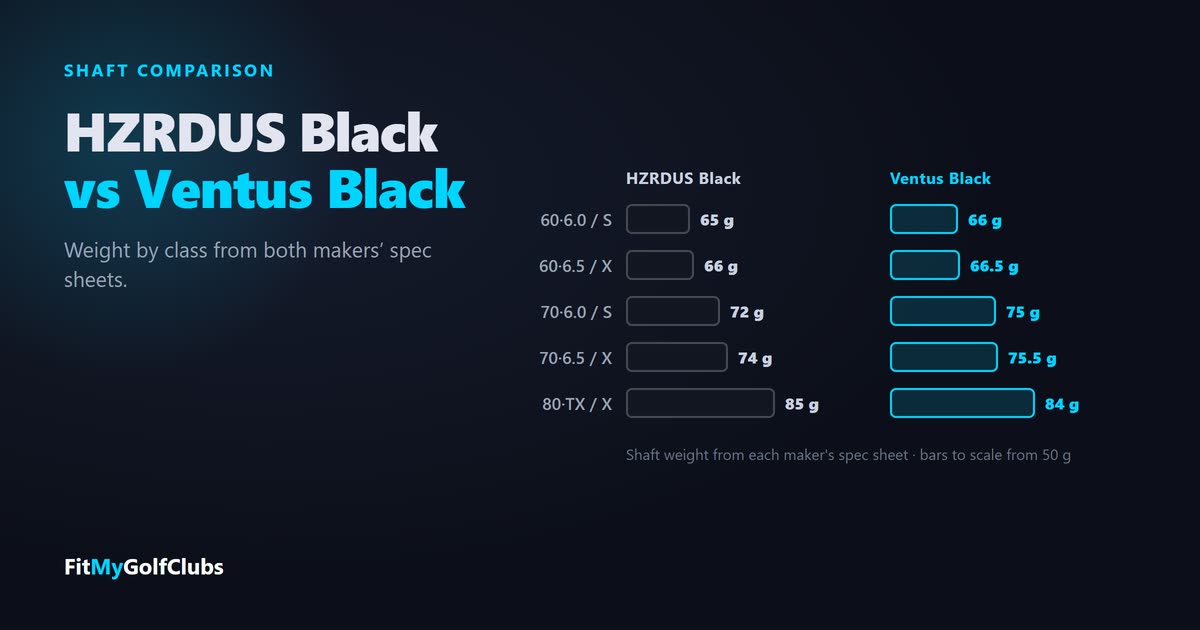
HZRDUS Black vs Ventus Black: Weight, Torque & Flex
HZRDUS G5 Black vs Fujikura Ventus Black from both makers' spec sheets: weight, torque and flex by class, and what each maker says about launch and spin.
Golf Club Fitting
November 2, 2026
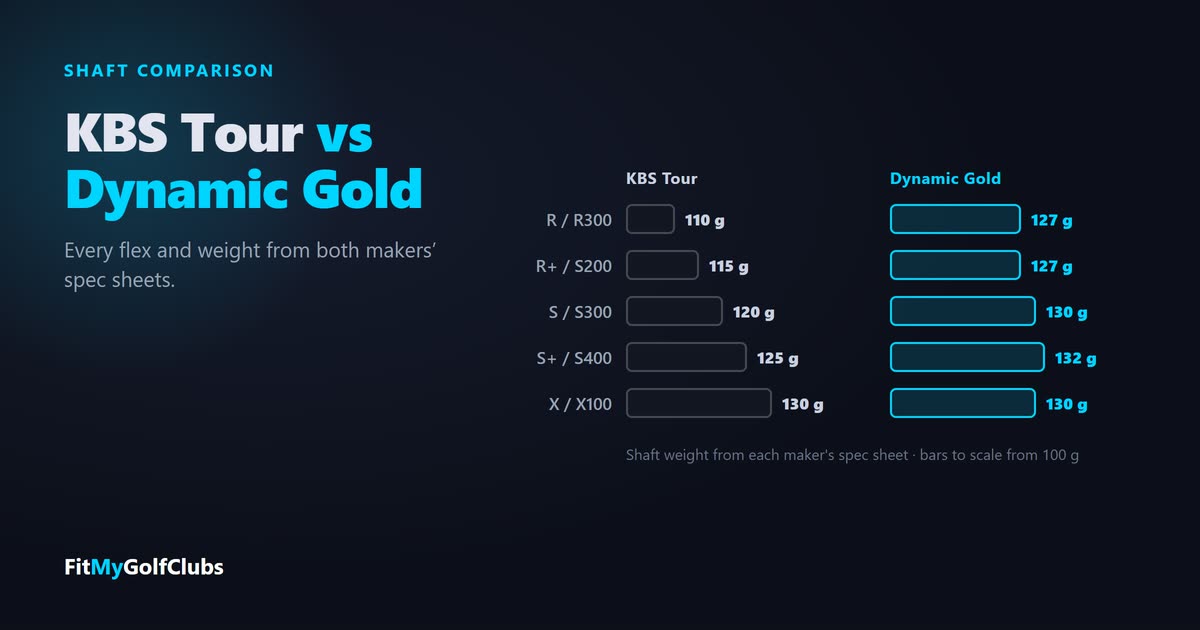
KBS Tour vs Dynamic Gold: Weight, Flex & Launch
KBS Tour vs Dynamic Gold from both makers' spec sheets: every flex and weight side by side, what each maker says about launch, and KBS Tour vs Project X.
Golf Club Fitting
November 2, 2026
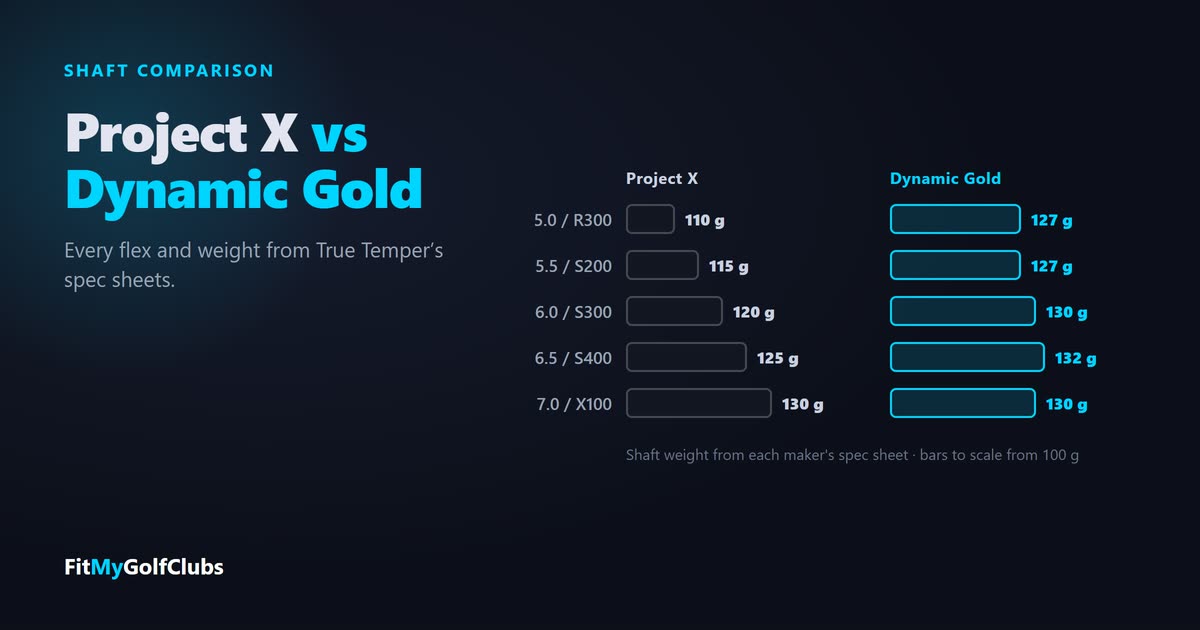
Project X vs Dynamic Gold: Weight, Flex & Specs
Project X vs Dynamic Gold from True Temper's spec sheets: every flex and weight side by side, what each is built for, and Project X 6.0 vs Dynamic Gold S300.


© 2026 FitMyGolfClubs. All rights reserved. | Patent Pending
Contact: sean@fitmygolfclubs.com