
Golf Club Fitting
November 2, 2026
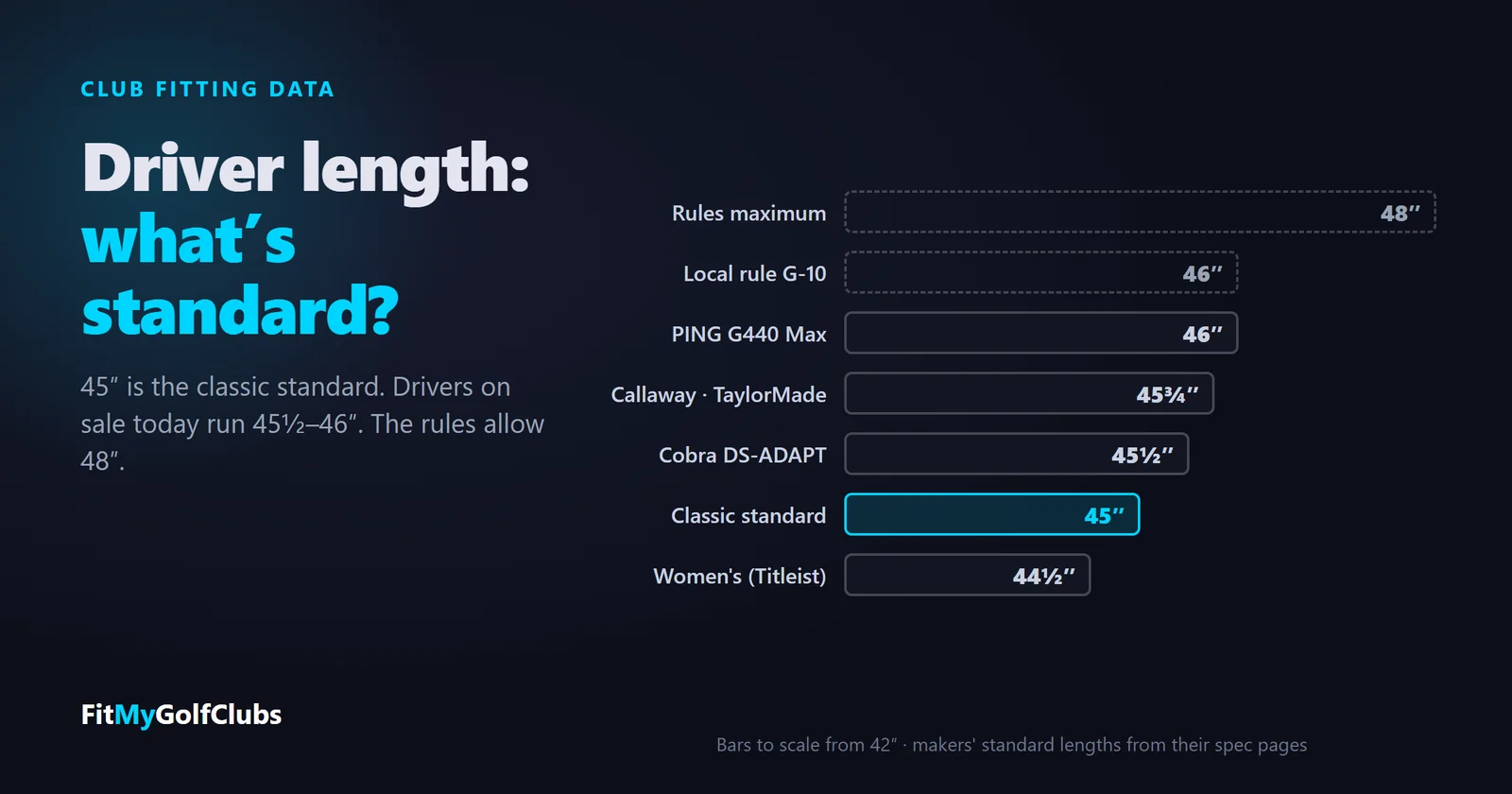
The quick answer: the classic standard driver length is 45 inches, but drivers sold today are 45½ to 46 inches: 45¾″ from Callaway and TaylorMade, 46″ for PING’s G440 Max with its stock shaft, 45½″ for Titleist’s GTS and Cobra’s DS-ADAPT Max-K. The rules allow up to 48″.
Standard Driver Length by Brand
Standard length for each maker’s current drivers, from their own spec pages:
Note PING’s two lengths: the G440 Max is 46″ with the stock ALTA CB Blue 50 shaft, and PING says that “Standard length with PING Tour 2.0 Chrome or Black, Mitsubishi Tensei 1K and Project X Denali Red shafts is 45 1/2″.” The same head can ship at two lengths depending on the shaft you pick. Makers also measure length slightly differently, so two drivers listed at the same length can differ by a fraction of an inch.
Why 45 inches is still called standard
Our golf club length chart uses 45″ for the driver because that is the classic standard the rest of the set steps down from: a 42½″ 3-wood, a 40″ 3-hybrid and so on. Drivers have crept longer since. In a 2014 notice to equipment makers, the R&A wrote that “most drivers are now marketed as having a length of between 45.5 and 46 inches.”
Driver Length by Height
Standard length fits a golfer of about 5’9″ to 6’0″. This table applies the same height adjustments as our length chart to the classic 45″ driver. It’s a starting point: your wrist-to-floor measurement and, above all, where you strike the ball refine it.
Two things to notice. First, most drivers off the rack (45½ to 46″) are already as long as, or longer than, this table suggests for a golfer of 6’1″ to 6’3″, so a shorter golfer buying off the rack is often playing a driver longer than their height calls for. Second, height is only a proxy: two golfers of the same height can have arms of different lengths, which is what wrist-to-floor measures. Our length by height guide walks through both measurements.
Longer vs. Shorter Driver: the Trade-off
A longer shaft makes a wider arc and more clubhead speed. The R&A’s estimate: “It is estimated that each additional inch of club length has the potential to increase driving distance by 2-3 yards as a result of increased clubhead speed.” That is the most an extra inch can give you, and only if you still find the middle of the face.
The catch is contact. A longer club is harder to return to the center of the face, and the R&A’s estimate counts speed only: it assumes the same strike. A heel or toe hit gives back ball speed, so the extra inch only pays if your contact holds up. That is why tour players, who swing faster than anyone, don’t play the longest drivers: in its 2014 notice the R&A wrote that “more recent data suggests that the majority of drivers currently used by touring professionals on the PGA Tour are now between 45 and 45.75 inches in length.” while “most drivers are now marketed as having a length of between 45.5 and 46 inches.” If you mishit your driver more than your 3-wood, length is the first thing to test.
Signs your driver is too long
- Strike marks scattered across the face, or mostly on the heel or toe (face tape or spray shows it in ten balls).
- You choke down on the grip without thinking about it.
- You hit your 3-wood off the tee straighter and almost as far.
- Your setup feels crowded or you stand up through the shot.
Cutting a driver down
Shortening a driver is a cheap job for a club builder, but it changes the feel. Taking length off lowers the swingweight: as our swing weight chart notes, a club ½″ shorter loses about 3 to 5 swingweight points, so a builder usually adds a little head weight to put the feel back. Titleist publishes how much: for a men’s driver, a SureFit weight 2g heavier than standard for each ½″ cut (see our Titleist SureFit chart). Where the cut is made matters too: cutting from the tip stiffens the shaft, and Titleist notes that “Each 1/2″ trimmed generally increases the shaft stiffness by between 1/4 to 1/3 flex”, so ask for the cut from the butt end unless you want a stiffer shaft. On an adjustable driver, you can also try the shorter length first by choking down an inch for a range session.
⛳ Is your driver the right length for the rest of your bag?
The free FitMyGolfClubs bag grade checks the length step from your driver to your next club: it expects about 2.5″ from driver to 3-wood and flags a step more than 0.75″ off that, along with every length step through the set. It takes about 3 minutes, from your specs alone. Grade my bag free →
Women’s, Senior and Junior Driver Length
Women’s clubs run about an inch shorter than men’s across the set. Titleist’s driver page puts it plainly: “44.5″ is the standard women's driver length.” and “42.5″ is the standard junior/youth driver length.” For seniors, the length question is the same as for anyone: use the height table, then check where you strike it.
A mini driver is shorter again, 43¼ to 44″; Callaway’s Quantum Mini is 44″. For many golfers who fight the driver, it is the easiest way to try a shorter club off the tee.
Driver Length Rules: 48 Inches and the 46-Inch Local Rule
The Equipment Rules cap every club except a putter at 48 inches: “In 2004, The R&A and the USGA adopted a maximum length limit of 48 inches for all clubs other than putters.” Since 2022 there is also a Model Local Rule, G-10, that lets elite competitions set a lower limit. The R&A and USGA announced that it “will be available beginning on 1 January 2022 to provide those running professional or elite amateur golf competitions with the option of limiting the maximum length of a golf club (excluding putters) to 46 inches.”
It doesn’t apply to everyday golf. In the USGA’s words, “it is not a ‘Rule of Golf,’ and as such, it is not mandated for the average, recreational golfer.” So a 46½″ long-drive driver is legal in your Saturday game; it’s only events that adopt G-10 that cap it at 46″.
How to Measure Your Driver’s Length
The USGA’s Equipment Rules define it: “For woods and irons, the measurement of length is taken when the club is lying on a horizontal plane and the sole is set against a 60 degree plane.” “The length is defined as the distance from the point of the intersection between the two planes to the top of the grip.” At home:
- Set the driver in its playing position, sole flat on the floor.
- Measure along the back of the shaft from the floor to the end of the grip cap.
- Compare with the maker’s standard above. If yours is more than ½″ off, it was probably built custom or cut down.
The same method for every club is in our golf club length by height guide.
That is the playing length. Makers measure slightly differently, so a fraction of an inch between their number and yours is normal.
Frequently asked questions
What is the standard length of a driver shaft?
The classic standard is 45 inches, but drivers sold today are 45½ to 46 inches: Callaway and TaylorMade build theirs at 45¾″, PING’s G440 Max at 46″ with the stock shaft, and Titleist’s GTS drivers and Cobra’s DS-ADAPT Max-K at 45½″. Women’s drivers are about an inch shorter.
How long should my driver’s shaft be for my height?
The length driver you should use for your height starts from standard, which fits about 5’9″ to 6’0″. Below that, take ¼″ to 1″ off; at 6’1″ to 6’3″ add about ½″, and ¾″ to 1″ above that. It’s a starting point: centered contact matters more than the number.
Is a 46 inch driver too long?
For many amateurs, yes. It is legal (the limit is 48 inches outside events that use the 46-inch local rule), but in the R&A’s 2014 data most tour drivers were 45 to 45¾ inches. If your strikes are scattered across the face, test a shorter length.
Does a shorter driver go straighter?
It is easier to hit in the center of the face, and centered strikes go straighter and keep more ball speed. The R&A estimates each extra inch can add 2 to 3 yards from clubhead speed, which a mishit easily gives back.
What is the maximum driver length allowed?
48 inches under the Equipment Rules, for every club except a putter. Since 2022, professional and elite amateur events can adopt Model Local Rule G-10, which lowers the limit to 46 inches. It does not apply to recreational golf.
How long is a women’s driver?
About an inch shorter than a men’s driver. Titleist lists 44.5 inches as its standard women’s driver length and 42.5 inches for junior drivers.
Can you shorten a driver shaft?
Yes. A club builder cuts it from the butt end and refits the grip. Expect the swingweight to drop about 3 to 5 points per half inch removed, which can be put back with a little head weight.
Sources: the R&A and USGA’s 12 October 2021 release on Model Local Rule G-10 and the R&A’s 17 December 2014 notice to manufacturers on club length; Callaway and TaylorMade driver spec tables (checked September 29, 2026); PING G440 Max and Cobra DS-ADAPT Max-K spec pages and Titleist’s GTS spec table and SureFit weight table (checked November 2, 2026); height adjustments from our golf club length chart.
Related reading
- Golf Club Length Chart — Standard length for every club, by height, with a free calculator.
- Golf Club Length by Height — The full height and wrist-to-floor fitting walkthrough.
- Mini Driver — Lofts, lengths and who a mini driver suits.
- Driver Loft Chart — The right driver loft for your swing speed and attack angle.
- Swing Weight Chart — How length changes swingweight, and the stock swingweights by brand.
- Golf Driver Fitting — What a driver fitting checks and what you can check yourself.
- Golf Swing Speed Chart — Find your swing speed and the flex that matches it.
- Golf Club Fitting Chart — Every chart we publish, in one place.
Related Articles
Golf Club Fitting
November 2, 2026
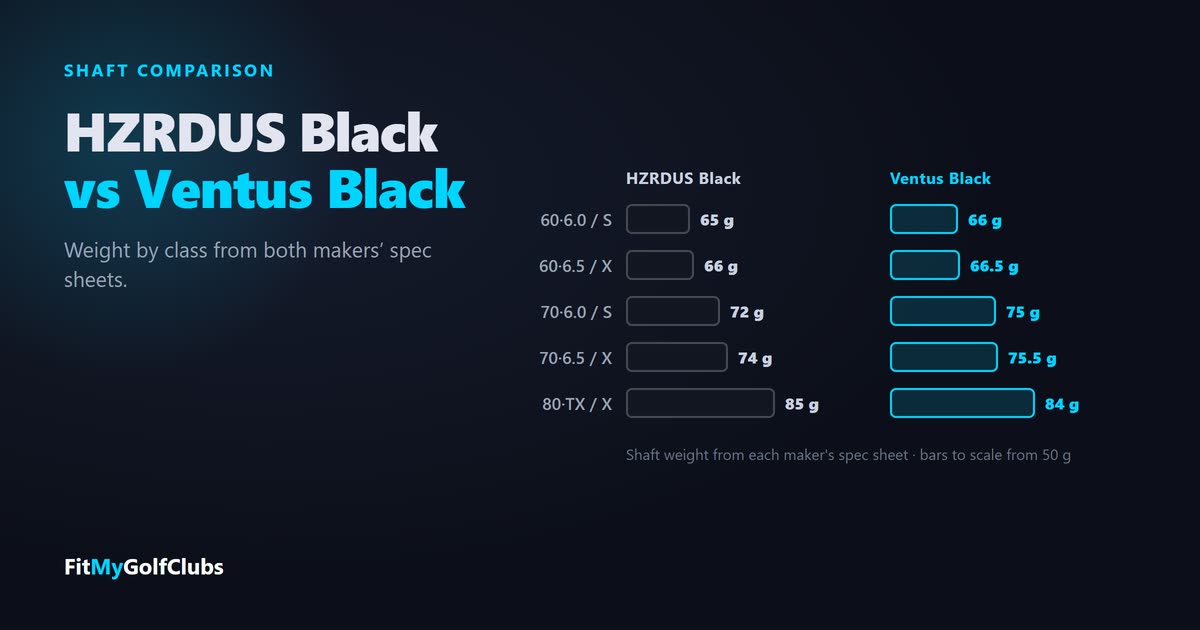
HZRDUS Black vs Ventus Black: Weight, Torque & Flex
HZRDUS G5 Black vs Fujikura Ventus Black from both makers' spec sheets: weight, torque and flex by class, and what each maker says about launch and spin.
Golf Club Fitting
November 2, 2026
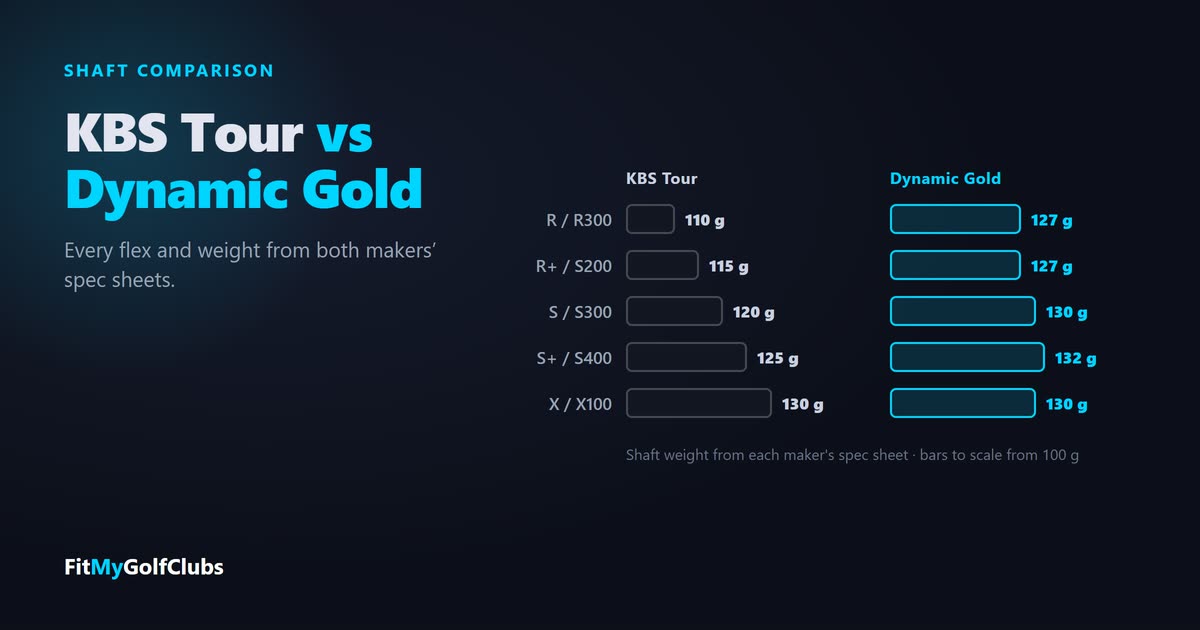
KBS Tour vs Dynamic Gold: Weight, Flex & Launch
KBS Tour vs Dynamic Gold from both makers' spec sheets: every flex and weight side by side, what each maker says about launch, and KBS Tour vs Project X.
Golf Club Fitting
November 2, 2026
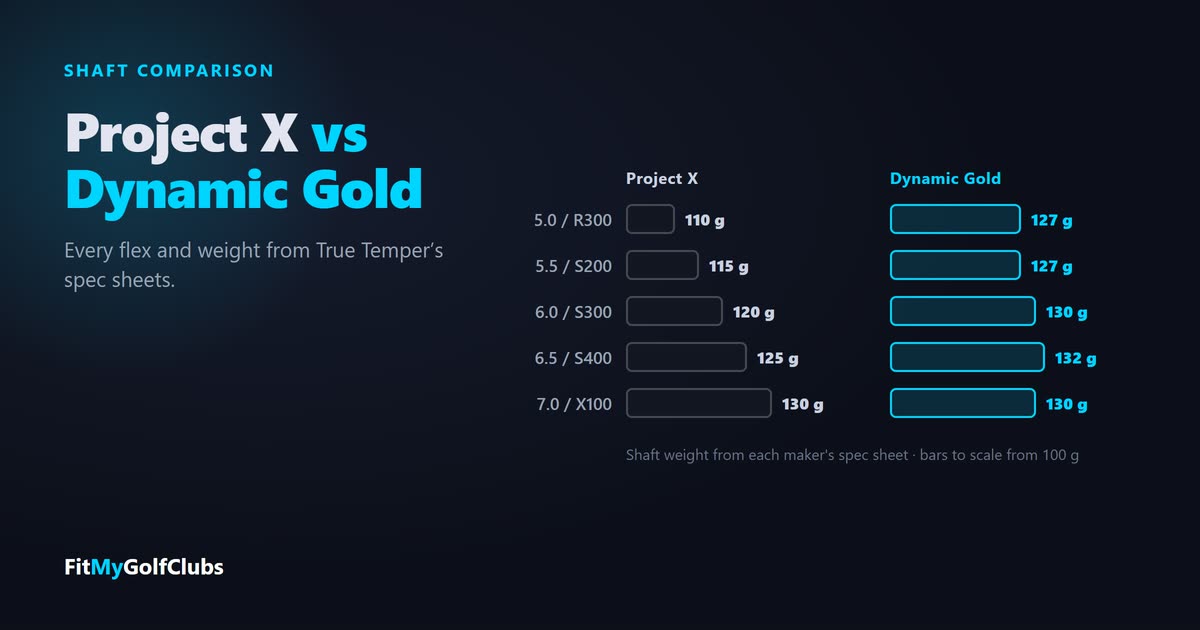
Project X vs Dynamic Gold: Weight, Flex & Specs
Project X vs Dynamic Gold from True Temper's spec sheets: every flex and weight side by side, what each is built for, and Project X 6.0 vs Dynamic Gold S300.


© 2026 FitMyGolfClubs. All rights reserved. | Patent Pending
Contact: sean@fitmygolfclubs.com