
Golf Club Fitting
October 8, 2026
The quick answer: Match driver loft to swing speed. Callaway’s driver buying guide suggests 12° or more under 85 mph, 10.5°–12° at 85–95 mph, 9°–10.5° at 95–105 mph and 8°–9° above 105 mph. Every major brand’s hosel can then add 1.5° to 2°, so one head covers several of those lofts.
Loft is only the means: what you are really fitting is launch and spin. TrackMan doesn’t publish a loft-by-speed table, but its Optimizer puts a 94 mph swing with a level attack angle at 13.6° launch and 2,772 rpm. Below: the chart in our swing-speed bands, every current driver’s stock lofts and adjustable range, what each hosel does, and the gap to your 3-wood.
Driver Loft Chart by Swing Speed
The rows are the same swing-speed bands as our swing speed shaft flex chart. The loft column is Callaway’s published guide; where Callaway’s speed cutoffs split one of our bands, both of its rows are shown. The right column is what TrackMan measured or modeled at speeds inside that band.
Callaway’s own note under its table: “Remember that slower swings generally need more loft to carry the ball, not less.” The TrackMan figures are reference points, not loft prescriptions: the tour numbers are averages of real drives, and the Optimizer figure is TrackMan’s modeled best carry for that speed. Callaway also notes that men’s drivers run 8° to 12°, with 9° to 10.5° the most common, and women’s 9° to 12.5°, with 10.5° to 12° the most common.
What Driver Loft Should I Use? Aim for Launch and Spin
TrackMan says every golfer “should be fitted to achieve the optimal balance of Launch Angle and spin rate based on their club speed and ball speed,” and that the driver’s loft “should be chosen so that it complements the golfer’s Attack Angle and club speed.” Four of its definitions explain how loft gets you there:
- Dynamic loft is the loft at impact, not the number on the head. Attack angle, shaft bend, release, face angle and strike point all change it.
- Launch angle “will always be a little less than dynamic loft but will have a similar value.”
- Spin loft is roughly dynamic loft minus attack angle, and “a higher Spin Loft will result in a higher spin rate.”
- More loft “generally increases Spin Rate.”
That is why attack angle matters as much as speed. TrackMan’s Combine data for male amateurs shows it:
The average golfer launches the ball at 12.6°, close to the Optimizer’s 13.6°, but hits down 1.8° and spins it 503 rpm more. TrackMan’s advice for the driver: “hitting up on the ball (positive Attack Angle) is a must.” So read your own ball flight before you change loft:
- Low launch, the ball falls out of the sky: add loft.
- High launch and high spin, the ball balloons: take loft off.
- Launch looks right but spin is high: the attack angle is the bigger lever. Adding loft adds spin.
And from Callaway: “Lower loft does not necessarily equate to more distance for most everyday golfers. While less loft can work for faster swinging golfers, not having enough loft can actually hurt your distance off the tee without enough swing speed.”
9 vs 10.5 Driver: The Hosel Covers Most of the Difference
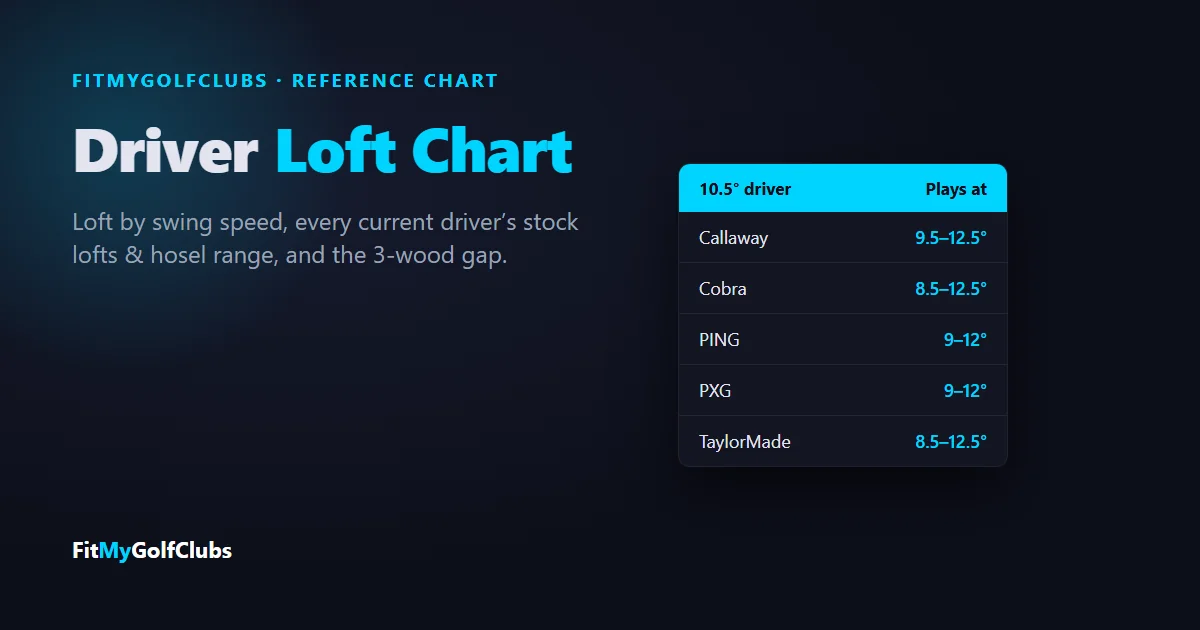
Per Callaway’s table, 9° to 10.5° is the suggestion at 95–105 mph, with more loft below that. But on most current drivers you can reach one from the other with the hosel. What a 9° and a 10.5° head play at, brand by brand:
Every 9° head here reaches 10.5°, and the 10.5° heads from Cobra, PING, PXG and TaylorMade reach 9°. Callaway is the exception: its OptiFit hosel takes off only 1°, so a 10.5° Callaway plays no lower than 9.5°. Titleist doesn’t sell a 10.5° driver; its heads come in whole degrees.
A 9° head set to 10.5° isn’t quite the same club as a 10.5° head. On a TaylorMade, +1.5° of loft also closes the face 3°; Titleist lists its loft settings as effective loft with a square face; PING’s and PXG’s hosels also have flat-lie settings. The brand charts below show exactly what else each setting moves.
Driver Lofts by Brand: Every Current Driver
Stock lofts (right-handed) and the full loft each head can play at through its hosel, from each brand’s own spec pages:
Across 52 current drivers, stock lofts run from 8° to 12°. Mini drivers are left out of the table: the Callaway Quantum Mini is 11.5° and 13.5° (OptiFit 4, whose steps Callaway doesn’t publish in degrees), the Titleist GTS300 13° and the PXG Secret Weapon Mini Driver 13°. PXG publishes its eight-setting chart for the GEN5 hosel and says the adapter “has eight settings for every one of our clubs”, so the PXG ranges assume that chart.
How Hosel Settings Change Driver Loft
Each brand’s hosel works differently, and most change more than loft:
Change one setting at a time and hit a few balls before you decide. If more loft launches better, check what it does to the next club down.
⛳ Changing your driver loft? Check the gap it leaves.
Every degree you add to or take off the driver changes the gap down to your 3-wood. Loft gapping is the #1 fitting flaw in the 231 bags we've graded. Our free bag grade checks every gap from driver to wedge in about 3 minutes, from your specs alone. Check my loft gaps free →
The 3-Wood Gap: Driver Loft and Loft Gapping
The 3-wood is the next club down, and on three current lines it is 15°: the PING G440 MAX, TaylorMade Qi4D and PXG Lightning. The loft between a 10.5° driver and a 15° 3-wood, at each hosel setting:
For scale, TrackMan’s tour averages put the driver 33 yards past the 3-wood on the PGA Tour (282 vs 249 yd carry) and 23 yards past it on the LPGA Tour (223 vs 200). If you add loft to your driver and the two clubs start to carry about the same, the 3-wood’s own hosel can take loft off too (PING’s G440 fairways adjust ±1.5°, TaylorMade’s Qi4D ±2°). A 4-wood (17° on the PING G440 MAX and PXG Lightning, 16.5° for TaylorMade’s Qi4D 3HL) is the other way to fill the space.
Frequently asked questions
What driver loft should I use?
Start from your swing speed. Callaway's guide suggests 12° or more under 85 mph, 10.5° to 12° at 85 to 95 mph, 9° to 10.5° at 95 to 105 mph and 8° to 9° above 105 mph. Then fine-tune with the hosel: add loft if the ball launches low and falls out of the sky, take it off if it balloons.
Is a 9 degree driver harder to hit?
It can be if your swing speed is slow. Callaway says lower loft does not necessarily mean more distance for everyday golfers, and that too little loft can hurt distance without enough swing speed. Most current 9° heads can be set to 10.5° with the hosel, so you can test both.
Is 12.5 too much loft for a driver?
Not for slower swings: Callaway's guide suggests 12° or more under 85 mph. A 10.5° Callaway, Cobra or TaylorMade head reaches 12.5° on its highest setting. If you swing fast and the ball balloons with high spin, it is too much.
How do adjustable drivers work?
The shaft is fitted with a sleeve that slots into the hosel. Loosen the screw, turn the sleeve to a new setting and tighten it again. Depending on the brand, the settings change loft by up to 1.5° or 2° and often the lie or face angle as well.
What is the difference between a 9 and a 10.5 degree driver?
1.5° of loft. All else equal, the 10.5° launches higher and, per TrackMan, more loft generally means more spin. On PING, Cobra, TaylorMade and PXG drivers the hosel can cover that 1.5° either way; a 10.5° Callaway only goes down to 9.5°.
What loft is a 3-wood?
The 3-wood is 15° on the PING G440 MAX, TaylorMade Qi4D and PXG Lightning fairways, 4.5° above a stock 10.5° driver. Adding 2° to the driver cuts that gap to 2.5°.
Sources: TrackMan’s launch angle, spin rate, attack angle, dynamic loft and spin loft pages and its 2023 Tour Averages; Callaway’s driver buying guide; and the driver and fairway spec pages of Callaway, Cobra, PING, PXG, TaylorMade and Titleist (see each brand’s settings chart for the exact pages). Checked October 9, 2026.
Related reading
- Golf Club Fitting Chart — Length and lie by height, flex by swing speed, and every chart we publish.
- PING Driver Adjustment Chart — All 8 Trajectory Tuning 2.0 settings with loft and lie, plus G440 and G430 specs.
- Cobra Driver Adjustment Chart — All 33 FutureFit33 settings with loft and lie, right- and left-handed.
- Callaway Driver Settings Chart — All 8 OptiFit settings, loft for every head, plus Quantum and Elyte specs.
- TaylorMade Loft Sleeve Chart — All 12 sleeve settings with loft, face and lie, plus Qi4D and Qi35 specs.
- Titleist SureFit Chart — All 16 Titleist driver settings decoded, right- and left-handed.
- PXG Hosel Settings Chart — All 8 PXG adapter settings, plus weights and specs for every current PXG driver.
- Golf Driver Fitting — Is a driver fitting worth it, and what to expect from one.
- Swing Speed Shaft Flex Chart — Driver and iron flex by swing speed, with a free calculator.
Related Articles
Golf Club Fitting
October 8, 2026
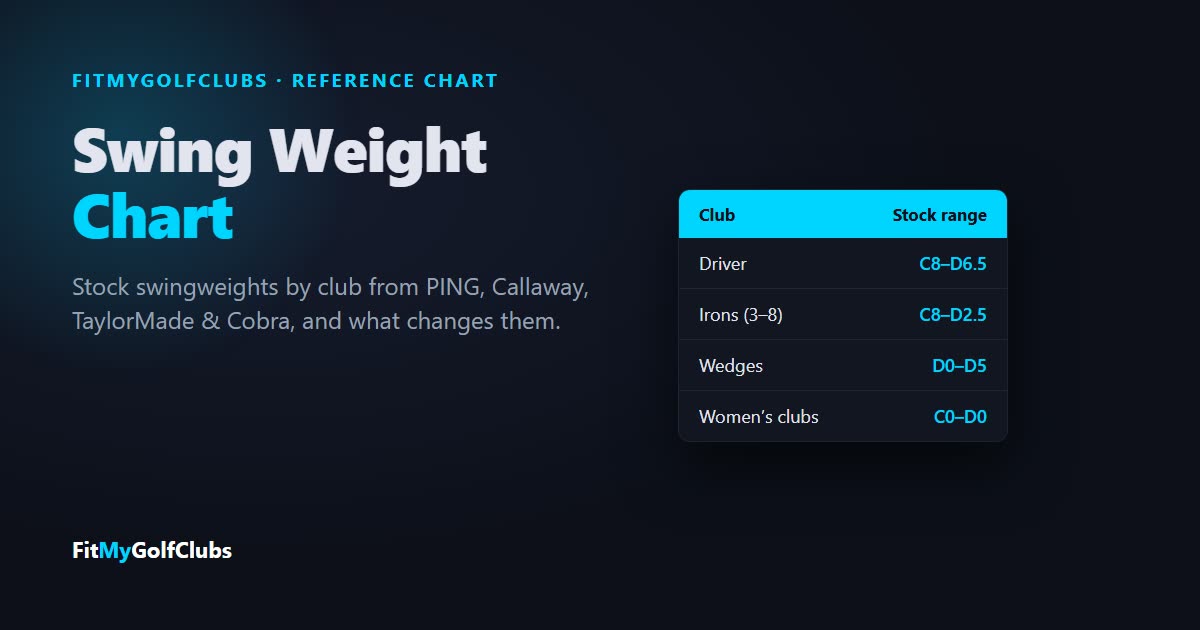
Swing Weight Chart: Standard Swingweights by Club and Brand
Swing weight chart: the A0–G9 scale, stock swingweights for drivers, irons and wedges from PING, Callaway, TaylorMade and Cobra, and what changes them.
Golf Club Fitting
October 8, 2026
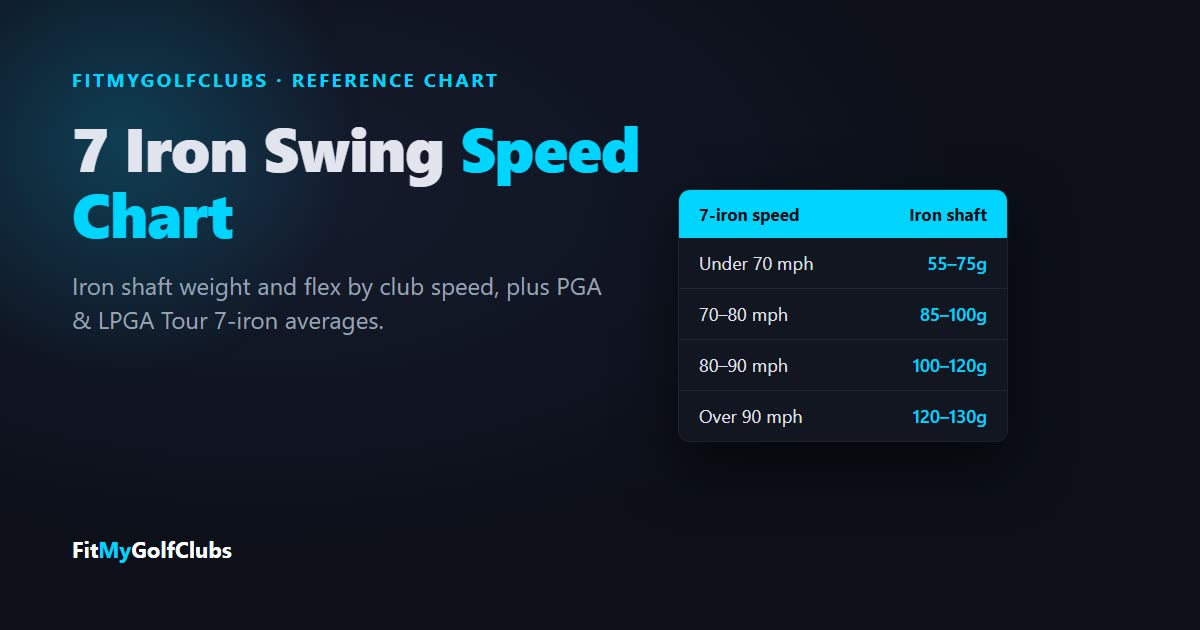
7 Iron Swing Speed Chart: Iron Shaft Weight, Flex & Carry
7 iron swing speed chart: iron shaft weight and flex by club speed, PGA (92 mph) and LPGA (78 mph) Tour averages, and 7-iron carry by speed.
Golf Club Fitting
October 8, 2026
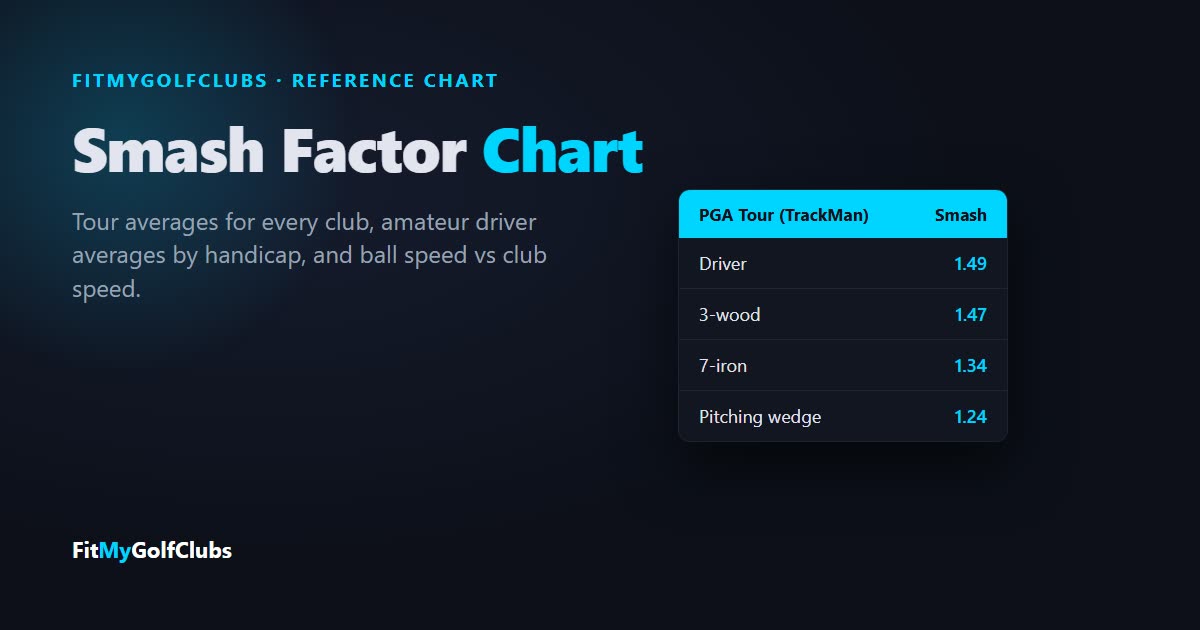
Smash Factor Chart: Tour Averages by Club + Ball Speed
Smash factor chart by club from TrackMan PGA and LPGA Tour averages, amateur driver averages by handicap, and a club speed to ball speed table.


© 2026 FitMyGolfClubs. All rights reserved. | Patent Pending
Contact: sean@fitmygolfclubs.com