
Golf Club Fitting
September 29, 2026
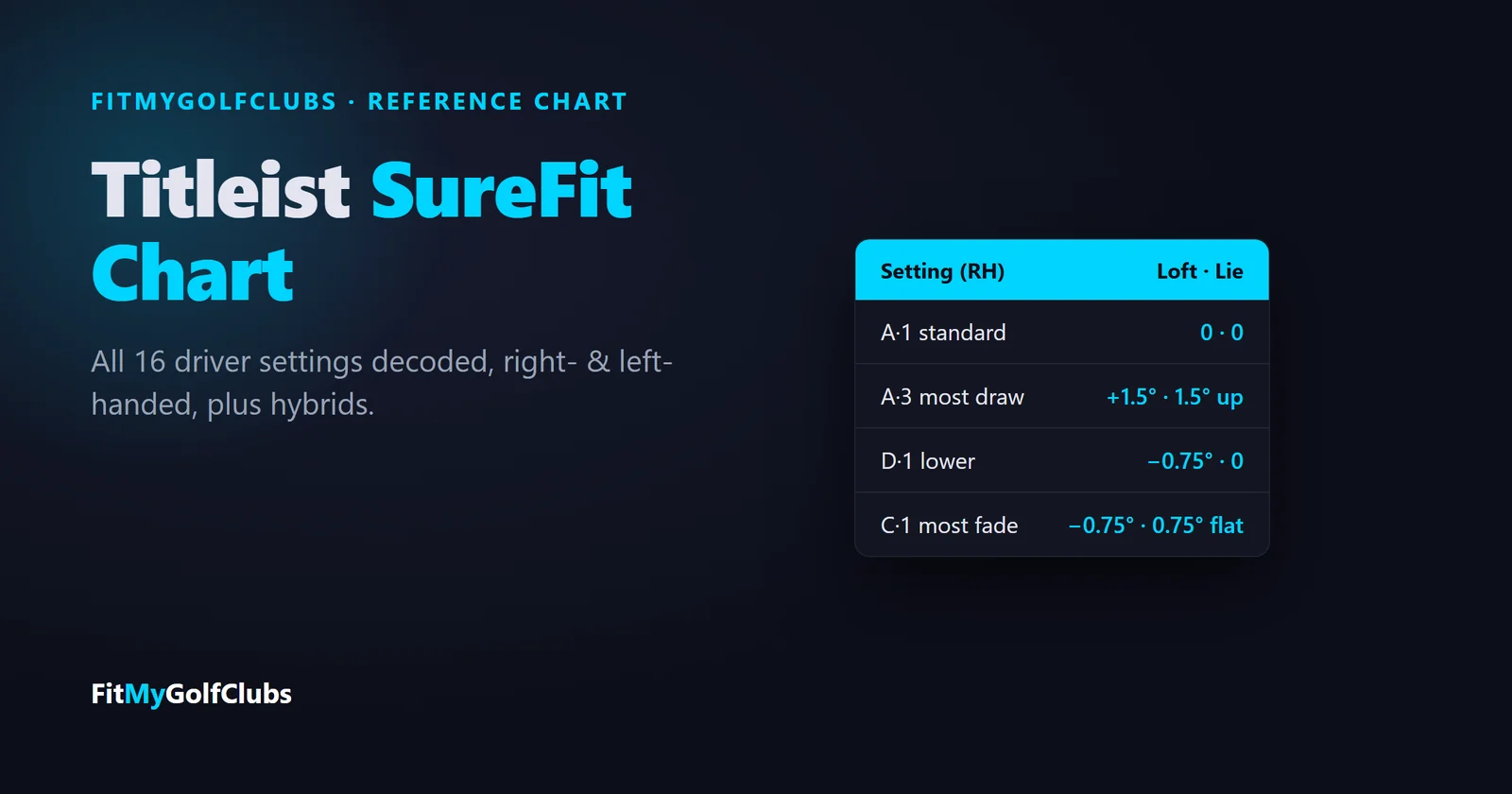
The quick answer: On a Titleist driver or fairway, A·1 is the standard setting for right-handers (D·4 for left-handers). The SureFit hosel has 16 settings in 0.75° steps: loft goes up to +1.5° or down to −0.75°, and lie goes up to 1.5° upright or 0.75° flat. A·3 is the most draw setting (+1.5° loft, 1.5° upright) and C·1 is the most fade (−0.75° loft, 0.75° flat). Hybrids use the same letters in 1° steps. Every setting is decoded below, from Titleist's own SureFit charts.
Titleist Driver Adjustment Chart (SureFit, Right-Handed)
The same chart applies to older Titleist drivers: TSR, TSi, TS and 917. Stock lofts, lie and length for each are listed further down.
⛳ Which setting should you use?
Pick the setting for your miss below. Then add the driver with its new loft to your bag, and the free grade checks the gap it leaves down to your 3-wood. Loft gapping is the #1 fitting flaw in the 231 bags we've graded. About three minutes, from your specs alone. Check my loft gaps free →
Driver Setting Finder
FREE — NO SIGNUPPick your driver brand and your miss. Get the setting for it, from the brand’s own chart.
Slice and hook are for a right-handed golfer. Left-handed and miss right? That's your hook.
Read it the way Titleist does: move up or down the grid to change trajectory (loft), and left or right to fine-tune direction (lie). For a right-hander, left of standard is more upright and more draw; right is flatter and more fade. The lettered ring (A to D) and numbered sleeve (1 to 4) combine into the setting you see at the hosel.
Every SureFit Setting, Decoded
What each setting does on a driver or fairway wood. Left-handed codes mean different things, so check the right column for your hand.
The same code does different things for right- and left-handers. A·1 is standard for a right-hander, but for a left-hander it's +0.75° loft at standard lie; a left-hander's standard is D·4. Titleist's loft figures are effective loft, meaning the loft with the face square at impact.
Titleist SureFit Chart: Left-Handed Driver and Fairway
Titleist Hybrid SureFit Chart
Hybrids use the same ring and sleeve in 1° steps, so each setting moves loft and lie further than on a driver.
Titleist TSR, TSi, TS and 917 Driver Settings
Older Titleist drivers use the same 16-setting SureFit chart as the GT and GTS: A·1 is standard for right-handers, D·4 for left-handers, and each step moves loft or lie 0.75°. Archived copies of Titleist’s SureFit guide from 2017, 2019, 2021 and 2023, when 917, TS, TSi and TSR drivers were Titleist’s current models, show this same driver chart. What changes between generations is the stock loft, head size and standard length.
Titleist TSR Driver Settings Chart (TSR1, TSR2, TSR3, TSR4)
Set a TSR2, or any TSR driver, with the chart above: A·1 is standard for right-handers and D·4 for left-handers. Titleist’s TSR driver specifications, as listed in December 2023:
The TSR1 sits at a 59° standard lie, half a degree more upright than the other TSR drivers, so A·1 on a TSR1 is 59°, not 58.5°. The TSR3 adds a weight track: in Titleist’s words, “TSR3 metals feature SureFit® CG track technology, offering five unique positions to adjust club head CG to fine-tune ball flight with neutral, fade or draw flight.” On the TSR4, Titleist lists the front weight position as the default, with a back position as the alternative.
Titleist TSi Driver Settings Chart (TSi1, TSi2, TSi3, TSi4)
Set a TSi2, or any TSi driver, with the chart above: A·1 is standard for right-handers and D·4 for left-handers. Titleist’s TSi driver specifications, as listed in October 2021:
As with the TSR, the TSi1 sits at a 59° standard lie and the rest at 58.5°. The TSi3 has the weight track: “TSi3 metals feature a new SureFit® CG track technology, offering five unique positions in the Driver and three unique positions in the Fairway to adjust club head CG to fine-tune ball flight with neutral, fade or draw flight.”
Titleist TS Driver Settings Chart (TS1, TS2, TS3, TS4)
Set a TS2, or any TS driver, with the chart above: A·1 is standard for right-handers and D·4 for left-handers. Titleist’s TS driver specifications, as listed in September 2020:
Every TS driver has a 58.5° standard lie. Titleist notes that “TS & 917 driver and fairway weights are not interchangeable.”
Titleist 917 Driver Settings Chart (917D2, 917D3)
Set a 917D2 or 917D3 with the chart above: A·1 is standard for right-handers and D·4 for left-handers. Titleist’s 917 driver specifications, as listed in November 2017:
Both 917 drivers are 45″ standard, half an inch shorter than a TS2 or TS3. They take a SureFit CG weight, and in Titleist’s words, “917 Metals are shipped with one additional SureFit® CG Weight.” The spare is either a Neutral or a Draw/Fade weight, whichever one isn’t installed in the head.
Which SureFit Setting Should You Use?
- You slice or want a draw: move left from A·1 to a more upright setting. B·2 (0.75° upright) or A·2 (1.5° upright) keep standard loft; A·3 adds 1.5° of loft for the most draw.
- You hook it or want a fade: move right to B·1 (0.75° flat). C·1 keeps that lie and also takes off 0.75° of loft: the most fade setting.
- You launch it too low: move up: D·4 (+0.75°) or A·4 (+1.5°) keep standard lie.
- You launch it too high or spin it too much: move down to D·1 (−0.75°), still at standard lie.
Those are right-handed codes; left-handers should use the left-handed chart above.
How to Change Your SureFit Setting
- Insert the SureFit wrench into the hosel screw and turn it counterclockwise until the hosel is loose.
- Move the adjustment ring to the setting you want.
- Tighten clockwise until you feel and hear the wrench click. If the screw feels like it's binding, stop and realign the parts.
Under the Rules of Golf, you can't change the setting during a round. Make your change before you tee off.
Current Titleist Driver Specs and Weights
The SureFit CG Track helps enhance ball speed, fine-tune trajectory, and control draw or fade spin in GTS3 and GTS4 drivers. There are five unique positions to adjust the heel-toe clubhead CG. The GTS2 has no track; it changes CG by swapping its two weights front and back.
GTS3 and GTS4 CG Track Settings (T2 to H2)
Titleist’s chart for the five track positions. T is toward the toe, H toward the heel, and N is neutral:
So match the track to your strike: if your mishits are on the toe, move toward T; on the heel, toward H.
All three GTS drivers have a standard length of 45.5″ and a standard lie of 58.5° in the A·1 position; Titleist lists 44.5″ as its standard women’s driver length and 42.5″ for junior drivers.Fairways and hybrids
- GT1 fairway: Two flat weights, front and back; standard 14g.
- GTS2 and GTS3 fairways: Two flat weights, heel and toe; standard 16g, neutral CG.
- GT1 hybrids: Two flat weights, front and back; standard back CG, forward CG option; standard 16g.
- GT2 and GT3 hybrids: Two flat weights, heel and toe; standard neutral CG; standard 16g.
Which Titleist Driver Flies Highest?
Titleist ranks its current drivers and weight settings by trajectory, from highest to lowest. “Back” is Titleist’s back-CG weight setting and “standard” its stock setting; the GT1 has one weight, fixed at the back:
- GT1, back CG (highest)
- GTS2, back CG
- GTS2, standard CG
- GTS3, back CG
- GTS3, standard CG
- GTS4, back CG
- GTS4, standard CG (lowest)
So the weights and the model do the same job in steps: moving a GTS weight back raises the flight a notch, and moving from GTS4 to GTS3 to GTS2 to GT1 raises it further.
SureFit Weights by Club Length
The SureFit weight also sets swingweight, so Titleist changes it when a club is built longer or shorter than standard. In Titleist’s words, “The following table helps guide you to which SureFit weight may be used to achieve a swingweight close to our nominal swingweight.”
For a men’s driver cut ½″ short, that means a weight 2g heavier than standard; 1″ short, 4g heavier. Titleist adds that its “fitting research shows that headweight has a significant influence on feel and that golfer preference was widely spread among all weights”, so treat the table as a starting point. More on length in our driver shaft length guide and on swingweight in the swing weight chart.
Are Titleist Driver Shafts Interchangeable?
Yes, across generations. Per Titleist, GTS, GT, TSR, TSi, TS, 917, 915, 913 and 910 driver shafts are interchangeable, and GTS, GT, TSR, TSi, TS, 917, 915 and 913 fairway shafts are interchangeable. So a shaft from an old 917 or TSi fits a new GTS head. Titleist warns that the system only works with genuine Titleist components.
What Graded Bags Show
Titleist makes 17% of the drivers in bags we’ve graded (42 of 246), and unlike TaylorMade, Callaway and PING, its most common head is 9°: 57% are 9° and 24% are 10°. The GT3 (11) and GT2 (9) are the most common models.
Bag data: 267 golfers who graded a bag on FitMyGolfClubs by October 25, 2026, one bag each (their most recent grade), with at least five clubs’ lofts on file; test and sample accounts excluded. Lofts are the head lofts golfers entered or that our catalog filled in for their model, not the hosel or sleeve setting. Aggregates only; no personal data.
Frequently asked questions
What is the A1 setting on a Titleist driver?
A·1 is the standard setting for right-handed Titleist drivers and fairways: standard loft and standard lie. For left-handers, D·4 is standard; A·1 on a left-handed club is +0.75° loft at standard lie.
What is the most draw setting on a Titleist driver?
A·3 for right-handers: +1.5° loft at 1.5° upright lie. For left-handers it's D·2.
What does D1 mean on a Titleist driver?
For a right-hander, D·1 is −0.75° loft at standard lie: the setting for a lower ball flight without changing direction. For a left-hander, D·1 is +1.5° loft at standard lie.
How much does the Titleist SureFit hosel adjust?
Driver and fairway settings move in 0.75° steps: loft from −0.75° to +1.5°, and lie from 0.75° flat to 1.5° upright. Hybrid settings move in 1° steps, from −1° to +2° loft and 1° flat to 2° upright.
Are Titleist driver shafts interchangeable?
Yes. Titleist says GTS, GT, TSR, TSi, TS, 917, 915, 913 and 910 driver shafts are interchangeable, and fairway shafts are interchangeable from the 913 on.
What is the standard lie angle of a Titleist GTS driver?
58.5° in the A·1 SureFit position, for GTS2, GTS3 and GTS4.
Can you change SureFit settings during a round?
No. Titleist notes that the settings must not be adjusted during a round of golf, under the Rules of Golf.
Source: Titleist's SureFit Performance Guide (charts, increments, weights and shaft compatibility) and GTS product specifications, checked September 29, 2026; weights by length, trajectory ranking and GTS lengths checked November 2, 2026; TSR, TSi, TS and 917 specifications and SureFit guides from Titleist’s own pages archived on web.archive.org (2017 to 2023), checked November 14, 2026. Loft values are Titleist's effective loft with a square face at impact.
Related reading
- Golf Club Fitting Chart — Length and lie by height, flex by swing speed, and every chart we publish.
- Callaway Driver Settings Chart — All 8 OptiFit settings, loft for every head, plus Quantum and Elyte specs.
- TaylorMade Loft Sleeve Chart — All 12 sleeve settings with loft, face and lie, plus Qi4D and Qi35 specs.
- PXG Hosel Settings Chart — All 8 PXG adapter settings, plus weights and specs for every current PXG driver.
- Cobra Driver Adjustment Chart — All 33 FutureFit33 settings with loft and lie, plus OPTM and DS-ADAPT specs.
- Why Do I Slice My Driver But Not My Irons? — The equipment causes behind a driver-only slice.
- Golf Driver Fitting: Is It Worth It? — What a driver fitting changes, and what you can set yourself.
- PXG Iron Loft Chart — Loft, lie, length and offset for every 0311 GEN8, GEN7 and Black Ops iron.
- Mizuno Iron Specs Chart — Loft, lie, offset and length for every JPX 925 and Mizuno Pro iron.
- Titleist Iron Loft Chart — Loft, lie and length for every T100, T150, T250, T250 Launch Spec and T350 iron.
- PING Iron Loft Chart — Loft, lie, offset and length for every G440, G430, i240, i230 and Blueprint iron.
- Vokey Grind Chart — Every SM11 loft, bounce and grind, and what each grind is for.
- PING Driver Adjustment Chart — All 8 Trajectory Tuning 2.0 hosel settings, plus G440, G430 and G Le specs.
- Driver Loft Chart — Driver loft by swing speed, every current driver’s loft range, and the gap to your 3-wood.
Related Articles
Golf Club Fitting
November 14, 2026
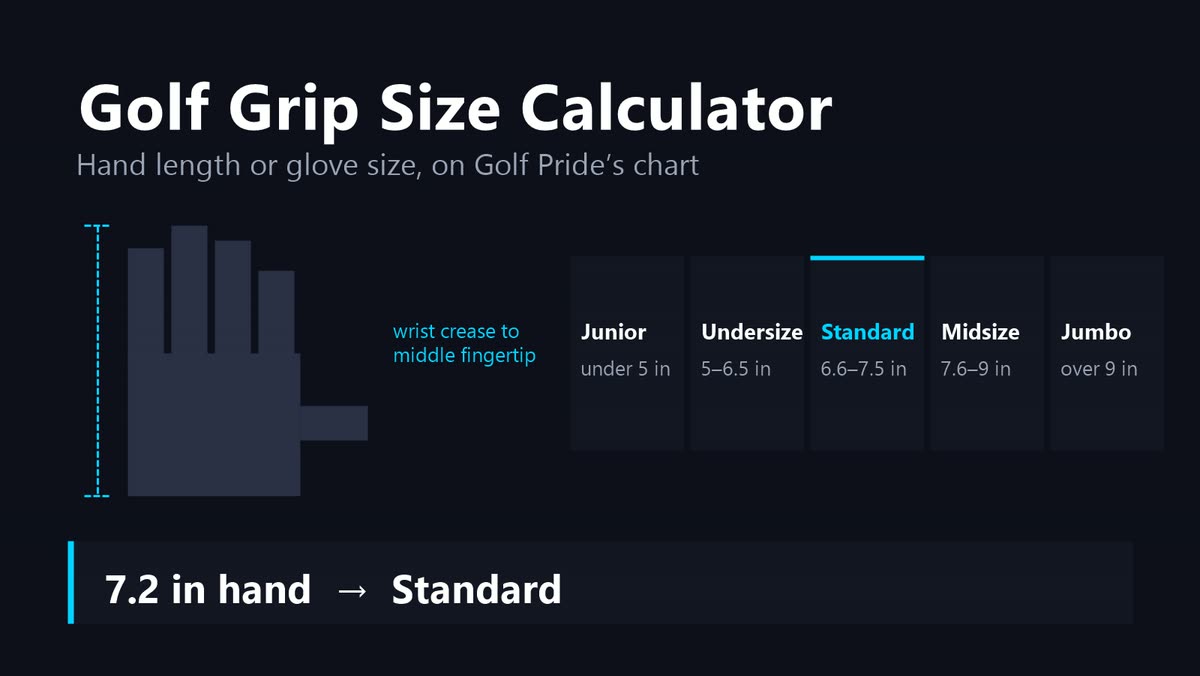
Golf Grip Size Calculator: Hand Size or Glove Size
Free golf grip size calculator: enter your hand length or glove size and get your grip size on Golf Pride’s chart, with PING’s color and tape-wrap tips.
Golf Club Fitting
November 14, 2026
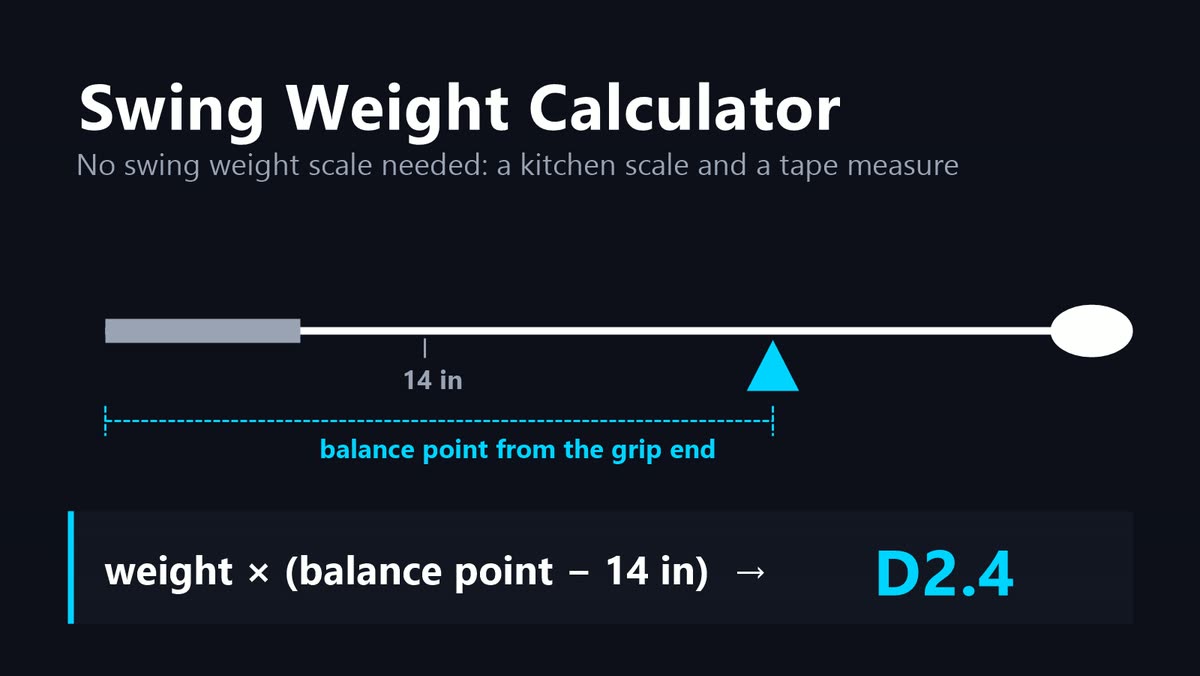
Swing Weight Calculator (No Swing Weight Scale Needed)
Free swing weight calculator: weigh your club, find its balance point and get the swing weight. Plus what length, grip and lead tape changes do to it.
Golf Club Fitting
November 2, 2026
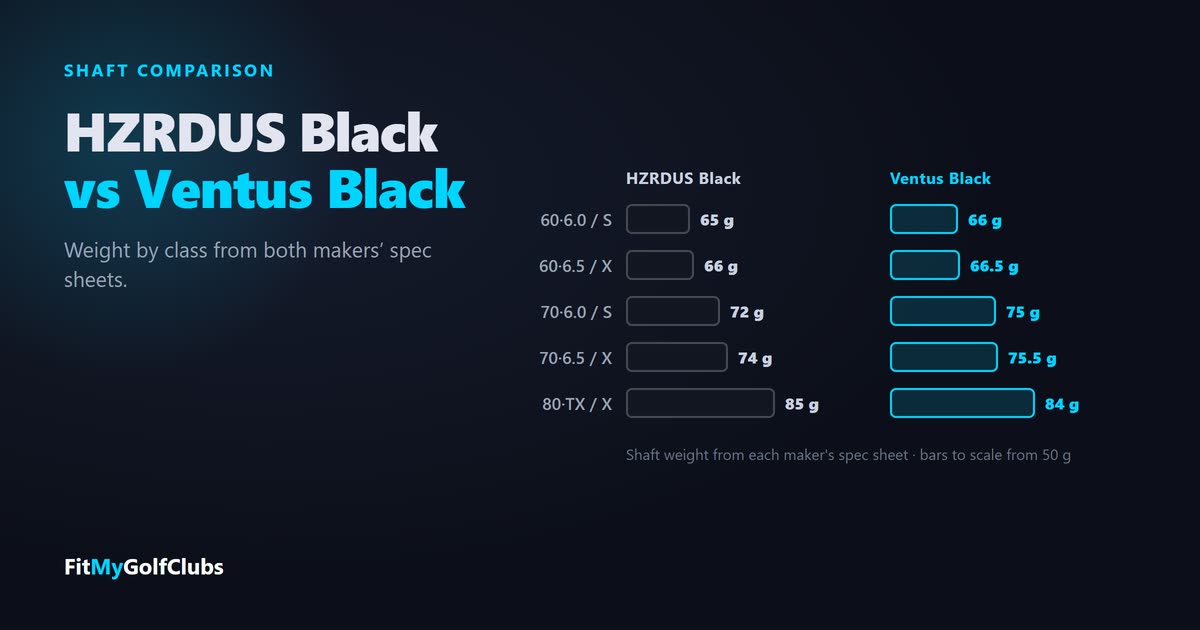
HZRDUS Black vs Ventus Black: Weight, Torque & Flex
HZRDUS G5 Black vs Fujikura Ventus Black from both makers' spec sheets: weight, torque and flex by class, and what each maker says about launch and spin.


© 2026 FitMyGolfClubs. All rights reserved. | Patent Pending
Contact: sean@fitmygolfclubs.com